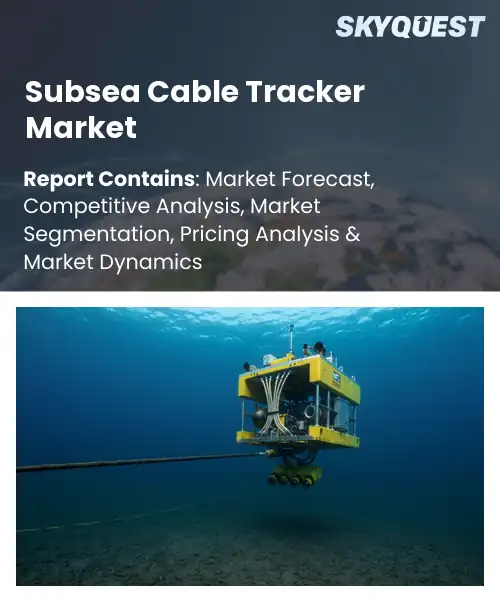
Subsea Cable Tracker Market
Report ID: SQMIG20I2967
Report ID: SQMIG20I2967
[email protected]
USA +1 351-333-4748
Report ID:
SQMIG20I2967 |
Region:
Global |
Published Date: April, 2026
Pages:
157
|Tables:
91
|Figures:
76


Global Subsea Cable Tracker Market size was valued at USD 284.5 Million in 2024 and is poised to grow from USD 304.98 Million in 2025 to USD 286.3 Million by 2033, growing at a CAGR of 7.2% during the forecast period (2026-2033).
The primary driver of the subsea cable tracker market is the exponential growth in global data traffic that has made submarine fiber optic networks critical infrastructure. Subsea cable trackers locate, map and monitor undersea cables to prevent damage, enable rapid repairs and ensure continuity. This market matters because outages disrupt financial services, cloud operations and cross border communications, prompting hyperscalers and governments to invest in resilience. Historically the field evolved from bathymetric charts and cable laying logs to integrated geospatial sensors, ROV inspections and AI based anomaly detection, illustrated by strategic investments around new transoceanic routes and data center hubs.Building on that criticality, the key factor accelerating growth is regulatory pressure combined with incentives that translate risk awareness into procurement of advanced tracking solutions. Stricter environmental and maritime safety rules compel operators to conduct real time monitoring while cloud providers pay for SLA driven visibility, so vendors deploy fiber tapping sensors, acoustic monitors and predictive analytics to reduce mean time to repair. In practice this causes faster mobilization of ROVs and chartered cable ships after incidents, lowers economic losses from service interruptions, and opens opportunities for subscription monitoring services, data licensing and integration of trackers into national resilience programs.
How is AI enhancing real-time fault detection in the subsea cable tracker market?
AI is improving real time fault detection in the subsea cable tracker market by combining machine learning with advanced signal processing to identify anomalous acoustic and electromagnetic signatures. Key aspects include sensor fusion across autonomous and remotely operated vehicles and seabed sensors, edge computing for low latency event detection, and predictive analytics that help prioritize inspections. The market context shows rising demand for continuous monitoring as offshore energy projects and data traffic expand, pushing service providers to adopt automated workflows. Vendors are applying AI to synthetic aperture sonar imagery and anomaly triage so investigations become more targeted and repairs faster and less disruptive.Sonardyne March 2026, announced a subsea monitoring system that applies edge AI and underwater communications to flag cable anomalies in near real time and to streamline operator response, supporting greater efficiency and faster resolution and helping drive market adoption. This reduces unnecessary vessel mobilization and improves prioritization of repair campaigns while giving operators actionable alerts for continuous integrity management.
Market snapshot - (2026-2033)
Global Market Size
USD 284.5 Million
Largest Segment
Compliance & Regulatory Audits
Fastest Growth
Environmental & Sustainability Audits
Growth Rate
7.2% CAGR
To get more insights on this market click here to Request a Free Sample Report
Global subsea cable tracker market is segmented by audit type, service provider, end-use industry and region. Based on audit type, the market is segmented into Compliance & Regulatory Audits, Ethical & Labor Standards Audits (SEDEX/SA8000), Environmental & Sustainability Audits and Others (Supply Chain & Diversity Audits). Based on service provider, the market is segmented into Third-party Professional Audit Firms and In-house/Internal Audit Departments. Based on end-use industry, the market is segmented into Consumer Goods & Retail (Apparel/FMCG), Manufacturing & Industrial, Food & Agriculture and Others (Pharmaceuticals & Electronics). Based on region, the market is segmented into North America, Europe, Asia Pacific, Latin America and Middle East & Africa.
Environmental & Sustainability Audits segment dominates because growing emphasis on minimizing seabed impact and ensuring lifecycle sustainability makes tracker data central to audit outcomes. Stakeholders demand traceable evidence of carbon footprint, habitat protection, and decommissioning protocols, driving adoption of advanced monitoring and reporting features. This creates higher investment in tracker technologies tailored for environmental compliance, positioning sustainability-focused audits as primary buyers shaping product requirements and procurement priorities in the Subsea Cable Tracker Market.
However, Compliance & Regulatory Audits are growing fastest as tightening reporting obligations and enforcement drive operators to deploy trackers for verifiable route and maintenance records. Regulatory scrutiny fuels demand for standardized, interoperable tracking platforms and services, accelerating adoption and creating compliance-driven opportunities that expand market applications.
Third-party Professional Audit Firms segment dominates because independent verification and technical audit expertise are critical for credible subsea cable validation, where complex seabed surveys and failure forensics require external scrutiny. Their specialized methodologies, cross-industry experience, and access to advanced diagnostic tools position them as trusted intermediaries, prompting operators and insurers to prefer third-party-backed tracker data, driving demand for audit-ready tracking solutions in the Subsea Cable Tracker Market.
However, In-house/Internal Audit Departments are growing fastest as operators build internal surveillance to lower costs and speed incident response. Embedding trackers into operational controls and analytics enables real-time compliance and predictive maintenance, encouraging investment in internal teams and bespoke platforms that scale across assets and deliver ongoing risk reduction.
To get detailed segments analysis, Request a Free Sample Report
Asia Pacific dominance stems from a dense network of international data routes and a concentration of technological capability concentrated around key markets. Major carriers and cloud providers in the region prioritize continuous monitoring and rapid fault localization, driving demand for advanced tracking solutions. Local manufacturing capacity and strong maritime services support rapid deployment and maintenance. Governments and private operators emphasize resilient connectivity for economic growth, creating integrated ecosystems of research, shipyards, and service providers. High transoceanic traffic between Asia Pacific and other regions elevates strategic importance of cable asset management, while proximity to content hubs and data centers fosters innovation in tracking technologies and operational practices. Significant private sector investment in research and development and a skilled maritime and engineering workforce further supports continuous improvement of cable tracking capabilities.
Subsea Cable Tracker Market in Japan benefits from advanced electronics manufacturing, deep expertise in maritime engineering, and close collaboration between major carriers and research institutions. Emphasis on high reliability and precision monitoring drives adoption of sophisticated tracking systems. Shipbuilding capacity and specialized maintenance services enable rapid response to faults. Regulatory clarity and strong private sector investment further supports continuous improvement of cable monitoring technologies and operational standards across international routes
Subsea Cable Tracker Market in South Korea is propelled by advanced semiconductor and communications industries that foster sophisticated sensor integration and data analytics. Major carriers and content providers prioritize resilient links, encouraging deployment of proactive monitoring solutions. Proximity to dense transpacific routes and strong shipbuilding infrastructure facilitates maintenance cycles. Collaborative programs between industry, academia, and government enhance technical capabilities and promote standardized operational procedures for cable tracking and fault management.
Expansion in North America is driven by concentrated demand from cloud providers, major content distributors, and enterprise networks that require assured connectivity and rapid fault resolution. A robust service ecosystem comprising specialized vessel operators, marine surveyors, and engineering firms enables efficient deployment and repair of monitoring hardware. Heightened focus on cybersecurity and supply chain integrity raises the profile of tracking solutions that provide visibility and tamper detection. Regulatory attention to critical infrastructure and coordinated planning between federal and regional authorities stimulates investments in cable resilience. Active collaboration between carriers, data center operators, and technology vendors accelerates adoption of advanced analytics and remote monitoring, while integration with coastal infrastructure projects and offshore energy initiatives further expands the operational scope of subsea cable tracking capabilities.
Subsea Cable Tracker Market in United States is shaped by large cloud and content operators demanding resilient networks and by defense and regulatory priorities that emphasize asset protection. A mature supplier ecosystem of analytics vendors, marine contractors, and specialized survey vessels supports implementation and maintenance. Close collaboration between public agencies and private carriers promotes standardized practices. Investment in operational analytics and cybersecurity integration defines the market orientation and direction
Subsea Cable Tracker Market in Canada reflects the importance of extensive coastal connectivity and regional sovereignty considerations, including interest in remote route monitoring. Operators emphasize environmental sensitivity and community engagement alongside technical implementation. A network of marine research organizations, coastal authorities, and service providers supports tailored tracking solutions that address challenging bathymetry and seasonal conditions. Collaboration with national stakeholders promotes resilient deployment and asset management approaches across domestic coastal waters.
Europe is reinforcing its role through coordinated policy frameworks, strategic investments in landing infrastructure, and an emphasis on interoperable standards for cable monitoring and protection. National and cross border initiatives promote shared mapping, joint response protocols, and combined repair capabilities that enhance regional resilience. A mature maritime services sector including specialized shipyards and survey firms supports efficient maintenance, while research institutions and technology vendors drive innovations in sensing, analytics, and secure telemetry. Regulatory focus on critical infrastructure protection and environmental stewardship fosters responsible deployment practices. Collaborative financing mechanisms and closer alignment between energy, telecom, and defense stakeholders expand the operational scope of subsea cable tracking across continental routes and adjacent international corridors.
Subsea Cable Tracker Market in Germany benefits from strong engineering capabilities and integration with industrial network operators prioritizing reliability. Advanced sensor development and systems integration are supported by research centers and technology firms focused on robust monitoring solutions. Port infrastructure and specialized maritime service providers facilitate efficient deployment and maintenance operations. Cooperation between energy and telecommunications stakeholders encourages interoperable approaches and asset management frameworks tailored to complex offshore connectivity requirements
Subsea Cable Tracker Market in United Kingdom is supported by leading repair and landing hubs that provide mobilization and specialized vessel services. A dense cluster of maritime equipment suppliers and monitoring centers underpins operational readiness. Regulatory and security frameworks emphasize continuity and protection of critical links, encouraging investment in proactive tracking technologies. Collaboration among telecom operators, ports, and research organizations fosters standardized response procedures and enhanced mapping capabilities for routes
Subsea Cable Tracker Market in France draws on naval engineering expertise and involvement in Atlantic and Mediterranean route planning. Research institutions and technology firms collaborate with maritime services to develop tailored monitoring solutions suited to varied seabed conditions. National and European alignment supports coordinated mapping and maintenance protocols. Port infrastructure and specialized repair capabilities enable operational responses, while emphasis on environmental assessment informs responsible deployment and protection strategies and resilience
To know more about the market opportunities by region and country, click here to
Buy The Complete Report
Surging Demand For Cloud Services
Increasing Need For Network Resilience
High Capital Investment Requirements
Regulatory And Permitting Challenges
Request Free Customization of this report to help us to meet your business objectives.
Competitive landscape in the global subsea cable tracker market is centering on technology differentiation, strategic partnerships and demand from offshore wind and power interconnectors as primary competitive drivers. Firms pursue acquisitions for sensor and analytics capabilities, form partnerships to combine inertial navigation and magnetometer systems, and commercialise autonomous surveillance. Examples include Seekable’s collaboration with Exail on inertial sensing for cable detection and Helsing’s autonomous Lura platform partnerships.
Top Player’s Company Profile
Recent Developments
SkyQuest’s ABIRAW (Advanced Business Intelligence, Research & Analysis Wing) is our Business Information Services team that Collects, Collates, Correlates, and Analyses the Data collected by means of Primary Exploratory Research backed by robust Secondary Desk research. As per SkyQuest analysis, the global subsea cable tracker market is propelled by surging global data traffic that makes submarine fiber networks critical infrastructure and a second driver in the form of tightening regulatory pressure and incentives that push operators toward real-time monitoring solutions. Growth is tempered by high capital investment requirements for deployment and monitoring infrastructure, which can limit adoption among smaller operators. Asia Pacific leads the market given dense transoceanic routes, manufacturing capacity and strong private sector investment, while Environmental & Sustainability Audits dominate demand as stakeholders prioritize traceable evidence of seabed impact and lifecycle stewardship, steering procurement toward advanced monitoring and reporting features.
| Report Metric | Details |
|---|---|
| Market size value in 2024 | USD 284.5 Million |
| Market size value in 2033 | USD 286.3 Million |
| Growth Rate | 7.2% |
| Base year | 2024 |
| Forecast period | (2026-2033) |
| Forecast Unit (Value) | USD Million |
| Segments covered |
|
| Regions covered | North America (US, Canada), Europe (Germany, France, United Kingdom, Italy, Spain, Rest of Europe), Asia Pacific (China, India, Japan, Rest of Asia-Pacific), Latin America (Brazil, Rest of Latin America), Middle East & Africa (South Africa, GCC Countries, Rest of MEA) |
| Companies covered |
|
| Customization scope | Free report customization with purchase. Customization includes:-
|
To get a free trial access to our platform which is a one stop solution for all your data requirements for quicker decision making. This platform allows you to compare markets, competitors who are prominent in the market, and mega trends that are influencing the dynamics in the market. Also, get access to detailed SkyQuest exclusive matrix.
Table Of Content
Executive Summary
Market overview
Parent Market Analysis
Market overview
Market size
KEY MARKET INSIGHTS
COVID IMPACT
MARKET DYNAMICS & OUTLOOK
Market Size by Region
KEY COMPANY PROFILES
Methodology
For the Subsea Cable Tracker Market, our research methodology involved a mixture of primary and secondary data sources. Key steps involved in the research process are listed below:
1. Information Procurement: This stage involved the procurement of Market data or related information via primary and secondary sources. The various secondary sources used included various company websites, annual reports, trade databases, and paid databases such as Hoover's, Bloomberg Business, Factiva, and Avention. Our team did 45 primary interactions Globally which included several stakeholders such as manufacturers, customers, key opinion leaders, etc. Overall, information procurement was one of the most extensive stages in our research process.
2. Information Analysis: This step involved triangulation of data through bottom-up and top-down approaches to estimate and validate the total size and future estimate of the Subsea Cable Tracker Market.
3. Report Formulation: The final step entailed the placement of data points in appropriate Market spaces in an attempt to deduce viable conclusions.
4. Validation & Publishing: Validation is the most important step in the process. Validation & re-validation via an intricately designed process helped us finalize data points to be used for final calculations. The final Market estimates and forecasts were then aligned and sent to our panel of industry experts for validation of data. Once the validation was done the report was sent to our Quality Assurance team to ensure adherence to style guides, consistency & design.
Analyst Support
Customization Options
With the given market data, our dedicated team of analysts can offer you the following customization options are available for the Subsea Cable Tracker Market:
Product Analysis: Product matrix, which offers a detailed comparison of the product portfolio of companies.
Regional Analysis: Further analysis of the Subsea Cable Tracker Market for additional countries.
Competitive Analysis: Detailed analysis and profiling of additional Market players & comparative analysis of competitive products.
Go to Market Strategy: Find the high-growth channels to invest your marketing efforts and increase your customer base.
Innovation Mapping: Identify racial solutions and innovation, connected to deep ecosystems of innovators, start-ups, academics, and strategic partners.
Category Intelligence: Customized intelligence that is relevant to their supply Markets will enable them to make smarter sourcing decisions and improve their category management.
Public Company Transcript Analysis: To improve the investment performance by generating new alpha and making better-informed decisions.
Social Media Listening: To analyze the conversations and trends happening not just around your brand, but around your industry as a whole, and use those insights to make better Marketing decisions.
REQUEST FOR SAMPLE
 REQUEST FREE CUSTOMIZATION


Want to customize this report? This report can be personalized according to your needs. Our analysts and industry experts will work directly with you to understand your requirements and provide you with customized data in a short amount of time. We offer $1000 worth of FREE customization at the time of purchase.
Feedback From Our Clients


 USA (+1) 351-333-4748

