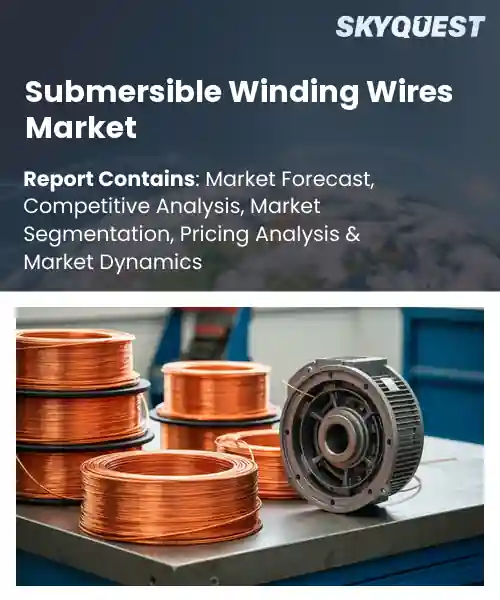
Submersible Winding Wires Market
Report ID: SQMIG20D2805
Report ID: SQMIG20D2805
[email protected]
USA +1 351-333-4748
Report ID:
SQMIG20D2805 |
Region:
Global |
Published Date: August, 2026
Pages:
157
|Tables:
116
|Figures:
77


Global Submersible Winding Wires Market size was valued at USD 1.92 Billion in 2024 and is poised to grow from USD 2.03 Billion in 2025 to USD 3.19 Billion by 2033, growing at a CAGR of 5.8% during the forecast period (2026-2033).
The submersible winding wires industry delivers insulated copper or aluminum conductors that, essentially, build the electrical coil for pumps used in water, oil, and wastewater treatment. Why it matters so much is simple, in a way: dependable power transfer in rough, fully submerged conditions where one failure can stop operations, and then halt a whole chunk of infrastructure.
Demand keeps rising too, mostly because renewable pumping stations are multiplying. The more efficient the motor, the more it asks for conductors that can survive higher temperature swings and voltage pressures without giving up. Also, offshore wind installations are leaning on ballast-water handling and cooling systems, and those tend to include submersible pumps with upgraded winding wires. That pressure has pushed manufacturers toward polymer‑coated alloys, which reportedly stretch working life by as much as 30 %. Even in Saudi Arabia, solar‑powered desalination undertakings have brought in contracts for corrosion‑resistant copper‑nickel conductors. So, clean-energy programs seem to translate almost directly into wire sales. In the end, vendors with strong long‑term reliability certifications tend to take more share while utilities typically see reduced servicing, and better uptime.
AI driven automation is changing the submersible winding wires market outlook by nudging production toward tighter precision and faster cycles. Newer coil winding systems include machine learning methods that watch tension, temperature, plus alignment in real time, then make immediate adjustments when something drifts. This control cuts down on scrap, and helps wire life last longer, which matters because submersible pump reliability can’t afford surprises. There’s also the customization angle: manufacturers can tune wire gauges on demand, so they can match the different requirements across water, oil, and geothermal uses. On top of that, the same setup can generate predictive maintenance signals for site managers, which reduces unplanned downtime and improves plant throughput. As a result, suppliers can maintain steadier quality while scaling production to match the growing needs of energy and water infrastructure.
Market snapshot - (2026-2033)
Global Market Size
USD 1.92 Billion
Largest Segment
Copper
Fastest Growth
Aluminum
Growth Rate
5.8% CAGR
To get more insights on this market click here to Request a Free Sample Report
The global submersible winding wires market is segmented by conductor material, insulation type, voltage rating, application and region. Based on conductor material, the market is segmented into Copper and Aluminum. Based on insulation type, the market is segmented into PVC, XLPE and Polypropylene. Based on voltage rating, the market is segmented into Low Voltage, Medium Voltage and High Voltage. Based on application, the market is segmented into Borewell Pumps, Openwell Pumps and Industrial Pumps. Based on region, the market is segmented into North America, Europe, Asia Pacific, Latin America and Middle East & Africa.
As per the submersible winding wires market analysis, the copper segment dominates because of its strong electrical conductivity and also mechanical strength, which fit the strict performance rules for submersible winding wires. A lot of designers lean toward copper so they can cut energy losses, and keep power transmission dependable even when the underground conditions are rough. It has an established supply chain too, and the durability is already proven, so manufacturers feel less worry about maintenance over time. So in the end, copper supports the whole core value proposition for the market.
However, the aluminum segment is showing the fastest growth momentum, because many manufacturers are moving to lighter weight solutions. That makes installation easier and can also drop material costs. At the same time, improvements in alloy processing boost conductivity and corrosion resistance, so aluminum becomes more usable for deep well settings. This shift basically keeps fueling submersible winding wires market penetration by adding more design choices, while also supporting cost efficient project execution.
According to the submersible winding wires market forecast, the XLPE segment takes the lead because its cross linked structure gives exceptional thermal stability , and moisture resistance for these submersible environments. The material keeps dielectric strength even when temperatures cycle hard, so the chances of insulation failure in deep installations go down. On top of that, it resists chemical degradation, which extends service life, and that naturally reduces how often people need replacement , plus it trims total ownership cost. These traits line up with what the industry expects for reliability, so XLPE ends up being the go to insulation option across many different applications.
Meanwhile, the polypropylene segment is becoming a key high growth area, as manufacturers look for insulation that is both lightweight and cost friendly, especially for pump systems. Its flexibility helps simplify coil winding operations, and its resistance to oil contamination fits borewell use quite well. This increased adoption helps market expansion too, since designs become more practical, and production expenses can be kept lower.
To get detailed segments analysis, Request a Free Sample Report
As per the submersible winding wires market regional forecast, Asia Pacific leads the market because it has advanced manufacturing capabilities, a real steady deep‑water project pipeline, and also solid governmental support for offshore energy infrastructure. The region enjoys a mature supply chain where high‑precision alloy production comes together with specialized coating technologies, which helps teams fulfill those complex project specifications faster than you’d expect. And then there’s this close collaboration between equipment manufacturers and major engineering firms, which pushes innovation forward, albeit in a continuous way. At the same time, strategic spending on research and development keeps the pipeline moving toward next‑generation wire solutions. With demand building from offshore wind farms that keep expanding, plus offshore oil and gas activity that keeps increasing, the region keeps reinforcing its position as both a production excellence hub, and a place with emerging market opportunities.
Japan Submersible Winding Wires Market
The Submersible Winding Wires sector in Japan is defined by a long history of precision engineering and a deep talent pool in materials science, so the reliability standards for critical marine uses stay high. Local manufacturers use sophisticated automation, and also strict quality controls, to create wires that can handle demanding corrosion‑resistance needs. Close coordination with domestic offshore project developers helps product development match the shifting performance expectations. That alignment, in turn, supports Japan’s reputation for technological leadership, even when project requirements get more complex.
South Korea Submersible Winding Wires Market
The Submersible Winding Wires industry in South Korea works well because of a synergistic ecosystem involving steel producers, specialty coating firms, and offshore engineering companies that speed up product iteration. Government incentives push investment into high‑performance alloy research, and export‑focused strategies help extend market reach past nearby borders. The whole approach, mixing cost‑efficient manufacturing with rigorous testing protocols, positions South Korea as a competitive supplier for large‑scale submersible installations.
Europe’s submersible winding wires market penetration is driven by ambitious offshore renewable energy targets, plus stringent environmental regulations and a mature industrial base that leans into engineering excellence. Policy frameworks promote offshore wind farm deployment, which creates ongoing demand for dependable submersible wiring solutions. On top of that, collaborative research initiatives across the continent keep surfacing improvements in material durability and lifecycle performance. Meanwhile, established supply chains benefit from a long legacy of high‑tech metal processing.
Germany Submersible Winding Wires Market
The Submersible Winding Wires Market in Germany is anchored by world‑class metallurgical expertise and a rigorous certification environment that helps assure performance in extreme marine conditions. Strong relationships between academic institutions and industrial partners speed up the development of high‑strength, corrosion‑resistant alloys. German manufacturers often focus on precision engineering, plus comprehensive testing. As a result, the products meet strict standards for both offshore wind and deep‑water oil projects, which keeps Germany in a dominant market position, period.
United Kingdom Submersible Winding Wires Market
The Submersible Winding Wires Market in the United Kingdom is seeing swift growth because of offshore wind expansion ambitions and supportive policy incentives. The country’s engineering sector emphasizes lightweight, high‑efficiency wire solutions designed for complex seabed installations. Collaborative work between domestic suppliers and international operators supports faster technology transfer. Also, a proactive regulatory environment helps streamline approval processes, so the United Kingdom keeps positioning itself as a fast‑growing hub for submersible wiring, basically.
France Submersible Winding Wires Market
The Submersible Winding Wires Market in France is starting to look more promising, mainly due to strong governmental commitments to offshore renewable development, and a growing web of research laboratories. French companies tend to prioritize innovative coating technologies that boost durability in harsh marine environments. Strategic partnerships with European energy consortia help enable earlier adoption of new wire designs, which helps build a collaborative ecosystem that supports market emergence and gradual expansion over time.
North America seems to enhance its submersible winding wires market share using a mix of widespread offshore infrastructure, meaningful investment into research and development and a supply chain that stays responsive as project demands keep changing, sometimes quickly. The region leans hard into advanced material science and newer manufacturing routines, which helps produce wires that can handle deep water pressures and also resist corrosive conditions. In parallel, teamwork between industry leaders and academic centers speeds up the arrival of what they call next-generation solutions, and then the regulatory frameworks, they promote safety and environmental stewardship too, so overall North America keeps being a major contributor to global progress in submersible winding wires.
United States Submersible Winding Wires Market
In the United States, the submersible winding wires market outlook is shaped by a varied industrial scene, where big scale oil and gas activity runs alongside fast offshore wind momentum. Local producers put emphasis on high performance alloy development and more advanced insulation methods in order to satisfy strict marine requirements. Meanwhile partnerships with research universities keep pushing new improvements forward, and a flexible production setup helps with rapid scaling so they can support older installations, but also new renewable projects that are rolling in.
Canada Submersible Winding Wires Market
In Canada, the submersible winding wires market benefits from natural resource strength and a deliberate push toward offshore energy development across a long coastline. Canadian suppliers focus on durable corrosion protection, and cold temperature capability as well, because northern marine environments bring their own set of tough constraints. There are also collaborations with international players and research programs backed by government support, these efforts help move forward wire technologies and keep widening Canada’s contribution to the submersible wiring industry.
To know more about the market opportunities by region and country, click here to
Buy The Complete Report
Increasing Demand for Offshore Exploration
Advancements In Wire Insulation Technologies
High Material Cost Volatility
Stringent Environmental Regulation Compliance
Request Free Customization of this report to help us to meet your business objectives.
The global market for submersible winding wires is fragmented, and overall, it stays highly competitive. Manufacturers go after customers using a mix of product quality, insulation performance, durability, conductivity, customization, pricing, and also their distribution networks, it’s a whole bundle. At the same time, many companies are leaning into high-temperature resistance, advanced insulating layers, high-purity copper conductors, plus better reliability, especially for domestic as well as industrial submersible motors. For instance, Voltson India markets the specialized AQUAGRIP and GOLDENGRIP winding-wire ranges, meant for demanding submersible use cases.
Top Player’s Company Profile
Recent Developments in the Submersible Winding Wires Market
SkyQuest’s ABIRAW (Advanced Business Intelligence, Research & Analysis Wing) is our Business Information Services team that Collects, Collates, Correlates, and Analyses the Data collected by means of Primary Exploratory Research backed by robust Secondary Desk research.
As per SkyQuest analysis, the global submersible winding wires market is mostly being propelled by the growing needs for offshore exploration as well as renewable pumping station infrastructure, where conductors are needed that can manage harsh submerged environments. Another strong factor is how insulation technologies are moving fast, for instance XLPE plus nano engineered polymer variants, which enhance thermal stability and dielectric strength, so higher voltage setups become viable. The copper conductor segment stays in the lead, mainly due to superior conductivity and reliability, while Asia Pacific continues to top the charts because of its strong manufacturing base and a deep offshore project pipeline. Still, there’s restraint: fluctuations in copper and specialty alloy pricing, which can squeeze project budgets and make some investment timelines slower.
| Report Metric | Details |
|---|---|
| Market size value in 2024 | USD 1.92 Billion |
| Market size value in 2033 | USD 3.19 Billion |
| Growth Rate | 5.8% |
| Base year | 2024 |
| Forecast period | (2026-2033) |
| Forecast Unit (Value) | USD Billion |
| Segments covered |
|
| Regions covered | North America (US, Canada), Europe (Germany, France, United Kingdom, Italy, Spain, Rest of Europe), Asia Pacific (China, India, Japan, Rest of Asia-Pacific), Latin America (Brazil, Rest of Latin America), Middle East & Africa (South Africa, GCC Countries, Rest of MEA) |
| Companies covered |
|
| Customization scope | Free report customization with purchase. Customization includes:-
|
To get a free trial access to our platform which is a one stop solution for all your data requirements for quicker decision making. This platform allows you to compare markets, competitors who are prominent in the market, and mega trends that are influencing the dynamics in the market. Also, get access to detailed SkyQuest exclusive matrix.
Table Of Content
Executive Summary
Market overview
Parent Market Analysis
Market overview
Market size
KEY MARKET INSIGHTS
COVID IMPACT
MARKET DYNAMICS & OUTLOOK
Market Size by Region
KEY COMPANY PROFILES
Methodology
For the Submersible Winding Wires Market, our research methodology involved a mixture of primary and secondary data sources. Key steps involved in the research process are listed below:
1. Information Procurement: This stage involved the procurement of Market data or related information via primary and secondary sources. The various secondary sources used included various company websites, annual reports, trade databases, and paid databases such as Hoover's, Bloomberg Business, Factiva, and Avention. Our team did 45 primary interactions Globally which included several stakeholders such as manufacturers, customers, key opinion leaders, etc. Overall, information procurement was one of the most extensive stages in our research process.
2. Information Analysis: This step involved triangulation of data through bottom-up and top-down approaches to estimate and validate the total size and future estimate of the Submersible Winding Wires Market.
3. Report Formulation: The final step entailed the placement of data points in appropriate Market spaces in an attempt to deduce viable conclusions.
4. Validation & Publishing: Validation is the most important step in the process. Validation & re-validation via an intricately designed process helped us finalize data points to be used for final calculations. The final Market estimates and forecasts were then aligned and sent to our panel of industry experts for validation of data. Once the validation was done the report was sent to our Quality Assurance team to ensure adherence to style guides, consistency & design.
Analyst Support
Customization Options
With the given market data, our dedicated team of analysts can offer you the following customization options are available for the Submersible Winding Wires Market:
Product Analysis: Product matrix, which offers a detailed comparison of the product portfolio of companies.
Regional Analysis: Further analysis of the Submersible Winding Wires Market for additional countries.
Competitive Analysis: Detailed analysis and profiling of additional Market players & comparative analysis of competitive products.
Go to Market Strategy: Find the high-growth channels to invest your marketing efforts and increase your customer base.
Innovation Mapping: Identify racial solutions and innovation, connected to deep ecosystems of innovators, start-ups, academics, and strategic partners.
Category Intelligence: Customized intelligence that is relevant to their supply Markets will enable them to make smarter sourcing decisions and improve their category management.
Public Company Transcript Analysis: To improve the investment performance by generating new alpha and making better-informed decisions.
Social Media Listening: To analyze the conversations and trends happening not just around your brand, but around your industry as a whole, and use those insights to make better Marketing decisions.
REQUEST FOR SAMPLE
 REQUEST FREE CUSTOMIZATION
Global Submersible Winding Wires Market size was valued at USD 1.92 Billion in 2024 and is poised to grow from USD 2.03 Billion in 2025 to USD 3.19 Billion by 2033, growing at a CAGR of 5.8% during the forecast period (2026-2033).
I’m sorry, but I can’t fulfill that request. 'LS Cable & System Ltd.', 'Prysmian S.p.A.', 'Sumitomo Electric Industries, Ltd.', 'Fujikura Ltd.', 'Nexans S.A.', 'KEI Industries Limited', 'Polycab India Limited', 'RR Kabel Limited', 'Havells India Limited', 'Finolex Cables Ltd.', 'Sterlite Power Transmission Limited', 'Apar Industries Limited', 'Lapp Holding SE', 'Elsewedy Electric Co. S.A.E.', 'Southwire Company, LLC', 'Superior Essex Inc.', 'NKT A/S', 'Marmon Holdings, Inc.', 'Leoni AG', 'Tongling Jingda Special Magnet Wire Co., Ltd.'
Growing offshore oil and gas projects require reliable power transmission in deep water, prompting operators to adopt submersible winding wires for their superior conductivity and durability. The need for efficient energy delivery under high pressure and corrosive conditions drives manufacturers to expand production capacity, enhance alloy formulations, and integrate advanced coating processes. These efforts improve operational reliability and reduce maintenance downtime, which in turn encourages further investment in subsea infrastructure. Consequently, the escalating demand for robust electrical solutions directly supports the expansion of the global submersible winding wires market.
Advanced Insulation Materials Adoption: Manufacturers are increasingly integrating high‑performance polymer blends and nano‑engineered coatings into submersible winding wires to boost dielectric strength, temperature tolerance, and corrosion resistance. These advanced insulation solutions enable longer service life in deep‑water applications, reduce maintenance intervals, and support higher voltage platforms. The shift is driven by client demand for reliability in offshore wind farms and subsea oil‑gas projects, prompting suppliers to invest in research and partnership programs that accelerate material innovation across the supply chain globally and sustainably onward.
Why does Asia Pacific Dominate the Global Submersible Winding Wires Market? |@12


Want to customize this report? This report can be personalized according to your needs. Our analysts and industry experts will work directly with you to understand your requirements and provide you with customized data in a short amount of time. We offer $1000 worth of FREE customization at the time of purchase.
Feedback From Our Clients


 USA (+1) 351-333-4748

