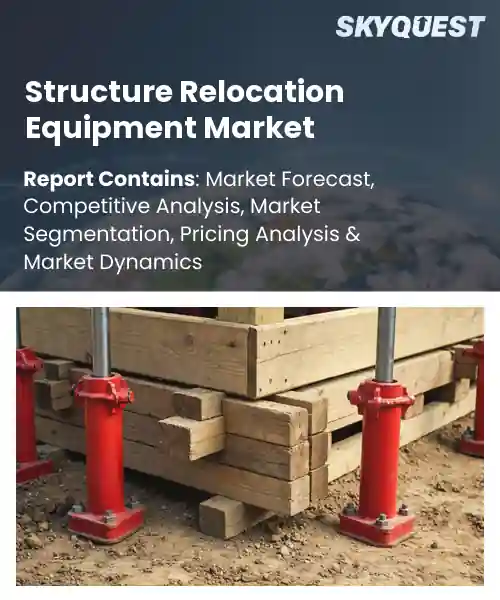
Structure Relocation Equipment Market
Report ID: SQMIG20G2110
Report ID: SQMIG20G2110
[email protected]
USA +1 351-333-4748
Report ID:
SQMIG20G2110 |
Region:
Global |
Published Date: February, 2026
Pages:
157
|Tables:
150
|Figures:
80


Global Structure Relocation Equipment Market size was valued at USD 7.2 Billion in 2024 and is poised to grow from USD 7.54 Billion in 2025 to USD 10.89 Billion by 2033, growing at a CAGR of 4.7% during the forecast period (2026-2033).
Growing urban densification, increasing infrastructure renewal projects, rising focus on preserving existing structures, advancements in heavy lifting technologies, and demand for cost-effective construction solutions are driving sales of structure relocation equipment.
Rapid technological advancements in hydraulics, computerized synchronization, and heavy transport platforms now allow safer and more efficient movement of extremely heavy structures such as bridge spans, refinery modules, and hospital wings. These innovations reduce operational downtime and lifecycle costs, encouraging contractors and project owners to adopt relocation technologies. As a result, manufacturers are expanding rental fleets, offering integrated relocation services, and adopting remote monitoring systems to support projects in urban redevelopment, disaster recovery, and modular construction. Growing need to relocate buildings, bridges, and industrial modules instead of demolishing them is expected to primarily drive structure relocation equipment market growth. Urban redevelopment and infrastructure modernization projects are encouraging developers and governments to preserve existing assets while clearing space for new construction.
On the contrary, high equipment costs, complex project planning requirements, regulatory and safety challenges, and limited availability of skilled operators are anticipated to slow down structure relocation equipment market penetration across the study period and beyond.
How is IoT Enhancing Safety and Efficiency of Structure Relocation Equipment?
IoT is improving safety and efficiency in the structure relocation equipment market by providing continuous sensor monitoring, remote telemetry, and digital twin integration. Sensors that are fitted in the equipment enable teams to monitor the activities closely and take prompt actions in the event of any safety risks that might occur. The IoT systems can also send automatic notifications in the event ofany unsafe conditions that have been identified. Digital twin systems have also been utilized for the development of relocatable modular buildings and the sensors fitted in these buildings have helped in the monitoring process.
Market snapshot - (2026-2033)
Global Market Size
USD 7.2 Billion
Largest Segment
Hydraulic Systems
Fastest Growth
Unified Lifting Jacks
Growth Rate
4.7% CAGR
To get more insights on this market click here to Request a Free Sample Report
Global structure relocation equipment market is segmented by product type, customer type, load capacity, application, end-user, and region. Based on product type, the market is segmented into unified lifting jacks, hydraulic systems, mechanical lifting tools, dollies, trailers, cribs, moving skates & rollers, and others. Based on customer type, the market is segmented into large enterprises and small to medium enterprises. Based on load capacity, the market is segmented into light load, medium load, and heavy load. Based on application, the market is segmented into residential structures, commercial structures, and industrial structures. Based on end-user, the market is segmented into construction companies, heavy transport & logistics companies, industrial & manufacturing firms, government & municipal authorities, and infrastructure contractors. Based on region, the market is segmented into North America, Europe, Asia Pacific, Latin America, and Middle East & Africa.
The unified lifting jacks segment is forecasted to spearhead the global structure relocation equipment market revenue generation across the study period. The ability of these systems to deliver integrated, synchronized lifting that minimizes structural stress and accelerates relocation workflows is helping this segment hold sway over others. The precise control and compatibility with hydraulic platforms minimize alignment issues and rework, which are major advantages for contractors with safety and efficiency in focus. Reliability, support from original equipment manufacturers, and the ability to work with different building footprints make them the first choice for complex moves, generating demand and defining equipment specifications.
However, moving skates & rollers are emerging as the key high growth segment as per this structure relocation equipment industry analysis. Low setup footprint and rapid deployment suit confined sitesthereby creating new business scope. The development of the material and modular design allows for the use of the equipment in urban renovations and tight commercial relocations, and the load monitoring and steerability of the platforms enhance productivity and create opportunities for smaller contractors.
The heavy load segment is estimated to account for the highest global structure relocation equipment market share in the future. High capacity required for moving large, dense structures underpins major infrastructure and industrial relocations, which helps this segment cement its dominance. Good designs and trailers minimize the need for disassembly, reducing the intricacy and liability of the logistics, thus making them indispensable for the project. The engineering focus on stability, braking, and load distribution ensures contractor reliance, thus supporting the procurement pattern for heavy capacity equipment on demanding projects
Meanwhile, medium load is turning out to be the fastest-growing segment due to its versatility, which makes it appropriate for urban retrofits and commercial renovation projects. Developments in lighter material and modular transportation have eased mobilization impediments for mid-sized projects, hence increasing contractor adoption and development of versatile equipment and related services.
To get detailed segments analysis, Request a Free Sample Report
Advanced engineering capability, deep capital markets, and extensive infrastructure needs to support consistent dominance of North America in terms of structure relocation equipment demand. The presence of rental and aftermarket equipment service support systems is also expected to boost acceptance of advanced structure relocation equipment. Safety standards and equipment regulations are a very important part of the marketplace, which ensures that the market for sophisticated and reliable machinery is always increasing. The proximity of major equipment manufacturers and suppliers allows for quick adoption of new technologies, like hydraulic jacking systems, skidding systems, and modular transportation. Comprehensive training and digital tracking of assets will increase all parties' operational efficiency. There are numerous financing and insurance companies offering financing solutions that assist with the decrease of barriers for completing jobs/projects. Additionally, environmental and disaster preparedness planning encourage more investment into relocate-able and reusable equipment, allowing for even broader application of such processes on both coastal and inland sites across North America.
High industrial activity, sophisticated project management practices, and a dense network of leasing and service providers support steady structure relocation of equipment demand in the country. Emphasis on safety certification and operator training helps build maturity across the United States and boost adoption of advanced structure relocation equipment. High demand for sophisticated lifts and specialized relocations drive innovation and collaboration between companies.
Regional construction demands, emphasis on infrastructure resilience, and collaboration between local contractors and equipment suppliers support consistent structure relocation equipmentadoption in Canada. Project sites that are remote and varied in topography create sustained demand for flexible transportation and jacking solutions with strong back-up support. Emphasis on reducing impact of projects on environment and launch of new utility and critical facility projects are also predicted to boost structure relocation equipment sales across the country through 2033.
Initiation of urban renewal programs, strict preservation policies, and increasing interest in sustainable and relocatable construction methods will enhance the demand for structure relocation equipment in European nations. Availability of harmonized policies and skilled engineering expertise will help execute projects and invest in modern jacking, skidding, and modular transportation methods. The rental and service market help in the elimination of entry barriers and the development of experiments with non-destructive relocation techniques. Strong manufacturing industries in key markets support development and availability of sophisticated equipment and increasing digitalization in monitoring and project management helps to enhance safety and predictability. Increased interest in training and certification for operators, along with cross-disciplinary collaborations, is beneficial for improving market capability for complex relocation projects. Joint efforts for improving learning and knowledge transfer among equipment suppliers, preservation experts, and contractors will help to accelerate learning and knowledge transfer, and investment needs and priorities for public and private sectors will help to increase applications for various commercial, heritage, and infrastructure projects within Europe
Robust industrial base, established manufacturing ecosystem, and high engineering standards shape structure relocation equipment procurement in Germany. Focus on efficiency, safety, and performance requirements helps drive the adoption of equipment for industrial, infrastructure, and redevelopment projects. Strong inter-linking between equipment suppliers, engineering consultants, and contractors helps drive innovation in heavy lifting, modular transport, and jacking equipment solutions. Precision equipment requirements are met by integrating high-end testing and certification processes, as well as service support capabilities.
The consistent activity in urban regeneration schemes, flexible finance options, and contractor alliances is ensuring that there is a constant requirement for structure relocation equipment in the United Kingdom. The emphasis on adaptive reuse and renewal of infrastructure is driving the adoption of modular transport equipment and hydraulic jacking systems. The collaboration between equipment suppliers, tech firms, and heritage consultants is driving innovation in relocation of equipment.
Emphasis on heritage conservation, urban renewal, and sustainable relocation approaches are boosting adoption of advanced structure relocation equipment in France. Expanding technical training and local services will further grow the scope for its practical applications. Collaboration of conservation architects, contractors, and equipment suppliers will continue to foster innovative solutions for sensitive moves Interest in terms of public and private stakeholders will also support pilot projects that highlight the potential of modular transport and non-destructive lifting techniques.
Rise in infrastructure development activity, growing local manufacturing, and increasing technical collaboration are creating new opportunities for structure relocation equipment companies. The region’s emphasis on sustainable infrastructure and coastal management is creating interest in flexible relocation solutions, and the access to competitive local manufacturing and engineering skills is supporting the development of cost-effective variations of existing equipment to meet the region’s needs. The partnerships between local and international companies are supporting the transfer of technology to create customized solutions to meet the region’s needs. The investment in operator training and local support infrastructure is supporting the enhancement of operational readiness, and the rental infrastructure is expanding to create greater availability across a range of applications within the region. Countries with established precision engineering and digital control expertise are contributing to high-value systems to meet safety and maintenance needs in the region. Export focus and customization opportunities enable the solutions to meet a range of site constraints across countries such as India, China, and Japan through 2033.
Advanced precision engineering and a strong safety culture are primarily shaping structure relocation equipment adoption across Japan. The strong after-sales support and training capabilities make the market ready for complex relocation and modular transport solutions in general. The majority of structure relocation equipment sales come from infrastructure resilience programs and specialized industrial relocations that necessitate precision and accuracy. Rise in partnerships between equipment suppliers, consultancies, and testing companies also create new business scope.
Robust heavy industry demand, advanced fabrication capability, and expertise in heavy transport operations support high structure relocation equipment sales in South Korea. Focus on operator competence and service support, along with partnerships with global technology providers, is beneficial for successful project execution in various relocation equipment applications. Shipbuilding and industrial projects require highly efficient jacking and skidding systems, and digital automation provides precision to these applications.
To know more about the market opportunities by region and country, click here to
Buy The Complete Report
Urbanization Fueling Project Volume
The rapid growth of cities around the world is also leading to an increased need to develop new structures, bridges, and rehabilitate infrastructure, which means that there is a need to relocatestructural components on a regular basis. The use of structure relocation equipment has made it easier to move heavy structures without necessarily causing disruptions on site, which is why many contractors and project owners are adopting it. The fact that many projects around cities are small means that the use of specialized equipment is likely to increase its adoption.
Technological Advancements in Equipment
The constant advancements in technology concerning the field of hydraulic jacking, modular skid systems, and control automation technology are enhancing the capability, accuracy, and safety of the equipment used to relocate structures, thus ensuring a more predictable and labor-saving operation. The enhanced telemetry and control capabilities reduce the risks associated with the operation while providing accurate control in restricted spaces, thus enhancing client confidence. The reduction in downtime and enhanced reliability of structure relocation operations encourage engineers and contractors to specify newer technology, thereby boosting investment and innovation in the market.
High Capital Investment Requirements
One of the major hindrances to the entry of the relocation services into the market is the high cost of owning specialized equipment for relocation. The process of relocation is very capital-intensive for medium and small-sized contractors. The need to employ skilled manpower to operate the equipment and maintain the equipment adds to the high cost of owning equipment for relocation, which is beyond the reach of most project owners. This has a direct consequence on potential buyers, who may be forced to postpone purchasing and instead use conventional means.
Regulatory and Permitting Challenges
Regulatory complexities and permitting requirements, as well as differences in local safety regulations, may also slow down projects that require structure relocation. Such uncertainties and administrative complexities may affect equipment suppliers and contractors, thereby deterring the use of specialized relocation equipment for projects that require such services. Regulatory complexities and differences in cross-jurisdictional permitting and environmental impact assessments may also slow project timelines and affect the planning of logistics, thereby deterring the use of specialized relocation equipment for projects that require such services.
Request Free Customization of this report to help us to meet your business objectives.
Competitive dynamics in the global structure relocation equipment market are driven by large infrastructure and offshore wind projects that force fleet expansion and capability differentiation. Players pursue consolidation, bespoke equipment and engineering partnerships to win project bids. Mammoet’s acquisition of ALE strengthened its global fleet and scope. Sarens showcased heavy-lift innovation with Big Carl on reactor works, while Huisman partnered with Cadeler on a monopile gripper for offshore wind.
Modular Prefabrication Adoption: Rise in demand for modular and prefabricated structure relocation systems that enable faster site assembly and reduced onsite disruption is creating new business scope. Industry players are keen on repeatable process models, standardized interfaces, and prefabrication to speed up the process. This structure relocation equipment market trend helps to reduce site disruption and enhance safety coordination going forward.
Digital Integration and Automation: Digital integration is changing the landscape of structure relocation equipment with the integration of connected sensors, remote monitoring, and simulation tools. Service providers are increasingly using platform-based workflows and digital twins for the visualization of restructuring, prediction, and management of multi-disciplinary teams in complex urban environments. High demand for automation is also expected to boost the importance of this structure relocation equipment industry trend.
SkyQuest’s ABIRAW (Advanced Business Intelligence, Research & Analysis Wing) is our Business Information Services team that Collects, Collates, Correlates, and Analyses the Data collected by means of Primary Exploratory Research backed by robust Secondary Desk research.
As per SkyQuest analysis, rising urban densification and increasing infrastructure renewal projects are anticipated to drive the demand for structure relocation equipment going forward. However, high equipment costs and complex project planning requirements are slated to slow down the adoption of structure relocation equipment in the future. North America is slated to spearhead the demand for structure relocation equipment owing to strong investments in infrastructure modernization and presence of advanced construction technologies. Integration of IoT sensors for real-time monitoring and adoption of digital twin technologies for safer relocation planning are anticipated to be key trends driving the structure of relocation equipment industry over the coming years.
| Report Metric | Details |
|---|---|
| Market size value in 2024 | USD 7.2 Billion |
| Market size value in 2033 | USD 10.89 Billion |
| Growth Rate | 4.7% |
| Base year | 2024 |
| Forecast period | (2026-2033) |
| Forecast Unit (Value) | USD Billion |
| Segments covered |
|
| Regions covered | North America (US, Canada), Europe (Germany, France, United Kingdom, Italy, Spain, Rest of Europe), Asia Pacific (China, India, Japan, Rest of Asia-Pacific), Latin America (Brazil, Rest of Latin America), Middle East & Africa (South Africa, GCC Countries, Rest of MEA) |
| Companies covered |
|
| Customization scope | Free report customization with purchase. Customization includes:-
|
To get a free trial access to our platform which is a one stop solution for all your data requirements for quicker decision making. This platform allows you to compare markets, competitors who are prominent in the market, and mega trends that are influencing the dynamics in the market. Also, get access to detailed SkyQuest exclusive matrix.
Table Of Content
Executive Summary
Market overview
Parent Market Analysis
Market overview
Market size
KEY MARKET INSIGHTS
COVID IMPACT
MARKET DYNAMICS & OUTLOOK
Market Size by Region
KEY COMPANY PROFILES
Methodology
For the Structure Relocation Equipment Market, our research methodology involved a mixture of primary and secondary data sources. Key steps involved in the research process are listed below:
1. Information Procurement: This stage involved the procurement of Market data or related information via primary and secondary sources. The various secondary sources used included various company websites, annual reports, trade databases, and paid databases such as Hoover's, Bloomberg Business, Factiva, and Avention. Our team did 45 primary interactions Globally which included several stakeholders such as manufacturers, customers, key opinion leaders, etc. Overall, information procurement was one of the most extensive stages in our research process.
2. Information Analysis: This step involved triangulation of data through bottom-up and top-down approaches to estimate and validate the total size and future estimate of the Structure Relocation Equipment Market.
3. Report Formulation: The final step entailed the placement of data points in appropriate Market spaces in an attempt to deduce viable conclusions.
4. Validation & Publishing: Validation is the most important step in the process. Validation & re-validation via an intricately designed process helped us finalize data points to be used for final calculations. The final Market estimates and forecasts were then aligned and sent to our panel of industry experts for validation of data. Once the validation was done the report was sent to our Quality Assurance team to ensure adherence to style guides, consistency & design.
Analyst Support
Customization Options
With the given market data, our dedicated team of analysts can offer you the following customization options are available for the Structure Relocation Equipment Market:
Product Analysis: Product matrix, which offers a detailed comparison of the product portfolio of companies.
Regional Analysis: Further analysis of the Structure Relocation Equipment Market for additional countries.
Competitive Analysis: Detailed analysis and profiling of additional Market players & comparative analysis of competitive products.
Go to Market Strategy: Find the high-growth channels to invest your marketing efforts and increase your customer base.
Innovation Mapping: Identify racial solutions and innovation, connected to deep ecosystems of innovators, start-ups, academics, and strategic partners.
Category Intelligence: Customized intelligence that is relevant to their supply Markets will enable them to make smarter sourcing decisions and improve their category management.
Public Company Transcript Analysis: To improve the investment performance by generating new alpha and making better-informed decisions.
Social Media Listening: To analyze the conversations and trends happening not just around your brand, but around your industry as a whole, and use those insights to make better Marketing decisions.
REQUEST FOR SAMPLE
 REQUEST FREE CUSTOMIZATION
Global Structure Relocation Equipment Market size was valued at USD 7.2 Billion in 2024 and is poised to grow from USD 7.54 Billion in 2025 to USD 10.89 Billion by 2033, growing at a CAGR of 4.7% during the forecast period (2026-2033).
Competitive dynamics in the global structure relocation equipment market are driven by large infrastructure and offshore wind projects that force fleet expansion and capability differentiation. Players pursue consolidation, bespoke equipment and engineering partnerships to win project bids. Mammoet’s acquisition of ALE strengthened its global fleet and scope. Sarens showcased heavy-lift innovation with Big Carl on reactor works, while Huisman partnered with Cadeler on a monopile gripper for offshore wind. 'Innovate Prefabricate Inc: Established in 2019, their main objective is to deliver a kit-of-parts structural system and AI-led design and supply tool for rapid, code-compliant multifamily delivery. Recent development: the company has combined hardware kit development with software-led feasibility and supply workflows and is positioning pilots for multifamily projects. They target reducing on-site complexity and easing logistics coordination across suppliers and installers.', 'ootBox: Established in 2020, their main objective is to provide moveable, finished workspace units built from repurposed shipping containers for lease and short-term site use. Recent development: the company raised visibility and a strategic investment after appearing on Shark Tank and then expanded product variations and leasing offers for pop-up retail, lease-up offices and custom projects. Their model emphasizes turnkey delivery and rapid site deployment.', 'Bigge Crane and Rigging Co.', 'Atlas Rigging & Transfer', 'Mammoet', 'Emirates Building Systems', 'J.R. Merritt Controls', 'North American & Southern Equipment', 'McKinney-Waterloo', 'Burkhalter Rigging', 'Specialized Rigging Services', 'Roll-Lift', 'M. Press & Co.', 'SSG - Structure Support Group', 'Pro-Rig', 'Rigging Solutions', 'Atlantic Relocation Systems', 'B. Young Equipment', 'O'Sullivan's Moving & Storage', 'Allied Equipment Rentals', 'U-Haul', 'Heavy Lift Services'
Rapid urbanization in many regions is increasing demand for new buildings, bridges, and infrastructure rehabilitation, which in turn requires frequent relocation and positioning of large structural components. Structure relocation equipment enables efficient movement of heavy loads with reduced site disruption and faster project timelines, encouraging contractors and project owners to specify these solutions. As urban projects often face confined sites and logistical constraints, the versatility and safety benefits of specialized relocation equipment make it a preferred option, supporting broader adoption and market expansion.
Modular Prefabrication Adoption: Industry participants are increasingly favoring modular and prefabricated structure relocation systems that enable faster site assembly, reduced onsite disruption, improved safety coordination. Stakeholders emphasize repeatable processes, standardized interfaces, and offsite fabrication to compress project schedules and simplify logistics while preserving structural integrity. This trend encourages manufacturers to develop configurable, transport-friendly modules and integrated services that align with client timelines and urban constraints. Adoption drives collaboration between engineers, transport specialists, and logistics providers to optimize end-to-end relocation workflows and lifecycle outcomes.
Advanced engineering capability, deep capital markets, and extensive infrastructure needs to support consistent dominance of North America in terms of structure relocation equipment demand.


Want to customize this report? This report can be personalized according to your needs. Our analysts and industry experts will work directly with you to understand your requirements and provide you with customized data in a short amount of time. We offer $1000 worth of FREE customization at the time of purchase.
Feedback From Our Clients


 USA (+1) 351-333-4748

