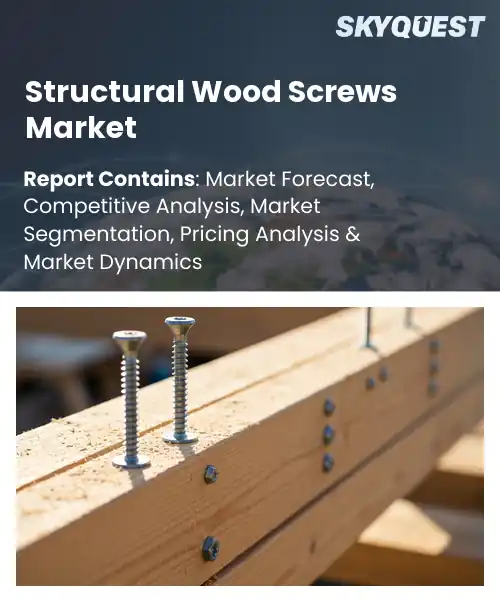
Structural Wood Screws Market
Report ID: SQMIG20C2233
Report ID: SQMIG20C2233
[email protected]
USA +1 351-333-4748
Report ID:
SQMIG20C2233 |
Region:
Global |
Published Date: June, 2026
Pages:
157
|Tables:
146
|Figures:
73


Global Structural Wood Screws Market size was valued at USD 2.22 Billion in 2024 and is poised to grow from USD 2.36 Billion in 2025 to USD 3.85 Billion by 2033, growing at a CAGR of 6.32% during the forecast period (2026-2033).
The primary driver of the structural wood screws market is the rapid adoption of engineered and mass timber construction, which has increased demand for reliable high-strength fastening solutions. Structural wood screws are specialized fasteners designed to join heavy timber, CLT panels and engineered lumber where predictable performance and code compliance are required. This market matters because fasteners affect structural integrity, build speed and lifecycle costs in residential and commercial projects. The market shifted from nails and lag bolts toward coated high-strength screws and mechanized installation systems, evident in decking projects across North America and modular timber buildings expanding in Europe.
A principal factor accelerating global structural wood screws demand is the tightening of building codes and performance standards, which creates a direct need for certified fasteners with predictable strength. When regulators mandate higher wind and seismic resistance, architects specify engineered fasteners and manufacturers respond by producing screws with greater shear capacity and corrosion resistance, driving product innovation. This cycle reduces installation time and warranty risk, making timber more competitive with steel. In practical terms contractors choose high-capacity coated screws for coastal decks and seismic retrofits, while modular builders adopt automated driving systems that increase throughput and open new regional markets.
How is AI optimizing manufacturing efficiency in the structural wood screws market?
AI is reshaping efficiency across the structural wood screws market by optimizing design, production and quality workflows. Key aspects include AI driven process control for CNC and forming machines, vision systems for automated inspection, predictive maintenance on presses and robotic fastening for repeatable assembly. Many manufacturers now apply AI to reduce rework and improve consistency while meeting code and traceability demands. This helps address market pressure for faster reliable components and smoother supply coordination. Examples include AI assisted CNC programming that shortens setup, datasets that enable real time screw classification and research into asynchronous multi robot scheduling for timber assembly.
Vicomm Technology April 2026, introduced an Intelligent Screw Fastening System that pairs AI vision with force feedback to ensure correct screw selection and torque, improve traceability and reduce stoppages, which supports higher throughput and steadier market growth.
Market snapshot - (2026-2033)
Global Market Size
USD 2.22 Billion
Largest Segment
Lag Screws
Fastest Growth
Timber Screws
Growth Rate
6.32% CAGR
To get more insights on this market click here to Request a Free Sample Report
Global structural wood screws market is segmented by type, material, drive type, application, distribution and region. Based on type, the market is segmented into Lag Screws, Self-Tapping Wood Screws, Deck Screws, Timber Screws and Others. Based on material, the market is segmented into Stainless Steel, Carbon Steel and Coated/Galvanized Steel. Based on drive type, the market is segmented into Phillips, Torx/Star and Hex. Based on application, the market is segmented into Residential Construction, Commercial Construction and DIY & Home Improvement. Based on distribution, the market is segmented into Hardware Stores, Online and Direct to Contractors. Based on region, the market is segmented into North America, Europe, Asia Pacific, Latin America and Middle East & Africa.
Deck Screws segment dominates because deck screws are engineered to balance high withdrawal resistance, corrosion protection, and installation speed for outdoor and finish carpentry applications, so they become the preferred choice for many contractors and retailers. Their head and thread geometries reduce splitting and accelerate fastening, while compatibility with composite materials and supplier focus on decking-specific SKUs drives frequent specification and steady procurement in structural wood screw applications.
However, Timber Screws are the most rapidly expanding area because deep threads and stout shanks enable reliable connections in heavy timber and engineered wood projects, attracting designers and contractors seeking bolt alternatives. Improvements in thread form and coatings broaden usable applications and simplify installation, accelerating adoption and unlocking new structural fastening opportunities.
Stainless Steel segment leads because stainless fasteners deliver superior corrosion resistance and longevity for demanding woodworking and outdoor structural uses, prompting specification where durability and low maintenance are priorities. Their nonreactive interaction with treated and exotic timbers reduces failure risk over service life, while manufacturer emphasis on high-grade alloys and performance assurance builds confidence among engineers, specifiers, and premium contractors, supported by warranty programs.
However, Coated/Galvanized Steel is the fastest growing material category as improved coating chemistries deliver better corrosion protection at lower cost, appealing to contractors and retail channels. Tailored coatings for treated lumber and outdoor exposure broaden applications and let manufacturers offer differentiated SKUs that accelerate adoption and widen market accessibility.
To get detailed segments analysis, Request a Free Sample Report
North America dominates due to a combination of mature construction markets, strong demand for timber framing and renovation, and well developed manufacturing and distribution networks. Market leadership is reinforced by rigorous building codes that favor high performance fasteners, broad adoption of engineered wood products, and concentrated research and development in corrosion resistant coatings and thread geometries. Established suppliers maintain close relationships with builders and industrial buyers, enabling rapid product customization and logistical reliability. Ongoing investment in automation and quality assurance, combined with efficient aftermarket service and training programs, strengthens buyer confidence and supports premium positioning that propagates across export channels and influences global fastener standards.
Structural Wood Screws Market in United States benefits from extensive contractor networks, wide adoption of engineered lumber, and strong aftermarket support from manufacturers and distributors. Product innovation focuses on corrosion resistance and specialized thread forms for demanding applications. Close collaboration between suppliers and construction firms facilitates specification driven purchases. Procurement practices and a preference for proven, high performance fasteners sustain demand across residential restoration and large scale commercial timber projects.
Structural Wood Screws Market in Canada is shaped by timber rich supply chains and emphasis on durability in harsh climates. Manufacturers prioritize coatings and material treatments suited to coastal and cold weather exposure. Strong linkages with lumber processors and prefabrication firms support tailored screw specifications for modular construction. Distribution channels focus on servicing urban builders alike, while sustainability certification and quality assurance practices guide procurement toward lasting, reliable fastening solutions.
Rapid expansion in Europe is driven by a convergence of sustainability goals, increasing acceptance of engineered wood systems, and a strong policy emphasis on low carbon construction. The marketplace is responding to architect and developer demand for high performance fastening solutions compatible with cross laminated timber, prefabricated elements, and intensive renovation programs. Regional standardization and certification frameworks promote product quality and interoperability, enabling suppliers to scale beyond local markets. Growing collaboration among fastener manufacturers, lumber producers, and construction technology providers accelerates application specific innovation in coatings and thread design. Urban redevelopment and a preference for lighter, faster building methods have also shifted procurement toward specialized structural screws, while national market dynamics create pockets of leadership and rapid adoption across different countries.
Structural Wood Screws Market in Germany is characterized by high specification demands and a preference for precision engineered fasteners. Prefabrication and engineered timber adoption demand consistent material quality and traceable production. Local manufacturers emphasize technical documentation, testing, and tailored coating systems for diverse structural applications. Strong links with engineering consultancies and testing institutes support rigorous product qualification, while efficient logistics and focused supplier networks enable reliable supply to construction projects.
Structural Wood Screws Market in United Kingdom is experiencing rapid adoption driven by modular construction and offsite manufacturing trends. Demand from renovation and retrofit activity favors high performance, easily specified fastening systems. Manufacturers and distributors concentrate on delivery, technical support, and product ranges suited to timber frame structures. Urban housing programs and contractor preferences for installation performance encourage uptake, while product testing and certification ease market entry for innovative solutions.
Structural Wood Screws Market in France is emerging alongside renewed interest in timber architecture, renovation, and retrofit projects. Designers and builders specify performance fasteners that meet aesthetic and durability requirements for visible timber elements. Small manufacturers emphasize bespoke product options and responsive technical service to support engineered applications. Growing certification processes and partnerships between material suppliers and prefab builders are creating pathways for greater market acceptance within mainstream construction practices.
Asia Pacific is strengthening its position through a mix of advanced manufacturing, targeted product development, and rising adoption of engineered wood construction. Regional producers are investing in precision machining and coating technologies to meet diverse climatic and seismic performance needs, while supply chain integration supports rapid scaling for both domestic and export markets. Collaboration between fastener manufacturers and prefabrication specialists fosters application specific solutions suited to modular housing and commercial timber systems. Market maturation is also supported by knowledge transfer from established exporters and an expanding base of testing and certification bodies that improve product credibility. National construction practices that emphasize durability and rapid assembly further encourage specification of structural screws, positioning the region as an increasingly influential source of both innovation and competitively manufactured components.
Structural Wood Screws Market in Japan emphasizes high reliability and performance to meet stringent seismic and durability requirements. Manufacturers focus on precision engineering, specialized heat treatments, and advanced corrosion protection suitable for coastal and humid environments. Close collaboration with construction firms yields documented product specifications and application guidance. Demand is concentrated in seismic resilient timber systems and prefabricated elements, where consistent quality and performance are prioritized by builders and engineers.
Structural Wood Screws Market in South Korea is advancing through strong manufacturing capabilities and rapid adoption of prefabrication techniques. Producers emphasize automated production, surface treatments, and tight quality control to serve modular housing and timber projects. Industry collaboration with technology providers supports development of application fastening solutions and simplified installation systems. Increasing attention to export opportunities and alignment with international testing practices enhances supplier credibility and further supports regional uptake.
To know more about the market opportunities by region and country, click here to
Buy The Complete Report
Growth In Residential Construction
Increased Use Of Engineered Timber
Volatility In Steel And Coatings
Complex Building Code Requirements
Request Free Customization of this report to help us to meet your business objectives.
Competition in the global structural wood screws market is driven by technical differentiation and channel consolidation, with wider code acceptance and mass timber adoption prompting firms to pursue M and A, distribution rollups, and product partnerships. Examples include Bossard increasing its stake in Torp Fasteners, Endries’ recent acquisition activity, CAMO’s 2023 code compliant structural screw launch, and Simpson Strong Tie expanding mass timber screw offerings.
Top Player’s Company Profile
Recent Developments
SkyQuest’s ABIRAW (Advanced Business Intelligence, Research & Analysis Wing) is our Business Information Services team that Collects, Collates, Correlates, and Analyses the Data collected by means of Primary Exploratory Research backed by robust Secondary Desk research. As per SkyQuest analysis, the global structural wood screws market is propelled chiefly by rapid adoption of engineered and mass timber construction, with expansion in residential construction serving as a second significant driver. A major restraint remains volatility in steel and coating prices and availability, which can disrupt supply, margins and product rollouts. North America currently dominates the market due to mature timber adoption, strict codes and strong distribution networks, while deck screws lead in demand because they balance corrosion protection, withdrawal resistance and fast installation for outdoor and finish carpentry. Together these dynamics encourage product innovation, specification shifts toward certified high-strength screws and greater focus on supply chain resilience.
| Report Metric | Details |
|---|---|
| Market size value in 2024 | USD 2.22 Billion |
| Market size value in 2033 | USD 3.85 Billion |
| Growth Rate | 6.32% |
| Base year | 2024 |
| Forecast period | (2026-2033) |
| Forecast Unit (Value) | USD Billion |
| Segments covered |
|
| Regions covered | North America (US, Canada), Europe (Germany, France, United Kingdom, Italy, Spain, Rest of Europe), Asia Pacific (China, India, Japan, Rest of Asia-Pacific), Latin America (Brazil, Rest of Latin America), Middle East & Africa (South Africa, GCC Countries, Rest of MEA) |
| Companies covered |
|
| Customization scope | Free report customization with purchase. Customization includes:-
|
To get a free trial access to our platform which is a one stop solution for all your data requirements for quicker decision making. This platform allows you to compare markets, competitors who are prominent in the market, and mega trends that are influencing the dynamics in the market. Also, get access to detailed SkyQuest exclusive matrix.
Table Of Content
Executive Summary
Market overview
Parent Market Analysis
Market overview
Market size
KEY MARKET INSIGHTS
COVID IMPACT
MARKET DYNAMICS & OUTLOOK
Market Size by Region
KEY COMPANY PROFILES
Methodology
For the Structural Wood Screws Market, our research methodology involved a mixture of primary and secondary data sources. Key steps involved in the research process are listed below:
1. Information Procurement: This stage involved the procurement of Market data or related information via primary and secondary sources. The various secondary sources used included various company websites, annual reports, trade databases, and paid databases such as Hoover's, Bloomberg Business, Factiva, and Avention. Our team did 45 primary interactions Globally which included several stakeholders such as manufacturers, customers, key opinion leaders, etc. Overall, information procurement was one of the most extensive stages in our research process.
2. Information Analysis: This step involved triangulation of data through bottom-up and top-down approaches to estimate and validate the total size and future estimate of the Structural Wood Screws Market.
3. Report Formulation: The final step entailed the placement of data points in appropriate Market spaces in an attempt to deduce viable conclusions.
4. Validation & Publishing: Validation is the most important step in the process. Validation & re-validation via an intricately designed process helped us finalize data points to be used for final calculations. The final Market estimates and forecasts were then aligned and sent to our panel of industry experts for validation of data. Once the validation was done the report was sent to our Quality Assurance team to ensure adherence to style guides, consistency & design.
Analyst Support
Customization Options
With the given market data, our dedicated team of analysts can offer you the following customization options are available for the Structural Wood Screws Market:
Product Analysis: Product matrix, which offers a detailed comparison of the product portfolio of companies.
Regional Analysis: Further analysis of the Structural Wood Screws Market for additional countries.
Competitive Analysis: Detailed analysis and profiling of additional Market players & comparative analysis of competitive products.
Go to Market Strategy: Find the high-growth channels to invest your marketing efforts and increase your customer base.
Innovation Mapping: Identify racial solutions and innovation, connected to deep ecosystems of innovators, start-ups, academics, and strategic partners.
Category Intelligence: Customized intelligence that is relevant to their supply Markets will enable them to make smarter sourcing decisions and improve their category management.
Public Company Transcript Analysis: To improve the investment performance by generating new alpha and making better-informed decisions.
Social Media Listening: To analyze the conversations and trends happening not just around your brand, but around your industry as a whole, and use those insights to make better Marketing decisions.
REQUEST FOR SAMPLE
 REQUEST FREE CUSTOMIZATION
Global Structural Wood Screws Market size was valued at USD 2.22 Billion in 2024 and is poised to grow from USD 2.36 Billion in 2025 to USD 3.85 Billion by 2033, growing at a CAGR of 6.32% during the forecast period (2026-2033).
Competition in the global structural wood screws market is driven by technical differentiation and channel consolidation, with wider code acceptance and mass timber adoption prompting firms to pursue M and A, distribution rollups, and product partnerships. Examples include Bossard increasing its stake in Torp Fasteners, Endries’ recent acquisition activity, CAMO’s 2023 code compliant structural screw launch, and Simpson Strong Tie expanding mass timber screw offerings. 'Würth Group', 'Simpson Strong-Tie (Simpson Manufacturing)', 'FastenMaster (OMG Inc.)', 'GRK Canada Ltd. (Würth)', 'Spax International', 'Kreg Tool Company', 'Hillman Group', 'National Nail (CAMO)', 'Starborn Industries', 'Leland Industries', 'Triangle Fastener Corporation', 'Illinois Tool Works (ITW)', 'Bralo Group', 'Titen HD (Simpson)', 'Camo Fasteners'
Expansion in residential construction increases demand for reliable fastening solutions, prompting builders and contractors to prefer structural wood screws for their superior holding strength and ease of installation. As more housing projects proceed, specifiers increasingly favor screws that reduce installation time and provide durable connections in timber frameworks. This preference drives manufacturers to broaden product portfolios and improve distribution, supporting market growth. The resulting emphasis on quality and availability encourages adoption across renovation and new-build applications, reinforcing the role of structural wood screws in modern residential construction practices.
Sustainable Materials Adoption: Increasing emphasis on environmental performance is pushing manufacturers and specifiers toward structurally optimized, sustainably sourced screw solutions that align with green building agendas. Demand is growing for raw materials and finishes with lower ecological impact, greater recyclability, and improved lifecycle transparency. Suppliers are responding through material substitutions, eco-design, and enhanced traceability to meet architect and developer requirements. Certification and documented sustainability credentials are becoming differentiators, driving closer collaboration across procurement, design, and manufacturing to support circularity and reputational objectives.
Why does North America Dominate the Global Structural Wood Screws Market? |@12


Want to customize this report? This report can be personalized according to your needs. Our analysts and industry experts will work directly with you to understand your requirements and provide you with customized data in a short amount of time. We offer $1000 worth of FREE customization at the time of purchase.
Feedback From Our Clients


 USA (+1) 351-333-4748

