
Structural Composites Market
Report ID: SQMIG15A2596
Report ID: SQMIG15A2596
[email protected]
USA +1 351-333-4748
Report ID:
SQMIG15A2596 |
Region:
Global |
Published Date: August, 2025
Pages:
176
|Tables:
62
|Figures:
69


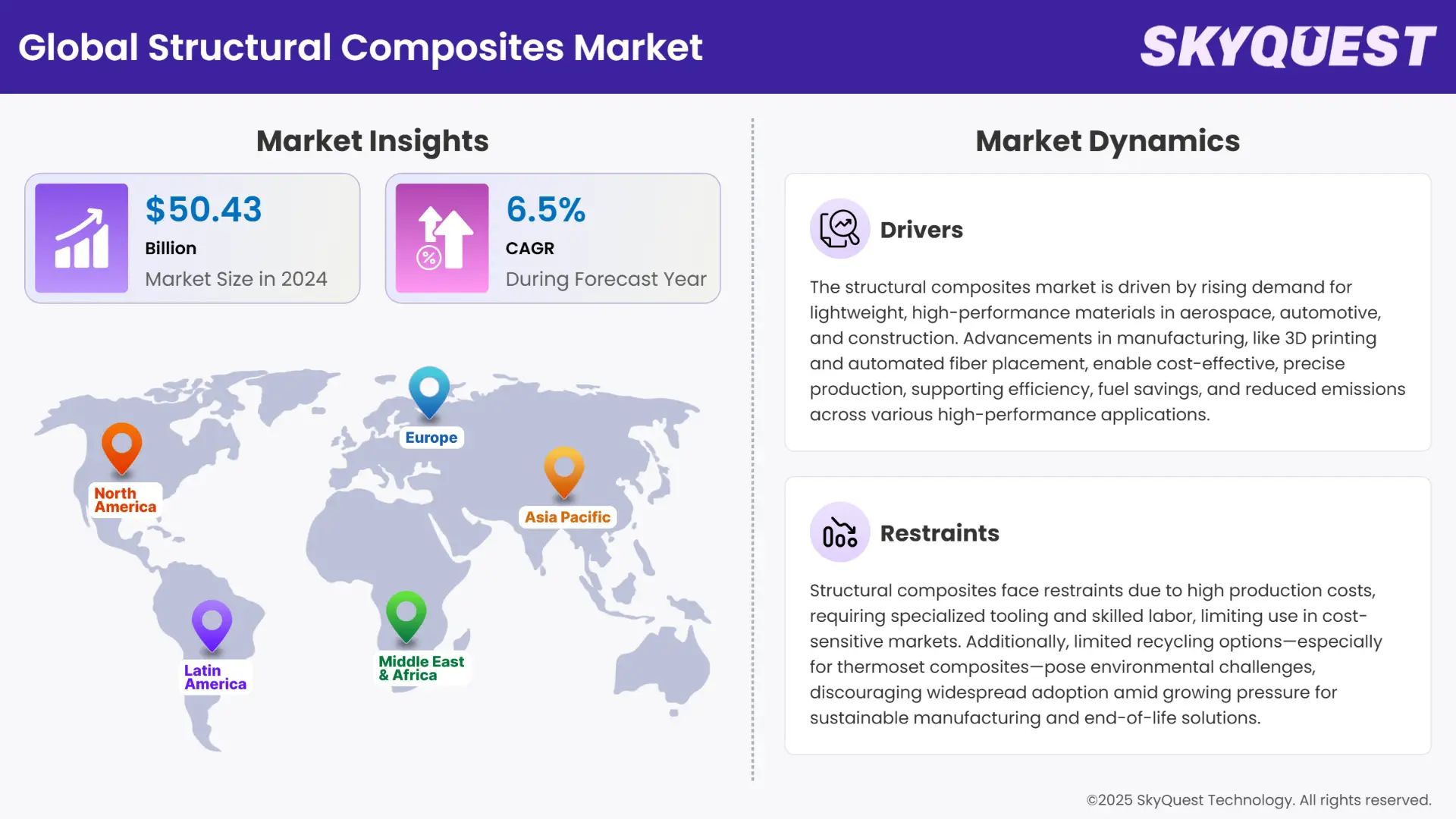
Global Structural Composites Market size was valued at USD 50.1 Billion in 2024 and is poised to grow from USD 53.35 Billion in 2025 to USD 88.3 Billion by 2033, growing at a CAGR of 6.5% in the forecast period (2026–2033).
The global structural composites market is on a steady upward trajectory, spurred by the ongoing demand for lightweight, high-strength materials in multiple industries. Structural composites, due to their high mechanical properties, corrosion resistance, and flexible design, are rapidly being utilized in the automotive, aerospace, construction, and wind energy industries, among others.
The automotive industry is utilizing structural composites to improve fuel economy and cut emissions, while the aerospace industry is utilizing these materials to maximize weight while maintaining strength and safety. In construction, property developers and municipalities are using structural composites for infrastructure projects because of their durability and low maintenance. Further, changes in manufacturing technologies, including automated fiber placement and advanced resin infusion processes, have increased efficiency and expanded the range of applications.
The structural composites market is also evolving with the emergence of hybrid composites, as well as the use of bio-based materials, in part, as a response to trends and regulations pushing a lower environmental impact. While there are challenges ahead, the structural composites market is well-positioned to flourish as industries prioritize performance, lightweight solutions, and long-term cost options.
How is AI Improving Manufacturing Processes in Structural Composites?
Artificial Intelligence (AI) is transforming the structural composites industry in the areas of design, manufacturing and performance monitoring. As early as 2024, innovations brought about by AI contributed to the development of new composite materials, which significantly improved material stiffness, strength and durability and helped develop the high-performance composites market. Generative AI algorithms optimize composite structure design by taking into account many parameters, including physical properties of different materials and manufacturing constraints, which is speeding up prototyping and reducing material waste. Additionally, AI-enabled systems are accelerating and enhancing the monitoring of composite structures, particularly in the aerospace sector, meaning that operators can identify and mitigate potential issues before they become a safety concern. These innovations demonstrate that AI is improving both the efficiency and capabilities of structural composites applications and enhancing innovation, across a number of industries, including aerospace, automotive and construction.
To get more insights on this market click here to Request a Free Sample Report
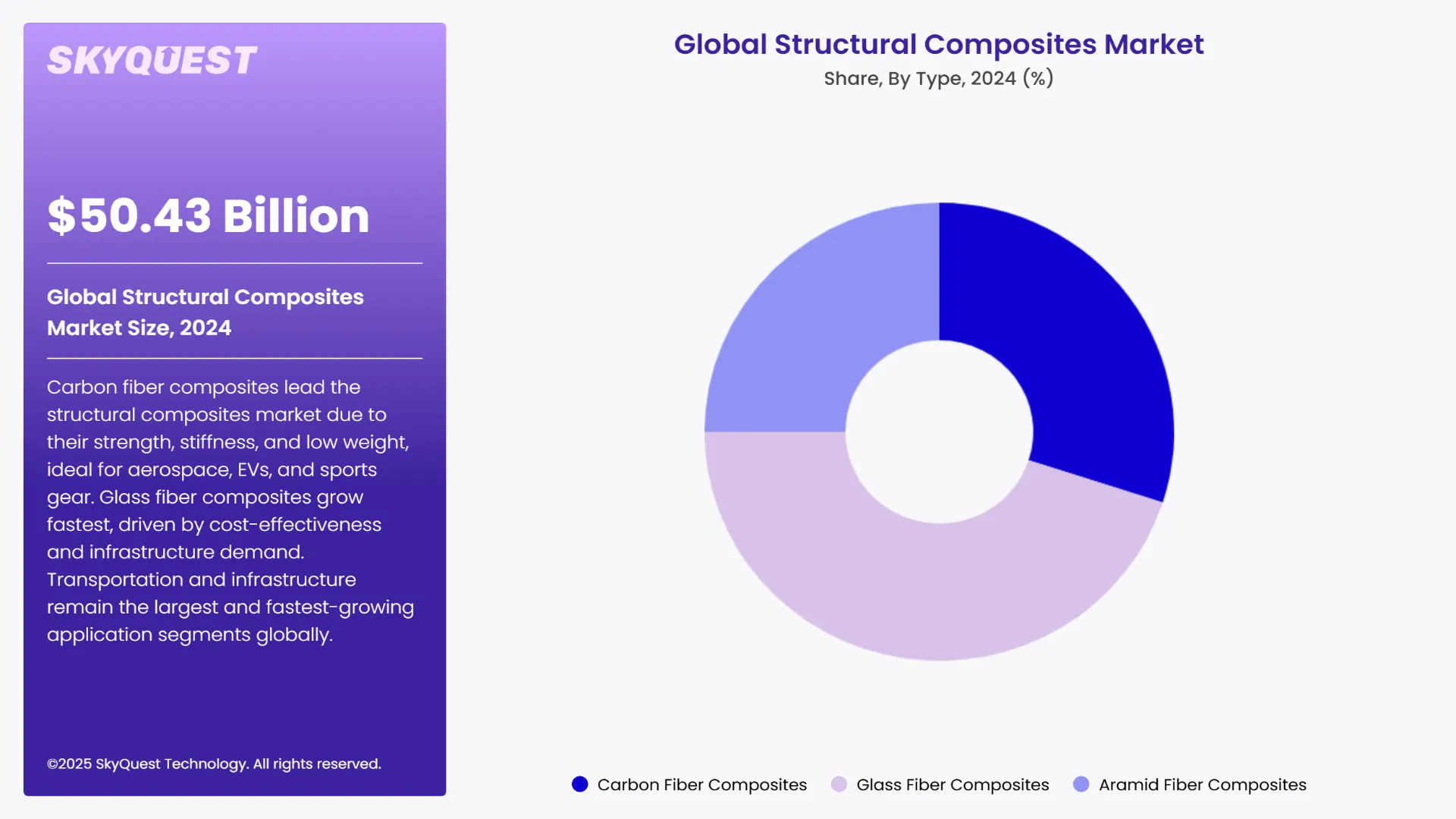
Global structural composites market is segmented into type, end-user and region. Based on type, the market is segmented into carbon fiber composites, glass fiber composites and aramid fiber composites. Based on end-user, the market is segmented into manufacturing, transportation and infrastructure. Region-wise, the market is segmented into North America, Europe, Asia-Pacific, Middle East and Africa, and Latin America.
Carbon fiber composites remain the largest segment of the structural composites market given their unique properties of strength, stiffness, and low weight. Applications in aerospace, automotive, wind energy and high-performance sports gear where a lightweight component results in a more fuel efficient or faster more efficient assessment. New methods of carbon fiber production and processing automated fiber placement and hybrid composites, several with the potential to produce carbon fiber, are continuously expanding. Increased use of light-weight components in electric vehicles, light-weight aircraft components, and high-performance sporting goods helps to support and grow carbon fiber composites as the leading type of composite material worldwide.
As per global structural composites market analysis, glass fiber composites are currently exhibiting the fastest growth segment of the market due to their low-cost, versatility, and ease of manufacture. It provides users with moderately lower strength and durability at a lower cost than carbon fiber composites. Some current applications include automotive parts, construction materials, marine applications, and industrial machinery components. The market growth is driven by infrastructure spend, light weight vehicles initiatives, and the renewable energy provided by wind turbine blades.
As per the global structural composites market forecast, the transportation segment dominates the market due to the demand for lightweight, durable materials used in automotive, aerospace, rail, and marine applications. Reduction in vehicle weight can translate into reduced fuel use, emissions, and improvements in vehicle and vessel performance, thus composites, particularly carbon-fiber and glass-fiber composites, will continue to be in demand. The continued transformation toward electric vehicles and lightweight aircraft components will only continue to solidify the transportation segment as the largest source of demand.
As per the global structural composites market outlook, the infrastructure segment is the largest and fastest growing segment in the market. The use of composites is allowing them to be used more dominantly in bridges, buildings, piping, and other civil engineering structures. Composites are increasingly used in bridges, buildings, pipelines, and other civil engineering projects due to their corrosion resistance, low maintenance, and long service life. With the increasing global investments in smart cities (renewable energy projects such as wind turbine blades), and sustainable construction practices, faster uptake to these materials in the infrastructure segment can easily be achieved.
To get detailed segments analysis, Request a Free Sample Report
As per industry analysis, North America is the largest structural composites market due to demand driven by aerospace, automotive, construction, and the industrial sector. North America has established chemical manufacturing systems, R&D infrastructure, and materials that are high-performance, lightweight, and sustainable in nature. Companies are investing in innovation of structural composites, some examples include automated fiber placement, hybrid composites, and bio-based resins.
Structural Composites Market in the U.S.
The United States represents the largest market segment in North America because it has a mature industrial base and aerospace, automotive, and industrial applications produce a high demand. The key to the growth within structural composites comes from the development of lightweight carbon fiber composites and specialty resin systems that improve performance and efficiency.
Structural Composites Market in Canada
Canada's market emphasizes environmentally sustainable and high-performance composites in the aerospace, transportation, and infrastructure sectors. The manufacturers are using bio-based fibres and recycled products to support the regulations set out in the national sustainability plan. Research institutes and chemical producers have developed new polymer matrices and fibre reinforcements to improve mechanical performance while minimizing negative environmental consequences.
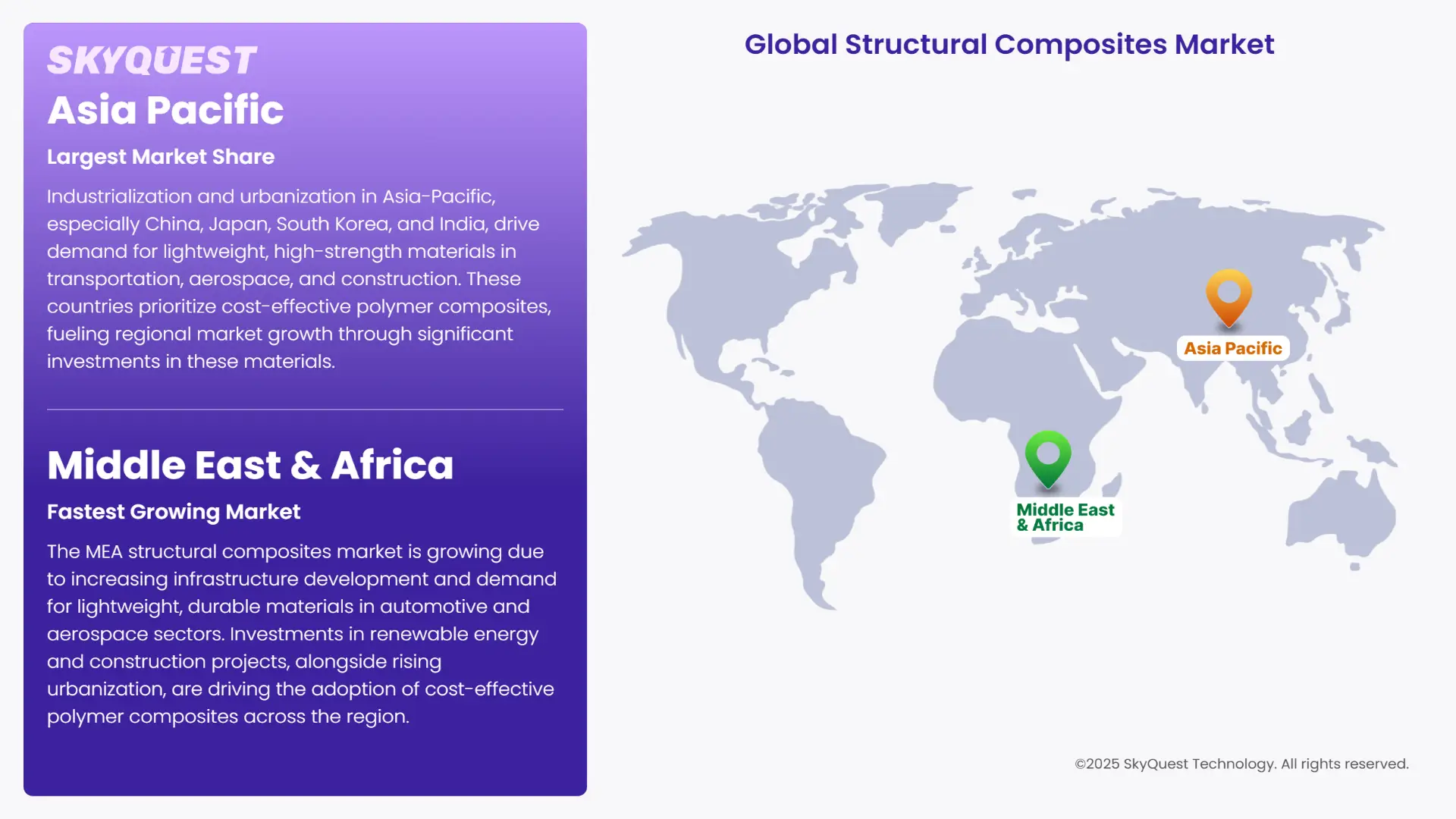
Industrialization, urbanization, as well as the need for lightweight and high-strength materials in transportation, aerospace and construction is driving the growth of the Asia-Pacific region. Countries such as China, Japan, South Korea, and India have made considerable investments in polymer composites, often putting a premium on cost-effective solutions over advanced materials.
Structural Composites Market in Japan
Japan’s economy is driven by high-performance materials mainly in the aerospace, electronics, and automotive industries. Companies are interested in thermally stable, durable composites and advanced processing technologies as a way to drive factory efficiency and performance.
Structural Composites Market in South Korea
South Korea is establishing itself as a regional leader in advanced composites, especially in the automotive, aerospace and consumer electronics sectors. R&D is supported to explore bio-based fibres, high-performance resins, and top-quality composites to minimize imported materials and support sustainable production.
As per regional analysis, with strict regulations on the protected environment, sustainability goals, and a developed chemicals and materials industry, Europe is a key market. Market needs continue to evolve with demand for lightweight, durable, and sustainable composites needed globally in automotive, aerospace, infrastructure, and other industrial applications. Companies are investing in new processing technologies and developing new bio-based fiber systems to address the evolving market needs.
Structural Composites Market in Germany
As per regional forecast, Germany is at the forefront of chemical production in Europe, along with R&D developments and production volume. There are indications of market opportunity for recycled, biodegradable, and high-performance composites in automotive, aerospace, and industrial contexts.
Structural Composites Market in the U.K.
Market growth in the U.K. is often driven using renewable content and composite materials with premium high-performance properties. Other sectors such as automotive, construction, and packaging are also indicating that eco-friendly fibers and resins are increasingly being used to meet sustainability deadlines and regulatory targets.
Structural Composites Market in Italy
As per regional outlook, Italy's structural composites market has increased demand in aerospace, automotive, and packaging. In response, manufacturers are increasingly seeking to leverage natural, recyclable, and functional composites to meet consumer requirements and consumer preferences, along with regulatory requirements while still improving together product durability and performance.
To know more about the market opportunities by region and country, click here to
Buy The Complete Report
Increasing Demand for Low Weight, High Performance Materials
Advancements in Manufacturing Technologies
High Production Expenses
Limited Recycling and End-of-life Solutions
Request Free Customization of this report to help us to meet your business objectives.
The structural composites industry will be dynamic and competitive, with key players taking strategic actions to improve their market share and technologies. Companies are constantly engaging in mergers, acquisitions, and collaborations to broaden their product lines and enter new markets.
As per market strategies, Hexcel and Toray Industries, advanced composite material industry leaders, are entering joint ventures in 2024 to concentrate on developing advanced next-generation composites for aerospace purposes. These joint ventures allow these companies to utilize each other's competences in materials science and manufacturing processes for advanced composites, which promote innovation and shorten the time to bring new products to market.
A surge of startups in the structural composites sector is focused on creating advanced, lightweight and sustainable materials for aerospace, automotive, construction and renewable energy markets. These startups are harnessing the power of new technologies, including AI-supported design, 3D-printing and innovative fiber-reinforced resins, to manufacture high-performance composites that provide both superior performance in terms of strength-to-weight ratios and environmental sustainability. Many are also researching competitive bio-based materials and recyclable composites to take advantage of global sustainability mandates and trends.
Fabheads Automation (India, founded 2015): Fabheads Automation, founded by former ISRO engineers Dhinesh Kanagaraj and Abhijeet Rathore (Angbatt), provides robotic automation technology for carbon fiber manufacturing and has developed Adaptive Toe Placement (ATP) technology which allows for precise handling of brittle composite materials.
Continuous Composites (USA, founded 2015): Continuous Composites is a start-up based in Idaho and they have invented Continuous Fibre 3D Printing (CF3D) technology, that enables composite parts to be produced fast and cheap. In 2021, the company collaborated with French manufacturing.
SkyQuest’s ABIRAW (Advanced Business Intelligence, Research & Analysis Wing) is our Business Information Services team that Collects, Collates, Correlates, and Analyses the Data collected by means of Primary Exploratory Research backed by robust Secondary Desk research.
According to SkyQuest analysis, artificial intelligence (AI) is radically changing the structural composites market by improving design, manufacturing, and monitoring. Generative AI makes it possible to design and develop lightweight, high-strength composite structures and prototype them faster and with less material waste. AI-enabled automation and robotics in manufacturing through automated fiber placement (AFP) and 3D printing make production more efficient and better, allow for more geometries than conventional manufacturing, and enable better control of the manufacturing process. Furthermore, AI-embedded monitoring systems in aerospace and other high-performance applications make it possible to evaluate the real-time performance of structures based on stress, fatigue, etc. This allows for proactive maintenance and enhances safety. Developments in 2024 highlight AI designed high-performance composites in aerospace, automotive and construction industries that propel innovation and performance while driving economic growth and serving markets.
| Report Metric | Details |
|---|---|
| Market size value in 2024 | USD 50.1 Billion |
| Market size value in 2033 | USD 88.3 Billion |
| Growth Rate | 6.5% |
| Base year | 2024 |
| Forecast period | 2026–2033 |
| Forecast Unit (Value) | USD Billion |
| Segments covered |
|
| Regions covered | North America (US, Canada), Europe (Germany, France, United Kingdom, Italy, Spain, Rest of Europe), Asia Pacific (China, India, Japan, Rest of Asia-Pacific), Latin America (Brazil, Rest of Latin America), Middle East & Africa (South Africa, GCC Countries, Rest of MEA) |
| Companies covered |
|
| Customization scope | Free report customization with purchase. Customization includes:-
|
To get a free trial access to our platform which is a one stop solution for all your data requirements for quicker decision making. This platform allows you to compare markets, competitors who are prominent in the market, and mega trends that are influencing the dynamics in the market. Also, get access to detailed SkyQuest exclusive matrix.
Table Of Content
Executive Summary
Market overview
Parent Market Analysis
Market overview
Market size
KEY MARKET INSIGHTS
COVID IMPACT
MARKET DYNAMICS & OUTLOOK
Market Size by Region
KEY COMPANY PROFILES
Methodology
For the Structural Composites Market, our research methodology involved a mixture of primary and secondary data sources. Key steps involved in the research process are listed below:
1. Information Procurement: This stage involved the procurement of Market data or related information via primary and secondary sources. The various secondary sources used included various company websites, annual reports, trade databases, and paid databases such as Hoover's, Bloomberg Business, Factiva, and Avention. Our team did 45 primary interactions Globally which included several stakeholders such as manufacturers, customers, key opinion leaders, etc. Overall, information procurement was one of the most extensive stages in our research process.
2. Information Analysis: This step involved triangulation of data through bottom-up and top-down approaches to estimate and validate the total size and future estimate of the Structural Composites Market.
3. Report Formulation: The final step entailed the placement of data points in appropriate Market spaces in an attempt to deduce viable conclusions.
4. Validation & Publishing: Validation is the most important step in the process. Validation & re-validation via an intricately designed process helped us finalize data points to be used for final calculations. The final Market estimates and forecasts were then aligned and sent to our panel of industry experts for validation of data. Once the validation was done the report was sent to our Quality Assurance team to ensure adherence to style guides, consistency & design.
Analyst Support
Customization Options
With the given market data, our dedicated team of analysts can offer you the following customization options are available for the Structural Composites Market:
Product Analysis: Product matrix, which offers a detailed comparison of the product portfolio of companies.
Regional Analysis: Further analysis of the Structural Composites Market for additional countries.
Competitive Analysis: Detailed analysis and profiling of additional Market players & comparative analysis of competitive products.
Go to Market Strategy: Find the high-growth channels to invest your marketing efforts and increase your customer base.
Innovation Mapping: Identify racial solutions and innovation, connected to deep ecosystems of innovators, start-ups, academics, and strategic partners.
Category Intelligence: Customized intelligence that is relevant to their supply Markets will enable them to make smarter sourcing decisions and improve their category management.
Public Company Transcript Analysis: To improve the investment performance by generating new alpha and making better-informed decisions.
Social Media Listening: To analyze the conversations and trends happening not just around your brand, but around your industry as a whole, and use those insights to make better Marketing decisions.
REQUEST FOR SAMPLE
 REQUEST FREE CUSTOMIZATION
Global Structural Composites Market size was valued at USD 50.1 Billion in 2024 and is poised to grow from USD 53.35 Billion in 2025 to USD 88.3 Billion by 2033, growing at a CAGR of 6.5% in the forecast period (2026–2033).
The structural composites industry will be dynamic and competitive, with key players taking strategic actions to improve their market share and technologies. Companies are constantly engaging in mergers, acquisitions, and collaborations to broaden their product lines and enter new markets. 'Arkema', 'X-Bow Systems Inc.', 'Hexcel Corporation', 'Toray Industries', 'Teijin Limited', 'Mitsubishi Chemical Holdings Corporation', 'Solvay S.A.', 'Owens Corning', '3M Company', 'Huntsman Corporation', 'SABIC', 'SGL Carbon SE', 'BASF SE', 'DuPont de Nemours, Inc.'
The growing need for lightweight, high-performance materials within aerospace, automotive, and construction is contributing to the higher use of structural composites. Lighter components can increase fuel efficiency within vehicles and aircraft, lower energy use, and improve overall performance; hence, composites will continue to be favored over traditional metals. Furthermore, with the increasing need to reduce greenhouse gas emissions and reduce operational costs, this market trend has encouraged more industries to adopt composites within their high-performance applications.
Adoption of Sustainable and Bio-Based Composites: The growing focus to environmentally friendly composites made with renewable fibers and recyclable resins is expanding. As with other products, the global move to push sustainability and net zero carbon footprints are forcing companies to locate eco-friendly composites and still stay within regulation. Investigations into hybrid composites (natural fibers in addition to conventional reinforcement) are also becoming common as a compromise on performance, cost, and environmental impact.
As per industry analysis, North America is the largest structural composites market due to demand driven by aerospace, automotive, construction, and the industrial sector. North America has established chemical manufacturing systems, R&D infrastructure, and materials that are high-performance, lightweight, and sustainable in nature. Companies are investing in innovation of structural composites, some examples include automated fiber placement, hybrid composites, and bio-based resins.


Want to customize this report? This report can be personalized according to your needs. Our analysts and industry experts will work directly with you to understand your requirements and provide you with customized data in a short amount of time. We offer $1000 worth of FREE customization at the time of purchase.
Feedback From Our Clients


 USA (+1) 351-333-4748

