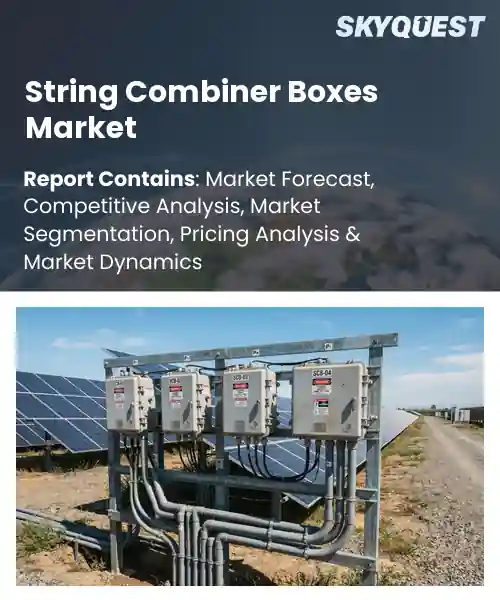
String Combiner Boxes Market
Report ID: SQMIG20D2881
Report ID: SQMIG20D2881
[email protected]
USA +1 351-333-4748
Report ID:
SQMIG20D2881 |
Region:
Global |
Published Date: September, 2026
Pages:
157
|Tables:
143
|Figures:
78


Global String Combiner Boxes Market size was valued at USD 2.96 Billion in 2024 and is poised to grow from USD 3.18 Billion in 2025 to USD 5.63 Billion by 2033, growing at a CAGR of 7.4% during the forecast period (2026-2033).
String combiner boxes (SCBs) are modular electrical assemblies that aggregate multiple photovoltaic (PV) strings into a single conduit for efficient power routing to inverters. Their relevance stems from the expansion of utility‑scale solar farms, where managing hundreds of strings becomes a logistical and safety challenge. Over the past decade, the global PV capacity climbed from roughly 40 GW in 2012 to over 1 TW in 2024, prompting manufacturers to refine SCB designs for higher current ratings and integrated monitoring. Early installations in Arizona and Spain relied on simple junction boxes, but modern projects now embed SCBs that support fault detection and expansion. The growth catalyst for the global SCB market is the increasing integration of smart‑grid functionality within solar farms, which demands data acquisition and remote shutdown capabilities. As operators pursue higher plant availability, they install SCBs equipped with sensors and communication modules that relay string‑level performance to control systems. This capability reduces downtime by pinpointing defective strings within minutes, a benefit exemplified by a 2023 Texas utility that cut fault‑resolution time from hours to under ten minutes after retrofitting its 250 MW project. Consequently, manufacturers are expanding product lines to include IoT‑compatible units, opening revenue streams in new installations and aftermarket upgrades.
How is AI-driven automation influencing the design and efficiency of string combiner boxes in solar installations?
AI driven automation is reshaping the design of string combiner boxes by embedding intelligent monitoring, predictive fault detection and adaptive circuit management directly into the hardware. Manufacturers now integrate edge computing modules that learn from voltage and temperature patterns to optimise string routing and reduce losses. This shift enables installers to configure boxes faster and to rely on remote diagnostics instead of manual checks. The market is seeing a move from static metal enclosures toward modular platforms that can be updated with software patches. As solar farms scale, the demand for smarter, lighter and more reliable combiner solutions is growing rapidly.ABB March 2024, introduced an AI enabled combiner box that continuously balances string currents and alerts operators to potential hot spots. This innovation shortens installation time and improves overall plant efficiency, reinforcing market momentum for intelligent hardware by leveraging machine learning algorithms that adapt to changing irradiance conditions and reduce downtime.
Market snapshot - (2026-2033)
Global Market Size
USD 2.96 Billion
Largest Segment
DC String Combiner Boxes
Fastest Growth
Smart Combiner Boxes
Growth Rate
7.4% CAGR
To get more insights on this market click here to Request a Free Sample Report
Global string combiner boxes market is segmented by product type, number of inputs, application, installation, end user and region. Based on product type, the market is segmented into DC String Combiner Boxes, AC Combiner Boxes and Smart Combiner Boxes. Based on number of inputs, the market is segmented into Up to 8 Strings, 9–16 Strings and Above 16 Strings. Based on application, the market is segmented into Residential Solar, Commercial Solar and Utility-Scale Solar. Based on installation, the market is segmented into Indoor and Outdoor. Based on end user, the market is segmented into EPC Contractors, Solar Developers and Utilities. Based on region, the market is segmented into North America, Europe, Asia Pacific, Latin America and Middle East & Africa.
DC String Combiner Boxes segment dominates because they directly aggregate photovoltaic strings at the DC level, simplifying wiring, reducing losses, and enhancing system reliability. Their inherent compatibility with large‑scale inverter architectures and ease of integration make them the preferred choice for developers seeking cost‑effective, high‑performance solutions. Additionally, their standardized connectors and robust protection features streamline installation and maintenance, further solidifying their position as the go‑to option for large deployments.
However, Smart Combiner Boxes segment emerges as the most rapidly expanding area because they embed communication modules, real‑time monitoring, and automated fault isolation, aligning with the industry’s shift toward digital twins and predictive maintenance. Their ability to deliver actionable data accelerates system optimization and creates new revenue streams for service providers.
Above 16 Strings segment dominates because projects with extensive string counts require high‑capacity aggregation to maintain manageable conduit sizes and reduce balance‑of‑system complexity. This configuration offers superior voltage management, lower resistive losses, and streamlined protective coordination, making it the logical choice for large installations. Its ability to accommodate future expansion without redesign further entrenches its leadership in the market. Moreover, manufacturers have optimized thermal designs and modular layouts, enhancing reliability and easing field integration for contractors.
Meanwhile, Up to 8 Strings segment is witnessing the strongest growth because small‑scale residential and commercial projects favor compact, low‑cost solutions that simplify roof mounting and comply with limited space constraints. This ease of installation stimulates broader adoption, prompting manufacturers to expand product portfolios and driving market expansion.
To get detailed segments analysis, Request a Free Sample Report
Asia Pacific commands the leading share of the global string combiner boxes market due to a confluence of advanced manufacturing capabilities, robust solar project pipelines, and supportive policy frameworks that encourage renewable integration. The region benefits from a deep pool of engineering talent and a supply chain that emphasizes cost efficiency while maintaining high quality standards. Strong collaboration between component manufacturers and EPC firms accelerates product innovation, particularly in modular and compact designs tailored for diverse climatic conditions. Export-oriented production enables manufacturers to serve emerging markets, extending Asia Pacific influence. Continuous investment in research and development sustains a pipeline of next‑generation products that address higher voltage requirements and smarter monitoring capabilities, positioning the region as a hub of technological leadership.
String Combiner Boxes Market in Japan benefits from a mature photovoltaic industry that emphasizes high reliability and compact design to suit limited rooftop space. Local manufacturers leverage engineering and stringent quality certifications, fostering confidence among system integrators. Collaborative research programs with universities drive advances in monitoring and fault isolation, aligning with national goals for grid resilience. Strong domestic demand from both utility‑scale farms and industrial rooftop installations sustains a steady flow of new projects.
String Combiner Boxes Market in South Korea is propelled by a strong focus on smart energy solutions and a well‑established electronics manufacturing base. Producers integrate advanced semiconductor components to create highly efficient combiner units that support high‑density solar arrays. Government initiatives encouraging renewable integration in industrial parks stimulate demand for sophisticated equipment, while close cooperation between OEMs and research institutes accelerates the rollout of condition‑monitoring features. This synergy sustains a competitive edge in both domestic deployments and export opportunities.
The rapid expansion of the string combiner boxes market in Europe is underpinned by ambitious renewable energy targets, stringent grid reliability standards, and a collective shift toward modular photovoltaic solutions. Policy frameworks across the continent encourage the deployment of large‑scale solar farms while also supporting distributed rooftop installations, creating a broad base for advanced combiner technology. Engineers prioritize designs that offer high safety margins, seamless integration with smart inverters, and robust monitoring capabilities to meet the rigorous compliance environment. Collaborative clusters of manufacturers, research institutes, and utilities foster continuous product refinement, especially in compact and high‑current configurations. This ecosystem of regulatory support, technical excellence, and market demand positions Europe as a dynamic arena for sustained growth in string combiner solutions.
String Combiner Boxes Market in Germany reflects its status as a hub of engineering excellence and a mature solar sector. Domestic manufacturers capitalize on precision manufacturing and strong quality assurance protocols to deliver highly reliable units for utility‑scale projects. Close collaboration with grid operators ensures that combiner designs meet rigorous safety and performance criteria, while ongoing research into digital diagnostics enhances operational visibility. The combination of stable policy support and a deep talent pool sustains Germany’s leadership in both innovation and export of advanced combiner technology.
String Combiner Boxes Market in United Kingdom is experiencing accelerated adoption driven by ambitious offshore and onshore solar initiatives. Industry players focus on lightweight, weather‑resistant designs that suit the country’s diverse climatic conditions and support rapid deployment. Integration with smart monitoring platforms aligns with the national emphasis on digital grid management, enabling real‑time fault detection and performance optimization. Collaborative efforts between manufacturers and research bodies accelerate the introduction of next‑generation features, reinforcing the United Kingdom’s reputation as a fast‑moving market for cutting‑edge solar infrastructure.
String Combiner Boxes Market in France is emerging as a focal point for renewable expansion, particularly in regional solar clusters and agricultural installations. Manufacturers emphasize modularity and ease of installation to address the country’s varied terrain and dispersed project sites. Ongoing collaborations with academic institutions drive innovations in thermal management and predictive maintenance, supporting the French agenda for resilient and self‑sufficient energy systems. As policy incentives promote greater solar penetration, the market is set to grow steadily, positioning France as a notable contributor to the European landscape.
North America is strengthening its position in the string combiner boxes market through a blend of technological innovation, expansive solar deployment, and a resilient manufacturing ecosystem. The region benefits from deep expertise in power electronics and a culture of rapid prototyping that accelerates the introduction of high‑efficiency, digitally enabled combiner solutions. Strategic partnerships between component suppliers and large‑scale developers foster designs that integrate seamlessly with advanced inverter and monitoring platforms, addressing the growing need for grid‑friendly solar installations. Robust investment in grid modernization programs encourages the adoption of equipment that supports fault isolation and real‑time data analytics, enhancing overall system reliability. Together, these forces create a fertile environment for continued leadership and export potential in the global combiner box arena.
String Combiner Boxes Market in United States is driven by extensive utility‑scale solar development and a strong emphasis on innovation in power management. Leading manufacturers leverage advanced semiconductor technologies to produce high‑capacity units that align with stringent safety standards and facilitate efficient string-level monitoring. Collaborative initiatives with research labs and technology firms accelerate the rollout of smart features such as remote diagnostics and adaptive load management. The supportive regulatory climate and abundant renewable incentives further stimulate demand, positioning the United States as a pivotal market for both domestic growth and global technology leadership.
String Combiner Boxes Market in Canada reflects a growing focus on renewable integration within a diverse climatic landscape. Producers prioritize robust, temperature‑tolerant designs that can endure harsh winter conditions while maintaining high performance. Integration with emerging smart‑grid solutions enables precise monitoring and rapid fault response, aligning with national objectives for grid resilience. Partnerships between manufacturers and academic research centers drive advancements in corrosion resistance and modular construction, supporting the expansion of both distributed rooftop projects and remote off‑grid applications across the country.
To know more about the market opportunities by region and country, click here to
Buy The Complete Report
Increasing Renewable Energy Installations
Advancements In Digital Monitoring
High Initial Capital Expenditure
Complex Installation Requirements
Request Free Customization of this report to help us to meet your business objectives.
The global string combiner boxes market is shaped by intense competition among established manufacturers and emerging players, with recent M&A activity such as Schneider Electric’s acquisition of a niche solar hardware firm and ABB’s partnership with a leading inverter producer driving consolidation; technology innovation is evident in Siemens’ launch of a modular, AI‑enabled combiner platform and Huawei’s integration of advanced monitoring sensors, both aimed at enhancing system reliability and reducing installation costs.
Top Player’s Company Profile
Recent Developments
SkyQuest’s ABIRAW (Advanced Business Intelligence, Research & Analysis Wing) is our Business Information Services team that Collects, Collates, Correlates, and Analyses the Data collected by means of Primary Exploratory Research backed by robust Secondary Desk research. As per SkyQuest analysis, the global string combiner boxes market is being propelled primarily by the rapid increase in renewable energy installations, which demand efficient power aggregation for utility‑scale solar farms, while a second strong catalyst is the integration of advanced digital monitoring that enables real‑time analytics and predictive maintenance, boosting system reliability. The market’s leading region is Asia Pacific, driven by its extensive manufacturing base and aggressive solar pipeline, and the dominant product segment remains DC string combiner boxes because they simplify wiring and reduce losses in large‑scale projects. However, high initial capital expenditure for smart‑enabled units poses a restraint, tempering adoption in cost‑sensitive markets.
| Report Metric | Details |
|---|---|
| Market size value in 2024 | USD 2.96 Billion |
| Market size value in 2033 | USD 5.63 Billion |
| Growth Rate | 7.4% |
| Base year | 2024 |
| Forecast period | (2026-2033) |
| Forecast Unit (Value) | USD Billion |
| Segments covered |
|
| Regions covered | North America (US, Canada), Europe (Germany, France, United Kingdom, Italy, Spain, Rest of Europe), Asia Pacific (China, India, Japan, Rest of Asia-Pacific), Latin America (Brazil, Rest of Latin America), Middle East & Africa (South Africa, GCC Countries, Rest of MEA) |
| Companies covered |
|
| Customization scope | Free report customization with purchase. Customization includes:-
|
To get a free trial access to our platform which is a one stop solution for all your data requirements for quicker decision making. This platform allows you to compare markets, competitors who are prominent in the market, and mega trends that are influencing the dynamics in the market. Also, get access to detailed SkyQuest exclusive matrix.
Table Of Content
Executive Summary
Market overview
Parent Market Analysis
Market overview
Market size
KEY MARKET INSIGHTS
COVID IMPACT
MARKET DYNAMICS & OUTLOOK
Market Size by Region
KEY COMPANY PROFILES
Methodology
For the String Combiner Boxes Market, our research methodology involved a mixture of primary and secondary data sources. Key steps involved in the research process are listed below:
1. Information Procurement: This stage involved the procurement of Market data or related information via primary and secondary sources. The various secondary sources used included various company websites, annual reports, trade databases, and paid databases such as Hoover's, Bloomberg Business, Factiva, and Avention. Our team did 45 primary interactions Globally which included several stakeholders such as manufacturers, customers, key opinion leaders, etc. Overall, information procurement was one of the most extensive stages in our research process.
2. Information Analysis: This step involved triangulation of data through bottom-up and top-down approaches to estimate and validate the total size and future estimate of the String Combiner Boxes Market.
3. Report Formulation: The final step entailed the placement of data points in appropriate Market spaces in an attempt to deduce viable conclusions.
4. Validation & Publishing: Validation is the most important step in the process. Validation & re-validation via an intricately designed process helped us finalize data points to be used for final calculations. The final Market estimates and forecasts were then aligned and sent to our panel of industry experts for validation of data. Once the validation was done the report was sent to our Quality Assurance team to ensure adherence to style guides, consistency & design.
Analyst Support
Customization Options
With the given market data, our dedicated team of analysts can offer you the following customization options are available for the String Combiner Boxes Market:
Product Analysis: Product matrix, which offers a detailed comparison of the product portfolio of companies.
Regional Analysis: Further analysis of the String Combiner Boxes Market for additional countries.
Competitive Analysis: Detailed analysis and profiling of additional Market players & comparative analysis of competitive products.
Go to Market Strategy: Find the high-growth channels to invest your marketing efforts and increase your customer base.
Innovation Mapping: Identify racial solutions and innovation, connected to deep ecosystems of innovators, start-ups, academics, and strategic partners.
Category Intelligence: Customized intelligence that is relevant to their supply Markets will enable them to make smarter sourcing decisions and improve their category management.
Public Company Transcript Analysis: To improve the investment performance by generating new alpha and making better-informed decisions.
Social Media Listening: To analyze the conversations and trends happening not just around your brand, but around your industry as a whole, and use those insights to make better Marketing decisions.
REQUEST FOR SAMPLE
 REQUEST FREE CUSTOMIZATION


Want to customize this report? This report can be personalized according to your needs. Our analysts and industry experts will work directly with you to understand your requirements and provide you with customized data in a short amount of time. We offer $1000 worth of FREE customization at the time of purchase.
Feedback From Our Clients


 USA (+1) 351-333-4748

