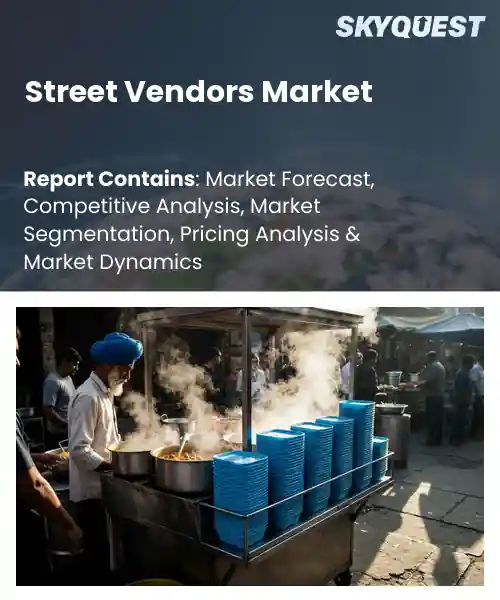
Street Vendors Market
Report ID: SQMIG30C2212
Report ID: SQMIG30C2212
[email protected]
USA +1 351-333-4748
Report ID:
SQMIG30C2212 |
Region:
Global |
Published Date: July, 2026
Pages:
157
|Tables:
179
|Figures:
79


Global Street Vendors Market size was valued at USD 2.82 Billion in 2024 and is poised to grow from USD 2.99 Billion in 2025 to USD 4.77 Billion by 2033, growing at a CAGR of 6.0% during the forecast period (2026-2033).
The key factor that drives the street vendor market is urbanization, as it causes a dense population with constant need for easily accessible cheap food and services. As is seen in the case of Bangkok, Lagos, and Mexico City, these informal vendors have progressed from simple carts to organized groups who cater to commuters, tourists, and poor people alike. This market is important since it provides affordable nutrition, provides jobs for millions of people, and even contributes through taxation when formalized. The last two decades have seen rapid development in the form of mobile money transfer and microfinance, which have made simple carts into scalable businesses.
Availability of digital infrastructure forms the key ingredient that pushes the street vendor industry globally. As soon as mobile internet becomes available in a particular locality, street vendors start using contactless payment systems. In such cases, there are fewer security issues associated with cash transactions, as well as greater customer base, which results in a growth in vendor income by 20 percent. For instance, in cities such as Seoul and Nairobi, special platforms are developed to collect street vendors' information in order to make a searchable database, increasing the tourism rate and investments in developing street kiosks with solar charging capacity.
How is AI-driven Payment Automation Reshaping the Street Vendors Market?
The integration of artificial intelligence for payment automation has revolutionized street vending through automation that integrates mobile point of sale software that can identify cash, credit cards, and digital wallets, providing instant reconciliation of transactions and inventories. The integration of the AI technology has minimized the transaction friction and risks of handling cash, and it also offers real-time insights that allow vendors to make modifications to their menus and prices. With this technology, operators can easily access loyalty programs and promotional offers without having to go through the hassle of manual integration. As urban traffic increases, technology attracts more vendors and helps existing vendors to embrace technology.
Market snapshot - (2026-2033)
Global Market Size
USD 2.82 Billion
Largest Segment
Food & Beverages
Fastest Growth
Handicrafts & Souvenirs
Growth Rate
6.0% CAGR
To get more insights on this market click here to Request a Free Sample Report
Global street vendors market is segmented by product type, vendor type, location type, payment mode, end user, ownership type and region. Based on product type, the market is segmented into Food & Beverages, Apparel & Accessories, Fruits & Vegetables, Household Goods, Handicrafts & Souvenirs and Others. Based on vendor type, the market is segmented into Mobile Street Vendors, Stationary Street Vendors, Pushcart Vendors and Kiosk Vendors. Based on location type, the market is segmented into Urban Areas, Tourist Destinations, Transportation Hubs, Residential Areas and Others. Based on payment mode, the market is segmented into Cash, Digital Payments and Hybrid. Based on end user, the market is segmented into Local Consumers, Tourists, Office Workers, Students and Others. Based on ownership type, the market is segmented into Individual Vendors, Family-Owned Vendors and Organized Street Vendor Associations/Cooperatives. Based on region, the market is segmented into North America, Europe, Asia Pacific, Latin America and Middle East & Africa.
The Food & Beverages segment prevails due to the fulfillment of the basic consumption requirement on a daily basis of a large number of customers, which ensures regular footfalls to vendors' premises. The immediate availability of foods, cultural inclination towards street foods, and low cost of entry for vendors help this product maintain its relevance in street markets. This product adds strength to the vendor's survival and helps in maintaining a relationship between vendors and customers.
On the other hand, the Handicrafts & Souvenirs segment enjoys the highest growth momentum since the demand for unique cultural products is on the rise among both tourists and hobbyists. Additionally, the use of storytelling through digital media is helping the growth of the segment in terms of awareness.
The Mobile Street Vendors segment dominates as they have the capability to traverse quickly through high-density areas to increase their exposure to diverse consumers. Being flexible enough to change location according to real-time demands, having lower overheads, and dealing directly with passers-by make them have an agile presence that ensures impulsive buying; thus, mobility becomes an important competitive advantage in the street's economy.
On the other hand, the Kiosk Vendors segment is becoming one of the fastest growing as micro stores give a solid platform for digital payment and inventory management integration. The increasing assurance among customers due to consistent hours and a better range of products draws for office employees and students to visit more often.
To get detailed segments analysis, Request a Free Sample Report
Asia-Pacific utilizes a combination of strong urban cultures, concentrated population centers, and the long-standing practice of informal trading that provides an ideal backdrop for street vending to thrive. Customers in the region appreciate the immediate accessibility and low cost of the products, while the local governments have a balanced approach that regulates yet encourages street vendors. The use of technology such as mobile payments has increased efficiency on the part of the vendors, making the industry even more resilient. Furthermore, the culinary dynamism and tourism potential of the region fuel the demand, making Asia-Pacific the world’s leader in street vending.
The success of the Street Vendors Market in Japan is driven by the synergy between detailed craftsmanship and innovation in seasonally inspired cuisine, drawing both residents and tourists looking for unique and quick meals. The presence of regulatory mechanisms helps promote growth in an organized manner, and the festivals and train stations offer fertile grounds for vendors to flourish.
The Street Vendors Market in South Korea gets an advantage out of having customers who are young and prefer quick delivery and different tastes. Various measures are being taken by the government to improve hygiene levels and ensure vendor certification for increased stability. In addition, the use of online order systems creates convenience as vendors can expand their customer base easily.
In Europe, the street vendor industry is reenergized by the renewed focus on sustainable and locally produced foods along with experiential shopping, which connects well with eco-aware consumers. Various urban revitalization programs and walkable cities create special zones in which vendors can thrive, and cultural fairs and tourism bring in crowds. In addition, policy climates within many European cities are changing to offer more avenues for licenses and micro-enterprise to encourage entry into the market.
The German Street Vendors Market focuses on high-quality products, local produce, and adherence to strict hygiene codes. There are organized market areas in cities offering a combination of traditional and modern foodstuffs, attracting a wide array of people. Programs run by the city government help vendors get permits and training.
Street Vendors Market in the UK witnesses rapid development due to the popularity of street food culture as well as active pop-up trends in large cities. Lenient licensing requirements and community-based market projects create low thresholds for entry for new ventures. Customers are attracted by uniqueness and originality, hence, leading to innovation on part of street food vendors.
The French market for street vendors is developing into a unique market niche that leverages the gastronomic legacy of the country along with its tourism. Legal changes intend to strike a balance between heritage conservation and business and promote the creation of food stalls. The emphasis on artisan products and season-specific menu appeals to the discerning consumers and is growing gradually.
The development of street vending in North America is achieved using an entrepreneurial spirit coupled with a dynamic regulatory system and technology incorporation to improve efficiency. Inclusive urban public space and friendly licensing policies are emphasized to promote participation by various vendors. Customer preferences have shifted towards unique and quick service, leading vendors to implement innovative menu and sustainability strategies. Collaboration with delivery services and community involvement programs increases their reach as well as visibility.
Street Vendors Market in America thrives within a cultural milieu that favors innovative cuisine and entrepreneurship. Pop-up permits and vending corridors have been set up by cities, allowing vendors to enter the market quickly. Use of digital payments and social media marketing ensures greater customer reach and visibility. The focus on using locally sourced ingredients and different ethnicities is in keeping with the preferences of customers.
Street Vendors Market in Canada operates under favorable municipal policies as well as multicultural urban settings that promote diversity in cooking. The vendors make use of seasonal produce and regional specialties to appeal to customers who are health conscious. Cooperation with local food fairs and community markets increases visibility and online services facilitate easy ordering and payments, helping the market move steadily forward.
To know more about the market opportunities by region and country, click here to
Buy The Complete Report
Growing Urban Population
A fast-growing population of people living in urban areas results in more people walking in the streets and commuting through buses, trains, and other modes of transportation who need food and services that are convenient and affordable. The street vendors cater to these needs by providing flexibility of location, cultural diversity of offerings, and fast transactions; thus, the vendors appeal to people who are busy and in a hurry. Such flexibility and low overhead cost encourage entrepreneurship, leading to growth in their presence.
Leveraging Mobile Payment Technology
The increasing use of smartphones and contactless payment mechanisms allow vendors to process digital payments, making it easier for customers and increasing their confidence while purchasing. In using mobile wallets, vendors can easily minimize their risk of cash transactions and simplify their selling process, creating loyal customers. Such technology also helps them keep track of the current sales trend and make changes in the product offerings and prices, accordingly, thus strengthening the market’s resilience and promoting involvement of tech-savvy businesspersons in it.
Strict Licensing Regulations
Municipalities have stringent licensing conditions that involve a lot of paperwork, health checks, and expensive payments, and this discourages potential vendors on the streets from going formal. Due to the complications involved in the process of gaining a license, potential entrepreneurs who are small may opt out of entering the market and therefore reduce visibility in the sector. This results in the challenge of the expansion of the number of participants and development of the market sustainably.
Limited Access to Formal Finance
Most of the street vendors do not have collaterals nor credit ratings that will allow them access to bank financing services. Financial exclusion has left many vendors to fend for themselves by saving money informally or taking money through microloans at very high interest rates, limiting their capacity to improve their equipment, stock, and expand their operations. Their inability to scale up operations limits their competitiveness and ability to contribute to the economy as a whole.
Request Free Customization of this report to help us to meet your business objectives.
The competition in the global street-vendor marketplace has become more intense as platforms look to grow through consolidation, strategic alliances with fintech companies, and inventory management with the help of artificial intelligence; a trend of mergers and acquisitions in consumer-facing segments has prompted the same in regional vendor aggregator players, with alliances with mobile payment providers facilitating cashless transactions and data-heavy loyalty programs.
Digital Payment Integration: The growing desire for cashless payments by consumers has encouraged street sellers to embrace mobile wallets, QR-code payment systems, and contactless cards. These developments bring about faster transactions, lower handling fees, and expanded consumer bases including the younger population in urban areas. Street sellers get the advantage of getting sales data in real time that allows them to adjust inventories and carry out targeted marketing campaigns. Service providers develop low-cost, offline-first systems aimed at improving financial inclusion and creating additional sources of income through value-added services.
Eco-Friendly Product Diversification: Increased environmental consciousness prompts urban residents to opt for sustainable options, compelling vendors to increase sales of reusable boxes, plant-based snacks, and organic produce harvested locally. Vendors use their unique selling point through their sustainability credentials to distinguish themselves from mainstream vendors. Collaboration with local farms and eco-certification institutions will improve their credibility, while the use of social media will strengthen their story about responsible consumerism, earning them the loyalty of environmentally conscious customers.
SkyQuest’s ABIRAW (Advanced Business Intelligence, Research & Analysis Wing) is our Business Information Services team that Collects, Collates, Correlates, and Analyses the Data collected by means of Primary Exploratory Research backed by robust Secondary Desk research.
As per SkyQuest analysis, the fast-growing number of city dwellers, which results in high footfall and continuous demand for affordable foods and services, serves as the key growth driver for augmenting the street vendor market. Secondly, the usage of mobile payments technology also boosts market growth by allowing contactless payments, sales analytics, and reaching out more customers. The Food & Beverages category is leading one driving the sales growth due to meeting the regular demand for food consumption, and the leading regional player on the market is Asia Pacific owing to its densely populated cities, culture of informal trade, and the early introduction of digital payments. Yet the rigid licensing rules work as a significant barrier to marketentry.
| Report Metric | Details |
|---|---|
| Market size value in 2024 | USD 2.82 Billion |
| Market size value in 2033 | USD 4.77 Billion |
| Growth Rate | 6.0% |
| Base year | 2024 |
| Forecast period | (2026-2033) |
| Forecast Unit (Value) | USD Billion |
| Segments covered |
|
| Regions covered | North America (US, Canada), Europe (Germany, France, United Kingdom, Italy, Spain, Rest of Europe), Asia Pacific (China, India, Japan, Rest of Asia-Pacific), Latin America (Brazil, Rest of Latin America), Middle East & Africa (South Africa, GCC Countries, Rest of MEA) |
| Companies covered |
|
| Customization scope | Free report customization with purchase. Customization includes:-
|
To get a free trial access to our platform which is a one stop solution for all your data requirements for quicker decision making. This platform allows you to compare markets, competitors who are prominent in the market, and mega trends that are influencing the dynamics in the market. Also, get access to detailed SkyQuest exclusive matrix.
Table Of Content
Executive Summary
Market overview
Parent Market Analysis
Market overview
Market size
KEY MARKET INSIGHTS
COVID IMPACT
MARKET DYNAMICS & OUTLOOK
Market Size by Region
KEY COMPANY PROFILES
Methodology
For the Street Vendors Market, our research methodology involved a mixture of primary and secondary data sources. Key steps involved in the research process are listed below:
1. Information Procurement: This stage involved the procurement of Market data or related information via primary and secondary sources. The various secondary sources used included various company websites, annual reports, trade databases, and paid databases such as Hoover's, Bloomberg Business, Factiva, and Avention. Our team did 45 primary interactions Globally which included several stakeholders such as manufacturers, customers, key opinion leaders, etc. Overall, information procurement was one of the most extensive stages in our research process.
2. Information Analysis: This step involved triangulation of data through bottom-up and top-down approaches to estimate and validate the total size and future estimate of the Street Vendors Market.
3. Report Formulation: The final step entailed the placement of data points in appropriate Market spaces in an attempt to deduce viable conclusions.
4. Validation & Publishing: Validation is the most important step in the process. Validation & re-validation via an intricately designed process helped us finalize data points to be used for final calculations. The final Market estimates and forecasts were then aligned and sent to our panel of industry experts for validation of data. Once the validation was done the report was sent to our Quality Assurance team to ensure adherence to style guides, consistency & design.
Analyst Support
Customization Options
With the given market data, our dedicated team of analysts can offer you the following customization options are available for the Street Vendors Market:
Product Analysis: Product matrix, which offers a detailed comparison of the product portfolio of companies.
Regional Analysis: Further analysis of the Street Vendors Market for additional countries.
Competitive Analysis: Detailed analysis and profiling of additional Market players & comparative analysis of competitive products.
Go to Market Strategy: Find the high-growth channels to invest your marketing efforts and increase your customer base.
Innovation Mapping: Identify racial solutions and innovation, connected to deep ecosystems of innovators, start-ups, academics, and strategic partners.
Category Intelligence: Customized intelligence that is relevant to their supply Markets will enable them to make smarter sourcing decisions and improve their category management.
Public Company Transcript Analysis: To improve the investment performance by generating new alpha and making better-informed decisions.
Social Media Listening: To analyze the conversations and trends happening not just around your brand, but around your industry as a whole, and use those insights to make better Marketing decisions.
REQUEST FOR SAMPLE
 REQUEST FREE CUSTOMIZATION
Global Street Vendors Market size was valued at USD 2.82 Billion in 2024 and is poised to grow from USD 2.99 Billion in 2025 to USD 4.77 Billion by 2033, growing at a CAGR of 6.0% during the forecast period (2026-2033).
The competitive landscape of the global street‑vendors market is intensifying as platforms seek scale through consolidation, strategic alliances with fintech providers, and AI‑driven inventory tools; a recent M&A wave in consumer sectors has spurred similar buy‑outs among regional vendor aggregators, while partnerships with mobile‑payment firms enable cashless transactions and data‑rich loyalty programs, accelerating market penetration. 'Zomato Limited', 'Swiggy Limited', 'Paytm', 'PhonePe Pvt. Ltd.', 'Magicpin', 'BharatPe', 'Pine Labs Pvt. Ltd.', 'Mswipe Technologies Pvt. Ltd.', 'Open Network for Digital Commerce (ONDC)', 'Vendoor Technologies', 'Jhanko', 'Hokart', 'MyMandi', 'Meesho', 'Shiprocket', 'Waayu', 'Ola Consumer', 'Acerware Technologies', 'Google India (Google Pay)', 'Amazon India (Amazon Local Shops)'
The rapid increase in urban dwellers creates a larger concentration of pedestrians and commuters who rely on convenient, low‑cost food and service options. Street vendors meet this demand by offering flexible locations, culturally diverse products, and quick transactions, which attract time‑pressed consumers. Their ability to adapt to shifting foot traffic patterns and operate with minimal overhead encourages entrepreneurial entry, thereby expanding the overall market presence and sustaining continuous growth within densely populated cities and fostering a vibrant street culture that enhances local economies.
Digital Payment Integration: Consumers increasingly prefer cash‑less transactions, prompting street vendors to adopt mobile wallets, QR‑code payment platforms, and contactless cards. This shift enhances transaction speed, reduces handling costs, and broadens customer reach, especially among younger urban dwellers. Vendors benefit from real‑time sales data, enabling inventory adjustments and targeted promotions. Service providers respond with low‑fee, offline‑first solutions tailored to informal settings, fostering deeper financial inclusion and creating new revenue streams through value‑added services such as loyalty programs and micro‑insurance offerings for sustainable growth.
Why does Asia Pacific Dominate the Global Street Vendors Market? |@12


Want to customize this report? This report can be personalized according to your needs. Our analysts and industry experts will work directly with you to understand your requirements and provide you with customized data in a short amount of time. We offer $1000 worth of FREE customization at the time of purchase.
Feedback From Our Clients


 USA (+1) 351-333-4748

