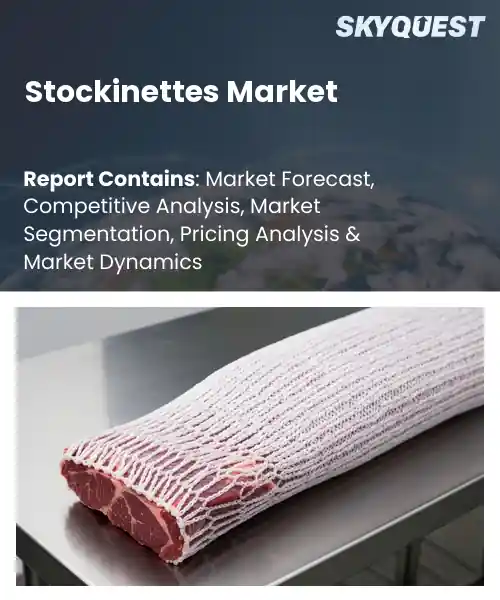
Stockinettes Market
Report ID: SQMIG35B2427
Report ID: SQMIG35B2427
[email protected]
USA +1 351-333-4748
Report ID:
SQMIG35B2427 |
Region:
Global |
Published Date: July, 2026
Pages:
157
|Tables:
150
|Figures:
78


Global Stockinettes Market size was valued at USD 487.3 Million in 2024 and is poised to grow from USD 513.61 Million in 2025 to USD 782.28 Million by 2033, growing at a CAGR of 5.4% during the forecast period (2026-2033).
High incidence of orthopedic disorders, increasing number of surgical procedures, rising geriatric population, advancements in wound care materials, and expanding demand for home healthcare are driving demand for stockinettes.
Growing incidence of musculoskeletal disorders and chronic wounds coupled with the rapid increase in the aging population is expected to primarily drive stockinettes market growth. Rising adoption of stockinettes in orthopedic casting, wound care, compression therapy, and post-surgical recovery is supporting market expansion by improving patient comfort and reducing the risk of skin irritation and infections. Continuous advancements in breathable fabrics, moisture-wicking materials, antimicrobial finishes, and sensor-enabled stockinettes are enhancing treatment outcomes and encouraging wider adoption across hospitals and home healthcare settings. Increasing investments in R&D and strategic collaborations between medical textile manufacturers and healthcare companies are also expected to create new growth opportunities for the stockinettes market.
In contrast, high costs of advanced stockinettes, fluctuations in raw material prices, availability of alternative wound care products, and stringent regulatory requirements are anticipated to slow down stockinettes market penetration across the study period and beyond.
How is AI-driven Automation Influencing Production of Stockinettes?
AI is revolutionizing the stockinettes industry through improvements in efficiency, quality of goods, and management of logistics. Automation enabled by AI will assist in efficient production, and intelligent stitching techniques enable timely adjustments in fabric tensions to ensure quality and shorten production time. Demand analysis through machine learning allows efficient management of inventories and prevention of overstocking. Vision systems utilizing AI technology are capable of identifying defective products and thus ensure better quality and less wastage.
Market snapshot - (2026-2033)
Global Market Size
USD 487.3 Million
Largest Segment
Orthopedic Stockinettes
Fastest Growth
Prosthetic Stockinettes
Growth Rate
5.4% CAGR
To get more insights on this market click here to Request a Free Sample Report
Global stockinettes market is segmented by product type, material, sterility, application, end user, and region. Based on product type, the market is segmented into orthopedic stockinettes, surgical stockinettes, prosthetic stockinettes, and others. Based on material, the market is segmented into cotton, synthetic fiber, blended fabric, and others. Based on sterility, the market is segmented into sterile, non-sterile, and others. Based on application, the market is segmented into casting, wound care, prosthetics, burn care, and others. Based on end user, the market is segmented into hospitals, orthopedic clinics, ambulatory surgical centers, rehabilitation centers, and Others. Based on region, the market is segmented into North America, Europe, Asia Pacific, Latin America, and Middle East & Africa.
The orthopedic stockinettes segment is forecasted to account for the largest global stockinettes market share going forward. They play an important role in traditional casting techniques that continue to form the basis of bone fracture treatment. The high efficacy of stockinettes in practice, along with convenience and versatility of use with different types of casts, ensures ongoing demand. The physicians' preference for using these products because of the increased comfort for patients and less skin irritation contributes to the importance of these products on the market.
However, prosthetic stockinettes are witnessing the strongest growth momentum as per this stockinettes industry analysis, as improvements in technology for limb replacements make way for the use of customized stockinettes for proper fitting and protecting the skin. The improvement in breathable designs and customization in size for user comfort encourages quick adaptation by prosthetic companies.
The synthetic fiber segment is slated to lead the global stockinettes market revenue generation over the coming years. It has better moisture management and durability than conventional fabrics and thus satisfies clinicians’ requirements for sustained usage. The property of retaining tensile strength even when wet ensures that the cast does not slip off. Additionally, because it is lightweight, it allows better mobility of the patients. Thus manufacturers always look to incorporate synthetic fabrics in casts, confirming the demand for high-performance fabrics in the market.
On the other hand, blended fabric is emerging as the key high growth segment as manufacturers combine cotton softness with synthetic resilience to meet comfort and performance demands. This hybrid approach attracts providers seeking cost effective solutions without compromising quality, spurring rapid product line extensions and widening adoption across multiple care environments, thus accelerating market expansion.
To get detailed segments analysis, Request a Free Sample Report
North America has the advantage of an established culture of consumption that places emphasis on freshness and convenience, leading to continual need for high-quality stockinettes. An efficient network of logistical systems and state-of-the-art cold-chain operations facilitate quick distribution from the farm level to retail centers. This is complemented by research and development initiatives that promote innovations in packaging materials and sustainability, keeping pace with increasing regulatory demands. Significant investment in agricultural technology provides for a consistent flow of supply, while industry partnerships facilitate standards in best practices throughout the value chain. Taken together, these form a synergistic approach that underpins the North American dominance in the stockinettes market.
Stockinettes Market in the United States reflects a sophisticated blend of consumer expectations for freshness and retailer emphasis on supply‑chain efficiency. Extensive distribution corridors, innovative packaging designs, and a focus on environmentally responsible materials characterize the market. Collaborative initiatives between growers, processors, and packaging firms drive continual improvements in product integrity, while heightened awareness of waste reduction shapes procurement strategies. The result is a dynamic ecosystem where quality, speed, and sustainability converge to meet high consumer standards.
Stockinettes Market in Canada is shaped by a strong commitment to food safety and a climate that demands resilient packaging solutions. Integrated transport frameworks and strategic hub locations facilitate swift movement of goods across vast territories. Producers prioritize biodegradable and recyclable options in response to regulatory encouragement and consumer preference for greener choices. Partnerships among agricultural cooperatives and packaging innovators enhance adaptability, ensuring that product freshness is preserved from farm gate to retail shelf while supporting national sustainability goals.
The European stockinettes industry experiences an influx from the synergy of tight controls on the quality of food, sophisticated retailing systems, and the cultural preference for fresh products. The harmonization of the standards among the member countries ensures smooth international business operations and stimulates the companies to use the same packaging techniques. The awareness among the consumers about sustainability increases the popularity of reusable and biodegradable materials and spurs the development of sustainable packaging. The joint efforts of the university and industry in the form of R&D programs speed up the introduction of smart packaging solutions that improve the shelf life of the products.
Stockinettes Market in Germany stands as a benchmark for efficiency and sustainability within the region. Advanced manufacturing facilities integrate precision engineering with environmentally conscious design, delivering high‑performance packaging. Strong cooperation between agricultural cooperatives and packaging firms ensures alignment with rigorous quality standards. Consumer preference for minimal waste encourages adoption of recyclable and compostable stockinettes, driving continuous product refinement. The market benefits from proactive governmental support for circular economy initiatives, reinforcing its dominant standing.
Stockinettes Market in the United Kingdom is experiencing swift growth propelled by consumer demand for convenience and freshness. Retail chains prioritize rapid turnover, prompting investments in innovative, lightweight packaging that maintains product integrity. Emerging interest in sustainable solutions accelerates the shift toward reusable and biodegradable stockinettes, supported by collaborative research across industry and academia. The regulatory environment emphasizes transparency and waste reduction, encouraging manufacturers to adopt cutting‑edge materials and design practices that resonate with environmentally conscious shoppers.
Stockinettes Market in France is emerging as a vibrant segment focused on artisanal quality and ecological stewardship. Producers emphasize locally sourced inputs and packaging that reflects French culinary heritage, while also exploring bio‑based materials to meet rising eco‑friendly expectations. Collaborative networks between boutique growers and packaging specialists foster tailored solutions that enhance product appeal. Government incentives for sustainable packaging reinforce this emerging trajectory, positioning France as a growing contributor to the broader European market.
Asia Pacific increases its stockinettes industry presence via a combination of technology usage, urbanization of consumer bases, and environmental sustainability initiatives. The rapid modernization of the supply chain infrastructure leads to faster deliveries, helping retain freshness and minimize any potential spoilage. Smart packing efforts involving tracking of the temperature and humidity level match the growing demand for higher-quality products across many regions. Standardization activities between different countries contribute to international transactions, while government requirements to use eco-friendly packing drive innovation from the manufacturers. The culture of fresh and ready-to-eat produce increases the need for stockinettes among the consumers.
Stockinettes Market in Japan blends meticulous attention to product presentation with cutting‑edge material science. High consumer standards for aesthetic appeal and freshness drive the development of ultra‑thin, barrier‑enhanced packaging. Collaboration between food producers and technology firms yields intelligent stockinettes that respond to environmental conditions, extending shelf life. Sustainability initiatives promote the use of renewable fibers and recyclable polymers, reflecting national priorities for waste reduction. The market’s emphasis on precision and quality reinforces its reputation as a leader in innovative packaging.
Stockinettes Market in South Korea is characterized by rapid adoption of digitally integrated packaging solutions that cater to tech‑savvy consumers. Manufacturers focus on lightweight, high‑performance materials that align with fast‑moving retail environments. Growing environmental awareness fuels investment in biodegradable and recyclable stockinettes, supported by governmental incentives for greener production. Close ties between research institutions and industry accelerate the rollout of smart packaging that monitors freshness, positioning South Korea as a dynamic contributor to the evolving regional market.
To know more about the market opportunities by region and country, click here to
Buy The Complete Report
Rising Prevalence of Orthopedic Disorders and Surgical Procedures
The increasing incidence of fractures, musculoskeletal disorders, sports injuries, and orthopedic surgeries is a major driver for the stockinettes market. Stockinettes are widely used beneath casts, splints, and compression bandages to improve patient comfort and protect the skin. The growing aging population, which is more susceptible to bone-related conditions, further boosts demand. Rising healthcare spending and greater access to orthopedic treatments in developing countries are also contributing to the increasing adoption of stockinettes across hospitals, clinics, and rehabilitation centers.
Growing Demand for Advanced Wound Care and Home Healthcare
High Costs of Advanced Medical Textile Products
Availability of Alternative Wound Care and Casting Materials
Request Free Customization of this report to help us to meet your business objectives.
Collaborations with hospitals, distributors, and healthcare providers, along with investments in automated manufacturing and advanced textile technologies, are helping manufacturers strengthen their market presence. Expansion into emerging healthcare markets, portfolio diversification, regulatory compliance, and acquisitions remain key competitive strategies as companies seek to address the growing demand for orthopedic, wound care, and compression therapy applications worldwide.
SkyQuest’s ABIRAW (Advanced Business Intelligence, Research & Analysis Wing) is our Business Information Services team that Collects, Collates, Correlates, and Analyses the Data collected by means of Primary Exploratory Research backed by robust Secondary Desk research.
As per SkyQuest analysis, high prevalence of orthopedic disorders, increasing number of surgical procedures, and rising geriatric population are anticipated to drive the demand for stockinettes going forward. However, high costs of advanced stockinettes, fluctuations in raw material prices, and availability of alternative wound care products are slated to slow down the adoption of stockinettes in the future. North America is slated to spearhead the demand for stockinettes owing to high volume of orthopedic procedures, advanced healthcare infrastructure, and increasing adoption of advanced wound care products. Development of sensor-enabled stockinettes, integration of antimicrobial and moisture-wicking materials, and advancements in smart medical textiles are anticipated to be key trends driving the stockinettes market in the long run.
| Report Metric | Details |
|---|---|
| Market size value in 2024 | USD 487.3 Million |
| Market size value in 2033 | USD 782.28 Million |
| Growth Rate | 5.4% |
| Base year | 2024 |
| Forecast period | (2026-2033) |
| Forecast Unit (Value) | USD Million |
| Segments covered |
|
| Regions covered | North America (US, Canada), Europe (Germany, France, United Kingdom, Italy, Spain, Rest of Europe), Asia Pacific (China, India, Japan, Rest of Asia-Pacific), Latin America (Brazil, Rest of Latin America), Middle East & Africa (South Africa, GCC Countries, Rest of MEA) |
| Companies covered |
|
| Customization scope | Free report customization with purchase. Customization includes:-
|
To get a free trial access to our platform which is a one stop solution for all your data requirements for quicker decision making. This platform allows you to compare markets, competitors who are prominent in the market, and mega trends that are influencing the dynamics in the market. Also, get access to detailed SkyQuest exclusive matrix.
Table Of Content
Executive Summary
Market overview
Parent Market Analysis
Market overview
Market size
KEY MARKET INSIGHTS
COVID IMPACT
MARKET DYNAMICS & OUTLOOK
Market Size by Region
KEY COMPANY PROFILES
Methodology
For the Stockinettes Market, our research methodology involved a mixture of primary and secondary data sources. Key steps involved in the research process are listed below:
1. Information Procurement: This stage involved the procurement of Market data or related information via primary and secondary sources. The various secondary sources used included various company websites, annual reports, trade databases, and paid databases such as Hoover's, Bloomberg Business, Factiva, and Avention. Our team did 45 primary interactions Globally which included several stakeholders such as manufacturers, customers, key opinion leaders, etc. Overall, information procurement was one of the most extensive stages in our research process.
2. Information Analysis: This step involved triangulation of data through bottom-up and top-down approaches to estimate and validate the total size and future estimate of the Stockinettes Market.
3. Report Formulation: The final step entailed the placement of data points in appropriate Market spaces in an attempt to deduce viable conclusions.
4. Validation & Publishing: Validation is the most important step in the process. Validation & re-validation via an intricately designed process helped us finalize data points to be used for final calculations. The final Market estimates and forecasts were then aligned and sent to our panel of industry experts for validation of data. Once the validation was done the report was sent to our Quality Assurance team to ensure adherence to style guides, consistency & design.
Analyst Support
Customization Options
With the given market data, our dedicated team of analysts can offer you the following customization options are available for the Stockinettes Market:
Product Analysis: Product matrix, which offers a detailed comparison of the product portfolio of companies.
Regional Analysis: Further analysis of the Stockinettes Market for additional countries.
Competitive Analysis: Detailed analysis and profiling of additional Market players & comparative analysis of competitive products.
Go to Market Strategy: Find the high-growth channels to invest your marketing efforts and increase your customer base.
Innovation Mapping: Identify racial solutions and innovation, connected to deep ecosystems of innovators, start-ups, academics, and strategic partners.
Category Intelligence: Customized intelligence that is relevant to their supply Markets will enable them to make smarter sourcing decisions and improve their category management.
Public Company Transcript Analysis: To improve the investment performance by generating new alpha and making better-informed decisions.
Social Media Listening: To analyze the conversations and trends happening not just around your brand, but around your industry as a whole, and use those insights to make better Marketing decisions.
REQUEST FOR SAMPLE
 REQUEST FREE CUSTOMIZATION
Global Stockinettes Market size was valued at USD 487.3 Million in 2024 and is poised to grow from USD 513.61 Million in 2025 to USD 782.28 Million by 2033, growing at a CAGR of 5.4% during the forecast period (2026-2033).
The competitive landscape of the Global Stockinettes market is shaped by aggressive M&A activity, strategic partnerships with data‑analytics firms, and rapid tech innovation such as AI‑driven trading algorithms; recent acquisitions of niche analytics platforms and joint ventures with cloud providers illustrate how incumbents are defending market share while nimble entrants leverage real‑time data integration to capture niche trader segments. 'BSN Medical GmbH', 'Lohmann & Rauscher GmbH & Co. KG', '3M Company', 'Cardinal Health, Inc.', 'Medline Industries, LP', 'Hartmann Group', 'Mölnlycke Health Care AB', 'Smith & Nephew plc', 'Paul Hartmann AG', 'Dynarex Corporation', 'Winner Medical Co., Ltd.', 'Texpol Sp. z o.o.', 'Kuteks A.S.', 'Albion Surgical Ltd.', 'Crepeband Ltd.', 'MedGyn Products, Inc.', 'Medisca Inc.', 'Medichem International', 'GPC Medical Ltd.', 'AdvaCare Pharma'
Real-time payment capabilities enable instantaneous settlement, fostering consumer confidence and encouraging merchants to incorporate Stockinettes into their checkout processes. This seamless experience reduces friction, prompting higher transaction volumes and prompting businesses to prioritize platforms that support such speed. As merchants seek to meet evolving consumer expectations for immediacy, they increasingly view Stockinettes as essential infrastructure, thereby stimulating market expansion through broader adoption and deeper integration across retail channels. The resulting network effect further amplifies brand visibility and encourages ancillary service development, reinforcing growth trajectories.
Digital Integration Driving Adoption: Manufacturers are increasingly embedding digital connectivity into stockinettes, enabling real‑time inventory monitoring, predictive maintenance, and seamless integration with enterprise resource planning systems. This shift enhances operational visibility, reduces downtime, and supports data‑driven decision making across supply chains. As customers demand faster order fulfillment and greater transparency, producers are prioritizing IoT‑enabled features that align with broader Industry 4.0 initiatives, positioning digitally enabled stockinettes as a strategic asset for competitive differentiation while also fostering long‑term customer loyalty and operational resilience across global markets.
Why does North America Dominate the Global Stockinettes Market? |@12


Want to customize this report? This report can be personalized according to your needs. Our analysts and industry experts will work directly with you to understand your requirements and provide you with customized data in a short amount of time. We offer $1000 worth of FREE customization at the time of purchase.
Feedback From Our Clients


 USA (+1) 351-333-4748

