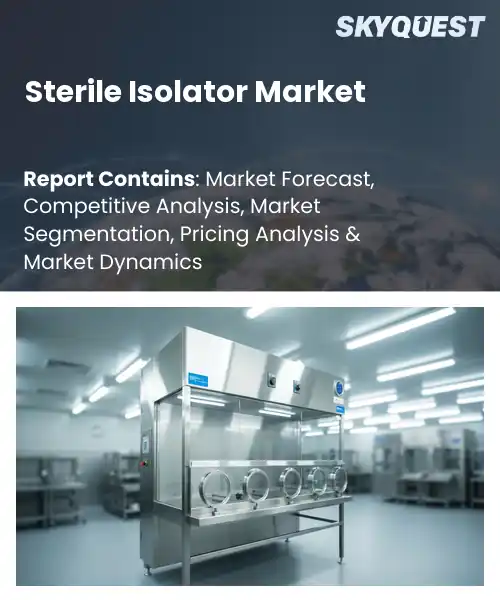
Sterile Isolator Market
Report ID: SQMIG35A4029
Report ID: SQMIG35A4029
[email protected]
USA +1 351-333-4748
Report ID:
SQMIG35A4029 |
Region:
Global |
Published Date: June, 2026
Pages:
157
|Tables:
173
|Figures:
79


Global Sterile Isolator Market size was valued at USD 1187.3 Million in 2024 and is poised to grow from USD 1275.16 Million in 2025 to USD 2257.36 Million by 2033, growing at a CAGR of 7.4% during the forecast period (2026-2033).
The sterile isolator market is a wide market which comprises equipment that provides a closed, aseptic environment for handling biopharmaceutical products, medical devices and compounds. Its importance lies in the need to eliminate contamination risks that may compromise patient safety and regulatory compliance. Increasing demand for biologics and cell-based therapies, which require strong sterility assurance during the manufacturing process, is a key driver of market growth. Over the past ten years advances have been made in barrier technology and automation, turning isolators from basic glove boxes into monitored, integrated systems. For example, vaccine makers added modular isolator lines during the COVID-19 surge, a classic example of how market growth is driven by increasing product complexity.
The regulatory tightening in aseptic processing is one of the key factors driving the sterile isolator market. The manufacturers are driven to create a system that provides traceable sterility. Regulatory bodies such as the FDA require monitoring and data integrity. Companies invest in isolators equipped with particle counters and decontamination cycles. This reduces batch failures and disposal costs. The chain offers providers the possibility to provide solutions for retrofitting and maintenance platforms. Take, for example, a biologics plant that embedded sensors in its isolator line, cutting downtime by 15% and accelerating gene-therapy batch release, showing how pressure to comply drives tech upgrades and market expansion.
How is AI-driven automation improving efficiency in the sterile isolator market?
AI-based automation is transforming the way we design and run sterile isolator processes by linking live sensor data to predictive algorithms that then automatically control airflow, pressure and temperature without any human intervention. Machine vision inspects glove ports and barrier integrity for defects before they can impact product quality. The integrated scheduling software links cleaning cycles to production runs, reducing idle time and saving resources. These capabilities support compliance reporting, reduce labor costs, increase throughput and help drive more agile sterile manufacturing in a fast growing market, to meet the increasing demand for aseptic drug manufacturing.
In April 2024, Thermo Fisher Scientific introduced an AI-enabled isolator platform that automatically adjusts containment parameters to speed up changeover and enable higher batch volumes, all while maintaining sterility. The innovation is a simple win for efficiency and market expansion.
Market snapshot - (2026-2033)
Global Market Size
USD 1187.3 Million
Largest Segment
Fastest Growth
Growth Rate
7.4% CAGR
To get more insights on this market click here to Request a Free Sample Report
Global sterile isolator market is segmented by product type, application, end user, pressure type, configuration, sales channel and region. Based on product type, the market is segmented into Open Isolators, Closed Isolators and Restricted Access Barrier Isolators and Others. Based on application, the market is segmented into Aseptic Processing, Sterility Testing and Containment Applications and Others. Based on end user, the market is segmented into Pharmaceutical Companies, Biotechnology Companies and Research Laboratories and Others. Based on pressure type, the market is segmented into Positive Pressure Isolators and Negative Pressure Isolators. Based on configuration, the market is segmented into Floor Standing Systems and Modular Systems and Others. Based on sales channel, the market is segmented into Direct Sales and Distributors and Others. Based on region, the market is segmented into North America, Europe, Asia Pacific, Latin America and Middle East & Africa.
The closed isolators segment is leading the market due to the preference by manufacturers for a fully sealed environment that prevents any pathways for external contamination and ensures a higher level of sterility assurance for critical bioproducts. The design is inherently rugged, reducing the skill required of the operator, simplifying validation protocols and meeting the rigorous regulatory expectations of aseptic processing. Such reliability encourages widespread use in high value applications, and this in turn gives confidence to suppliers and encourages investment in advanced sealing technologies and material innovations across the global industry.
However, the open isolators segment is showing the strongest growth momentum with flexible access points enabling quick product changeovers and lower upfront costs, attractive to smaller biopharma companies looking for agile manufacturing. Emerging modular facilities and cost sensitive projects boost the demand and this configuration serves as a catalyst for the broader market expansion globally.
The positive pressure segment is dominant because maintaining a higher internal pressure, than the surrounding environment, would generate an outward air flow that would continually sweep away contaminants from the critical work zone. This physical barrier helps achieve cleanroom standards, minimises costly filtration upgrades and gives regulators confidence in the aseptic barrier. Therefore, this pressure mode is the choice of manufacturers for high value biologics, leading to widespread adoption at multiple processing stages for operations.
Meanwhile the segment of negative pressure is emerging as the high growth area as it contains hazardous aerosols and pathogens and is vital for vaccine production and infectious disease research. This setup is being propelled by tightening regulations on biosafety and growing demand for handling of compounds. It is poised to unlock market niches and drive expansion.
To get detailed segments analysis, Request a Free Sample Report
North America has advantages of sophisticated pharmaceutical manufacturing infrastructure, stringent regulatory frameworks that focus on aseptic processing, and heavy investment in research and development. The region boasts a cluster of top manufacturers who are eager to adopt technology and incorporate automated isolator solutions. Rapid deployment and maintenance of sterile isolator systems are facilitated by developed supply chains and an extensive network of component suppliers. Plus, massive biopharma and high value drug manufacturing experience provides a healthy demand for controlled environments. The collaborative industry and academic institution partnerships further augment the innovation, setting North America as the benchmark market for sterile isolator technology.
The U.S. sterile isolator market is driven by a robust biotech industry that demands stringent contamination control. Major contract manufacturers and leading pharmaceutical companies are quickly adopting advanced isolator designs. Government incentives for advanced manufacturing are strong and the regulatory guidance framework is well developed encouraging consistent investment. Dedicated service providers offer high reliability and fast support to the end-user throughout the entire product lifecycle and provide compliance assurance.
The sterile isolator market is boosted by collaborative research environment and government programs encouraging advanced manufacturing adoption in Canada. The pharmaceutical and biotech landscape is emphasizing the use of high quality aseptic processes, with leading companies incorporating isolator technology to critical production lines. The closeness to North American supply chains and skilled workforce ensures implementation is smooth. We have enduring collaborations with academic institutions that promote ongoing enhancements and custom solutions for specialized therapeutic areas to ensure future market resilience and compliance assurance.
Growth is being fueled by stringent European regulatory requirements for patient safety and product sterility, prompting manufacturers to invest in high-performance isolator systems. Sustainability and energy-efficient technologies are major priorities for the region, resulting in the deployment of isolators with advanced filtration and reduced footprint. Germany, the United Kingdom and France have co-developed industrial clusters to enable rapid technology transfer and customization for different therapeutic pipelines. Innovation in aseptic processing is being driven by strong public-private partnerships and access to the most advanced designs from world-class equipment suppliers. This, among other factors, is creating a healthy environment where the need for sterile isolator solutions is increasing in both mature and emerging pharmaceutical hubs.
The contamination free production is one of the key aspects for the Sterility Isolator Market for the highly regulated German pharmaceutical industry. Big multinationals and a tight network of specialized suppliers are helping disseminate isolator technologies. Robust engineering experience in integration systems for custom biologics. In addition, government incentives to promote advanced manufacturing and a focus on environmental compliance are driving the adoption of precision aseptic solutions. Germany is leading Europe.
The biotech ecosystem is focusing on new drug development, which is driving the fast growth of the sterile isolator market in the United Kingdom. Research groups collaborate with manufacturers to test new isolator designs that meet strict GMP rules. Supportive regulatory framework is the catalyst for adoption of containment solutions and skilled workforce facilitates technology transfer. The UK is also a prime location for aseptic manufacturing and further investment in integration and remote monitoring also accelerates adoption.
In France, the Sterile Isolator Market is changing, with manufacturers looking to have more control over aseptic processes to satisfy regulatory expectations. Driven by the growing appearance of innovative biopharma start-ups, there is a requirement for modular isolator solutions which can be deployed. Academic research centers and equipment suppliers are teaming up to speed up the adoption of technology for niche therapeutic areas. Government backing for advanced manufacturing infrastructure further encourages adoption, helping France to carve a niche in the sterile isolator landscape.
In France, the Sterile Isolator Market is changing, with manufacturers looking to have more control over aseptic processes to satisfy regulatory expectations. Driven by the growing appearance of innovative biopharma start-ups, there is a requirement for modular isolator solutions which can be deployed. Academic research centers and equipment suppliers are teaming up to speed up the adoption of technology for niche therapeutic areas. Government backing for advanced manufacturing infrastructure further encourages adoption, helping France to carve a niche in the sterile isolator landscape.
The Japanese sterile isolator market is characterized by a culture of precision engineering and a robust pharmaceutical industry with an intense focus on aseptic manufacturing. The high-end isolator technology for complex biologics and cell therapies is being introduced by big manufacturers. Research universities and industry associations are working on better containment solutions. Japan is bolstering its leadership in sterile processing with isolator designs, government incentives and a drive for sustainability.
South Korea Sterile Isolator Market Propelled by Biotech Investment and National Agenda Manufacturing Centric These advanced isolator systems help local pharmaceutical companies to meet the stringent quality standards for injectables and biologics. The partnerships between government research institutes and equipment manufacturers accelerate the development of containment solutions that are designed to meet the requirements of local production. Automation and digital oversight are making South Korea a hub for sterile processing technology and more operational control.
To know more about the market opportunities by region and country, click here to
Buy The Complete Report
Increasing Demand For Sterile Production
Adoption Of Single-Use is growing
High Capital Investment Required
Stringent Validation and Certification
Request Free Customization of this report to help us to meet your business objectives.
Established isolator companies and fast-growing niche players are competing fiercely, using M&A to expand their technology portfolios, developing strategic distribution partnerships to enter new geographic regions and ramping up product innovation including advanced HEPA filtration and digital monitoring. Recent examples include the high-profile acquisition of a niche sterile workstation provider, as well as a joint development agreement focused on next-generation positive pressure isolator designs.
SkyQuest’s ABIRAW (Advanced Business Intelligence, Research & Analysis Wing) is our Business Information Services team that Collects, Collates, Correlates, and Analyses the Data collected by means of Primary Exploratory Research backed by robust Secondary Desk research.
As per SkyQuest analysis the global sterile isolator market is projected to reach $2.26 billion by 2033 driven primarily by the rising demand for sterile production in biologics and cell‑based therapies which pushes manufacturers toward robust containment solutions. A second important catalyst is the growing adoption of single‑use isolators that cut cleaning time and lower operational costs. The market is led by North America where advanced pharma infrastructure and strict regulatory guidance support rapid uptake and closed isolators dominate because they provide the highest sterility assurance. However, high capital outlay and the need for extensive validation and certification act as notable restraints, tempering faster diffusion of new systems.
| Report Metric | Details |
|---|---|
| Market size value in 2024 | USD 1187.3 Million |
| Market size value in 2033 | USD 2257.36 Million |
| Growth Rate | 7.4% |
| Base year | 2024 |
| Forecast period | (2026-2033) |
| Forecast Unit (Value) | USD Million |
| Segments covered |
|
| Regions covered | North America (US, Canada), Europe (Germany, France, United Kingdom, Italy, Spain, Rest of Europe), Asia Pacific (China, India, Japan, Rest of Asia-Pacific), Latin America (Brazil, Rest of Latin America), Middle East & Africa (South Africa, GCC Countries, Rest of MEA) |
| Companies covered |
|
| Customization scope | Free report customization with purchase. Customization includes:-
|
To get a free trial access to our platform which is a one stop solution for all your data requirements for quicker decision making. This platform allows you to compare markets, competitors who are prominent in the market, and mega trends that are influencing the dynamics in the market. Also, get access to detailed SkyQuest exclusive matrix.
Table Of Content
Executive Summary
Market overview
Parent Market Analysis
Market overview
Market size
KEY MARKET INSIGHTS
COVID IMPACT
MARKET DYNAMICS & OUTLOOK
Market Size by Region
KEY COMPANY PROFILES
Methodology
For the Sterile Isolator Market, our research methodology involved a mixture of primary and secondary data sources. Key steps involved in the research process are listed below:
1. Information Procurement: This stage involved the procurement of Market data or related information via primary and secondary sources. The various secondary sources used included various company websites, annual reports, trade databases, and paid databases such as Hoover's, Bloomberg Business, Factiva, and Avention. Our team did 45 primary interactions Globally which included several stakeholders such as manufacturers, customers, key opinion leaders, etc. Overall, information procurement was one of the most extensive stages in our research process.
2. Information Analysis: This step involved triangulation of data through bottom-up and top-down approaches to estimate and validate the total size and future estimate of the Sterile Isolator Market.
3. Report Formulation: The final step entailed the placement of data points in appropriate Market spaces in an attempt to deduce viable conclusions.
4. Validation & Publishing: Validation is the most important step in the process. Validation & re-validation via an intricately designed process helped us finalize data points to be used for final calculations. The final Market estimates and forecasts were then aligned and sent to our panel of industry experts for validation of data. Once the validation was done the report was sent to our Quality Assurance team to ensure adherence to style guides, consistency & design.
Analyst Support
Customization Options
With the given market data, our dedicated team of analysts can offer you the following customization options are available for the Sterile Isolator Market:
Product Analysis: Product matrix, which offers a detailed comparison of the product portfolio of companies.
Regional Analysis: Further analysis of the Sterile Isolator Market for additional countries.
Competitive Analysis: Detailed analysis and profiling of additional Market players & comparative analysis of competitive products.
Go to Market Strategy: Find the high-growth channels to invest your marketing efforts and increase your customer base.
Innovation Mapping: Identify racial solutions and innovation, connected to deep ecosystems of innovators, start-ups, academics, and strategic partners.
Category Intelligence: Customized intelligence that is relevant to their supply Markets will enable them to make smarter sourcing decisions and improve their category management.
Public Company Transcript Analysis: To improve the investment performance by generating new alpha and making better-informed decisions.
Social Media Listening: To analyze the conversations and trends happening not just around your brand, but around your industry as a whole, and use those insights to make better Marketing decisions.
REQUEST FOR SAMPLE
 REQUEST FREE CUSTOMIZATION
Global Sterile Isolator Market size was valued at USD 1187.3 Million in 2024 and is poised to grow from USD 1275.16 Million in 2025 to USD 2257.36 Million by 2033, growing at a CAGR of 7.4% during the forecast period (2026-2033).
The competitive landscape is shaped by intense rivalry among established isolator manufacturers and fast‑growing niche players, each leveraging M&A to consolidate technology portfolios, forming strategic distribution partnerships to broaden geographic reach, and accelerating product innovation through advanced HEPA filtration and digital monitoring. Recent examples include a high‑profile acquisition of a niche sterile workstation provider and a joint development agreement targeting next‑generation positive‑pressure isolator designs. 'SKAN AG', 'Getinge AB', 'Syntegon Technology GmbH', 'Azbil Telstar, S.L.', 'Comecer S.p.A.', 'Extract Technology Ltd.', 'Fedegari Group', 'Hosokawa Micron Group', 'Bioquell UK Ltd.', 'Jacomex SAS', 'Tema Sinergie S.p.A.', 'NuAire, Inc.', 'Germfree Laboratories, Inc.', 'Steriline S.r.l.', 'Ortner Reinraumtechnik GmbH', 'Weiss Technik GmbH', 'ISOTECH Design Ltd.', 'Tofflon Science and Technology Group Co., Ltd.', 'Marchesini Group S.p.A.', 'I.M.A. Industria Macchine Automatiche S.p.A.'
Growing awareness of contamination risks across pharmaceutical and biotech facilities is prompting manufacturers to adopt sterile isolators, which provide controlled environments that prevent product exposure to external microbes. This shift enhances confidence in product safety, supports compliance with stringent quality standards, and encourages broader adoption of advanced aseptic processing techniques, thereby expanding the addressable market for isolator solutions. Customers are also prioritizing investments that reduce downtime and improve operational efficiency, further reinforcing the market’s upward trajectory. These factors collectively drive sustained demand.
Integrated Digital Monitoring: Manufacturers are increasingly adopting fully integrated digital monitoring systems that combine real‑time environmental sensors, automated alarm analytics, and cloud‑based data dashboards. This shift enables continuous verification of sterility parameters, rapid identification of deviations, and proactive maintenance planning without interrupting production. By eliminating manual log entries and reducing human error, facilities achieve higher compliance confidence and operational efficiency, while also supporting remote oversight for multi‑site organizations and facilitating faster response to regulatory inquiries through improved traceability and accountability across global stakeholders.
Why does North America Dominate the Global Sterile Isolator Market? |@12


Want to customize this report? This report can be personalized according to your needs. Our analysts and industry experts will work directly with you to understand your requirements and provide you with customized data in a short amount of time. We offer $1000 worth of FREE customization at the time of purchase.
Feedback From Our Clients


 USA (+1) 351-333-4748

