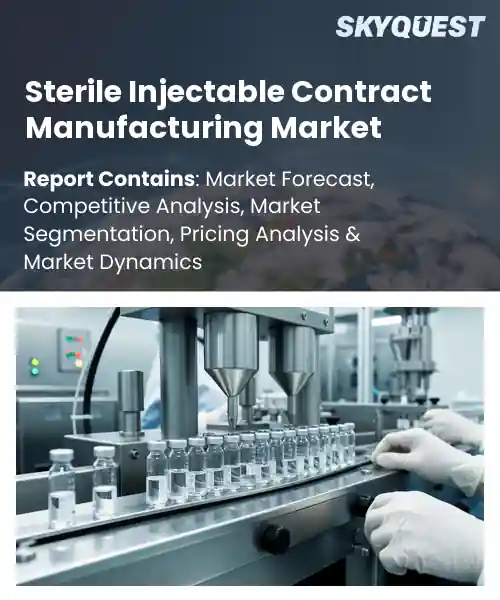
Sterile Injectable Contract Manufacturing Market
Report ID: SQMIG35J2384
Report ID: SQMIG35J2384
[email protected]
USA +1 351-333-4748
Report ID:
SQMIG35J2384 |
Region:
Global |
Published Date: June, 2026
Pages:
157
|Tables:
118
|Figures:
77


Global Sterile Injectable Contract Manufacturing Market size was valued at USD 14.52 Billion in 2024 and is poised to grow from USD 15.67 Billion in 2025 to USD 28.85 Billion by 2033, growing at a CAGR of 7.92% during the forecast period (2026-2033).
The primary driver of the sterile injectable contract manufacturing market is the accelerating shift toward biologic therapies and complex parenteral products that demand specialized aseptic processing and strict regulatory adherence. There are also many third party sterile fill-finish, lyophilization, vial and prefilled syringe manufacturers in the biotech and pharmaceutical industry. The healthcare market will continue to grow as a result of high costs for capital investment and stringent Good Manufacturing Practice (GMP) regulations that make it costly to do in-house manufacturing. Over recent decades the sector moved from simple small-molecule vial filling to diversified facilities supporting monoclonal antibodies, vaccines and cell therapy campaigns, and the COVID-19 response exposed capacity shortfalls that spurred CMO expansion.
A key trend driving the global sterile injectable contract manufacturing sector is capacity constraint combined with technology adoption, because surges in complex biologic demand create bottlenecks that force sponsors to outsource and accelerate CMO capital projects. When limited vial and prefilled syringe capacity leads to supply risk, companies prioritize strategic partnerships and invest in single-use technologies, automated aseptic isolators and lyophilization lines to reduce contamination risk and changeover time. As a result, CMOs can offer faster time-to-market for oncology and vaccine candidates, enabling smaller biotech firms to commercialize without owning plants, and opening opportunities in regional fill-finish hubs and specialty cold-chain services.
How is AI Improving Process Efficiency in the Sterile Injectable Contract Manufacturing Market?
Artificial Intelligence (AI) is enhancing the effectiveness of sterile injectable contract manufacturing (cGMP) processes by making processes quicker, providing more accurate monitoring, detecting more defects earlier and providing better batch control. This has been accomplished using automated visual inspections versus manual inspections which may take much longer, predictive maintenance to reduce the occurrence of unscheduled maintenance, and data harmonization to expedite batch release and investigations. Creating additional capacity to increase supply will require a CDMO to be able to take advantage of AI technology to ensure their product(s) meet current regulations.
In May 2026, Simtra BioPharma announced a co innovation with SCW.AI to implement a digital factory across its sterile injectable sites. This deployment applies AI driven monitoring and compliance modules to speed investigations, reduce manual data tasks and harmonize operations, which supports more efficient production and smoother commercial scale up.
Market snapshot - (2026-2033)
Global Market Size
USD 14.52 Billion
Largest Segment
Small Volume Parenterals (SVP)
Fastest Growth
Prefilled Syringes
Growth Rate
7.92% CAGR
To get more insights on this market click here to Request a Free Sample Report
Global sterile injectable contract manufacturing market is segmented by product type, molecule type, packaging, end-user and region. Based on product type, the market is segmented into small volume parenterals (SVP), large volume parenterals (LVP), lyophilized products and prefilled syringes. Based on molecule type, the market is segmented into small molecules and biologics. Based on packaging, the market is segmented into vials, ampoules, prefilled syringes and bags. Based on end-user, the market is segmented into large pharma, biotech companies and generics. Based on region, the market is segmented into North America, Europe, Asia Pacific, Latin America and Middle East & Africa.
Based on the global sterile injectable contract manufacturing market growth, vials segment dominates because vials offer universal compatibility with a wide range of liquid and lyophilized formulations and an established regulatory and manufacturing ecosystem that reduces development friction. Their standardized formats simplify aseptic fill finish operations, inventory management, and cold chain logistics, encouraging CMOs to invest in high throughput lines. This yields cost efficiencies, predictable scale up from clinical to commercial production and strong supplier networks that sustain broad adoption across therapeutic areas.
However, prefilled syringes are emerging as the most rapidly expanding packaging choice driven by patient centric care, self administration demand, and preference for dose accuracy and safety. Investment in dedicated fill finish capability and manufacturer focus on ready to administer formats is accelerating service offerings and creating opportunities in chronic and specialty injectable therapies.
Biologics segment leads because biologics require specialized aseptic processing, cold chain handling, and advanced analytical controls that drive substantial CMO investment in dedicated facilities and expertise. They have a high level of sophistication that requires robust quality assurance processes, use of within the technology, and customized post-processing. These factors create an overall very high barrier to entry as well as a need for long-lasting relationships between companies involved. Consequently, contract manufacturers with biologics capabilities secure prioritized capacity, enable collaborative development models, and shape industry standards for sterile injectable production.
Meanwhile, small molecules are emerging as the fastest growing category because reformulations and simpler process requirements enable scalable high throughput fill finish. Outsourcing demand for injectable generics and new delivery formats is prompting CMOs to expand flexible manufacturing platforms, accelerating capacity additions and broadening service portfolios to capture diverse commercial and clinical opportunities.
To get detailed segments analysis, Request a Free Sample Report
As per the global sterile injectable contract manufacturing market share, North America dominates the industry due to a convergence of scientific leadership, deep capital resources, and a mature contract development and manufacturing organization ecosystem. High concentration of innovative biotechnology and pharmaceutical companies creates sustained outsourcing demand for aseptic fill finish and complex biologic formulations. The trust that exists among all global sponsors is fostered through well-established government regulated pathways and firm quality standards. With investments in advanced sterile technologies, integrated supply chain capabilities, and an experienced workforce, sponsors are able to achieve quick ramp-up from clinical to commercial supply. Collaborative partnerships between manufacturers, technology providers, and research institutions facilitate process innovation and risk mitigation; ultimately providing support for North American capacity and attractiveness for more complex injectable projects. Regional manufacturing hubs are located near the major clinical trial centers and commercial markets where the products will be sold.
Sterile injectable contract manufacturing market in the United States is characterized by a dense network of CDMO operators, advanced aseptic processing capabilities, and close alignment with innovative biopharma sponsors. Proven regulatory processes and venture and institutional capital support facilitate development of complex injectables. Emphasis on technology transfer, quality systems, and end to end supply solutions enables sponsors to move from clinical supply to commercial launch with high confidence and agility.
Sterile injectable contract manufacturing market in Canada benefits from a collaborative ecosystem linking specialty manufacturers, research institutions. Quality compliance, scalable aseptic facilities and experienced technical staff provide increasing interest for outsourcing from both domestic and international sponsors. Flexible manufacturing models and regional supply chain robustness stimulate partnerships in the delivery of biologics and sterile small molecular manufacturing projects. A combination of policy support and targeted investments drive progress towards modernisation and capabilities enhancement across multiple manufacturing locations.
Based on global sterile injectable contract manufacturing regional forecast, Europe is experiencing rapid expansion in the industry driven by coordinated industrial strength, regulatory alignment, and active investment in modern aseptic capabilities. Deep specialization among filled finishes, lyophilization, and highly potent processing is achieved by well-established pharmaceutical clusters; and harmonized oversight provides the confidence required by sponsors to pursue regional outsourcing. Strategic relationships between local CDMO providers and international companies accelerate the transfer of technology and the adaptation of capacity to manufacturing complex biologics and biosimilars. The existence of validated policy support for manufacturing resiliency offers a technical labor force with skills to focus on quality and sustainability, supports renovation of facilities and cross-border collaboration. The highly dense clinical networks and logistical connections enable organisations to efficiently serve multiple European markets and will continue to drive the demand for contract manufacturing services for sterile injectables.
Sterile injectable contract manufacturing market in Germany benefits from advanced engineering, concentrated pharmaceutical clusters, and rigorous facility quality. With experienced technical teams capable of delivering consistent and reliable processes for the aseptic filling and handling of biologics (or drugs) through collaboration with several research institutions, Germany has positioned itself as a preferred partner for those sponsors looking for high quality injectable manufacturing or integrated supply solutions throughout Europe and internationally due to its strong logistics export competency.
Sterile injectable contract manufacturing market in the United Kingdom benefits from an innovative ecosystem, dense research networks, and responsive regulatory engagement that support CDMO expansion. Focus on sterile process technologies and flexible capacity models draws domestic and international sponsors. Collaboration between academia and industry accelerates technology transfer, skills development, and resilience, while investments in specialized fill finish and biologic handling help strengthen United Kingdom role as a competitive outsourcing hub.
Sterile injectable contract manufacturing market in France is emerging through targeted modernization of facilities, growing CDMO capabilities, and strong links to research centers. The growing trend of outsourcing among both local and international sponsors is supported by an increase in demand for better standards of quality in clinical supply and having experts that specialize in processing sterile products. Public initiatives are encouraging companies to upgrade their capabilities and provide training to their staff.
As per global sterile injectable contract manufacturing regional outlook, Asia Pacific is strengthening its position in sterile injectable contract manufacturing through sustained investments in advanced manufacturing infrastructure, regulatory harmonization, and strategic partnerships with global CDMO and pharmaceutical sponsors. The combination of low manufacturing costs and the rapid acceptance of automation, robotic systems, and other advanced aseptic technologies make this region competitive for clinical trials and commercializing injectable products. Local governments and trade organizations are encouraging companies to upgrade their capabilities and develop their local workforce in order to meet increasingly high expectations for quality. Joint ventures among multinational companies and regional firms accelerate the technology transfer process, which will help these companies to grow and develop their respective businesses. Japan and Korea are providing unique capabilities in precision engineering, innovative processing methods, and a strong quality culture that is enabling the region to develop a reputation for reliable, high-quality sterile injectable manufacturing, in addition to its cost advantages.
Sterile injectable contract manufacturing market in Japan is defined by precision engineering, rigorous quality systems, and early adoption of automation. Collaboration between pharmaceutical companies and specialised CDMO's in research institutions support the drug development process for complex medical devices and biologics to ensure a higher level of regulation as well as an adequate supply chain to support clinical and commercial requirements. Focus on continuous improvement, traceability, and integrated logistics enhances Japan global appeal for sponsors seeking technically sophisticated injectable manufacturing.
Sterile injectable contract manufacturing market in South Korea combines strong process innovation, advanced automation, and a vibrant biotech sector. Manufacturers focus on high quality standards, efficient aseptic filling, and specialist handling for biologic and complex injectable products. Research institutions and industrial leaders cooperate together in ways to promote the transfer of new technologies and the development of an upskilled workforce. An emphasis on integrating supply chains with a focus on being export-ready means that South Korea is well positioned to be a competitive partner for companies wanting to outsource sterile injectable manufacturing.
To know more about the market opportunities by region and country, click here to
Buy The Complete Report
Expansion Of Biologic Therapies
Advancements In Manufacturing Technologies
Regulatory Complexity and Variability
High Capital Intensity Of Facilities
Request Free Customization of this report to help us to meet your business objectives.
Competition in the global sterile injectable contract manufacturing market outlook is defined by rapid consolidation, capacity expansions and technical alliances driven by chronic shortages of specialized fill and finish capacity for complex biologics. Strategic activity is concrete: acquisitive site purchases, multi party partnerships and targeted investments in automation and lyophilization to secure high value injectable programs.
Top Player’s Company Profile
Recent Developments
SkyQuest’s ABIRAW (Advanced Business Intelligence, Research & Analysis Wing) is our Business Information Services team that Collects, Collates, Correlates, and Analyses the Data collected by means of Primary Exploratory Research backed by robust Secondary Desk research.
As per SkyQuest analysis, the global sterile injectable contract manufacturing industry is driven primarily by the accelerating shift to biologic therapies that require specialized aseptic processing and complex cold chain handling while a second significant driver is rapid advancements in manufacturing technologies such as single use systems, automation and digitalized aseptic operations that improve throughput and quality. The market is restrained by divergent regulatory requirements and high compliance burdens across jurisdictions that slow cross-border scaling. North America remains the dominant region due to deep biotech ecosystems and capital availability, and vials continue to be the dominating segment because of their compatibility, standardization and established fill-finish infrastructure supporting clinical to commercial scale-up.
| Report Metric | Details |
|---|---|
| Market size value in 2024 | USD 14.52 Billion |
| Market size value in 2033 | USD 28.85 Billion |
| Growth Rate | 7.92% |
| Base year | 2024 |
| Forecast period | (2026-2033) |
| Forecast Unit (Value) | USD Billion |
| Segments covered |
|
| Regions covered | North America (US, Canada), Europe (Germany, France, United Kingdom, Italy, Spain, Rest of Europe), Asia Pacific (China, India, Japan, Rest of Asia-Pacific), Latin America (Brazil, Rest of Latin America), Middle East & Africa (South Africa, GCC Countries, Rest of MEA) |
| Companies covered |
|
| Customization scope | Free report customization with purchase. Customization includes:-
|
To get a free trial access to our platform which is a one stop solution for all your data requirements for quicker decision making. This platform allows you to compare markets, competitors who are prominent in the market, and mega trends that are influencing the dynamics in the market. Also, get access to detailed SkyQuest exclusive matrix.
Table Of Content
Executive Summary
Market overview
Parent Market Analysis
Market overview
Market size
KEY MARKET INSIGHTS
COVID IMPACT
MARKET DYNAMICS & OUTLOOK
Market Size by Region
KEY COMPANY PROFILES
Methodology
For the Sterile Injectable Contract Manufacturing Market, our research methodology involved a mixture of primary and secondary data sources. Key steps involved in the research process are listed below:
1. Information Procurement: This stage involved the procurement of Market data or related information via primary and secondary sources. The various secondary sources used included various company websites, annual reports, trade databases, and paid databases such as Hoover's, Bloomberg Business, Factiva, and Avention. Our team did 45 primary interactions Globally which included several stakeholders such as manufacturers, customers, key opinion leaders, etc. Overall, information procurement was one of the most extensive stages in our research process.
2. Information Analysis: This step involved triangulation of data through bottom-up and top-down approaches to estimate and validate the total size and future estimate of the Sterile Injectable Contract Manufacturing Market.
3. Report Formulation: The final step entailed the placement of data points in appropriate Market spaces in an attempt to deduce viable conclusions.
4. Validation & Publishing: Validation is the most important step in the process. Validation & re-validation via an intricately designed process helped us finalize data points to be used for final calculations. The final Market estimates and forecasts were then aligned and sent to our panel of industry experts for validation of data. Once the validation was done the report was sent to our Quality Assurance team to ensure adherence to style guides, consistency & design.
Analyst Support
Customization Options
With the given market data, our dedicated team of analysts can offer you the following customization options are available for the Sterile Injectable Contract Manufacturing Market:
Product Analysis: Product matrix, which offers a detailed comparison of the product portfolio of companies.
Regional Analysis: Further analysis of the Sterile Injectable Contract Manufacturing Market for additional countries.
Competitive Analysis: Detailed analysis and profiling of additional Market players & comparative analysis of competitive products.
Go to Market Strategy: Find the high-growth channels to invest your marketing efforts and increase your customer base.
Innovation Mapping: Identify racial solutions and innovation, connected to deep ecosystems of innovators, start-ups, academics, and strategic partners.
Category Intelligence: Customized intelligence that is relevant to their supply Markets will enable them to make smarter sourcing decisions and improve their category management.
Public Company Transcript Analysis: To improve the investment performance by generating new alpha and making better-informed decisions.
Social Media Listening: To analyze the conversations and trends happening not just around your brand, but around your industry as a whole, and use those insights to make better Marketing decisions.
REQUEST FOR SAMPLE
 REQUEST FREE CUSTOMIZATION
Global Sterile Injectable Contract Manufacturing Market size was valued at USD 14.52 Billion in 2024 and is poised to grow from USD 15.67 Billion in 2025 to USD 28.85 Billion by 2033, growing at a CAGR of 7.92% during the forecast period (2026-2033).
Competition in the global sterile injectable contract manufacturing market is defined by rapid consolidation, capacity expansions and technical alliances driven by chronic shortages of specialized fill and finish capacity for complex biologics. Strategic activity is concrete: acquisitive site purchases, multi party partnerships and targeted investments in automation and lyophilization to secure high value injectable programs. 'Lonza Group', 'Baxter BioPharma Solutions', 'Pfizer CentreOne', 'Fresenius Kabi', 'Gland Pharma', 'ICU Medical (Hospira)', 'Thermo Fisher Scientific', 'Catalent Inc.', 'Curia Global', 'Piramal Pharma Solutions', 'Berkshire Sterile Manufacturing', 'Jubilant HollisterStier', 'Kemwell Biopharma', 'Aragen Life Sciences', 'Vetter Pharma', 'LSCC (Lyons Specialty Coating)', 'Nephros Inc.', 'NextPharma', 'Alcami Corporation', 'CoreRx Inc.'
The expanding pipeline of biologic therapies increases demand for sterile injectable formulation and fill–finish services that require specialized containment, aseptic processing, and cold-chain management. Sponsors often seek contract manufacturers with validated sterile facilities and regulatory experience to mitigate technical and compliance risks, accelerate time to clinic, and avoid capital investment in complex infrastructure. This outsourcing preference reinforces CMO capacity expansion and service differentiation, thereby supporting market growth as companies prioritize reliable partners who can deliver sterile injectable biologics with consistent quality and regulatory readiness.
Biologics And Complex Modalities: Demand for biologics, cell and gene therapies, and other complex injectable formats is reshaping contract manufacturing priorities, prompting providers to develop specialized capabilities for delicate molecules and cold-chain handling. Sponsors increasingly seek partners experienced with high-potency handling, advanced formulation expertise, and sterile fill-finish processes tailored to sensitive modalities. This shift is encouraging deeper scientific collaboration, customized technology platforms, and flexible development pathways that reduce technical risk while supporting faster clinical translation of complex therapies into sterile injectable forms and adoption.
Why does North America Dominate the Global Sterile Injectable Contract Manufacturing Market? |@12


Want to customize this report? This report can be personalized according to your needs. Our analysts and industry experts will work directly with you to understand your requirements and provide you with customized data in a short amount of time. We offer $1000 worth of FREE customization at the time of purchase.
Feedback From Our Clients


 USA (+1) 351-333-4748

