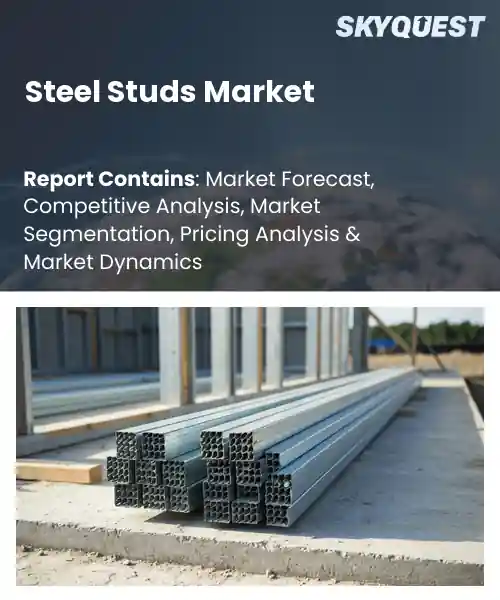
Steel Studs Market
Report ID: SQMIG15O2064
Report ID: SQMIG15O2064
[email protected]
USA +1 351-333-4748
Report ID:
SQMIG15O2064 |
Region:
Global |
Published Date: July, 2026
Pages:
157
|Tables:
149
|Figures:
78


Global Steel Studs Market size was valued at USD 8.4 Billion in 2024 and is poised to grow from USD 8.87 Billion in 2025 to USD 13.72 Billion by 2033, growing at a CAGR of 5.6% during the forecast period (2026-2033).
Steel studs are metallic structural components that make up the backbone of interior walls and ceilings. The importance of steel studs is due to the lightweight, non-flammable, and sustainable nature of steel, compared to timber. The key factor influencing demand for steel studs is the continuous growth in worldwide construction activity. This growth is especially noticeable in developing countries where increased urbanization has led to higher demand for skyscrapers. In the past ten years, there has been an increase in the use of steel studs due to the mandatory framing in the United States and Europe, which started with the adoption of the 2016 International Building Code amendment.
Another important influence on the international steel stud market will be the increasing tendency towards green construction practices, which necessitates the development of light alloys and certification of their products according to certain criteria. Since projects are often oriented towards gaining LEED or BREEAM certificates, which require low levels of embodied carbon, steel studs' lower embodied carbon in comparison with wood studs turns into an obvious advantage, which makes it possible for projects such as the refurbishment of Shanghai International Finance Centre of 2023 to choose steel studs due to their low impact on the environment.
How is AI-driven Automation Influencing Cost Efficiency in the Steel Studs Market?
AI-assisted automation is revolutionizing the steel studs industry through the process of optimizing designing, cutting, and assembling. Machine learning techniques help analyze project requirements and provide an optimized layout for studs, minimizing wastage, and decreasing labor hours. Automated robotic welding and computer numerical control cutters work accurately and minimize errors and speed up the process. Predictive maintenance through sensor data ensures there will be no downtime and hence increases cost efficiency and productivity. This has become even more relevant as there is an increase in demand in the construction industry and the need to maintain low margins.
Market snapshot - (2026-2033)
Global Market Size
USD 8.4 Billion
Largest Segment
Load-Bearing Studs
Fastest Growth
Shaft Wall Studs
Growth Rate
5.6% CAGR
To get more insights on this market click here to Request a Free Sample Report
Global steel studs market is segmented by product type, coating type, application, end user, distribution channel and region. Based on product type, the market is segmented into Load-Bearing Studs, Non-Load-Bearing Studs, Shaft Wall Studs and Others. Based on coating type, the market is segmented into Galvanized, Galvannealed, Painted and Others. Based on application, the market is segmented into Residential Buildings, Commercial Buildings, Industrial Buildings, Infrastructure and Others. Based on end user, the market is segmented into Construction Companies, Drywall Contractors, Building Material Suppliers and Others. Based on distribution channel, the market is segmented into Direct Sales, Building Material Distributors and Others. Based on region, the market is segmented into North America, Europe, Asia Pacific, Latin America and Middle East & Africa.
Galvanized segment dominates the market because it offers superior corrosion resistance, which aligns with builders’ need for long lasting structural components. The protective zinc layer prolongs service life, reduces maintenance costs, and satisfies stringent durability standards across construction projects. Consequently, manufacturers prioritize galvanizing processes, and specifiers favor this option, reinforcing its market leadership and driving consistent demand in both commercial and residential sectors globally today ensuring reliability.
However, painted segment emerges as the fastest growing because aesthetic demands and design trends push architects toward color matched steel studs. Advances in low VOC paint formulations simplify compliance with environmental regulations, while ease of onsite finishing accelerates installation schedules. This momentum fuels expanding use in wall systems and creates new opportunities for market expansion.
Residential Buildings segment leads because the surge in single family and multifamily construction drives consistent need for lightweight, fire rated framing solutions. Steel studs provide rapid on site assembly, reduce labor intensity, and meet stringent safety codes, making them attractive for builders focused on speed and cost efficiency. Additionally, growing consumer preference for sustainable materials reinforces the adoption of steel framing in home projects, cementing its prominent market position.
Meanwhile, the industrial Buildings segment is witnessing the strongest growth momentum because manufacturers are upgrading facilities to accommodate advanced production lines that require robust, high load capacity partitions. Steel studs engineered for heavy duty applications offer superior strength and dimensional stability, aligning with strict industrial safety standards. This demand is amplified by automation trends and the need for flexible floor layouts, propelling rapid market expansion.
To get detailed segments analysis, Request a Free Sample Report
Asia Pacific enjoys the combination of vertical development of cities, extensive housing construction projects, and a rich history of skilled metalwork. The domestic producers benefit from vertically integrated processes that minimize delivery time and increase the efficiency of production, and the constant investment in the advancement of coating and rolling processes increases product performance. Energy-efficient construction requirements and the increasing use of environmentally friendly building materials increase the need for light and strong framing structures. The proximity to the source of raw materials helps maintain low prices and allows the region to easily export its products to new markets.
Steel Studs Market in Japan thrives on a tradition of precision engineering and a strong focus on durability and seismic resilience. Builders prioritize lightweight framing that aligns with strict building codes, while manufacturers emphasize high‑strength alloys to meet demanding performance criteria. The market is propelled by ongoing urban redevelopment projects and a shift toward energy‑efficient construction, encouraging the integration of advanced coating technologies. Close coordination between steel producers and construction firms ensures rapid adoption of innovative stud designs, supporting both new builds and retrofits across the country.
South Korean Steel Studs Industry features fast adoption of advanced construction techniques as well as a strong focus on sustainability issues. Local manufacturers take advantage of cutting-edge production plants which ensure quality production at competitive costs. Increasing demands for skyscrapers in the country lead to the necessity of constructing lightweight but heavy-duty framing. Another advantage of the market is active cooperation between producers and architects who develop special steel studs designed for different architectural styles. The efforts of the government to promote eco-friendly buildings make the process of transitioning to energy-efficient steel studs faster.
The North American market is witnessing significant growth owing to increased residential construction, increasing focus on energy-efficient building envelopes, and an inclination towards economical and efficient framing. The codes have been mandating the use of more resilient and non-flammable building materials, which favor the usage of steel studs. The manufacturers, in response to this requirement, are launching advanced coatings that improve the corrosion resistance as well as the aesthetics of steel studs. Increasing use of modular construction methods will create a need for standard parts that can be installed easily and will add to the demand for steel studs.
Market for Steel Studs in the USA is supported by significant building of homes as well as renovations in different climate zones. The advantages of this material, such as its light weight and efficient structure, correspond to the necessity of accelerating the pace of work and minimizing expenses of labor. Constant improvement in developing fire resistance and acoustic properties adds to the attractiveness of this material, particularly for multistory housing and commercial buildings. Using wall panels made from steel studs increases the need in them because of the necessity of reliable solutions which minimize waste at the construction site.
Steel Studs Market in Canada benefits from a construction climate that emphasizes durability against harsh environmental conditions and compliance with rigorous energy standards. Manufacturers focus on superior coating technologies that protect against corrosion and moisture, meeting the needs of both residential and institutional projects. The market is supported by a growing preference for sustainable building practices, with steel studs offering recyclability and reduced carbon footprints. Close alignment with regional building codes encourages the use of high‑strength, lightweight framing, facilitating faster erection times and cost efficiencies across the country’s diverse housing and commercial sectors.
The European market position is improved by strict regulatory standards that favor energy efficiency, fire safety, and lower carbon emissions. Europe boasts a developed construction industry that makes use of prefabricated and modular constructions using steel studs, which offer high performance, durability, and easy recyclability. International research efforts foster the creation of advanced alloy steels and coatings that make the market more attractive. An advanced distribution network guarantees prompt delivery to urban reconstruction projects and large-scale renovation. Also, favorable policies aimed at promoting green buildings and circular economy contribute to the transition towards steel frames as the key component of sustainable construction.
Steel Studs Market in Germany is distinguished by a focus on precision manufacturing and compliance with rigorous safety and efficiency standards. Industry players prioritize high‑strength, lightweight profiles that support the country’s extensive residential and commercial construction activities. The market benefits from deep integration with engineering firms that develop customized solutions for energy‑efficient retrofits and new builds. Advanced surface treatments enhance durability, aligning with German preferences for long‑lasting, low‑maintenance building components. Collaborative efforts between producers and regulatory bodies ensure that steel studs consistently meet evolving environmental and performance criteria.
Steel Studs Market in the United Kingdom is an indication of a high level of awareness regarding the sustainability of buildings and fast cycles of construction. Steel structures are used owing to their versatility with regard to architecture as well as the ability to minimize waste at the construction site. The market is also stimulated by a high requirement for fire resistance and acoustical performance because of changes in building codes. Collaboration between manufacturers and design consultants leads to the development of new designs of studs enabling modular construction.
Steel Studs Market in France is propelled by an emphasis on energy‑saving construction and adherence to strict fire safety norms. Manufacturers invest in high‑quality coating technologies that enhance corrosion resistance, catering to both historic renovation projects and contemporary developments. The market benefits from collaborative networks that integrate steel framing into prefabricated wall systems, accelerating construction timelines while maintaining aesthetic standards. Strong governmental support for green building initiatives encourages the adoption of recyclable, low‑impact materials, positioning steel studs as a central element in France’s drive toward more sustainable built environments.
To know more about the market opportunities by region and country, click here to
Buy The Complete Report
Growing Demand for Sustainable Construction
The increasing emphasis on environmentally friendly building practices drives architects and developers to select steel studs for their recyclable content and reduced carbon footprint, prompting manufacturers to expand production capacities and innovate greener alloys. This shift enhances market acceptance as project specifications prioritize sustainability, encouraging broader adoption across residential and commercial sectors. Consequently, the sector experiences heightened procurement activity, reinforcing growth trajectories and fostering long‑term investment in advanced manufacturing techniques, and supporting supply chain resilience while also meeting regulatory standards for energy efficiency.
Adoption of Modular Construction Methods
Increased adoption of modular construction methods drives the growth of steel stud systems due to their ability to help assemble quickly on-site, achieve accurate dimensioning, and limit wastage. The repetitive nature of the production cycle for manufacturers helps reduce costs, which are eventually passed to developers who are looking for quick turnaround times. The positive feedback loop results in increased marketability of the product as contractors choose to use the system in modular panels, thus driving demand through varied building types.
Rising Cost of Raw Materials
Price variations of steel billets and alloying materials affect the cost of producing steel studs, thus making the manufacturers either absorb such costs or pass them on to their clients. Such a situation makes price-sensitive clients shun from ordering, and opt for other fasteners where possible. As a result, growth of the market becomes slower since the purchasing decision will be guided by the cost factor and, therefore, investments will not take place until such price fluctuations settle down.
Stringent Building Code Regulations
Tighter building codes in many jurisdictions impose strict performance criteria for fire resistance, acoustic insulation, and structural integrity, which can restrict the applicability of standard steel studs without additional treatments or certifications. Manufacturers must invest in research and testing to meet these mandates, raising time‑to‑market and cost structures. As a result, some developers opt for alternative framing systems that more readily satisfy regulatory demands, thereby dampening demand for conventional steel studs and slowing overall market momentum across residential, commercial, and industrial projects, and influencing procurement strategies.
Request Free Customization of this report to help us to meet your business objectives.
Consolidation and innovation define the competitive environment in the worldwide market for steel studs because companies are engaged in mergers and strategic alliances in order to enlarge their product range and geographical presence. Telling Industries is making use of its experience in manufacturing metal frames by forming joint ventures that use state-of-the-art fasteners, while some newcomers are raising venture capital for production of green steel and digital manufacturing techniques.
SkyQuest’s ABIRAW (Advanced Business Intelligence, Research & Analysis Wing) is our Business Information Services team that Collects, Collates, Correlates, and Analyses the Data collected by means of Primary Exploratory Research backed by robust Secondary Desk research.
According to SkyQuest analysis, the growing requirement for sustainable construction, wherein architects and developers opt for construction material that can be recycled and produce less carbon emission, is a key growth driver. However, the growing costs of raw materials have become the major constraints that limit projects which are cost sensitive. Asia Pacific holds geographical dominance in the global market due to its high urbanization and logistics network, and the leading segment will be galvanized coating due to its high corrosion resistance. The other driving factor would be the quick introduction of modular building systems.
| Report Metric | Details |
|---|---|
| Market size value in 2024 | USD 8.4 Billion |
| Market size value in 2033 | USD 13.72 Billion |
| Growth Rate | 5.6% |
| Base year | 2024 |
| Forecast period | (2026-2033) |
| Forecast Unit (Value) | USD Billion |
| Segments covered |
|
| Regions covered | North America (US, Canada), Europe (Germany, France, United Kingdom, Italy, Spain, Rest of Europe), Asia Pacific (China, India, Japan, Rest of Asia-Pacific), Latin America (Brazil, Rest of Latin America), Middle East & Africa (South Africa, GCC Countries, Rest of MEA) |
| Companies covered |
|
| Customization scope | Free report customization with purchase. Customization includes:-
|
To get a free trial access to our platform which is a one stop solution for all your data requirements for quicker decision making. This platform allows you to compare markets, competitors who are prominent in the market, and mega trends that are influencing the dynamics in the market. Also, get access to detailed SkyQuest exclusive matrix.
Table Of Content
Executive Summary
Market overview
Parent Market Analysis
Market overview
Market size
KEY MARKET INSIGHTS
COVID IMPACT
MARKET DYNAMICS & OUTLOOK
Market Size by Region
KEY COMPANY PROFILES
Methodology
For the Steel Studs Market, our research methodology involved a mixture of primary and secondary data sources. Key steps involved in the research process are listed below:
1. Information Procurement: This stage involved the procurement of Market data or related information via primary and secondary sources. The various secondary sources used included various company websites, annual reports, trade databases, and paid databases such as Hoover's, Bloomberg Business, Factiva, and Avention. Our team did 45 primary interactions Globally which included several stakeholders such as manufacturers, customers, key opinion leaders, etc. Overall, information procurement was one of the most extensive stages in our research process.
2. Information Analysis: This step involved triangulation of data through bottom-up and top-down approaches to estimate and validate the total size and future estimate of the Steel Studs Market.
3. Report Formulation: The final step entailed the placement of data points in appropriate Market spaces in an attempt to deduce viable conclusions.
4. Validation & Publishing: Validation is the most important step in the process. Validation & re-validation via an intricately designed process helped us finalize data points to be used for final calculations. The final Market estimates and forecasts were then aligned and sent to our panel of industry experts for validation of data. Once the validation was done the report was sent to our Quality Assurance team to ensure adherence to style guides, consistency & design.
Analyst Support
Customization Options
With the given market data, our dedicated team of analysts can offer you the following customization options are available for the Steel Studs Market:
Product Analysis: Product matrix, which offers a detailed comparison of the product portfolio of companies.
Regional Analysis: Further analysis of the Steel Studs Market for additional countries.
Competitive Analysis: Detailed analysis and profiling of additional Market players & comparative analysis of competitive products.
Go to Market Strategy: Find the high-growth channels to invest your marketing efforts and increase your customer base.
Innovation Mapping: Identify racial solutions and innovation, connected to deep ecosystems of innovators, start-ups, academics, and strategic partners.
Category Intelligence: Customized intelligence that is relevant to their supply Markets will enable them to make smarter sourcing decisions and improve their category management.
Public Company Transcript Analysis: To improve the investment performance by generating new alpha and making better-informed decisions.
Social Media Listening: To analyze the conversations and trends happening not just around your brand, but around your industry as a whole, and use those insights to make better Marketing decisions.
REQUEST FOR SAMPLE
 REQUEST FREE CUSTOMIZATION
Global Steel Studs Market size was valued at USD 8.4 Billion in 2024 and is poised to grow from USD 8.87 Billion in 2025 to USD 13.72 Billion by 2033, growing at a CAGR of 5.6% during the forecast period (2026-2033).
The competitive landscape of the global steel studs market is shaped by active consolidation and collaborative innovation, with firms pursuing strategic acquisitions and partnerships to expand product portfolios and geographic reach. Telling Industries has leveraged its metal framing expertise through joint ventures that integrate advanced fastening technologies, while several emerging players are securing venture capital to accelerate green‑steel production and digital fabrication solutions, intensifying competition on cost, sustainability, and installation efficiency. 'ClarkDietrich Building Systems', 'Marino\WARE', 'Studco Building Systems', 'The Steel Network, Inc.', 'Nucor Corporation', 'MBA Building Supplies', 'Genesis Manazil Steel Framing', 'Hadley Group', 'Framecad Limited', 'Metek PLC', 'ArcelorMittal S.A.', 'Telling Industries, LLC', 'Steeler, Inc.', 'CEMCO LLC', 'California Expanded Metal Products Co.', 'Bailey Metal Products Limited', 'SCAFCO Steel Stud Company', 'Super Stud Building Products', 'Steel Construction Systems', 'Craco Manufacturing, Inc.'
The increasing emphasis on environmentally friendly building practices drives architects and developers to select steel studs for their recyclable content and reduced carbon footprint, prompting manufacturers to expand production capacities and innovate greener alloys. This shift enhances market acceptance as project specifications prioritize sustainability, encouraging broader adoption across residential and commercial sectors. Consequently, the sector experiences heightened procurement activity, reinforcing growth trajectories and fostering long‑term investment in advanced manufacturing techniques, and supporting supply chain resilience while also meeting regulatory standards for energy efficiency.
Modular Construction Adoption Accelerates: The construction industry increasingly embraces modular building techniques, driving demand for pre‑engineered steel studs that can be quickly fabricated and assembled on site. Manufacturers benefit from standardized designs, reduced waste, and shorter project cycles, while developers achieve faster time‑to‑market and lower labor costs. This shift encourages suppliers to expand product portfolios with versatile stud dimensions and integrated connection systems, positioning modularity as a key catalyst for market growth in both residential and commercial segments throughout North America and Europe worldwide.
Why does Asia Pacific Dominate the Global Steel Studs Market? |@12


Want to customize this report? This report can be personalized according to your needs. Our analysts and industry experts will work directly with you to understand your requirements and provide you with customized data in a short amount of time. We offer $1000 worth of FREE customization at the time of purchase.
Feedback From Our Clients


 USA (+1) 351-333-4748

