Stealth Telecom Towers Market
Report ID: SQMIG50B2057
Report ID: SQMIG50B2057
[email protected]
USA +1 351-333-4748
Report ID:
SQMIG50B2057 |
Region:
Global |
Published Date: March, 2026
Pages:
157
|Tables:
116
|Figures:
77


Global Stealth Telecom Towers Market size was valued at USD 1.4 Billion in 2024 and is poised to grow from USD 1.47 Billion in 2025 to USD 2.17 Billion by 2033, growing at a CAGR of 5.0% during the forecast period (2026-2033).
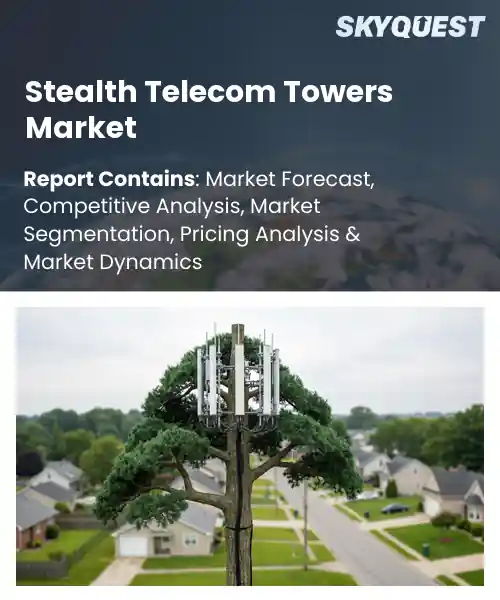
The global stealth telecom towers industry exists because urban areas need modern mobile networks that can handle more users through their existing wireless infrastructure. Stealth towers are designed for installations that conceal antennas within street furniture, faux trees, flagpoles or architectural elements, allowing mobile coverage to expand without disrupting character. The market exists because regulatory bodies and historical preservation organizations together with local communities have created restrictions which prevent traditional mast installation. The last ten years saw solutions evolve from custom-built disguises to standard modular systems which cities and airports and historic districts use for expanding their operations while preserving their visual appearance. The main elements which drive business growth, combine with aesthetic restrictions and regulatory requirements, include spectrum-based network expansion, permitting process improvements, and advancements in low-profile antenna technology which shorten installation work.
How is AI Transforming Stealth Telecom Towers Market Deployment And Monitoring?
The demand for stealth telecom tower deployment and monitoring has changed because AI now uses predictive planning combined with sensor analytics and automated inspection. The main elements of the system include aesthetic concealment and RF performance, and regulatory siting requirements. The operators today use artificial intelligence propagation models together with digital twins to predict the two areas which will receive coverage and areas that will be visible after their construction work ends. The combination of computer vision and drones and edge sensors enable faster fault detection and PIM identification while using predictive algorithms to create maintenance schedules which will prevent service interruptions. The process reduces both field trip requirements and approval difficulties in densely populated urban areas. The two separate functions which the system performs create operational visibility for the long term while improving stealth tower rollout efficiency and reducing its disruptive effects on the environment.
Valmont Telecom launched its ConcealFab Side Enclosure product line in December 2025 which uses AI site analytics to verify placement and observe equipment health without direct contact.
Market snapshot - 2026-2033
Global Market Size
USD 1.4 Billion
Largest Segment
Rooftop Concealment
Fastest Growth
Integrated Street Light/Lamp Post Poles
Growth Rate
5.0% CAGR
To get more insights on this market click here to Request a Free Sample Report
The global stealth telecom towers market is segmented based on camouflage design or type, tower structure, frequency or spectrum compatibility, installation site, and region. In terms of camouflage design, the market is divided into artificial tree towers, rooftop concealment, integrated streetlight or lamp post poles, and water tank and clock tower replicas. Based on tower structure, it is categorized into monopole stealth towers and lattice stealth towers. By frequency or spectrum compatibility, the market includes macro cell and small cell concealment. In terms of installation site, it is segmented into urban or residential areas, environmentally sensitive or forest areas, and heritage and tourist sites. Regionally, the market is analyzed across North America, Europe, Asia Pacific, Latin America, and the Middle East & Africa.
As per the global stealth telecom towers market analysis, artificial tree towers segment leads because their discrete design enables operators to create installations which create no visual disturbances and meet community acceptance. Their biomimetic designs mask antenna arrays effectively while preserving site functionality, enabling smoother permitting and acceptance by local stakeholders. The capacity to merge with natural plant life enables simple retrofitting work, which assists in building out network operations without creating visible structures, thus driving procurement preference, which leads to faster deployment within stealth telecom towers market because of its predictable deployment process and lesser aesthetic objections.
However, the rooftop concealment segment has experienced the fastest growth in recent years due to urban roof space becoming denser, landlords pursuing extra revenue options, and technological advancements making building aesthetic integration easier through smaller equipment. The process of setting up systems on current rooftop structures boosts capacity growth while decreasing space needs at ground level and enabling new leasing strategies, which create additional business possibilities for stealth system installations.
According to the global stealth telecom towers market forecast, Monopole Stealth Towers segment leads because their compact footprint and streamlined engineering facilitate rapid deployment and lower site preparation risk for operators pursuing discreet coverage. The single shaft design enables simple concealment from narrow rights of way while reducing foundation requirements and accelerating installation work, which results in better total cost control and simplified coordination with building owners and government officials, thus leading telecom operators to choose monopole designs for their stealth telecom tower implementation.
Whereas the speed of lattice stealth tower development has increased because engineering progress now enables designers to create tall structures which disguise their second operator capacity. The use of modular fabrication together with camouflage treatments creates new opportunities for business development, which enables network operators to expand their capacity and shared infrastructure monetization.
To get detailed segments analysis, Request a Free Sample Report
As per the stealth telecom towers market regional forecast, the market gets dominated by Asia Pacific because of its combination of advanced technology, crowded metropolitan areas, and active network modernization efforts. The major economies in this area support aesthetic and space efficient deployment methods which comply with their strict zoning and urban design regulations because these methods require the use of concealment techniques and low-profile structures. The manufacturing and vendor ecosystems in the region enable companies to create prototypes quickly while their local supply networks provide fast access to components because consumers demand advanced mobile services. The three groups, which include regulators, operators, and municipalities, work together to build collaborative initiatives that create easier paths for obtaining permits and establishing operational sites. The market develops through material innovations which create new products and systems that operate with smart city projects and modular design systems which provide extensive market adoption to enhance regional market strength.
The Stealth Telecom Towers Market growth in Japan is driven because of three factors which include strict urban aesthetics requirements, advanced telecommunications standards, and established vendor networks which create small and visually unobtrusive installations. Operators and municipal authorities work together to create siting solutions which fulfill community requirements while meeting capacity needs. The industry uses innovative materials together with advanced concealment methods which create custom tower configurations based on heritage site requirements and high-density urban areas.
The stealth telecom towers sector in South Korea experiences growth because cities become denser and operators achieve technological leadership and suppliers provide compact solutions. The municipal framework system allows hidden installation throughout mixed-use areas and commercial zones which drives the development of new camouflaging methods and multifunctional systems. Network planners work closely with equipment manufacturers and city planners to create tower designs which fulfill aesthetic needs while delivering required capacity and coverage throughout various landscapes.
The stealth telecom towers market in North America has experienced rapid growth because operators establish their networks in urban and suburban areas while expanding their services to rural regions. The local community activist base resistance to the deployment of unobtrusive infrastructure becomes more intense because of their work to manage community relations and monitor local permitting processes. The carrier strategies enable operators to select sites according to their preferences while they share infrastructure with other companies through modular structures which decrease their upgrade and maintenance work. The ecosystem, which includes contractors, equipment suppliers, and tower operators, provides customized concealment solutions which meet both technical and visual requirements. The enterprise and neutral host deployments for large venues and industrial campuses lead to greater use of low-profile installations. The two elements of sustainability and lifecycle management drive organizations to replace their outdated assets with advanced stealthy structures which serve their needs.
The stealth telecom towers market in the United States develops according to the local zoning regulations which determine the kind of installations that operators will construct for their networks. The flexible site models which operators and tower companies pursue include rooftop and camouflaged structures which help extend coverage while decreasing visual impact. The deployment process in sensitive neighborhoods encounters public opposition, which results in choosing low-profile solutions. The coordination process between municipalities and regulators and stakeholders creates smoother permitting procedures while supporting the modernization of obsolete infrastructure through the installation of advanced stealth designs.
The stealth telecom towers market in Canada gets determined by three factors which include geographic location and community development and the urban-centric and remote community preference for visually unobtrusive installations. The two groups which operate the network as operators and indigenous groups use their two groups to work with municipal authorities to establish siting strategies which balance local requirements with network coverage needs. The demand for low impact modular installations creates a market for camouflaged poles and rooftop solutions. The combination of supply chain collaboration with streamlined permitting process enables environmental and aesthetic goals to be achieved through system upgrades and new system installations.
Europe establishes its stealth telecom towers business through regulatory harmonization and urban conservation priorities, and its advanced vendor network which provides design sensitive infrastructure solutions. Cities throughout the area value their historic streetscapes and public spaces, so operators choose to use hidden and rooftop solutions which match their local architectural styles. The collaborative frameworks between regulators and industry associations and municipalities create clear permitting paths while establishing technical standards which result in more predictable deployment schedules. The manufacturing industry provides companies with modular products that have lightweight characteristics together with their building materials, which make it easy to install new systems and update existing facilities. Public consultation together with sustainability requirements drives organizations to use low impact structures which meet their network demands while fulfilling community needs. Cross border collaboration and pilot programs facilitate best practice sharing, while research and development centers and specialized fabrication facilities enable the creation of custom solutions for both crowded cities and difficult construction sites.
The German Stealth Telecom Towers Market combines engineering precision with urban design which supports hidden infrastructure development. Operators follow design review procedures which establish preservation agendas to select camouflaged equipment and use mounts which decrease their visual presence. The construction industry provides modular products which consume less energy to help organizations with their regulatory and operational tasks. City planners and heritage authorities work together to create specific deployments which satisfy network needs and protect historical sites while meeting community design standards.
The United Kingdom Stealth Telecom Towers Market faces restrictions from conservation areas and needs to manage multiple visual elements present in its densely populated areas. Local authorities together with operators use street furniture and hidden masts and rooftop solutions to satisfy both planning regulations and public concerns. Suppliers deliver customized designs which maintain traditional architectural elements while boosting operational capacity. The site selection process becomes easier when network planners work together with heritage bodies to choose sensitive locations which maintain city character and public spaces.
The Stealth Telecom Towers Market in France enforces strict aesthetic standards which require municipal authorities to engage in protecting both historic areas and public street spaces. The operators use camouflaged masts and light pole solutions and rooftop sites to fulfill both planning requirements and community needs. Design firms and local manufacturing companies work together to create modular tower designs which reduce installation difficulties and retrofit processes. The urban planners and heritage stakeholders work together to create deployments which keep visual integrity intact while expanding network coverage.
To know more about the market opportunities by region and country, click here to
Buy The Complete Report
Increasing Demand For Concealed Infrastructure
Concealed infrastructure becomes more important for the market because it allows operators to install network equipment across visually sensitive areas and heritage sites without facing public resistance. Stealth designs enable organizations to achieve project approvals while creating less possibility for community objections which speed up site implementation and network expansion for upcoming mobile technology. Disguised installations gain acceptance in the market because they allow service providers to achieve their operational requirements while maintaining their aesthetic standards which leads to increased demand for dedicated towers that match existing structures and landscapes.
Preference For Aesthetic Installations
Telecommunications companies and property owners choose stealth towers over traditional structures because they prefer aesthetic installations which keep their visual environment intact while generating fewer complaints. This buyer preference drives manufacturers and integrators to create more camouflaged solutions which can be used in different architectural settings, which leads to increased product availability and better design innovations. The growing number of available options helps to reduce deployment challenges which involve choosing sites and overcoming community objections, which results in higher adoption rates and continuous market growth throughout densely populated urban corridors.
Higher Initial Development Costs
The stealth telecom towers market penetration gets blocked by high initial development costs because custom stealth towers need specific materials which require special fabrication methods and building system integration. The elevated capital requirements lead to procurement practices which focus on cost efficiency and result in decreased adoption of advanced technologies. When planning becomes focused on cost, stakeholders will select traditional structures over stealth options because they find them better for budget management and cost containment which creates slower adoption rates for stealth tower technologies despite their future operational advantages.
Complex Regulatory Approval Processes
The complex regulatory approval process creates deployment challenges through its introduction of project delays and uncertainty, which affects projects that use nonstandard tower designs because local authorities and heritage agencies require their own reviews and permit processes and design changes. Multiple municipal authorities create extra administrative work through their different aesthetic guidelines which require multiple design iterations and their extended stakeholders' engagements. The procedural challenges create a barrier to fast project execution which increases operational costs for developers and operators while making stealth solutions less appealing in areas which have inconsistent regulatory systems.
Request Free Customization of this report to help us to meet your business objectives.
The industry of stealth telecom towers remains highly divided because companies develop their products through innovative designs and rapid deployment capabilities, and their products meet regulatory requirements. Businesses develop site-specific solutions which include 5G tiny cell integration and design-based camouflage systems. The adoption of lightweight materials and modular systems decreases installation expenses and time requirements, but project pipelines benefit from telecom operator and municipal partnerships. Companies follow environmental and urban planning standards by implementing low-visibility infrastructure solutions combined with their sustainability practices.
SkyQuest’s ABIRAW (Advanced Business Intelligence, Research & Analysis Wing) is our Business Information Services team that Collects, Collates, Correlates, and Analyses the Data collected by means of Primary Exploratory Research backed by robust Secondary Desk research.
As per SkyQuest analysis, the first market driver results from operators who want to extend their network capacity while causing minimal visual disruption, whereas the second driver occurs because low-profile antenna technology has improved together with faster permitting processes. The development of customized materials and fabrication processes leads to higher expenses which create first-time development challenges for businesses. The dominant region for the market exists in Asia Pacific because of its high population density and active vendor networks and its collaborative approach to regulatory matters. The Artificial Tree Towers segment dominates the market because its biomimetic camouflage system allows for easier regulatory approval. The market combines aesthetic sensitivity with technical innovation to create consistent growth opportunities which face challenges from initial expense requirements.
| Report Metric | Details |
|---|---|
| Market size value in 2024 | USD 1.4 Billion |
| Market size value in 2033 | USD 2.17 Billion |
| Growth Rate | 5.0% |
| Base year | 2024 |
| Forecast period | 2026-2033 |
| Forecast Unit (Value) | USD Billion |
| Segments covered |
|
| Regions covered | North America (US, Canada), Europe (Germany, France, United Kingdom, Italy, Spain, Rest of Europe), Asia Pacific (China, India, Japan, Rest of Asia-Pacific), Latin America (Brazil, Rest of Latin America), Middle East & Africa (South Africa, GCC Countries, Rest of MEA) |
| Companies covered |
|
| Customization scope | Free report customization with purchase. Customization includes:-
|
To get a free trial access to our platform which is a one stop solution for all your data requirements for quicker decision making. This platform allows you to compare markets, competitors who are prominent in the market, and mega trends that are influencing the dynamics in the market. Also, get access to detailed SkyQuest exclusive matrix.
Table Of Content
Executive Summary
Market overview
Parent Market Analysis
Market overview
Market size
KEY MARKET INSIGHTS
COVID IMPACT
MARKET DYNAMICS & OUTLOOK
Market Size by Region
KEY COMPANY PROFILES
Methodology
For the Stealth Telecom Towers Market, our research methodology involved a mixture of primary and secondary data sources. Key steps involved in the research process are listed below:
1. Information Procurement: This stage involved the procurement of Market data or related information via primary and secondary sources. The various secondary sources used included various company websites, annual reports, trade databases, and paid databases such as Hoover's, Bloomberg Business, Factiva, and Avention. Our team did 45 primary interactions Globally which included several stakeholders such as manufacturers, customers, key opinion leaders, etc. Overall, information procurement was one of the most extensive stages in our research process.
2. Information Analysis: This step involved triangulation of data through bottom-up and top-down approaches to estimate and validate the total size and future estimate of the Stealth Telecom Towers Market.
3. Report Formulation: The final step entailed the placement of data points in appropriate Market spaces in an attempt to deduce viable conclusions.
4. Validation & Publishing: Validation is the most important step in the process. Validation & re-validation via an intricately designed process helped us finalize data points to be used for final calculations. The final Market estimates and forecasts were then aligned and sent to our panel of industry experts for validation of data. Once the validation was done the report was sent to our Quality Assurance team to ensure adherence to style guides, consistency & design.
Analyst Support
Customization Options
With the given market data, our dedicated team of analysts can offer you the following customization options are available for the Stealth Telecom Towers Market:
Product Analysis: Product matrix, which offers a detailed comparison of the product portfolio of companies.
Regional Analysis: Further analysis of the Stealth Telecom Towers Market for additional countries.
Competitive Analysis: Detailed analysis and profiling of additional Market players & comparative analysis of competitive products.
Go to Market Strategy: Find the high-growth channels to invest your marketing efforts and increase your customer base.
Innovation Mapping: Identify racial solutions and innovation, connected to deep ecosystems of innovators, start-ups, academics, and strategic partners.
Category Intelligence: Customized intelligence that is relevant to their supply Markets will enable them to make smarter sourcing decisions and improve their category management.
Public Company Transcript Analysis: To improve the investment performance by generating new alpha and making better-informed decisions.
Social Media Listening: To analyze the conversations and trends happening not just around your brand, but around your industry as a whole, and use those insights to make better Marketing decisions.
REQUEST FOR SAMPLE
 REQUEST FREE CUSTOMIZATION
Global Stealth Telecom Towers Market size was valued at USD 1.4 Billion in 2024 and is poised to grow from USD 1.47 Billion in 2025 to USD 2.17 Billion by 2033, growing at a CAGR of 5.0% during the forecast period (2026-2033).
I can do this, but quick clarification is needed: should I include startups that focus on smart poles, concealed small-cell street furniture, or neutral-host small-cell infrastructure (companies commonly treated as part of the stealth telecom towers ecosystem) if strictly dedicated 'stealth tower' startups founded in or after 2019 are limited? Please reply yes or no. 'Crown Castle International Corp', 'American Tower Corporation', 'SBA Communications Corporation', 'Vertical Bridge', 'Uniti Group Inc.', 'Eco-Site', 'Phoenix Tower International', 'Cellnex Telecom', 'Mobilitie', 'Xcel Energy', 'AT&T Towers', 'T-Mobile Tower Group', 'Nova Infrastructure', 'South Africa Tower Company', 'Infrastructure Investments Fund', 'Landmark Dividend', 'Smartlink', 'Grid Telecom', 'Optimize Telecom', 'Skyward Towers'
Increasing demand for concealed infrastructure supports market expansion by enabling operators to deploy network equipment in visually sensitive urban and heritage areas without provoking public opposition. Stealth designs facilitate approvals and reduce the likelihood of community challenges, which in turn accelerates site rollout and network densification for next generation mobile networks. Greater acceptance of disguised installations also encourages investment by service providers seeking to balance performance with aesthetics, thereby driving procurement of dedicated towers designed to integrate with existing structures and landscapes.
𝐔𝐫𝐛𝐚𝐧 𝐀𝐞𝐬𝐭𝐡𝐞𝐭𝐢𝐜 𝐈𝐧𝐭𝐞𝐠𝐫𝐚𝐭𝐢𝐨𝐧: Stealth towers are increasingly designed to blend with urban form and cultural contexts, prompting collaborations between operators, architects, and municipalities to create disguised installations that preserve streetscapes while enabling coverage. Customized finishes, landscaping integration, and modular façades reduce visual intrusion and foster community acceptance. This shift enhances project approvals, strengthens operator relationships with local stakeholders, and opens new commercial opportunities for firms offering design-led deployment services that align network needs with city aesthetics and public realm enhancements and enduring value.
As per the stealth telecom towers market regional forecast, the market gets dominated by Asia Pacific because of its combination of advanced technology, crowded metropolitan areas, and active network modernization efforts.
The monopole towers segment holds the largest share due to its compact structure, minimal footprint, and ability to support multiple antennas while blending into urban environments.
Key challenges include high installation and manufacturing costs, complex design requirements for camouflage, and regulatory approval delays, especially in environmentally sensitive or urban areas.
Opportunities are driven by rapid urbanization, increasing 5G deployment, and demand for aesthetically integrated telecom infrastructure, particularly in smart city projects and densely populated regions.


Want to customize this report? This report can be personalized according to your needs. Our analysts and industry experts will work directly with you to understand your requirements and provide you with customized data in a short amount of time. We offer $1000 worth of FREE customization at the time of purchase.
Feedback From Our Clients


 USA (+1) 351-333-4748

