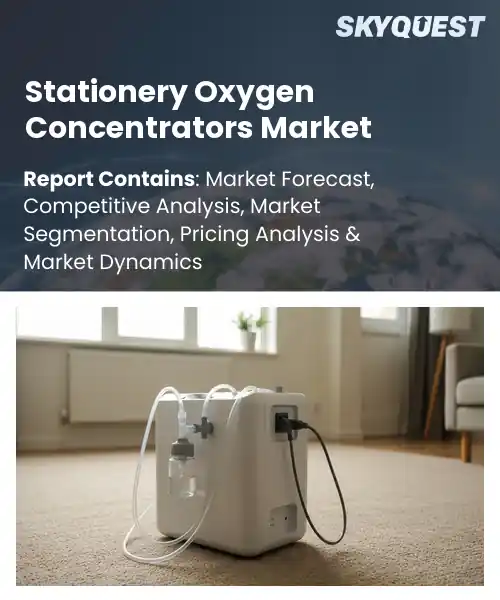
Stationery Oxygen Concentrators Market
Report ID: SQMIG35A3270
Report ID: SQMIG35A3270
[email protected]
USA +1 351-333-4748
Report ID:
SQMIG35A3270 |
Region:
Global |
Published Date: February, 2026
Pages:
157
|Tables:
115
|Figures:
77


Global Stationery Oxygen Concentrators Market size was valued at USD 1.8 Billion in 2024 and is poised to grow from USD 1.93 Billion in 2025 to USD 3.37 Billion by 2033, growing at a CAGR of 7.2% during the forecast period (2026-2033).
The global stationery oxygen concentrators market is a segment of medical devices that provides continuous oxygen delivery to patients with chronic respiratory diseases in home, clinic and long-term care environments. Its primary driver is the demographic trend of increasing numbers of aged individuals with chronic respiratory diseases. This market is very important because it provides an effective and affordable means of administering long-term oxygen therapy outside of the hospital, thereby reducing hospitalizations and improving patient quality of life. In the last 10 years, the global stationery oxygen concentrators market strategy have evolved from large, hospital based products to energy efficient, quiet products with built-in telemetry and other required reviews for regulatory approval.
Building on the demographic and technological trends described above, a key factor accelerating growth is expanding home healthcare infrastructure combined with reimbursement reforms that make prolonged oxygen therapy financially viable for payers and patients. When insurers adopt coverage policies and governments fund community care, providers invest in concentrator fleets and remote monitoring, which lowers hospital readmissions and creates demand for modular, low-maintenance units. For example, post-pandemic programs in Latin America and Asia funded home oxygen for COPD and post-COVID patients, prompting manufacturers to localize production, offer service contracts, and innovate sensor-driven fault alerts, thereby translating policy changes into global stationery oxygen concentrators market growth.
How is IoT Enhancing Remote Monitoring in the Stationery Oxygen Concentrators Market?
IoT is transforming remote monitoring for stationery oxygen concentrators by adding networked sensors and cloud connectivity that report device performance, oxygen purity, run time and alarms in real time. This connectivity lets clinicians and home medical equipment providers monitor adherence and detect faults early so they can schedule predictive maintenance instead of reactive visits. In a market where homecare demand is growing and service efficiency is critical, fleet level visibility improves patient safety and reduces operating costs. Real world examples of these capabilities include CAIRE’s myCAIRE telehealth platform and Drive DeVilbiss SmartLinkO2 which surface diagnostic and usage data remotely.
CAIRE in January 2025 launched the IntenOxy 5 stationary oxygen concentrator and emphasized pairing with telehealth tools that enable remote performance monitoring and simplified troubleshooting. This combination helps providers reduce field visits, respond faster to alarms and scale homecare services more efficiently.
Market snapshot - 2026-2033
Global Market Size
USD 1.8 Billion
Largest Segment
Low Flow Oxygen Concentrators
Fastest Growth
High Flow Oxygen Concentrators
Growth Rate
7.2% CAGR
To get more insights on this market click here to Request a Free Sample Report
Global stationery oxygen concentrators market is segmented by product type, power source, portability, end user and region. Based on product type, the market is segmented into low flow oxygen concentrators and high flow oxygen concentrators. Based on power source, the market is segmented into electricity powered and battery backup equipped. Based on portability, the market is segmented into stationary only and stationary with portable options. Based on end user, the market is segmented into hospitals, clinics, homecare settings and others. Based on region, the market is segmented into North America, Europe, Asia Pacific, Latin America and Middle East & Africa.
Based on the global stationery oxygen concentrators market forecast, electricity powered segment dominates because consistent mains power enables continuous high-flow delivery and predictable performance required by institutional buyers, driving procurement preference. The increased preference for these products by consumers encourages suppliers of such products to invest further in electricity-generating and servicing equipment thereby increasing their competitiveness within the marketplace via reliable operations and decreased overall complexity throughout the lifecycle of the products supplied by them.
However, Battery Backup Equipped units are witnessing the strongest growth momentum as focus on resiliency and uninterrupted oxygen delivery rises. Battery technology innovations and integrated power management systems allow deployment in unstable power facility environments as well as in homecare settings and promote new acquisition models, enabling faster access for manufacturers providing resilient solutions.
Stationary Only segment dominates because fixed installations provide robust continuous oxygen capacity and simple integration into clinical infrastructure, meeting core demands of larger care providers. Permanent units reduce logistics and handling complexity while allowing service providers to offer long-term maintenance agreements, which lowers total cost of ownership perceptions. This operational predictability and institutional procurement preference encourage widespread adoption of stationary units in primary acute and chronic care delivery environments.
Meanwhile, Stationary with Portable Options is emerging as the key high-growth area as demand shifts toward flexible care that blends inpatient and home therapy. Manufacturers are developing modular platforms and service models that expand market coverage and develop new streams of income by enabling portable modules to provide step-down care, short-term rentals, and clinical mobility for clinicians.
To get detailed segments analysis, Request a Free Sample Report
As per the global stationery oxygen concentrators market analysis, North America commands the industry due to integrated healthcare infrastructure, advanced medical device regulatory frameworks, and high concentration of reputable manufacturers and suppliers. The clinical utilization of medical equipment is being assisted by the strong demand for devices from healthcare providers and by regulatory pathways being established for reimbursement for continued use of these devices throughout the hospital and home care systems. Significant investment in research & development generates product innovation, quality assurance, and service networks that create greater reliability and uptime. Strong distribution networks and partnerships between the device manufacturers and clinical organizations allow for more rapid market penetration; focused training and technical support create end-user confidence. Regulatory consistency among stakeholders that foster collaboration will also strengthen adoption of devices in caring for patients.
Stationery Oxygen Concentrators Market in the United States is characterized by deep clinical acceptance, extensive hospital networks, and close collaboration between manufacturers and care centers. Support for Product Installations is a key focus, with an emphasis on product reliability, regulatory compliance, and typically extensive service contracts; furthermore, distribution networks and regional technical support providers help customers achieve uptime and provide training. The focus on innovative products and integrated respiratory care pathways continues to build preference for stationary oxygen concentrator platforms within the ranges of both acute and chronic medical care customers.
Stationery Oxygen Concentrators Market in Canada reflects coordinated regional procurement, emphasis on durable, low maintenance devices, and alignment with diverse care settings. The goals are to ensure that there is interoperability between new respiratory machines and the current inventory of machines, to enhance the training of clinicians to use the machine, and to ensure the clinical integration of new machines into their current settings. Provincial purchasing frameworks and health system priorities encourage deployment of stationary concentrator solutions across hospital and community care environments and remote patient monitoring.
Europe is experiencing rapid expansion of the stationery oxygen concentrators market owing to coordinated healthcare policies, strong hospital networks, and growing emphasis on home based respiratory care. Medical device manufacturers that are situated in the region have a successful history and provide localized production, regulatory guidance and customized service solutions that support clinical stakeholder needs. Collaboration between health systems through cross-border reimbursement alignment and procurement enable wider adoption. Additionally, development of clinical guidelines, professional societies, and evidence based usage of devices, all help support the use of devices. The ongoing integration of stationary devices into care pathways for chronic disease management, plus increased supplier focus on training and maintenance, enhances the trust level between providers and patients.
Stationery Oxygen Concentrators Market in Germany benefits from a strong manufacturing base, regulatory expertise, and established hospital procurement channels that prioritize reliability. By placing an emphasis on engineering quality and clinical validation, we can improve the adoption of portable concentrators across all respiratory centers; this also includes the clinical development of training programs as well as implementation of integrated care pathways to establish residual preference for stationary concentrators in both acute and chronic care settings at the national level.
Stationery Oxygen Concentrators Market in the United Kingdom is marked by private sector engagement, expanding community respiratory care, and service models emphasizing home oxygen management. Collaborations between clinical networks and technology providers accelerate piloting and uptake of stationary systems. Emphasis on patient centered care pathways, remote monitoring integration, and targeted training enhances clinician confidence. Longitudinal patient outcomes and deployment can be accomplished in a number of different care settings using procurement initiatives and regional reimbursement methodologies.
Stationery Oxygen Concentrators Market in France is emerging through clinical validation, hospital interest in integrated respiratory programs, and growing supplier engagement in maintenance services. Static systems should be evaluated in a chronic care pathway through national standards as well as regional activities. There is also great emphasis on how well devices work with current patient care equipment as well as how well clinicians are trained to use new devices. Manufacturer partnerships with health systems may help by providing the clinical and administrative support that allows for acceptance in both inpatient and outpatient respiratory therapy services.
Asia Pacific is strengthening its position through concentrated technological advancement, expanding domestic manufacturing capabilities, and strategic collaborations between medical device companies and healthcare providers. By utilizing highly compact energy-efficient designs and local service networks, we are meeting the unique needs of each region for both urban and remote care settings. With the emphasis on scalable models for providing respiratory care, along with investments in clinical education/training and post sale support, the market for such solutions is more ready than ever before. In addition to providing engineering capabilities and supply chain reliability, we can establish regional partnerships through distribution. With growing indigenous manufacturing, as well as improved regulatory pathways, there is a reduction of barriers to adoption of this technology, and thus improving the confidence for regional suppliers.
Stationery Oxygen Concentrators Market in Japan is driven by technological innovation, manufacturing excellence, and integration of advanced control systems that enhance reliability and efficiency. The partnership between biomedical engineers and clinical institutions improves the verification and customized solutions available for equipment used in both hospitals and patients' homes. Compact designs will allow stationary and portable concentrators to be effectively used in an integrated manner with other respiratory therapy equipment due to their ability to work together.
Stationery Oxygen Concentrators Market in South Korea benefits from electronics integration, strong manufacturing clusters, and collaboration between technology firms and medical institutions to develop stationary solutions. The emphasis on energy efficient operations and compact, easy-to-use interfaces meet all of the needs of hospitals and home care customers. To provide better yet faster technical support for end users and improve uptake by clinicians, we established an after-sales services framework together with a series of training programmes.
To know more about the market opportunities by region and country, click here to
Buy The Complete Report
Expanding Home Healthcare Adoption
Expanding availability and acceptance of home based care models has encouraged patients and clinicians to prefer long term oxygen solutions that can be maintained outside hospitals. Stationery oxygen concentrators offer patients with chronic conditions a continuous and dependable source of therapeutic oxygen that is convenient for them to use during everyday activities and reduces the frequency of visits to their doctor or the clinic. As such, many chronic condition patients prefer to use stationery oxygen concentrators instead of portable oxygen cylinders or other appliances because they are ergonomically designed and operate quietly and safely.
Advances In Energy Efficient Design
Continual improvements in compressor efficiency, sieve material quality, and control electronics have enhanced device reliability and user experience, encouraging broader clinical and consumer acceptance. In addition, the advances in oxygen purification technology provide consistent delivery of therapeutic oxygen. Smart monitoring technology and simplified maintenance has lowered the perceived complexity for caregivers and clinicians thus increasing their confidence in long term deployment and providing an incentive for manufacturers to increase their portfolio of products as well as broaden their distribution capabilities to accommodate the ever-increasing demand for their products.
High Initial Equipment Costs
The big price tag for an initial investment plus the assumption that stationary oxygen concentrated will require on-going maintenance for a long time to come can make healthcare providers and the individual buyer hesitant to make this purchase, causing a slower rate of at-home use of stationery oxygen concentrators in places where funds are tight. Because of limited/uncertain reimbursement for durable medical equipment, both patients and organisations view the ownership of durable home oxygen equipment as financially risky and prefer to lease all types of oxygen equipment, especially the less expensive and more portable options, whenever possible.
Regulatory and Reimbursement Complexity
Fragmented regulatory requirements across regions, varying standards for device classification and differing approval pathways create prolonged time to market and increase compliance burden for manufacturers, limiting rapid expansion. Inconsistent reimbursement frameworks and ambiguous coverage criteria for stationary oxygen therapy add uncertainty for purchasers and healthcare providers, reducing willingness to pay and to adopt new technologies. These regulatory and payer complexities disproportionately affect smaller suppliers and delay commercial scaling, impeding distribution network growth and slowing overall market availability of stationary devices in jurisdictions with stringent or evolving policy environments.
Request Free Customization of this report to help us to meet your business objectives.
The competitive landscape in global stationery oxygen concentrators market outlook is defined by rapid channel partnerships, targeted M&A and device differentiation as suppliers race to secure distribution and manufacturing scale. Competition is driven by the need for faster market access and lower unit costs through partnerships and technology upgrades. Partnerships like Belluscura's contract with McKesson for distribution, VARON's US distribution rollout, and the integration of Heyer and Aeonmed through their previously independent designs and manufacturing processes are considered to be a form of collaboration in the distribution of respiratory products.
Homecare Adoption Driving Demand: Growing preference for home-based respiratory care is shifting purchase and rental patterns toward portable, user-friendly oxygen concentrators. Patients and caregivers seek devices that enable daily mobility, simplified maintenance, and lower institutional dependence. Manufacturers are creating more lightweight products, quieter compressors, and longer-lasting batteries in order to provide patients suffering from chronic respiratory diseases with better options. Additionally, companies involved in healthcare delivery are increasingly willing to support home therapy through focused education and bundled services which help to simplify the process of starting home therapy and maintaining compliance.
Smart Integration And Connectivity: Advancements in connectivity and device intelligence now allow stationery oxygen concentrators to connect with remote monitoring platforms and telehealth ecosystems. Embedded sensors and secure data transmission enable predictive maintenance, adherence tracking, and personalized therapy adjustments while providing a means for greater collaboration between manufacturers and digital health providers. The ability to achieve interoperability through electronic health records and third-party applications enhances the coordination of care and drives value-based service models, which ultimately helps differentiate products within the global stationery oxygen concentrators market trends that has become increasingly driven by outcomes, enhancing convenience, and improving communication among health providers.
SkyQuest’s ABIRAW (Advanced Business Intelligence, Research & Analysis Wing) is our Business Information Services team that Collects, Collates, Correlates, and Analyses the Data collected by means of Primary Exploratory Research backed by robust Secondary Desk research.
As per SkyQuest analysis, the global stationery oxygen concentrators industry is propelled primarily by expanding home healthcare adoption, which increases demand for long term oxygen solutions outside hospitals, while growth is also supported by advances in energy efficient design that improve reliability and user experience. North America is leading the way with advanced infrastructure for integrated healthcare systems and procedures, while the electrically powered segment is leading as a product class (due to its consistent, reliable performance) and preferred by many institutions because it has been around longer than other types of energy delivery systems. The manufacturers who concentrate their efforts on modular service models and remote monitoring capabilities will be able to take advantage of increased opportunities as demand grows.
| Report Metric | Details |
|---|---|
| Market size value in 2024 | USD 1.8 Billion |
| Market size value in 2033 | USD 3.37 Billion |
| Growth Rate | 7.2% |
| Base year | 2024 |
| Forecast period | 2026-2033 |
| Forecast Unit (Value) | USD Billion |
| Segments covered |
|
| Regions covered | North America (US, Canada), Europe (Germany, France, United Kingdom, Italy, Spain, Rest of Europe), Asia Pacific (China, India, Japan, Rest of Asia-Pacific), Latin America (Brazil, Rest of Latin America), Middle East & Africa (South Africa, GCC Countries, Rest of MEA) |
| Companies covered |
|
| Customization scope | Free report customization with purchase. Customization includes:-
|
To get a free trial access to our platform which is a one stop solution for all your data requirements for quicker decision making. This platform allows you to compare markets, competitors who are prominent in the market, and mega trends that are influencing the dynamics in the market. Also, get access to detailed SkyQuest exclusive matrix.
Table Of Content
Executive Summary
Market overview
Parent Market Analysis
Market overview
Market size
KEY MARKET INSIGHTS
COVID IMPACT
MARKET DYNAMICS & OUTLOOK
Market Size by Region
KEY COMPANY PROFILES
Methodology
For the Stationery Oxygen Concentrators Market, our research methodology involved a mixture of primary and secondary data sources. Key steps involved in the research process are listed below:
1. Information Procurement: This stage involved the procurement of Market data or related information via primary and secondary sources. The various secondary sources used included various company websites, annual reports, trade databases, and paid databases such as Hoover's, Bloomberg Business, Factiva, and Avention. Our team did 45 primary interactions Globally which included several stakeholders such as manufacturers, customers, key opinion leaders, etc. Overall, information procurement was one of the most extensive stages in our research process.
2. Information Analysis: This step involved triangulation of data through bottom-up and top-down approaches to estimate and validate the total size and future estimate of the Stationery Oxygen Concentrators Market.
3. Report Formulation: The final step entailed the placement of data points in appropriate Market spaces in an attempt to deduce viable conclusions.
4. Validation & Publishing: Validation is the most important step in the process. Validation & re-validation via an intricately designed process helped us finalize data points to be used for final calculations. The final Market estimates and forecasts were then aligned and sent to our panel of industry experts for validation of data. Once the validation was done the report was sent to our Quality Assurance team to ensure adherence to style guides, consistency & design.
Analyst Support
Customization Options
With the given market data, our dedicated team of analysts can offer you the following customization options are available for the Stationery Oxygen Concentrators Market:
Product Analysis: Product matrix, which offers a detailed comparison of the product portfolio of companies.
Regional Analysis: Further analysis of the Stationery Oxygen Concentrators Market for additional countries.
Competitive Analysis: Detailed analysis and profiling of additional Market players & comparative analysis of competitive products.
Go to Market Strategy: Find the high-growth channels to invest your marketing efforts and increase your customer base.
Innovation Mapping: Identify racial solutions and innovation, connected to deep ecosystems of innovators, start-ups, academics, and strategic partners.
Category Intelligence: Customized intelligence that is relevant to their supply Markets will enable them to make smarter sourcing decisions and improve their category management.
Public Company Transcript Analysis: To improve the investment performance by generating new alpha and making better-informed decisions.
Social Media Listening: To analyze the conversations and trends happening not just around your brand, but around your industry as a whole, and use those insights to make better Marketing decisions.
REQUEST FOR SAMPLE
 REQUEST FREE CUSTOMIZATION
Global Stationery Oxygen Concentrators Market size was valued at USD 1.8 Billion in 2024 and is poised to grow from USD 1.93 Billion in 2025 to USD 3.37 Billion by 2033, growing at a CAGR of 7.2% during the forecast period (2026-2033).
The competitive landscape in stationary oxygen concentrators is defined by rapid channel partnerships, targeted M&A and device differentiation as suppliers race to secure distribution and manufacturing scale. Competition is driven by the need for faster market access and lower unit costs through partnerships and technology upgrades. Examples include Belluscura’s distribution agreement with McKesson, VARON’s U.S. distributor rollouts, and the Heyer–Aeonmed integration that combined manufacturing and ventilation portfolios. 'Philips Healthcare', 'Invacare Corporation', 'AirSep Corporation', 'Precision Medical, Inc.', 'O2 Concepts, LLC', 'Drive DeVilbiss Healthcare', 'MGC Diagnostics Corporation', 'GCE Group', 'Caire Inc.', 'DeVilbiss Healthcare', 'Yangco', 'ResMed Ltd.', 'Oxygen Concentrator Store', 'Chart Industries', 'Inogen, Inc.', 'NewLife Medical', 'Nidek Medical Products', 'Oxlife', 'Breathe Technologies', '3B Medical'
Expanding availability and acceptance of home based care models has encouraged patients and clinicians to prefer long term oxygen solutions that can be maintained outside hospitals. Stationary oxygen concentrators provide reliable, continuous therapeutic oxygen suitable for chronic conditions, offering convenience for daily living and reducing the need for frequent clinical visits. This preference drives manufacturers to optimize appliance ergonomics, noiseless operation, and safety features while payers and providers adapt to support at home therapy, thereby reinforcing investment, distribution, and product development focused on residential care.
Homecare Adoption Driving Demand: Growing preference for home-based respiratory care is shifting purchase and rental patterns toward portable, user-friendly oxygen concentrators. Patients and caregivers seek devices that enable daily mobility, simplified maintenance, and lower institutional dependence. Manufacturers respond with lightweight designs, quieter compressors, and extended battery options to improve acceptance among chronic respiratory populations. Healthcare providers and payers increasingly support home therapy through focused education and bundled services that streamline initiation and long-term adherence, creating consistent demand for scalable, consumer-oriented stationary oxygen concentrator offerings.
As per the global stationery oxygen concentrators market analysis, North America commands the industry due to integrated healthcare infrastructure, advanced medical device regulatory frameworks, and high concentration of reputable manufacturers and suppliers.


Want to customize this report? This report can be personalized according to your needs. Our analysts and industry experts will work directly with you to understand your requirements and provide you with customized data in a short amount of time. We offer $1000 worth of FREE customization at the time of purchase.
Feedback From Our Clients


 USA (+1) 351-333-4748

