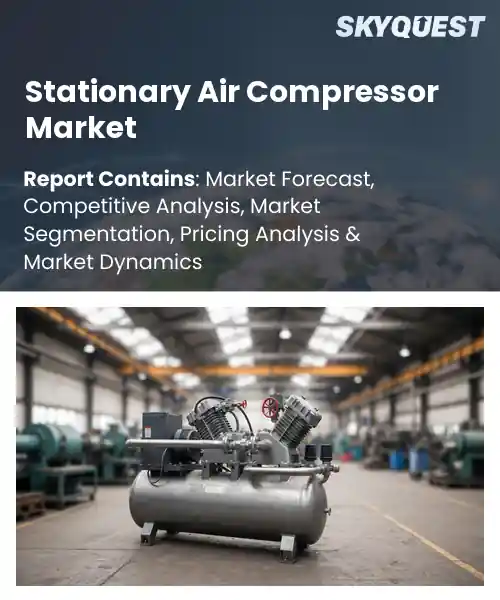
Stationary Air Compressor Market
Report ID: SQMIG20I3268
Report ID: SQMIG20I3268
[email protected]
USA +1 351-333-4748
Report ID:
SQMIG20I3268 |
Region:
Global |
Published Date: July, 2026
Pages:
157
|Tables:
180
|Figures:
79


Global Stationary Air Compressor Market size was valued at USD 36.0 Billion in 2024 and is poised to grow from USD 37.8 Billion in 2025 to USD 55.85 Billion by 2033, growing at a CAGR of 5.0% during the forecast period (2026-2033).
The global stationary air compressor market trends consists of large-scale compressors that are fixed at one location and provide compressed air for industrial, commercial and municipal applications. It matters because compressed air is the “fourth utility,” driving everything from automotive assembly lines to food‑processing plants and wastewater treatment facilities. The market historically started in the early 20th century when steam-driven units were replaced by compressors driven by electric motors, which provided more reliability and lower operating costs. Over the last two decades, the adoption of smart factories, advances in energy-efficient motor designs, variable-speed drives and predictive maintenance platforms have accelerated adoption, and compressors have become data-rich assets that can be remotely monitored and optimized. This has enlarged the addressable base of end‑users and raised the strategic importance of stationary compressors to production continuity and cost management.
A key growth driver today is the increasing demand for energy‑saving solutions, which forces manufacturers to replace old, high consumption units with ISO-efficiency rated models with inverter technology. Increasing electricity costs and tighter carbon-emission regulations are pushing companies such as automotive component suppliers and large-scale packaging plants to retrofit their facilities, leading to a surge in aftermarket sales and new installations. Reduced operating costs for end users and increased market revenues for OEMs that can provide integrated solutions combining compressed air generation, storage and analytics. For example, a leading beverage company installed a variable-frequency-drive compressor network that reduced its energy draw by 18% and reduced downtime by 12% through real-time fault detection. This success story shows how the promise of lower total cost of ownership stimulates investment, creating more opportunities in emerging regions where industrialization and infrastructure upgrades are progressing rapidly, and reinforcing the upward trajectory of the stationary air compressor market growth.
How is IoT-driven Automation Reshaping the Stationary Air Compressor Market?
IoT-enabled automation is transforming stationary air compressor market share into smart assets that can be monitored, tuned and maintained remotely. Sensors collect pressure, temperature, energy use and vibration data, feeding analytics that predict wear and optimise run-times. Today, manufacturers have cloud dashboards that allow plant managers to see real-time performance, set adaptive schedules and get alerts before a failure occurs. This connectivity reduces unplanned downtime, increases equipment life and correlates compressor output to variable production demand. With factories moving to Industry 4.0 principles, the ability to connect compressors to wider MES and ERP systems means they can be part of automated workflows, improving overall plant efficiency and sustainability.
In March 2024, Ingersoll Rand launched an IoT-enabled stationary compressor platform, showing predictive maintenance and energy-optimization features that are accelerating the use of smart compression solutions in manufacturing sites.
Market snapshot - (2026-2033)
Global Market Size
USD 36.0 Billion
Largest Segment
Reciprocating
Fastest Growth
Rotary Screw
Growth Rate
5.0% CAGR
To get more insights on this market click here to Request a Free Sample Report
Global stationary air compressor market is segmented by technology, lubrication, power rating, pressure range, power source, end use industry and region. Based on technology, the market is segmented into reciprocating, rotary screw, centrifugal, scroll and others. Based on lubrication, the market is segmented into oil-filled and oil-free. Based on power rating, the market is segmented into Up to 50 kW, 51–250 kW, 251–500 kW and above 500 kW. Based on pressure range, the market is segmented into low pressure, medium pressure and high pressure. Based on power source, the market is segmented into electric and internal combustion engine (ICE). Based on end use industry, the market is segmented into manufacturing, automotive, food & beverage, oil & gas, energy & power, construction, chemicals & petrochemicals, pharmaceuticals, mining & metals, healthcare and others. Based on region, the market is segmented into North America, Europe, Asia Pacific, Latin America and Middle East & Africa.
One of the reasons rotary screw technology is leading the way is that it is more efficient and has lower pulsation due to its continuous flow design, meeting the reliability expectations of modern industrial facilities. Manufacturers appreciate the ease of maintenance and suitability for a wide range of capacities, and energy-conscious operators appreciate the lower power consumption. These properties also further strengthen its important position in meeting diverse application requirements in the market.
On the other hand, scroll technology is becoming the fastest growing technology in the stationary air compressor market. Its compact architecture and intrinsically low noise operation open up new possibilities in space constrained and noise sensitive environments. Ongoing innovation in materials and precision manufacturing lower cost barriers and encourage adoption in food processing, healthcare and other sectors leading to market growth and diversification acceleration.
The most common is oil-free lubrication as it removes the risk of contamination, something which is vital in industries with strict regulations on product purity. Operating oil-free extends maintenance intervals and reduces downtime, raising the operational availability of critical processes. Its environmental benefits line up nicely with regulatory pressures and sustainability goals, making it the go-to option for manufacturers who want to reduce their ecological footprint while still delivering dependable compressor performance.
Alternatively, oil-filled lubrication is witnessing the highest growth momentum in the stationary air compressor market. Its high cooling efficiency allows it to operate under higher pressure and temperature conditions, making it attractive for heavy duty applications in oil & gas, mining and other industries. Ongoing advances in lubricant formulations enhance durability and efficiency, increasing acceptance and creating more opportunities for equipment providers.
To get detailed segments analysis, Request a Free Sample Report
The Asia Pacific region capitalizes on the mix of advanced manufacturing capabilities, strong engineering know-how, and high demand from a variety of industrial sectors. Always on the look out for world class automotive and electronics manufacturers, reliable compressed air solutions. Local manufacturers can offer energy efficient designs and smart monitoring features thanks to robust supply chains and a culture of rapid technology adoption. The government's focus on industrial modernization and backing of green initiatives is also driving investment in high performance compressors, cementing the region's leading position.
Stationary air compressor market outlook in Japan benefits from a mature manufacturing base and a tradition of precision engineering. Demand is driven by a broad spectrum of industries including automotive assembly, electronics fabrication and high‑tech equipment production. Companies prioritize reliability and low maintenance, fostering the development of sophisticated, compact units that meet stringent quality standards. Ongoing focus on sustainability encourages the integration of energy saving technologies across the sector.
Stationary air compressor market forecast in South Korea is propelled by a dynamic industrial landscape and strong export orientation. Heavy investment in automation and smart factory concepts generates a need for versatile and efficient compressed air solutions. Local manufacturers emphasize innovation, integrating digital controls and predictive maintenance to enhance operational uptime. Supportive industrial policies and a commitment to ecological responsibility promote the adoption of energy efficient models throughout the region.
North America's fast growth has been driven by a combination of industrial diversification, improved efficiency standards and a focus on sustainable operations. From aerospace to food processing, the United States and Canada are home to vast manufacturing networks that all require reliable compressed air systems. As automation advances and manufacturing gets smarter, so does the need for smart compressors that can monitor conditions in real-time. The push for environmental awareness is growing the demand for lower energy consumption, which is fueling the design of next-generation units to meet corporate sustainability goals.
Stationary air compressor market regional outlook in United States is characterized by a broad industrial base and a strong focus on technological innovation. Demand stems from sectors such as automotive, chemical processing and large‑scale distribution, where reliability and performance are critical. Companies prioritize modular designs and integration with advanced control systems to support flexible production lines. Emphasis on energy efficiency and compliance with stringent environmental guidelines encourages the uptake of high efficiency compressors equipped with intelligent diagnostics.
Stationary air compressor market regional forecast in Canada reflects the country’s robust resource extraction and manufacturing sectors. Energy intensive operations in mining, forestry and food processing drive the need for durable and efficient compressed air solutions. Industry participants value low operating costs and resilience in harsh climates, prompting a preference for rugged designs with advanced thermal management. Growing regulatory focus on emissions and energy use reinforces the shift toward eco‑friendly compressors featuring variable speed drives and smart monitoring.
Europe is strengthening its position through a combination of regulatory leadership, innovation ecosystems and a commitment to circular economy principles. The region’s stringent environmental regulations require manufacturers to manufacture highly efficient, low-emission compressors. Performance and digital integration continue to improve, driven by collaborative research initiatives and strong engineering talent. As part of the 4th industrial revolution, market players are developing modular retrofit-ready solutions that facilitate upgrades and prolong the life of equipment, thereby further enhancing Europe’s competitive position in the world arena.
Stationary air compressor market analysis in Germany benefits from a deep engineering heritage and a robust industrial sector. Demand is driven by automotive, machinery and chemical industries that require precise and reliable compressed air. German manufacturers emphasize high quality, durability and the integration of sophisticated automation features. Strong emphasis on energy efficiency and compliance with rigorous environmental directives supports the adoption of advanced variable speed technologies and digital condition monitoring.
Stationary air compressor market penetration in United Kingdom is shaped by a diverse manufacturing landscape and a focus on sustainable practice. Sectors such as aerospace, food processing and pharmaceuticals create a steady need for dependable compressed air solutions. Companies increasingly seek smart compressors with connectivity that enable real‑time performance analytics. The push toward lower carbon footprints and adherence to stringent efficiency standards accelerates the migration to next‑generation equipment featuring adaptive control and energy recovery capabilities.
Stationary air compressor industry in France reflects a blend of traditional manufacturing strength and emerging green initiatives. Key drivers include automotive assembly, chemical production and renewable energy projects that rely on reliable compressed air. French manufacturers prioritize compact, high efficiency designs that meet strict environmental criteria. Integration of advanced monitoring and predictive maintenance tools supports operational excellence, while a focus on modularity facilitates easy adaptation to evolving industrial demands.
To know more about the market opportunities by region and country, click here to
Buy The Complete Report
Energy Efficiency Advancements
Industrial Automation Integration
High Initial Capital Expenditure
Limited Technical Expertise
Request Free Customization of this report to help us to meet your business objectives.
The global stationary air compressor market is highly competitive, with leading manufacturers focusing on product innovation, energy-efficient technologies, digital monitoring solutions, and expansion of global service networks to strengthen their market positions. Companies including Atlas Copco, Ingersoll Rand, ELGi Equipments, Kaeser Kompressoren, Hitachi, Sullair, BOGE, Chicago Pneumatic, and FS-Curtis continue to invest in variable-speed drive (VSD) technology, oil-free compression systems, and IoT-enabled predictive maintenance platforms to improve operational efficiency and reduce lifecycle costs. Growing demand from manufacturing, automotive, food and beverage, pharmaceuticals, and electronics industries is encouraging manufacturers to develop smart compressor systems with enhanced energy management, remote diagnostics, and lower carbon emissions, intensifying competition across global markets.
Top Player’s Company Profile
Recent Developments in the Stationary Air Compressor Market
SkyQuest’s ABIRAW (Advanced Business Intelligence, Research & Analysis Wing) is our Business Information Services team that Collects, Collates, Correlates, and Analyses the Data collected by means of Primary Exploratory Research backed by robust Secondary Desk research. As per SkyQuest analysis, the global stationary air compressor market is set to expand at a 5 % CAGR through 2033, propelled primarily by energy‑efficiency advancements that enable manufacturers to lower operating costs and meet sustainability goals; a second important catalyst is the deepening integration of industrial automation and IoT, which turns compressors into smart, predictive assets that boost uptime. The market is led by the rotary‑screw segment, whose continuous‑flow design offers high efficiency and lower pulsation, and Asia Pacific dominates the landscape thanks to its strong manufacturing base and rapid adoption of green technologies. However, the high initial capital expenditure required for new installations remains a notable restraint.
| Report Metric | Details |
|---|---|
| Market size value in 2024 | USD 36.0 Billion |
| Market size value in 2033 | USD 55.85 Billion |
| Growth Rate | 5.0% |
| Base year | 2024 |
| Forecast period | (2026-2033) |
| Forecast Unit (Value) | USD Billion |
| Segments covered |
|
| Regions covered | North America (US, Canada), Europe (Germany, France, United Kingdom, Italy, Spain, Rest of Europe), Asia Pacific (China, India, Japan, Rest of Asia-Pacific), Latin America (Brazil, Rest of Latin America), Middle East & Africa (South Africa, GCC Countries, Rest of MEA) |
| Companies covered |
|
| Customization scope | Free report customization with purchase. Customization includes:-
|
To get a free trial access to our platform which is a one stop solution for all your data requirements for quicker decision making. This platform allows you to compare markets, competitors who are prominent in the market, and mega trends that are influencing the dynamics in the market. Also, get access to detailed SkyQuest exclusive matrix.
Table Of Content
Executive Summary
Market overview
Parent Market Analysis
Market overview
Market size
KEY MARKET INSIGHTS
COVID IMPACT
MARKET DYNAMICS & OUTLOOK
Market Size by Region
KEY COMPANY PROFILES
Methodology
For the Stationary Air Compressor Market, our research methodology involved a mixture of primary and secondary data sources. Key steps involved in the research process are listed below:
1. Information Procurement: This stage involved the procurement of Market data or related information via primary and secondary sources. The various secondary sources used included various company websites, annual reports, trade databases, and paid databases such as Hoover's, Bloomberg Business, Factiva, and Avention. Our team did 45 primary interactions Globally which included several stakeholders such as manufacturers, customers, key opinion leaders, etc. Overall, information procurement was one of the most extensive stages in our research process.
2. Information Analysis: This step involved triangulation of data through bottom-up and top-down approaches to estimate and validate the total size and future estimate of the Stationary Air Compressor Market.
3. Report Formulation: The final step entailed the placement of data points in appropriate Market spaces in an attempt to deduce viable conclusions.
4. Validation & Publishing: Validation is the most important step in the process. Validation & re-validation via an intricately designed process helped us finalize data points to be used for final calculations. The final Market estimates and forecasts were then aligned and sent to our panel of industry experts for validation of data. Once the validation was done the report was sent to our Quality Assurance team to ensure adherence to style guides, consistency & design.
Analyst Support
Customization Options
With the given market data, our dedicated team of analysts can offer you the following customization options are available for the Stationary Air Compressor Market:
Product Analysis: Product matrix, which offers a detailed comparison of the product portfolio of companies.
Regional Analysis: Further analysis of the Stationary Air Compressor Market for additional countries.
Competitive Analysis: Detailed analysis and profiling of additional Market players & comparative analysis of competitive products.
Go to Market Strategy: Find the high-growth channels to invest your marketing efforts and increase your customer base.
Innovation Mapping: Identify racial solutions and innovation, connected to deep ecosystems of innovators, start-ups, academics, and strategic partners.
Category Intelligence: Customized intelligence that is relevant to their supply Markets will enable them to make smarter sourcing decisions and improve their category management.
Public Company Transcript Analysis: To improve the investment performance by generating new alpha and making better-informed decisions.
Social Media Listening: To analyze the conversations and trends happening not just around your brand, but around your industry as a whole, and use those insights to make better Marketing decisions.
REQUEST FOR SAMPLE
 REQUEST FREE CUSTOMIZATION
Global Stationary Air Compressor Market size was valued at USD 36.0 Billion in 2024 and is poised to grow from USD 37.8 Billion in 2025 to USD 55.85 Billion by 2033, growing at a CAGR of 5.0% during the forecast period (2026-2033).
The competitive landscape is shaped by intense rivalry among established manufacturers as demand for energy‑efficient stationary compressors rises. Companies such as Atlas Copco, Ingersoll Rand and Elgi Equipments have pursued M&A deals to broaden their rotary‑compressor portfolios, while partnerships with automation providers are accelerating IoT‑enabled performance monitoring and driving differentiation. 'Atlas Copco', 'Ingersoll Rand Inc.', 'Hitachi, Ltd.', 'Mitsubishi Heavy Industries, Ltd.', 'ELGi Equipments Limited', 'Kaeser Kompressoren SE', 'Doosan Corporation', 'Siemens Energy AG', 'General Electric Company', 'Gardner Denver Holdings, Inc.', 'Kobe Steel, Ltd.', 'Boge Kompressoren Otto Boge GmbH & Co. KG', 'FS-Curtis', 'Sullair, LLC', 'Chicago Pneumatic', 'Airlift Compressors Pvt. Ltd.', 'Campbell Hausfeld', 'Rolair Systems', 'MAT Holdings, Inc.', 'BAUER COMP Holding GmbH'
Modern stationary air compressors incorporate advanced motor designs and smart control systems that reduce power consumption while maintaining output reliability. This enhances operational cost savings for end‑users, encouraging replacement of older, less efficient units and supporting market expansion. The perceived environmental benefits also align with corporate sustainability goals, further motivating investment in newer technology and driving overall demand for high‑efficiency compressors across industrial and commercial applications.
Energy Efficiency Drives Adoption: Organizations are prioritizing energy‑saving solutions to meet sustainability targets and reduce operating costs, prompting a shift toward high‑efficiency stationary air compressors equipped with variable‑speed drives and smart controls. These systems automatically adjust output to match real‑time demand, minimizing waste and extending equipment life. The emphasis on greener operations is influencing procurement policies, with buyers favoring manufacturers that demonstrate low carbon footprints and offer comprehensive maintenance programs that further enhance overall energy performance.
Why does Asia Pacific Dominate the Global Stationary Air Compressor Market? |@12


Want to customize this report? This report can be personalized according to your needs. Our analysts and industry experts will work directly with you to understand your requirements and provide you with customized data in a short amount of time. We offer $1000 worth of FREE customization at the time of purchase.
Feedback From Our Clients


 USA (+1) 351-333-4748

