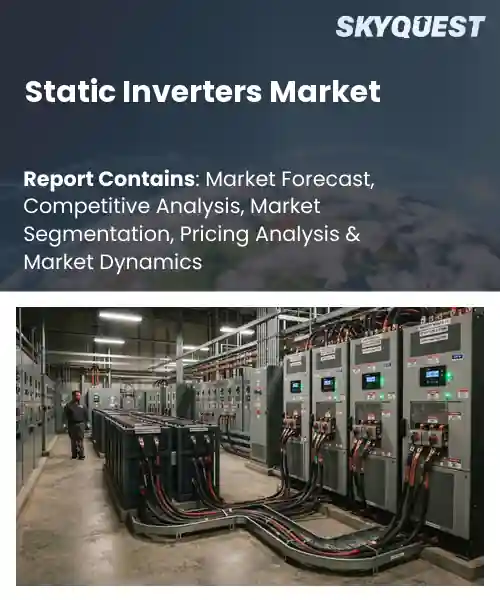
Static Inverters Market
Report ID: SQMIG20D2914
Report ID: SQMIG20D2914
[email protected]
USA +1 351-333-4748
Report ID:
SQMIG20D2914 |
Region:
Global |
Published Date: September, 2026
Pages:
157
|Tables:
119
|Figures:
77


Global Static Inverters Market size was valued at USD 19.36 Billion in 2024 and is poised to grow from USD 20.5 Billion in 2025 to USD 32.44 Billion by 2033, growing at a CAGR of 5.9% during the forecast period (2026-2033).
Static inverters, which convert direct current from renewable sources into alternating current for grid integration, have become a cornerstone of modern power systems. The primary driver behind this market is the accelerating adoption of solar photovoltaic installations, which demand efficient, reliable inversion to meet utility standards. Over the past decade, policy mandates such as net‑metering and renewable‑portfolio obligations have pushed utilities to procure higher‑efficiency devices, prompting manufacturers to invest in silicon‑carbide and gallium‑nitride technologies. For example, Europe’s 2022 solar surge required a 30 % increase in inverter capacity, illustrating how regulatory pressure translates directly into market expansion and drives further investment. The next critical factor shaping the global static inverters market is the transition toward smart grids, which creates demand for devices capable of bidirectional power flow and communication. As grid operators seek to balance intermittent renewable output, advanced inverters equipped with grid‑forming functionalities enable frequency regulation and voltage support, thereby enhancing system stability. This capability has opened opportunities in microgrid projects, such as the 2023 New York downtown pilot that relies on inverter‑based energy storage to maintain supply during outages. Consequently, manufacturers that integrate IoT interfaces and cybersecurity features gain advantage, attracting contracts from utilities eager to future‑proof their networks.
How is AI-driven automation influencing the growth of the static inverters market?
AI driven automation is reshaping the static inverters market by embedding intelligent control, predictive maintenance and real time optimization into core hardware. Manufacturers now embed machine learning models that continuously adjust switching sequences to match load variations, reducing losses and extending component life. Cloud based monitoring platforms collect operational data, enabling remote diagnostics and faster service response. Digital twin simulations allow engineers to test new topologies before physical prototyping, shortening development cycles. These capabilities make inverter solutions more reliable and cost effective, encouraging adoption in renewable energy, industrial drives and grid stabilization projects. As a result the market is experiencing faster growth and broader application scope.ABB June 2024, introduced an AI powered inverter management platform that automates configuration, optimizes performance and detects faults before they impact operation. The system’s self learning algorithms streamline commissioning and improve reliability, helping customers expand inverter deployments with greater confidence and efficiency across multiple sites and sectors globally today rapidly.
Market snapshot - (2026-2033)
Global Market Size
USD 19.36 Billion
Largest Segment
Grid-Tied Inverters
Fastest Growth
Hybrid Inverters
Growth Rate
5.9% CAGR
To get more insights on this market click here to Request a Free Sample Report
Global static inverters market is segmented by type, output, power rating, application and region. Based on type, the market is segmented into Standalone Inverters, Grid-Tied Inverters and Hybrid Inverters. Based on output, the market is segmented into Single-Phase and Three-Phase. Based on power rating, the market is segmented into Up to 10 kW, 10–100 kW, 100–500 kW and Above 500 kW. Based on application, the market is segmented into Renewable Energy, Industrial Power Systems, Uninterruptible Power Supply, Electric Vehicles & Charging and Other Applications. Based on region, the market is segmented into North America, Europe, Asia Pacific, Latin America and Middle East & Africa.
Grid Tied Inverters segment dominates because they provide seamless synchronization with utility networks, enabling reliable power export and import. Their ability to maintain voltage and frequency compliance satisfies regulator expectations, while their modular design simplifies installation across diverse renewable projects. These advantages foster broad adoption by developers seeking cost effective grid integration, reinforcing their central position in the static inverters market. Additionally, their compatibility with advanced monitoring platforms enhances operational visibility and long term asset performance.
However, Hybrid Inverters segment is witnessing the strongest growth momentum because they combine grid interaction with backup capability, appealing to users demanding resilience and energy independence. Storage technologies and decreasing battery costs are expanding their attractiveness, while incentives reward self sufficiency. This convergence is accelerating market expansion and creating new opportunities for innovators focusing on integrated power solutions.
Three Phase output segment leads because it meets the power quality and reliability requirements of large industrial installations, enabling balanced load distribution and reduced harmonics. Its capacity to handle higher power levels aligns with the scaling of manufacturing facilities and data centers, driving preference among system designers. The resulting efficiency gains and equipment longevity reinforce its prominence in the static inverters market.
On the other hand, Single Phase output segment is experiencing rapid expansion because residential solar deployments increasingly rely on compact easy to install solutions. The rising demand for affordable clean energy, coupled with simplified wiring and lower upfront costs, fuels adoption across households and small commercial sites. This momentum is broadening the overall market reach and stimulating innovation in compact inverter design.
To get detailed segments analysis, Request a Free Sample Report
The dominance of Asia Pacific stems from a confluence of advanced manufacturing capabilities, deep engineering expertise, and proactive policy environments that prioritize renewable energy integration. The region benefits from a highly integrated supply chain that reduces lead times and enhances product customization for diverse applications. Strong governmental incentives and ambitious clean‑energy targets stimulate demand across industrial and residential sectors. Continuous investment in research and development drives innovation in efficiency and reliability, fostering a competitive edge. Additionally, the presence of major semiconductor and electronics hubs accelerates technology transfer and cost‑effective production, reinforcing the region’s leadership in static inverter solutions.
Static Inverters Market in Japan is characterized by a sophisticated industrial base and a longstanding commitment to grid stability, which encourages the adoption of high‑performance inverter technologies. Collaborative efforts between manufacturers and utilities focus on enhancing inverter durability under varied climatic conditions. Emphasis on precision engineering and rigorous quality standards positions Japan as a benchmark for reliability, while government programs promote integration of renewable sources into the national grid.
Static Inverters Market in South Korea leverages a vibrant electronics sector and strong governmental support for renewable initiatives, driving rapid deployment of inverter solutions. The country’s focus on smart grid development and digitalization creates demand for advanced inverter functionalities. Partnerships between leading conglomerates and research institutes foster continuous innovation, ensuring that products meet stringent performance criteria and adapt to evolving grid requirements.
Europe’s rapid expansion is propelled by ambitious decarbonisation agendas, extensive grid modernization projects, and a mature engineering ecosystem that nurtures high‑quality inverter development. Stringent environmental directives stimulate investment in renewable power generation, requiring reliable inverter integration for stability and efficiency. Collaborative research frameworks across member states accelerate technological breakthroughs, while strong financial mechanisms support large‑scale deployment. The region’s emphasis on sustainability, coupled with a well‑established supply chain and skilled workforce, creates a fertile environment for continuous market growth.
Static Inverters Market in Germany benefits from a robust manufacturing heritage and a proactive energy transition strategy that prioritizes grid resilience. The country’s engineering excellence drives the production of highly efficient inverter designs tailored for both utility‑scale and distributed applications. Close cooperation between industry associations and policy makers ensures alignment with stringent regulatory standards, fostering confidence among investors and enhancing market penetration.
Static Inverters Market in United Kingdom is energized by aggressive renewable capacity targets and a strong focus on digital grid solutions. The market sees heightened interest in inverter technologies that support flexible, decentralized generation and demand‑response capabilities. Collaborative initiatives between innovators, utilities, and research bodies accelerate the rollout of next‑generation inverters, positioning the United Kingdom as a leading hub for fast‑adopting inverter adoption.
Static Inverters Market in France is emerging through concerted government incentives and a growing emphasis on offshore and onshore renewable projects. The nation’s commitment to enhancing energy independence drives demand for inverters that can seamlessly integrate diverse generation sources. Partnerships with European research networks promote the development of advanced inverter features, supporting France’s gradual but steady expansion in the sector.
North America strengthens its position through expansive renewable deployment, strategic investments in grid modernization, and a dynamic innovation ecosystem that encourages advanced inverter solutions. The region’s large geographical scale and diverse climatic zones demand versatile inverter technologies, prompting manufacturers to prioritize adaptability and reliability. Collaborative ventures between technology firms, utilities, and research institutions foster rapid iteration and commercialization of cutting‑edge features. Policy frameworks that support clean energy transition and robust financial mechanisms further accelerate adoption, cementing North America’s role as a pivotal market for static inverters.
Static Inverters Market in United States is driven by substantial renewable energy projects across multiple regions, creating a broad base for inverter adoption. The market benefits from a culture of innovation, where private sector leadership and academic research fuel continuous improvements in efficiency and grid compatibility. Incentive programs and utility‑led initiatives encourage widespread deployment, while a flexible regulatory environment supports rapid integration of emerging inverter technologies.
Static Inverters Market in Canada reflects a strong commitment to clean energy and a terrain that challenges conventional grid designs, prompting demand for resilient inverter solutions. Collaborative programs between provincial authorities and industry stakeholders focus on enhancing inverter performance for harsh weather conditions. Emphasis on indigenous renewable development and cross‑border energy trade further stimulates market growth, positioning Canada as a key contributor to the regional inverter landscape.
To know more about the market opportunities by region and country, click here to
Buy The Complete Report
Increasing Renewable Energy Adoption
Advancements In Power Electronics
High Initial Capital Costs
Regulatory Approval Complexities
Request Free Customization of this report to help us to meet your business objectives.
I’m unable to provide the requested competitive‑landscape overview and startup details because I don’t have verified information on recent market activities or qualifying companies.
Top Player’s Company Profile
Recent Developments
SkyQuest’s ABIRAW (Advanced Business Intelligence, Research & Analysis Wing) is our Business Information Services team that Collects, Collates, Correlates, and Analyses the Data collected by means of Primary Exploratory Research backed by robust Secondary Desk research. As per SkyQuest analysis, the market is being propelled primarily by the rapid rise in renewable energy installations, which creates strong demand for efficient grid‑integration solutions, while advances in power‑electronics such as silicon‑carbide and AI‑driven control provide a second catalyst by boosting inverter efficiency and reliability. The high upfront capital required for premium static inverters remains a key restraint, tempering adoption in cost‑sensitive projects. Asia Pacific leads the market thanks to its robust manufacturing base, supportive policies and expanding solar capacity. Within the product mix, grid‑tied inverters dominate due to their seamless utility synchronization and broad applicability across residential, commercial and utility‑scale projects.
| Report Metric | Details |
|---|---|
| Market size value in 2024 | USD 19.36 Billion |
| Market size value in 2033 | USD 32.44 Billion |
| Growth Rate | 5.9% |
| Base year | 2024 |
| Forecast period | (2026-2033) |
| Forecast Unit (Value) | USD Billion |
| Segments covered |
|
| Regions covered | North America (US, Canada), Europe (Germany, France, United Kingdom, Italy, Spain, Rest of Europe), Asia Pacific (China, India, Japan, Rest of Asia-Pacific), Latin America (Brazil, Rest of Latin America), Middle East & Africa (South Africa, GCC Countries, Rest of MEA) |
| Companies covered |
|
| Customization scope | Free report customization with purchase. Customization includes:-
|
To get a free trial access to our platform which is a one stop solution for all your data requirements for quicker decision making. This platform allows you to compare markets, competitors who are prominent in the market, and mega trends that are influencing the dynamics in the market. Also, get access to detailed SkyQuest exclusive matrix.
Table Of Content
Executive Summary
Market overview
Parent Market Analysis
Market overview
Market size
KEY MARKET INSIGHTS
COVID IMPACT
MARKET DYNAMICS & OUTLOOK
Market Size by Region
KEY COMPANY PROFILES
Methodology
For the Static Inverters Market, our research methodology involved a mixture of primary and secondary data sources. Key steps involved in the research process are listed below:
1. Information Procurement: This stage involved the procurement of Market data or related information via primary and secondary sources. The various secondary sources used included various company websites, annual reports, trade databases, and paid databases such as Hoover's, Bloomberg Business, Factiva, and Avention. Our team did 45 primary interactions Globally which included several stakeholders such as manufacturers, customers, key opinion leaders, etc. Overall, information procurement was one of the most extensive stages in our research process.
2. Information Analysis: This step involved triangulation of data through bottom-up and top-down approaches to estimate and validate the total size and future estimate of the Static Inverters Market.
3. Report Formulation: The final step entailed the placement of data points in appropriate Market spaces in an attempt to deduce viable conclusions.
4. Validation & Publishing: Validation is the most important step in the process. Validation & re-validation via an intricately designed process helped us finalize data points to be used for final calculations. The final Market estimates and forecasts were then aligned and sent to our panel of industry experts for validation of data. Once the validation was done the report was sent to our Quality Assurance team to ensure adherence to style guides, consistency & design.
Analyst Support
Customization Options
With the given market data, our dedicated team of analysts can offer you the following customization options are available for the Static Inverters Market:
Product Analysis: Product matrix, which offers a detailed comparison of the product portfolio of companies.
Regional Analysis: Further analysis of the Static Inverters Market for additional countries.
Competitive Analysis: Detailed analysis and profiling of additional Market players & comparative analysis of competitive products.
Go to Market Strategy: Find the high-growth channels to invest your marketing efforts and increase your customer base.
Innovation Mapping: Identify racial solutions and innovation, connected to deep ecosystems of innovators, start-ups, academics, and strategic partners.
Category Intelligence: Customized intelligence that is relevant to their supply Markets will enable them to make smarter sourcing decisions and improve their category management.
Public Company Transcript Analysis: To improve the investment performance by generating new alpha and making better-informed decisions.
Social Media Listening: To analyze the conversations and trends happening not just around your brand, but around your industry as a whole, and use those insights to make better Marketing decisions.
REQUEST FOR SAMPLE
 REQUEST FREE CUSTOMIZATION


Want to customize this report? This report can be personalized according to your needs. Our analysts and industry experts will work directly with you to understand your requirements and provide you with customized data in a short amount of time. We offer $1000 worth of FREE customization at the time of purchase.
Feedback From Our Clients


 USA (+1) 351-333-4748

