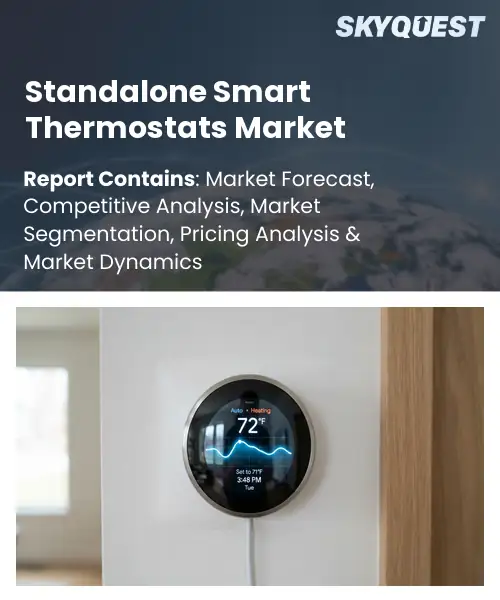
Standalone Smart Thermostats Market
Report ID: SQMIG25H2213
Report ID: SQMIG25H2213
[email protected]
USA +1 351-333-4748
Report ID:
SQMIG25H2213 |
Region:
Global |
Published Date: September, 2026
Pages:
157
|Tables:
152
|Figures:
78


Global Standalone Smart Thermostats Market size was valued at USD 2.5 Billion in 2024 and is poised to grow from USD 2.86 Billion in 2025 to USD 8.53 Billion by 2033, growing at a CAGR of 14.6% during the forecast period (2026-2033).
The surge in residential energy efficiency has emerged as the primary driver behind the standalone smart thermostat market. As households seek to lower utility bills and reduce carbon footprints, demand for devices that automate heating and cooling has risen sharply. Historically, thermostats were dial‑based controls; the introduction of programmable units in the early 2000s marked the first shift toward automation. Subsequent integration of Wi‑Fi connectivity and mobile apps transformed these products into standalone smart solutions capable of learning user patterns. For example, Nest’s launch in 2011 demonstrated the viability of cloud‑enabled temperature management, prompting established HVAC manufacturers to accelerate development. Energy‑price volatility and stricter building‑code regulations form the critical factor driving market growth, creating a cause‑and‑effect link for adoption. Rising electricity costs pressure homeowners to install smart thermostats that cut consumption by up to 15 percent through scheduling. Policies such as the EU’s EPBD and U.S. state incentive programs raise efficiency standards, shortening the payback period. A Denver apartment complex that added 5,000 thermostats saw a 12 percent reduction in heating fuel and earned a utility rebate. This blend of incentive and regulatory demand opens opportunities for OEMs to offer analytics services, target retrofit projects, and generate recurring revenue from cloud‑based reporting.
How are AI and IoT accelerating adoption in the standalone smart thermostats market?
AI and IoT are reshaping the standalone smart thermostat market by turning simple temperature controls into predictive, energy‑saving hubs. AI algorithms learn occupants’ schedules, weather patterns and heating system performance to fine‑tune heating and cooling without manual input. IoT connectivity links thermostats to smartphones, voice assistants and utility grids, enabling remote adjustments, real‑time diagnostics and demand‑response programs. Manufacturers now embed sensors that monitor humidity, occupancy and indoor air quality, creating richer data streams that feed back into AI models for continuous improvement. This convergence lowers energy bills, enhances comfort and simplifies installation, driving broader consumer acceptance and encouraging new entrants to develop differentiated, cloud‑enabled devices.In October 2023, Google introduced an AI‑enhanced Nest thermostat, showcasing how machine‑learning‑driven scheduling and seamless IoT integration can boost user adoption and operational efficiency in the market.
Market snapshot - (2026-2033)
Global Market Size
USD 2.5 Billion
Largest Segment
Wi-Fi Smart Thermostats
Fastest Growth
Learning Thermostats
Growth Rate
14.6% CAGR
To get more insights on this market click here to Request a Free Sample Report
Global standalone smart thermostats market is segmented by product type, connectivity, application, installation type, end-use industry and region. Based on product type, the market is segmented into Wi-Fi Smart Thermostats, Learning Thermostats, Programmable Smart Thermostats, Non-Programmable Smart Thermostats and Others. Based on connectivity, the market is segmented into Wi-Fi, Bluetooth, Zigbee, Z-Wave and Others. Based on application, the market is segmented into Heating, Cooling, Heating and Cooling and Others. Based on installation type, the market is segmented into Wall-Mounted, Portable and Others. Based on end-use industry, the market is segmented into Residential, Commercial Buildings, Hospitality, Retail, Healthcare and Others. Based on region, the market is segmented into North America, Europe, Asia Pacific, Latin America and Middle East & Africa.
Wi‑Fi Smart Thermostats segment dominates because it offers seamless integration with home networks, enabling users to control temperature remotely through smartphones and voice assistants. The ubiquity of broadband connections and consumer preference for easy‑to‑install devices drive widespread adoption. Manufacturers focus on intuitive interfaces and over‑the‑air updates, reinforcing reliability and user confidence, which solidifies its leading position in the standalone smart thermostats market and contributes to energy‑saving incentives for homeowners.
However, Learning Thermostats segment is witnessing the strongest growth momentum as adaptive algorithms personalize schedules based on occupancy patterns. Continuous data collection fuels smarter energy management, attracting eco‑conscious consumers and tech‑savvy early adopters. This innovation expands market reach and creates new opportunities for software‑driven value‑added services and strengthens brand loyalty.
Zigbee segment leads because it provides low‑power mesh networking that ensures reliable communication across multiple thermostats and ancillary sensors without overloading Wi‑Fi bandwidth. The protocol’s interoperability with major smart‑home ecosystems simplifies integration for installers and end‑users. Its resilience to signal interference and ability to cover large residential layouts make it a preferred choice for manufacturers seeking robust connectivity solutions in the standalone smart thermostats market and supports future firmware upgrades.
Meanwhile, Bluetooth segment emerges as the key high‑growth area as its direct‑pairing capability reduces installation complexity and eliminates the need for additional hubs. The proliferation of smartphones with built‑in Bluetooth and the push for plug‑and‑play experiences drive rapid consumer uptake. This trend accelerates market expansion and encourages innovative accessory development.
To get detailed segments analysis, Request a Free Sample Report
North America leads the global standalone smart thermostat market because of a confluence of technology leadership, high consumer awareness of energy savings, and mature residential construction practices. Manufacturers benefit from robust research ecosystems and close proximity to major technology hubs, enabling rapid product iteration and seamless integration with voice assistants and home automation platforms. Incentive programs and utility‑driven demand‑response initiatives encourage early adoption among homeowners, while a well‑established distribution network ensures ready product availability across both urban and suburban segments. Strong regulatory support for energy efficiency further reinforces market confidence, and the prevalence of retrofit projects in existing housing stock sustains continuous demand. Collectively, these dynamics create a self‑reinforcing environment that positions North America as the dominant arena for standalone smart thermostat solutions.
Standalone Smart Thermostats Market in United States is shaped by a highly connected consumer base that values convenience and cost containment. Strong brand presence and extensive partnerships with utility providers accelerate adoption, while a culture of early technology adoption drives demand for advanced features such as predictive heating and remote zoning. Ongoing home renovation trends and a focus on sustainability further reinforce the market’s depth and resilience in the residential sector.
Standalone Smart Thermostats Market in Canada benefits from proactive government incentives that promote energy‑efficient retrofits and a consumer mindset attuned to environmental stewardship. Collaboration between major appliance manufacturers and local utilities facilitates streamlined deployment of demand‑response programs, encouraging households to integrate intelligent climate control. The market also leverages strong broadband penetration and growing interest in smart‑home ecosystems, creating a supportive environment for premium and interoperable thermostat solutions across the nation wide.
Europe experiences rapid expansion of the standalone smart thermostat market due to a strong policy framework that emphasizes carbon reduction and building efficiency. Harmonized energy‑performance standards push developers and homeowners to adopt intelligent climate control solutions that can be integrated with renewable energy sources. High consumer awareness of sustainability, combined with dense urban housing stock, creates fertile ground for retrofitting initiatives and new construction projects. Robust collaboration between local manufacturers, technology firms, and utility providers enables tailored solutions that respect regional preferences and regulatory nuances. Additionally, the proliferation of interoperable smart‑home platforms and widespread broadband connectivity foster seamless user experiences, reinforcing demand across both mature and emerging market segments. This ecosystem encourages continuous product innovation and widens the appeal of energy‑smart living across residential and commercial environments.
Standalone Smart Thermostats Market in Germany is propelled by a rigorous energy‑efficiency agenda that incentivizes both new builds and extensive retrofits. Strong engineering expertise and a reputation for high‑quality manufacturing attract premium OEMs, while consumer demand for precise indoor climate control aligns with the country’s emphasis on sustainability. Integration with national smart‑grid initiatives and widespread adoption of renewable heating technologies further solidify Germany’s leading position in the sector in Europe today.
Standalone Smart Thermostats Market in United Kingdom is experiencing accelerated uptake driven by aggressive governmental housing decarbonisation schemes and generous subsidy programmes. Homeowners are motivated by energy cost visibility and the convenience of voice‑controlled climate adjustment. Partnerships between leading utility firms and technology startups accelerate rollout of demand‑response features, while the rise of mixed‑use developments creates new opportunities for integrated building management. This environment positions United Kingdom as the fastest‑growing market in Europe.
Standalone Smart Thermostats Market in France is emerging as consumers increasingly prioritize carbon‑neutral living and smart‑home convenience. National renovation incentives encourage the installation of intelligent climate devices in older apartment blocks, while a growing awareness of peak‑load pricing drives households toward programmable solutions. Collaboration between telecom operators and thermostat manufacturers expands connectivity options, and the influence of European Union energy directives reinforces market momentum, positioning France as a notable emerging player in the region.
Asia Pacific is strengthening its position in the standalone smart thermostat arena through a combination of rising middle‑class purchasing power, heightened awareness of energy costs, and vigorous governmental smart‑city agendas. Nations across the region are investing heavily in digital infrastructure, enabling seamless integration of thermostats with broader Internet‑of‑Things ecosystems and grid‑interactive services. Local manufacturers are accelerating product development cycles, often collaborating with global chipset providers to deliver region‑specific features such as humidity control for tropical climates. Urbanization trends and compact living spaces increase the appeal of space‑efficient climate management solutions, while subsidy schemes for energy‑saving retrofits boost adoption in both new builds and existing housing. These converging forces foster a dynamic market environment that propels Asia Pacific toward greater relevance in the global smart thermostat landscape.
Standalone Smart Thermostats Market in Japan is driven by a culture of precision engineering and a strong appetite for home automation. Government energy‑efficiency guidelines encourage households to adopt intelligent climate control, while high broadband penetration ensures reliable connectivity. Collaboration between domestic appliance brands and leading AI firms adds sophisticated learning algorithms that adapt to seasonal variations. Consumer preference for compact, aesthetically integrated devices aligns with Japan’s architectural trends, reinforcing market growth.
Standalone Smart Thermostats Market in South Korea benefits from rapid smart‑home adoption and regulatory frameworks that promote energy‑saving technologies. Leading electronics firms leverage advanced sensors to create responsive thermostat solutions suited to high‑rise apartments. Government incentives for green retrofits stimulate upgrades in existing homes, while extensive 5G coverage enables low‑latency remote control and integration with building‑management platforms. These elements accelerate market penetration and position South Korea as a key regional player.
To know more about the market opportunities by region and country, click here to
Buy The Complete Report
Increasing Energy Efficiency Awareness
Adoption Of Voice Controlled Systems
High Initial Installation Cost
Compatibility Issues With Legacy HVAC
Request Free Customization of this report to help us to meet your business objectives.
The standalone smart thermostat market is shaped by intense rivalry as incumbents and new entrants vie for ecosystem integration and energy‑efficiency leadership. Recent M&A activity, such as Honeywell’s acquisition of Resideo’s thermostat unit, and partnerships like Google’s collaboration with utility providers, illustrate how firms leverage consolidation and data‑sharing alliances to accelerate AI‑driven temperature control and differentiate product portfolios.
Top Player’s Company Profile
Recent Developments
SkyQuest’s ABIRAW (Advanced Business Intelligence, Research & Analysis Wing) is our Business Information Services team that Collects, Collates, Correlates, and Analyses the Data collected by means of Primary Exploratory Research backed by robust Secondary Desk research. As per SkyQuest analysis the global standalone smart thermostat market is being propelled primarily by growing energy‑efficiency awareness among consumers who seek lower utility bills and greener homes, while the rapid uptake of voice‑controlled systems adds a second boost by making hands‑free temperature adjustment commonplace. The Wi‑Fi smart thermostat segment leads the market because it offers the simplest remote‑control experience and universal compatibility, and North America remains the dominant region thanks to strong tech adoption, supportive incentives and an extensive retrofit base. The main restraint comes from the high initial installation cost, especially where professional wiring is required, which can deter price‑sensitive buyers and slow penetration.
| Report Metric | Details |
|---|---|
| Market size value in 2024 | USD 2.5 Billion |
| Market size value in 2033 | USD 8.53 Billion |
| Growth Rate | 14.6% |
| Base year | 2024 |
| Forecast period | (2026-2033) |
| Forecast Unit (Value) | USD Billion |
| Segments covered |
|
| Regions covered | North America (US, Canada), Europe (Germany, France, United Kingdom, Italy, Spain, Rest of Europe), Asia Pacific (China, India, Japan, Rest of Asia-Pacific), Latin America (Brazil, Rest of Latin America), Middle East & Africa (South Africa, GCC Countries, Rest of MEA) |
| Companies covered |
|
| Customization scope | Free report customization with purchase. Customization includes:-
|
To get a free trial access to our platform which is a one stop solution for all your data requirements for quicker decision making. This platform allows you to compare markets, competitors who are prominent in the market, and mega trends that are influencing the dynamics in the market. Also, get access to detailed SkyQuest exclusive matrix.
Table Of Content
Executive Summary
Market overview
Parent Market Analysis
Market overview
Market size
KEY MARKET INSIGHTS
COVID IMPACT
MARKET DYNAMICS & OUTLOOK
Market Size by Region
KEY COMPANY PROFILES
Methodology
For the Standalone Smart Thermostats Market, our research methodology involved a mixture of primary and secondary data sources. Key steps involved in the research process are listed below:
1. Information Procurement: This stage involved the procurement of Market data or related information via primary and secondary sources. The various secondary sources used included various company websites, annual reports, trade databases, and paid databases such as Hoover's, Bloomberg Business, Factiva, and Avention. Our team did 45 primary interactions Globally which included several stakeholders such as manufacturers, customers, key opinion leaders, etc. Overall, information procurement was one of the most extensive stages in our research process.
2. Information Analysis: This step involved triangulation of data through bottom-up and top-down approaches to estimate and validate the total size and future estimate of the Standalone Smart Thermostats Market.
3. Report Formulation: The final step entailed the placement of data points in appropriate Market spaces in an attempt to deduce viable conclusions.
4. Validation & Publishing: Validation is the most important step in the process. Validation & re-validation via an intricately designed process helped us finalize data points to be used for final calculations. The final Market estimates and forecasts were then aligned and sent to our panel of industry experts for validation of data. Once the validation was done the report was sent to our Quality Assurance team to ensure adherence to style guides, consistency & design.
Analyst Support
Customization Options
With the given market data, our dedicated team of analysts can offer you the following customization options are available for the Standalone Smart Thermostats Market:
Product Analysis: Product matrix, which offers a detailed comparison of the product portfolio of companies.
Regional Analysis: Further analysis of the Standalone Smart Thermostats Market for additional countries.
Competitive Analysis: Detailed analysis and profiling of additional Market players & comparative analysis of competitive products.
Go to Market Strategy: Find the high-growth channels to invest your marketing efforts and increase your customer base.
Innovation Mapping: Identify racial solutions and innovation, connected to deep ecosystems of innovators, start-ups, academics, and strategic partners.
Category Intelligence: Customized intelligence that is relevant to their supply Markets will enable them to make smarter sourcing decisions and improve their category management.
Public Company Transcript Analysis: To improve the investment performance by generating new alpha and making better-informed decisions.
Social Media Listening: To analyze the conversations and trends happening not just around your brand, but around your industry as a whole, and use those insights to make better Marketing decisions.
REQUEST FOR SAMPLE
 REQUEST FREE CUSTOMIZATION


Want to customize this report? This report can be personalized according to your needs. Our analysts and industry experts will work directly with you to understand your requirements and provide you with customized data in a short amount of time. We offer $1000 worth of FREE customization at the time of purchase.
Feedback From Our Clients


 USA (+1) 351-333-4748

