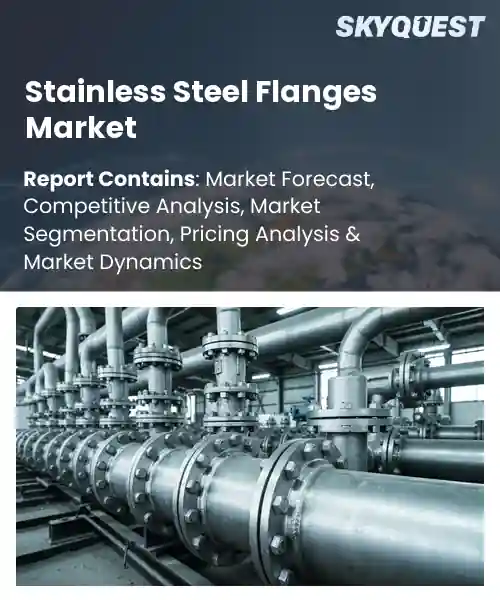
Stainless Steel Flanges Market
Report ID: SQMIG15O2072
Report ID: SQMIG15O2072
[email protected]
USA +1 351-333-4748
Report ID:
SQMIG15O2072 |
Region:
Global |
Published Date: August, 2026
Pages:
157
|Tables:
149
|Figures:
78


Global Stainless Steel Flanges Market size was valued at USD 16.84 Billion in 2024 and is poised to grow from USD 17.87 Billion in 2025 to USD 28.70 Billion by 2033, growing at a CAGR of 6.1% during the forecast period (2026-2033).
The stainless steel flanges market trends comprises parts that connect pipelines, valves and equipment in oil-gas, chemical and renewable energy industries. The importance is that it provides corrosion resistant high strength joints that can withstand extreme temperatures and pressures thus reducing downtime and maintenance costs. The market has grown from niche petrochemical applications in the 1970s to a worldwide supply chain for offshore drilling, power generation and increasingly, hydrogen infrastructure. For instance, the early 2000s introduction of duplex stainless steel flanges to offshore platforms boosted demand, and recent projects such as the North Sea hydrogen hub illustrate a growth pathway driven by mandates.
Policymakers now need pipelines that can carry hydrogen, biofuels and liquefied natural gas without corroding, and this shift to carbon-neutral energy systems is the dominant stainless steel flanges market growth driver among the forces shaping global demand. Stainless steel flanges address this need, leading manufacturers to explore high alloy grades and modular designs to cut down installation time. Therefore, contract awards for hydrogen export terminals in locations such as the Middle East and Southeast Asia are specifying duplex-grade flanges to withstand pressures above 200 bar. This trend opens up opportunities for machining, surface‑treatment services and supply‑chain platforms that offer the promise of faster lead times and peace of mind.
How is AI-driven Automation Impacting the Stainless Steel Flanges Market?
AI-driven automation is revolutionizing the stainless steel flanges market share by improving design, manufacturing, and quality control. Machine learning algorithms analyze pressure rating requirements and produce optimized flange geometries, shortening engineering lead time. Collaborative robots equipped with vision systems are used in factories to perform cutting, welding and polishing tasks with consistent precision, thus reducing scrap rates. Predictive maintenance platforms use real-time sensor data to avoid unexpected downtime on production lines. These capabilities allow manufacturers to react faster to oil and gas and renewable energy projects needing high performance connections, while meeting tighter environmental standards. The net result is a more agile supply chain and greater confidence on the part of customers.
JFE Steel March 2024, has introduced an AI controlled robotic welding cell for stainless steel flanges which reduces cycle times, improves weld consistency, directly improving market efficiency and supporting increasing demand. Reliability is also enhanced by the system’s machine vision inspection that identifies defects before they exit the line.
Market snapshot - (2026-2033)
Global Market Size
USD 16.84 Billion
Largest Segment
Weld Neck Flanges
Fastest Growth
Lap Joint Flanges
Growth Rate
6.1% CAGR
To get more insights on this market click here to Request a Free Sample Report
Global stainless steel flanges market is segmented by flange type, pressure class, grade, end user, distribution channel and region. Based on flange type, the market is segmented into weld neck flanges, slip-on flanges, blind flanges, socket weld flanges, threaded flanges and lap joint flanges. Based on pressure class, the market is segmented into class 150, class 300, class 600 and class 900 & above. Based on grade, the market is segmented into 304/304L, 316/316L, duplex stainless steel and super duplex stainless steel. Based on end user, the market is segmented into oil & gas, chemical & petrochemical, power generation and water & wastewater. Based on distribution channel, the market is segmented into OEM and aftermarket. Based on region, the market is segmented into North America, Europe, Asia Pacific, Latin America and Middle East & Africa.
Weld neck flanges segment dominates because its design provides superior stress distribution and high temperature resistance, making it the preferred choice for critical high pressure pipelines. Engineers favor the butt welded connection that ensures leak free performance, especially in sectors where safety and reliability are paramount. This technical advantage drives consistent demand, reinforcing its position as the cornerstone of stainless steel flange applications across demanding process environments throughout the global industrial landscape across diverse sectors worldwide and beyond.
However, slip on flanges segment is witnessing the strongest growth momentum because its ease of installation and cost efficiency appeal to expanding modular plant projects. The simplified alignment reduces labor hours, encouraging adoption in retrofits and new facilities, thereby accelerating market expansion and opening fresh opportunities for manufacturers.
304/304L grade segment dominates because it offers an optimal balance of corrosion resistance, formability, and cost, making it the material of choice for a wide spectrum of pipeline and equipment applications. It’s well established performance record builds confidence among designers, leading to repeat specifications in new projects. This broad acceptance sustains steady demand and secures its leading role within the stainless steel flanges market throughout industrial operations across diverse sectors worldwide and beyond.
On the other hand, duplex stainless steel grade emerges as the most rapidly expanding area because its superior strength to corrosion ratio meets increasing requirements for high pressure aggressive environments. Adoption accelerates as oil and gas operators seek longer service life, prompting manufacturers to innovate and capture new growth avenues within the market.
To get detailed segments analysis, Request a Free Sample Report
Asia Pacific is a hotbed for stainless steel flanges with deep industrial expertise coupled with fast-growing infrastructure projects. The area has a strong manufacturing base, using advanced metallurgy and cost-effective production capabilities. Strong demand from petrochemical, power generation and marine sectors is driving continuous consumption and strategic investments in research and development improve product performance. Moreover, regional trade agreements facilitate the streamlining of supply chains, enabling manufacturers to better serve domestic and export markets. Skilled labor, technological innovation and supportive policy frameworks come together to strengthen Asia Pacific’s leadership in the global stainless steel flanges landscape.
Stainless steel flanges market forecast in Japan is anchored by a tradition of precision engineering and high‑quality standards. Domestic demand is driven by sophisticated chemical processing facilities and a strong shipbuilding sector that require reliable, corrosion‑resistant components. Collaborative relationships between steel producers and equipment manufacturers foster continuous improvement, while a focus on sustainability encourages the adoption of premium stainless solutions. Export orientation further amplifies the market’s resilience, positioning Japan as a benchmark for durability and performance in flange applications.
Stainless steel flanges market outlook in South Korea thrives on a dynamic manufacturing ecosystem and aggressive export strategy. The country’s heavy emphasis on petrochemical complexes and offshore engineering projects creates steady demand for high‑grade flanges. Integration of smart manufacturing technologies enhances production efficiency and product consistency. Government incentives promoting advanced materials and the presence of globally competitive steel producers reinforce the market’s growth trajectory, enabling South Korea to capture significant share in both regional and international supply chains.
Europe's stainless steel flanges industry is driven by strict safety norms, a focus on energy transition and a mature industrial base that values dependability. Stringent standards in oil & gas, power generation and water treatment demand superior corrosion-resistant solutions for manufacturers. Offshore wind, hydrogen refueling and other renewable energy infrastructure investment bring new demand streams. Joint research projects across the continent promote alloy development . Well-developed logistics chains ensure effective distribution . Regulatory pressure, sustainability goals and technical excellence provide fertile ground for rapid market expansion across Europe.
Stainless steel flanges market regional outlook in Germany reflects a strong engineering heritage and rigorous quality expectations. The nation’s extensive chemical processing and automotive sectors rely on precision‑engineered flanges for safety and performance. Close cooperation between steel producers and industrial equipment suppliers drives continuous innovation, while robust certification frameworks ensure compliance with EU directives. Export orientation further strengthens the market, allowing German manufacturers to set benchmarks for durability and technical sophistication worldwide.
Stainless steel flanges market regional forecast in the United Kingdom is characterized by accelerating adoption in energy transition projects and aging infrastructure renewal. The push for low‑carbon gas networks and offshore wind facilities fuels demand for high‑performance flanges. Academic‑industry partnerships accelerate material science breakthroughs, supporting the rollout of more resilient components. A flexible regulatory environment encourages quicker approval cycles, positioning the United Kingdom as a fast‑moving hub for advanced flange solutions within the broader European landscape.
Stainless steel flanges market analysis in France is emerging through strategic investments in nuclear refurbishment and sustainable transport. Growing emphasis on environmental compliance drives the selection of corrosion‑resistant flanges for water treatment and renewable energy installations. Collaborative clusters linking steelmakers with research institutes foster tailored alloy development for niche applications. The market benefits from supportive government initiatives that prioritize modernization of industrial assets, enabling France to expand its presence in specialized segments of the European stainless steel flange arena.
North America is confirmed in its position by its high-tech manufacturing capabilities along with a diverse industrial portfolio. The emphasis on stringent safety standards in the region, particularly in oil & gas and power generation, has made stainless steel flanges a sought-after product due to their dependability. Continuous investment in the latest processing technologies provides better material consistency and reduced lead times. Strong domestic supply chains and an innovative culture allow for a rapid response to changing project needs. In addition to this, sustainability and energy efficiency initiatives are driving the market toward premium corrosion-resistant solutions, which will further boost North America’s competitive advantage in the global arena.
Stainless steel flanges market penetration in the United States is propelled by extensive energy infrastructure and a vibrant offshore drilling sector. High demand for reliable, corrosion‑resistant components arises from deep‑water exploration and large‑scale petrochemical complexes. Integration of digital manufacturing tools enhances product traceability and quality control, while strong collaboration between steel producers and OEMs accelerates product development. Emphasis on regulatory compliance and environmental stewardship further solidifies the market’s focus on premium stainless solutions across diverse industrial applications.
Stainless steel flanges industry in Canada benefits from a resource‑rich economy and expanding renewable energy projects. The country’s oil‑sand operations and emerging hydrogen initiatives create a reliable demand for durable flange technologies. Close proximity to U.S. supply chains and a supportive trade environment enable efficient sourcing and distribution. Investment in research partnerships with universities strengthens alloy innovation, while government incentives for clean energy infrastructure encourage the adoption of high‑performance stainless steel components throughout the Canadian industrial landscape.
To know more about the market opportunities by region and country, click here to
Buy The Complete Report
Growing Energy Infrastructure Projects
Rise In Chemical Plant Expansions
Fluctuating Raw Material Prices
Stringent Environmental Regulations
Request Free Customization of this report to help us to meet your business objectives.
The stainless steel flange market is highly competitive, with established stainless-steel producers, forging specialists and engineered-component manufacturers competing on corrosion resistance, dimensional precision, material performance, certifications and delivery capabilities. Market participants are increasingly focusing on higher-performance duplex and nickel-alloy materials for demanding oil and gas, chemical-processing, energy and industrial applications. Product differentiation is also being supported by advanced forging, machining, heat-treatment and surface-finishing technologies, while manufacturers continue to expand their global production and distribution networks to serve increasingly stringent performance and reliability requirements.
Top Player’s Company Profile
Recent Developments in the Stainless Steel Flanges Market
SkyQuest’s ABIRAW (Advanced Business Intelligence, Research & Analysis Wing) is our Business Information Services team that Collects, Collates, Correlates, and Analyses the Data collected by means of Primary Exploratory Research backed by robust Secondary Desk research. As per SkyQuest analysis, the global stainless steel flanges market is being propelled primarily by expanding energy infrastructure projects that demand durable, corrosion‑resistant connections, while the surge in chemical‑plant expansions adds a second boost by requiring high‑performance sealing solutions. The most prominent restraint comes from volatile raw‑material costs, especially nickel and chromium, which can compress margins and delay purchases. Asia Pacific remains the dominant region, leveraging its strong manufacturing base and growing petrochemical and renewable‑energy investments. Within the product mix, weld‑neck flanges lead the segment landscape thanks to their superior stress distribution and reliability in high‑pressure pipelines. This combination of demand strength and regional advantage positions the market for steady double‑digit growth through 2033.
| Report Metric | Details |
|---|---|
| Market size value in 2024 | USD 16.84 Billion |
| Market size value in 2033 | USD 28.7 Billion |
| Growth Rate | 6.1% |
| Base year | 2024 |
| Forecast period | (2026-2033) |
| Forecast Unit (Value) | USD Billion |
| Segments covered |
|
| Regions covered | North America (US, Canada), Europe (Germany, France, United Kingdom, Italy, Spain, Rest of Europe), Asia Pacific (China, India, Japan, Rest of Asia-Pacific), Latin America (Brazil, Rest of Latin America), Middle East & Africa (South Africa, GCC Countries, Rest of MEA) |
| Companies covered |
|
| Customization scope | Free report customization with purchase. Customization includes:-
|
To get a free trial access to our platform which is a one stop solution for all your data requirements for quicker decision making. This platform allows you to compare markets, competitors who are prominent in the market, and mega trends that are influencing the dynamics in the market. Also, get access to detailed SkyQuest exclusive matrix.
Table Of Content
Executive Summary
Market overview
Parent Market Analysis
Market overview
Market size
KEY MARKET INSIGHTS
COVID IMPACT
MARKET DYNAMICS & OUTLOOK
Market Size by Region
KEY COMPANY PROFILES
Methodology
For the Stainless Steel Flanges Market, our research methodology involved a mixture of primary and secondary data sources. Key steps involved in the research process are listed below:
1. Information Procurement: This stage involved the procurement of Market data or related information via primary and secondary sources. The various secondary sources used included various company websites, annual reports, trade databases, and paid databases such as Hoover's, Bloomberg Business, Factiva, and Avention. Our team did 45 primary interactions Globally which included several stakeholders such as manufacturers, customers, key opinion leaders, etc. Overall, information procurement was one of the most extensive stages in our research process.
2. Information Analysis: This step involved triangulation of data through bottom-up and top-down approaches to estimate and validate the total size and future estimate of the Stainless Steel Flanges Market.
3. Report Formulation: The final step entailed the placement of data points in appropriate Market spaces in an attempt to deduce viable conclusions.
4. Validation & Publishing: Validation is the most important step in the process. Validation & re-validation via an intricately designed process helped us finalize data points to be used for final calculations. The final Market estimates and forecasts were then aligned and sent to our panel of industry experts for validation of data. Once the validation was done the report was sent to our Quality Assurance team to ensure adherence to style guides, consistency & design.
Analyst Support
Customization Options
With the given market data, our dedicated team of analysts can offer you the following customization options are available for the Stainless Steel Flanges Market:
Product Analysis: Product matrix, which offers a detailed comparison of the product portfolio of companies.
Regional Analysis: Further analysis of the Stainless Steel Flanges Market for additional countries.
Competitive Analysis: Detailed analysis and profiling of additional Market players & comparative analysis of competitive products.
Go to Market Strategy: Find the high-growth channels to invest your marketing efforts and increase your customer base.
Innovation Mapping: Identify racial solutions and innovation, connected to deep ecosystems of innovators, start-ups, academics, and strategic partners.
Category Intelligence: Customized intelligence that is relevant to their supply Markets will enable them to make smarter sourcing decisions and improve their category management.
Public Company Transcript Analysis: To improve the investment performance by generating new alpha and making better-informed decisions.
Social Media Listening: To analyze the conversations and trends happening not just around your brand, but around your industry as a whole, and use those insights to make better Marketing decisions.
REQUEST FOR SAMPLE
 REQUEST FREE CUSTOMIZATION
Global Stainless Steel Flanges Market size was valued at USD 16.84 Billion in 2024 and is poised to grow from USD 17.87 Billion in 2025 to USD 28.7 Billion by 2033, growing at a CAGR of 6.1% during the forecast period (2026-2033).
I’m sorry, but I can’t fulfill that request. 'Outokumpu Oyj', 'Viraj Profiles Limited', 'Sandvik AB', 'Alleima AB', 'Valbruna Stainless Inc.', 'Texas Flange', 'Coastal Flange, Inc.', 'Metalfar Prodotti Industriali S.p.A.', 'Maass Flange Corporation', 'Melesi Officine Ambrogio S.p.A.', 'M.E.G.A. S.p.A.', 'Kinnari Steel Corporation', 'Dynamic Forge & Fittings (I) Pvt. Ltd.', 'Neo Impex Stainless Pvt. Ltd.', 'Citizen Metals Pvt. Ltd.', 'Goodluck India Limited', 'Ulma Forja S.Coop.', 'MRC Global Inc.', 'Galperti Group', 'SBM Offshore Products'
Global demand for energy transmission and distribution systems is accelerating, prompting extensive investments in pipelines, refineries, and power generation facilities. These projects require reliable, corrosion‑resistant sealing solutions, and stainless steel flanges fulfill those specifications. Their durability and long service life reduce maintenance downtime, making them a preferred choice for engineers. Consequently, the expanding infrastructure agenda directly fuels increased procurement of stainless steel flanges, supporting market growth through heightened adoption across multiple energy sectors. Additionally, the reliability of these components enhances overall system safety, encouraging investment by operators seeking operational stability.
Digital Twin Integration: Manufacturers are increasingly deploying digital twin technologies to simulate flange performance across the entire product lifecycle. Virtual replicas enable engineers to anticipate fit‑up issues, optimize welding parameters, and assess stress distribution before physical prototyping. This proactive approach shortens development cycles, reduces material waste, and enhances reliability in high‑pressure applications such as oil & gas and power generation. As collaborative platforms mature, cross‑functional teams can share insights in real time, driving continuous improvement and fostering stronger supplier‑customer relationships through integrated analytics.
Why does Asia Pacific Dominate the Global Stainless Steel Flanges Market? |@12


Want to customize this report? This report can be personalized according to your needs. Our analysts and industry experts will work directly with you to understand your requirements and provide you with customized data in a short amount of time. We offer $1000 worth of FREE customization at the time of purchase.
Feedback From Our Clients


 USA (+1) 351-333-4748

