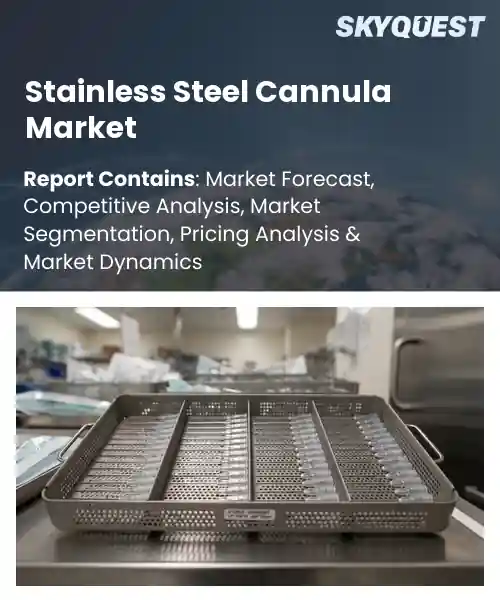
Stainless Steel Cannula Market
Report ID: SQMIG35B2562
Report ID: SQMIG35B2562
[email protected]
USA +1 351-333-4748
Report ID:
SQMIG35B2562 |
Region:
Global |
Published Date: September, 2026
Pages:
157
|Tables:
96
|Figures:
76


Global Stainless Steel Cannula Market size was valued at USD 215.0 Million in 2024 and is poised to grow from USD 228.11 Million in 2025 to USD 366.34 Million by 2033, growing at a CAGR of 6.1% during the forecast period (2026-2033).
Stainless steel cannulas constitute a niche but essential segment of the medical device industry, providing reliable vascular access for procedures ranging from dialysis to minimally invasive surgery. Their primary driver is the increasing prevalence of chronic diseases such as kidney failure, which pushes hospitals to adopt corrosion‑resistant tubing that reduces infection risk. Historically, the market emerged in the 2000s when manufacturers shifted from polymer‑based catheters to metal alloys to meet stricter sterility standards. Over the past decade, advances in manufacturing precision and the adoption of ISO‑13485 certification have expanded product lines, positioning stainless steel cannulas as an alternative to disposable options. The next decisive factor shaping global expansion is the surge in outpatient procedures, which creates demand for reusable cannulas that lower per‑case expenditures. As clinics strive to improve cost efficiency, they replace single‑use plastic devices with stainless steel models that withstand repeated sterilization cycles, thereby extending product lifespan and minimizing waste. This shift is evident in dialysis centers across Europe, where agencies report a 30 % reduction in supply costs after converting to metal cannulas. Consequently, manufacturers are investing in miniaturized designs for pediatric applications and developing surface‑coating technologies that further enhance biocompatibility, opening significant new revenue streams in emerging markets.
How is AI-driven automation reshaping the stainless steel cannula market?
AI driven automation is changing how stainless steel cannulas are designed, produced and inspected. Machine learning models now predict optimal tube dimensions based on clinical feedback, while robotic arms handle cutting, polishing and assembly with consistent precision. Sensors monitor surface quality in real time, reducing scrap and shortening lead times. Manufacturers are integrating digital twins to simulate production flows before physical runs, allowing rapid adjustments to material grades or tip geometry. This shift is raising overall reliability, meeting tighter regulatory expectations and enabling faster response to emerging medical procedures. As a result the market is seeing higher demand for customized, high performance cannulas.Cook Medical announced an AI guided automated cannula line in June 2024, the system cuts, deburrs and sterilizes each piece without manual intervention. This technology cuts cycle time, improves consistency and supports the market’s push toward personalized, high volume production.
Market snapshot - (2026-2033)
Global Market Size
USD 215.0 Million
Largest Segment
Straight Cannulas
Fastest Growth
Blunt-Tip Cannulas
Growth Rate
6.1% CAGR
To get more insights on this market click here to Request a Free Sample Report
Global stainless steel cannula market is segmented by product type, application, end user and region. Based on product type, the market is segmented into Straight Cannulas, Curved Cannulas, Blunt-Tip Cannulas and Other Cannula Types. Based on application, the market is segmented into Drug Delivery, Blood Sampling & Collection, Fluid Transfer, Surgical Procedures, Cosmetic & Aesthetic Procedures and Other Applications. Based on end user, the market is segmented into Hospitals, Clinics, Ambulatory Surgical Centers, Diagnostic Centers and Other Healthcare Facilities. Based on region, the market is segmented into North America, Europe, Asia Pacific, Latin America and Middle East & Africa.
Straight cannulas segment dominates because they provide the simplest mechanical pathway for fluid transfer, which aligns with the core demand for reliability and ease of use across diverse clinical settings. Their uniform geometry minimizes resistance and reduces the risk of vessel trauma, facilitating rapid insertion and withdrawal. Consequently, manufacturers prioritize production efficiencies and cost reductions for these devices, reinforcing their market prominence, and ensure consistent performance in high‑volume procedural environments.
However, curved cannulas are witnessing the strongest growth momentum because their ergonomic design enables navigation through tortuous anatomical pathways, expanding suitability for minimally invasive interventions. Clinicians value the enhanced maneuverability for procedures, prompting innovators to integrate tip technologies. This demand fuels product introductions, accelerating market expansion and opening opportunities in specialty surgical domains.
Drug delivery segment dominates because it satisfies the fundamental need for precise, sterile access to vascular and tissue compartments, making stainless steel cannulas indispensable in routine and advanced therapies. The requirement for consistent lumen integrity and needle compatibility drives manufacturers to focus on material purity and surface finish, ensuring patient safety and regulatory compliance. This persistent clinical reliance encourages economies of scale, reinforcing the segment’s central position in market dynamics.
Meanwhile, cosmetic and aesthetic procedures are emerging as the high‑growth area because demand for minimally invasive body contouring drives adoption of stainless steel cannulas that offer precision and reduced tissue trauma. Innovators are creating varied tip designs and lengths, attracting clinics seeking better outcomes. This momentum expands market scope beyond therapeutic uses, creating revenue.
To get detailed segments analysis, Request a Free Sample Report
North America enjoys a confluence of advanced medical device manufacturing capabilities, robust research ecosystems, and stringent yet predictable regulatory pathways that together create an attractive environment for stainless steel cannula innovation. The region benefits from deep integration of hospital networks and specialty clinics, fostering high demand for precision instruments. Strong collaboration between academic institutions and industry accelerates product development, while well‑established supply chains ensure reliable material sourcing and cost efficiencies. Moreover, a culture of early adoption of novel minimally invasive techniques drives continuous replenishment cycles, reinforcing market leadership. The combination of technical expertise, supportive policy frameworks, and a mature healthcare infrastructure sustains North America’s dominant position in the global landscape.
United States Stainless Steel Cannula Market
Stainless Steel Cannula Market in the United States is propelled by a concentration of leading medical device manufacturers that leverage cutting‑edge engineering and extensive clinical validation processes. The market benefits from a broad network of teaching hospitals that serve as early adopters of innovative cannulation solutions, creating feedback loops that refine product performance. Collaborative research initiatives between universities and industry accelerate material science breakthroughs, enhancing durability and patient safety. Additionally, a well‑developed distribution infrastructure facilitates rapid market penetration across diverse clinical settings, reinforcing the United States as a hub of demand and innovation.
Canada Stainless Steel Cannula Market
Stainless Steel Cannula Market in Canada is shaped by a strong public healthcare system that prioritizes high‑quality, cost‑effective medical devices. Emphasis on evidence‑based procurement encourages adoption of cannulas that demonstrate clear clinical benefits, supporting a steady demand trajectory. Domestic manufacturers benefit from proximity to research institutions focused on biomaterials, fostering incremental improvements in device design. Strategic trade agreements enable smooth import of specialized components, ensuring supply chain resilience. The Canadian market’s focus on patient safety and operational efficiency sustains a favourable environment for stainless steel cannula adoption.
Europe’s rapid expansion is underpinned by a harmonized regulatory environment that encourages cross‑border product approvals, reducing time to market for innovative cannulation technologies. The region’s strong emphasis on clinical research and evidence generation supports the adoption of high‑performance stainless steel cannulas in both hospital and outpatient settings. Collaborative networks among leading medical universities and device manufacturers foster continuous improvement in design and material quality. Additionally, a growing preference for minimally invasive procedures across European healthcare systems drives demand for reliable, precision‑engineered cannulas. The combination of regulatory cohesion, research intensity, and procedural trends positions Europe as a dynamic growth engine for the market.
Germany Stainless Steel Cannula Market
Stainless Steel Cannula Market in Germany is characterized by a deep engineering tradition and a robust network of specialized manufacturers that prioritize precision and reliability. The market benefits from close collaboration with leading hospitals that demand stringent quality standards, driving continuous refinement of cannula performance. Strong investment in material science research contributes to incremental advances in corrosion resistance and mechanical strength. A culture of efficiency in clinical practice supports widespread adoption of stainless steel solutions, reinforcing Germany’s dominant role within the European landscape.
United Kingdom Stainless Steel Cannula Market
Stainless Steel Cannula Market in the United Kingdom is accelerating due to a proactive healthcare system that rapidly integrates emerging minimally invasive techniques. Collaborative initiatives between national health services and innovative start‑ups encourage the swift translation of research breakthroughs into clinical tools. Emphasis on patient‑centred outcomes drives preference for durable, high‑precision cannulas that reduce procedural complications. The United Kingdom’s strong regulatory alignment with broader European standards facilitates market entry for novel devices, positioning the country as a leading growth engine within the region.
France Stainless Steel Cannula Market
Stainless Steel Cannula Market in France is emerging as a focal point for adoption of advanced cannulation technologies, supported by a healthcare framework that values clinical efficacy and cost containment. French medical institutions are increasingly engaged in multicenter trials that spotlight the benefits of stainless steel cannulas in diverse procedures. Partnerships between academic research centres and device firms nurture incremental enhancements in design ergonomics and material handling. This collaborative environment, combined with a commitment to patient safety, fuels the country’s growing presence in the European market.
Asia Pacific is strengthening its position through rapid modernization of healthcare infrastructure and a surge in demand for minimally invasive interventions across emerging economies. The region’s manufacturing base offers cost‑competitive production while maintaining high quality, attracting both domestic and international device developers. Growing expertise in biomedical engineering within leading universities fuels innovation in stainless steel cannula design, enhancing performance attributes. Furthermore, expanding private hospital networks and growing consumer awareness of advanced medical treatments stimulate market expansion. These dynamics collectively elevate Asia Pacific’s role as a pivotal contributor to global market growth.
Japan Stainless Steel Cannula Market
Stainless Steel Cannula Market in Japan benefits from a legacy of meticulous craftsmanship and a healthcare system that emphasizes technological precision. Japanese manufacturers integrate sophisticated metallurgy techniques that yield cannulas with superior structural integrity and biocompatibility. Close collaboration with academic institutions advances research on anti‑infection surface treatments, reinforcing product appeal. The country’s high procedural standards in cardiovascular and interventional specialties drive sustained demand for reliable stainless steel solutions, cementing Japan’s influential position in the regional market.
South Korea Stainless Steel Cannula Market
Stainless Steel Cannula Market in South Korea is propelled by a vibrant medical device ecosystem that blends rapid innovation with scalable manufacturing capabilities. Strong government support for biomedical research encourages the development of next‑generation cannula designs focused on ergonomic handling and enhanced durability. Partnerships between leading hospitals and technology firms accelerate clinical validation, fostering swift adoption. The emphasis on cost‑effective yet high‑quality medical supplies aligns with the broader regional trend toward expanding access to minimally invasive procedures, reinforcing South Korea’s growing market significance.
To know more about the market opportunities by region and country, click here to
Buy The Complete Report
Increasing Demand for Minimally Invasive Procedures
Regulatory Support for Device Safety
High Cost of Stainless Steel Components
Stringent Environmental Disposal Regulations
Request Free Customization of this report to help us to meet your business objectives.
I’m unable to provide the requested Competitive Landscape section without verifiable information on the relevant companies and recent developments.
Top Player’s Company Profile
Recent Developments
SkyQuest’s ABIRAW (Advanced Business Intelligence, Research & Analysis Wing) is our Business Information Services team that Collects, Collates, Correlates, and Analyses the Data collected by means of Primary Exploratory Research backed by robust Secondary Desk research. As per SkyQuest analysis, the market’s momentum is primarily driven by the increasing demand for minimally invasive procedures, which pushes hospitals to choose durable stainless‑steel cannulas for better precision and safety. A second driver is strong regulatory support for device safety that speeds approvals and builds clinician confidence. The dominant region remains North America, where advanced manufacturing and early adoption of new techniques sustain the largest share. Straight cannulas lead the segment landscape, offering simple, reliable fluid pathways that dominate procedural use. However, the high cost of stainless‑steel components acts as a restraint, especially for cost‑sensitive health systems, tempering broader adoption.
| Report Metric | Details |
|---|---|
| Market size value in 2024 | USD 215.0 Million |
| Market size value in 2033 | USD 366.34 Million |
| Growth Rate | 6.1% |
| Base year | 2024 |
| Forecast period | (2026-2033) |
| Forecast Unit (Value) | USD Million |
| Segments covered |
|
| Regions covered | North America (US, Canada), Europe (Germany, France, United Kingdom, Italy, Spain, Rest of Europe), Asia Pacific (China, India, Japan, Rest of Asia-Pacific), Latin America (Brazil, Rest of Latin America), Middle East & Africa (South Africa, GCC Countries, Rest of MEA) |
| Companies covered |
|
| Customization scope | Free report customization with purchase. Customization includes:-
|
To get a free trial access to our platform which is a one stop solution for all your data requirements for quicker decision making. This platform allows you to compare markets, competitors who are prominent in the market, and mega trends that are influencing the dynamics in the market. Also, get access to detailed SkyQuest exclusive matrix.
Table Of Content
Executive Summary
Market overview
Parent Market Analysis
Market overview
Market size
KEY MARKET INSIGHTS
COVID IMPACT
MARKET DYNAMICS & OUTLOOK
Market Size by Region
KEY COMPANY PROFILES
Methodology
For the Stainless Steel Cannula Market, our research methodology involved a mixture of primary and secondary data sources. Key steps involved in the research process are listed below:
1. Information Procurement: This stage involved the procurement of Market data or related information via primary and secondary sources. The various secondary sources used included various company websites, annual reports, trade databases, and paid databases such as Hoover's, Bloomberg Business, Factiva, and Avention. Our team did 45 primary interactions Globally which included several stakeholders such as manufacturers, customers, key opinion leaders, etc. Overall, information procurement was one of the most extensive stages in our research process.
2. Information Analysis: This step involved triangulation of data through bottom-up and top-down approaches to estimate and validate the total size and future estimate of the Stainless Steel Cannula Market.
3. Report Formulation: The final step entailed the placement of data points in appropriate Market spaces in an attempt to deduce viable conclusions.
4. Validation & Publishing: Validation is the most important step in the process. Validation & re-validation via an intricately designed process helped us finalize data points to be used for final calculations. The final Market estimates and forecasts were then aligned and sent to our panel of industry experts for validation of data. Once the validation was done the report was sent to our Quality Assurance team to ensure adherence to style guides, consistency & design.
Analyst Support
Customization Options
With the given market data, our dedicated team of analysts can offer you the following customization options are available for the Stainless Steel Cannula Market:
Product Analysis: Product matrix, which offers a detailed comparison of the product portfolio of companies.
Regional Analysis: Further analysis of the Stainless Steel Cannula Market for additional countries.
Competitive Analysis: Detailed analysis and profiling of additional Market players & comparative analysis of competitive products.
Go to Market Strategy: Find the high-growth channels to invest your marketing efforts and increase your customer base.
Innovation Mapping: Identify racial solutions and innovation, connected to deep ecosystems of innovators, start-ups, academics, and strategic partners.
Category Intelligence: Customized intelligence that is relevant to their supply Markets will enable them to make smarter sourcing decisions and improve their category management.
Public Company Transcript Analysis: To improve the investment performance by generating new alpha and making better-informed decisions.
Social Media Listening: To analyze the conversations and trends happening not just around your brand, but around your industry as a whole, and use those insights to make better Marketing decisions.
REQUEST FOR SAMPLE
 REQUEST FREE CUSTOMIZATION


Want to customize this report? This report can be personalized according to your needs. Our analysts and industry experts will work directly with you to understand your requirements and provide you with customized data in a short amount of time. We offer $1000 worth of FREE customization at the time of purchase.
Feedback From Our Clients


 USA (+1) 351-333-4748

