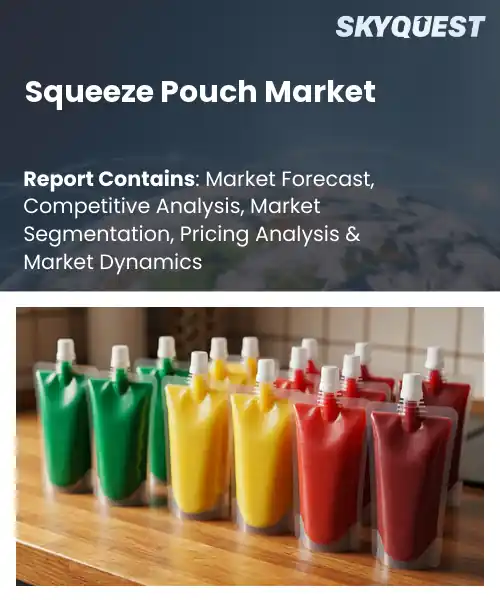
Squeeze Pouch Market
Report ID: SQMIG15H2186
Report ID: SQMIG15H2186
[email protected]
USA +1 351-333-4748
Report ID:
SQMIG15H2186 |
Region:
Global |
Published Date: March, 2026
Pages:
157
|Tables:
116
|Figures:
77


Global Squeeze Pouch Market size was valued at USD 74.86 billion in 2024 and is poised to grow from USD 78.153 billion in 2025 to USD 110.7 billion by 2033, growing at a CAGR of 4.4% during the forecast period (2026-2033).
Convenience-driven consumption is now the main factor that drives the global squeeze pouch market growth, which leads to changes in how people access on-the-go nutrition because of the urbanization and dual-income household lifestyle changes that brought about this convenience requirement. The flexible squeeze pouch system provides resealable packets that deliver purees and smoothies plus baby food and supplements with simple handling to customers, because the system enables users to store products for extended periods while using less material than rigid packaging systems.
In the past years, manufacturers developed new formulations, introduced recyclable laminates and designed products for various feeding occasions, which included major CPG brands launching organic puree lines and startups creating protein-forward pouches that appeal to busy parents and active adults.
In addition, the global squeeze pouch market penetration is driven mainly through sustainable packaging development, which results from brands needing recyclable and compostable materials to fulfill environmental obligations and create new retail connections according to regulatory requirements and customer preferences. Companies that spend money on mono-material pouches create better recyclability, which leads recycling programs and supermarkets to accept these products, while their acceptance boosts both shelf availability and customer testing. Startups use direct-to-consumer channels to sell their functional formulations, while manufacturers achieve better profit margins through premium eco-labeling, which creates business potential across sports nutrition, eldercare, and meal-replacement segments in international markets.
How is AI Optimizing Supply Chain Efficiency in the Squeeze Pouch Market?
AI technology enables supply chains for squeeze pouch operations to achieve better performance through its capacity to create a synchronized network which operates in real time while connecting demand forecasting with production scheduling and quality control and logistics functions. The system contains core components that include machine learning forecasts for baby food demand during seasonal periods and computer vision quality inspections for filling and capping lines and equipment maintenance predictions for pouch machines and distribution route optimization for delivery.
The market context experiences a rising need for products that deliver both practical use and environmentally friendly characteristics which compels brands to launch new stock-keeping units within tight deadlines while they need to keep product safety documentation. The technology of AI demonstrates its ability to enhance fill precision through its function of matching spout and closure requirements with production needs, which also decreases costly production interruptions.
Market snapshot - 2026-2033
Global Market Size
USD 78.4 Billion
Largest Segment
Plastic Pouches
Fastest Growth
Compostable Materials
Growth Rate
4.6% CAGR
To get more insights on this market click here to Request a Free Sample Report
The global squeeze pouch market is segmented based on material type, closure type, application, end user, and region. By material type, the market is categorized into plastic pouches and compostable materials. In terms of closure type, it includes spout pouches, zip lock pouches, and tear notch pouches. Based on application, the market is divided into food packaging, cosmetics, and pharmaceuticals. By end user, it is segmented into commercial use, household use, and others. Geographically, the market is segmented into North America, Europe, Asia Pacific, Latin America, and the Middle East and Africa.
As per the global squeeze pouch market analysis, the Compostable Materials segment leads the market because consumers and brands now consider sustainability an essential factor when selecting pouches in the market. Eco-focused purchasing causes formulators and retailers to prefer biobased and certified compostable films, which leads suppliers to increase their production capacity while gaining essential compliance certifications, resulting in wider market adoption of certified compostable solutions across food, cosmetics and pharmaceuticals as compostable products become the standard industry practice.
However, the plastic pouch segment represents the fastest growing segment within the Squeeze Pouch Market because it delivers value through its cost-effective nature and ability to work with current production systems. The continuous development of barrier coatings, lightweight products and recyclable packaging solutions enables manufacturers to produce various packaging options with different price ranges, which helps companies access new markets and distribute their products for common household usage.
According to the global squeeze pouch market forecast, the spout pouches segment occupies the leading position in the market because its dispensing features and easy handling of liquids plus semi-liquids meet the basic functional requirements of customers who use Squeeze Pouches. The use of precise pouring designs and reclosing systems helps customers to maintain better control of products, while these designs improve their overall experience, so food and cosmetics brands plus pharmaceutical companies will benefit from using spouted designs that include custom valve systems and dedicated spout filling equipment.
Whereas the zip lock pouch system is anticipated to have the highest squeeze pouch market share because its re-sealability feature allows consumers to use it for both convenient access and controlling their portion sizes. The new material compatibility along with their re-closable profiles has expanded their potential uses to include snacks, powders and multipack formats, which results in more households adopting these products while brands create opportunities to establish value for customers through repetitive product usage that decreases their need for single-use items.
To get detailed segments analysis, Request a Free Sample Report
As per the squeeze pouch market regional forecast, North America leads squeeze pouch sales because consumers want easy-to-use products which retail businesses sell extensively through their innovation networks. On-the-go formats find acceptance among all consumer groups, while manufacturers develop products that will suit every age group from infants to adults who need meal supplements and snacks. Retailers achieve quick product expansion through their private label operations and their alliances with major retail chains which help them gain more product distribution and store display space.
The combination of advanced food safety standards and transparent product information enables brands to charge higher prices because customers trust these brands. E-commerce platforms and supply chain systems ensure that products remain available for purchase in both urban and suburban areas. Research and development investment together with sustainability work and recyclable package development creates market dominance while establishing high entry barriers which protect against competition from emerging market players.
The United States Squeeze Pouch sector exhibits high consumer understanding of portable products together with active private label market growth and ongoing development of new nutrition and convenience items. The retail partnerships work together with the omnichannel distribution system to establish product availability across all urban and suburban regions. The combination of premium product placement and extensive marketing resources leads to product testing and repeat purchases while regulatory bodies and supply chain strength keep products safe and show customers their value plus brand distinction.
The Canadian Squeeze Pouch Market prospers from health-conscious customers who prefer clean label and organic products which Canadian retailers sell through their distribution networks. National retailers and regional suppliers work together to create exclusive product lines which match local consumer needs and seasonal product demands. Sustainable packaging practices and transparent sourcing methods build customer trust, while innovation hubs and private label development sustain category vitality across both urban centers and more remote communities with strong collaboration.
European consumers who want convenient packaging that maintains essential nutrients want better access to squeeze pouch products. The growing interest among consumers for clean labelsand organic and regionally sourced products has led manufacturers to design new products which they sell as premium items. Modern retail channels, including disciplined supermarket networks and expanding online grocery platforms, facilitate wide distribution and targeted marketing. The implementation of food safety regulations together with proper labeling requirements builds trust among consumers of different ages.
Brand owners and retailers establish collaborative programs which speed up their product development process across various local markets while creating products that meet the shopping requirements of environmentally conscious customers through recyclable and refillable packaging designs. Active product demonstrations and educational campaigns about nutrition together with influencer promotions lead to increased household product testing, which also happens when local producers share their traditional foods. Product diversification occurs at a faster rate when innovation spreads between neighboring markets.
The Squeeze Pouch industry in Germany has developed its industry through local production capabilities which create complete retail systems that deliver safe food processing technologies to consumers. Domestic producers focus on product safety and nutritional integrity and packaging innovation while major retailers work together to design special products. The German market supports premium positioning through its transparent ingredient culture together with customer demand for quality and its circular economy projects which determine its material selection processes and supply chain connections.
The United Kingdom shows an active market for Squeeze Pouch products which people use according to current trends while they access digital content through flexible shopping systems. The busy household segment shows strong trial potential because brands use influencer partnerships and targeted sampling while e-commerce and convenience channel growth creates better access to products. Product developers create new flavors and multi-purpose packaging designs which customers can use for different mealtimes. The category of development in urban areas depends on shoppers' trust which stems from sustainability statements and easy-to-understand ingredient information.
The French Squeeze Pouch Market emerges through artisanal and premium positioning, with consumers receptive to gourmet flavors and provenance claims. Smaller producers provide parents with recipes based on their regional foods which they can quickly prepare, while larger brands create products with better ingredient lists. The health aisle and specialty aisle retailers help create special product collections which street kiosks need to sell while customers show interest in shopping spaces because of sustainability initiatives and product details that provide transparent information.
Asia Pacific develops its squeeze pouch market by introducing local product developments and establishing new production facilities and implementing advanced shopping and online retail systems. The producers create product formulas that match local taste preferences and nutritional needs while investing in flexible packaging technology and supply chain management systems for their distribution networks. Multinational companies and local manufacturers establish partnerships which enable both firms to exchange technological expertise while they enter new market territories. The combination of convenience-seeking consumer behavior and increased consumer knowledge about ingredient composition and sustainable practices leads to product lines that meet the nutritional needs of infants and adults who require food for different urban and suburban situations.
Consumers in Japan Squeeze Pouch Market exhibit high sophistication which leads them to prefer products that provide premium quality along with advanced taste profiles and nutritional benefits. Domestic companies develop advanced systems which enable their clients to produce high-quality products through automated dispensing solutions while maintaining strict quality control processes. Retailers develop specific product collections which showcase product origins and customer convenience while sustainable packaging design solutions and space-efficient packaging cater to urban consumer needs for both infant and adult feeding products across various retail channels.
South Korean consumers show a positive response to new product experiences which include unique texture combinations and strong flavor profiles and products that offer easy consumption. Companies use flexible product development processes combined with strong relationships to launch new products which meet current market demands through their active online and mobile sales channels. Younger urban consumers are attracted to products which showcase ingredient transparency alongside premium product features and trendy packaging designs. Sustainability messaging and localized flavor innovation leads to new customer acquisition by attracting diverse demographic segments and various household types.
To know more about the market opportunities by region and country, click here to
Buy The Complete Report
Rising Demand for Convenience Packaging
Squeeze pouches attract consumers who want convenient food options because they match their preference for simple food products which require minimal preparation time. The manufacturers use single-handed feeding systems together with resealable spouts and portion control features to create products that caregivers and active consumers can easily access. Retailers show interest in providing shelf space for products that bring about consumer convenience while brands use this opportunity to develop new products which focus on making their items easier to carry. This trend encourages brands to invest more in their marketing and distribution systems, which create portable products that are easy to use. The trend results in the product becoming popular among various consumer groups.
Innovations in Packaging Materials
Advanced manufacturing technologies for lightweight films and spout design and multilayer barrier materials enable manufacturers to provide better product safety while delivering improved customer convenience, which leads to manufacturers developing more product options for their squeeze pouch product range. The suppliers enable their products to function better because they deliver extended shelf-life protection together with flavor preservation while providing recyclable products and solutions that use less material to help brands stand out and customers approve their designs. The market has become more versatile as material innovations drive companies to boost their research and development investments while they work with their supply chain partners to accelerate their product development process.
Environmental Concerns Over Disposal
Public knowledge about the end-of-life challenges which face multilayer flexible pouches combined with restricted recycling system capabilities has created negative public opinion which blocks environmentally aware customers and retail businesses from adopting this packaging solution. Packaging implementation strategies experience increased complexity because brands need to handle packaging management challenges which involve environmental contamination control, material separation difficulties, and recycling process identification limitations, which leads them to develop new packaging methods or product return systems. The environmental examination process will lengthen its approval periods which leads to delays in product market entrance because businesses will choose to invest their resources in developing sustainable product redesigns instead of pursuing fast market growth.
Supply Chain Integration Challenges
The market faces expansion limitations because businesses need to fulfill three conditions which include developing custom filling machinery, verifying suppliers, and achieving operational alignment between material producers and food manufacturers. Technical expertise and cross-functional planning work together to create essential requirements which production line changes need to implement pouch format support. Companies need to conduct resource-intensive validation procedures which require them to establish partnerships and modify existing operational processes. The resource allocation shift towards integration work causes companies to lose their ability to quickly establish regional market presence, which results in slower market growth for the entire region.
Request Free Customization of this report to help us to meet your business objectives.
The global squeeze pouch market exhibits competitive dynamics which depend on sustainable material innovations and existing contract pack facilities which lead to specific M&A activities and strategic business partnerships and filling technology improvements. The partnership between Amcor and Cheer Pack produces an all-PE spouted pouch for Stonyfield while SIG introduces its advanced aseptic pouch sterilization system for in-line use. The co-packers are developing their short run and digital printing capabilities to attract business from brands which want to win brand business.
Convenience Driven Innovation
Premiumization and Differentiation
SkyQuest’s ABIRAW (Advanced Business Intelligence, Research & Analysis Wing) is our Business Information Services team that Collects, Collates, Correlates, and Analyses the Data collected by means of Primary Exploratory Research backed by robust Secondary Desk research.
As per SkyQuest analysis, the squeeze pouch market experiences growth because consumers want products which provide them with easy-to-use solutions while companies use sustainability to create recyclable and compostable packaging. Environmental concerns about disposal and recycling limits make up the main barrier which prevents people from using the product while making it hard to spread the product to more people. North America leads as the main region because its retail channels and innovation ecosystems support compostable materials as the main segment which consumers and brands choose to show their environmental commitment. Manufacturers choose from three areas which include material innovation and fill technology upgrades and supply chain investments to achieve business growth in food and cosmetics and pharmaceutical sectors.
| Report Metric | Details |
|---|---|
| Market size value in 2024 | USD 74.86 billion |
| Market size value in 2033 | USD 110.7 billion |
| Growth Rate | 4.4% |
| Base year | 2024 |
| Forecast period | 2026-2033 |
| Forecast Unit (Value) | USD Billion |
| Segments covered |
|
| Regions covered | North America (US, Canada), Europe (Germany, France, United Kingdom, Italy, Spain, Rest of Europe), Asia Pacific (China, India, Japan, Rest of Asia-Pacific), Latin America (Brazil, Rest of Latin America), Middle East & Africa (South Africa, GCC Countries, Rest of MEA) |
| Companies covered |
|
| Customization scope | Free report customization with purchase. Customization includes:-
|
To get a free trial access to our platform which is a one stop solution for all your data requirements for quicker decision making. This platform allows you to compare markets, competitors who are prominent in the market, and mega trends that are influencing the dynamics in the market. Also, get access to detailed SkyQuest exclusive matrix.
Table Of Content
Executive Summary
Market overview
Parent Market Analysis
Market overview
Market size
KEY MARKET INSIGHTS
COVID IMPACT
MARKET DYNAMICS & OUTLOOK
Market Size by Region
KEY COMPANY PROFILES
Methodology
For the Squeeze Pouch Market, our research methodology involved a mixture of primary and secondary data sources. Key steps involved in the research process are listed below:
1. Information Procurement: This stage involved the procurement of Market data or related information via primary and secondary sources. The various secondary sources used included various company websites, annual reports, trade databases, and paid databases such as Hoover's, Bloomberg Business, Factiva, and Avention. Our team did 45 primary interactions Globally which included several stakeholders such as manufacturers, customers, key opinion leaders, etc. Overall, information procurement was one of the most extensive stages in our research process.
2. Information Analysis: This step involved triangulation of data through bottom-up and top-down approaches to estimate and validate the total size and future estimate of the Squeeze Pouch Market.
3. Report Formulation: The final step entailed the placement of data points in appropriate Market spaces in an attempt to deduce viable conclusions.
4. Validation & Publishing: Validation is the most important step in the process. Validation & re-validation via an intricately designed process helped us finalize data points to be used for final calculations. The final Market estimates and forecasts were then aligned and sent to our panel of industry experts for validation of data. Once the validation was done the report was sent to our Quality Assurance team to ensure adherence to style guides, consistency & design.
Analyst Support
Customization Options
With the given market data, our dedicated team of analysts can offer you the following customization options are available for the Squeeze Pouch Market:
Product Analysis: Product matrix, which offers a detailed comparison of the product portfolio of companies.
Regional Analysis: Further analysis of the Squeeze Pouch Market for additional countries.
Competitive Analysis: Detailed analysis and profiling of additional Market players & comparative analysis of competitive products.
Go to Market Strategy: Find the high-growth channels to invest your marketing efforts and increase your customer base.
Innovation Mapping: Identify racial solutions and innovation, connected to deep ecosystems of innovators, start-ups, academics, and strategic partners.
Category Intelligence: Customized intelligence that is relevant to their supply Markets will enable them to make smarter sourcing decisions and improve their category management.
Public Company Transcript Analysis: To improve the investment performance by generating new alpha and making better-informed decisions.
Social Media Listening: To analyze the conversations and trends happening not just around your brand, but around your industry as a whole, and use those insights to make better Marketing decisions.
REQUEST FOR SAMPLE
 REQUEST FREE CUSTOMIZATION
Global Squeeze Pouch Market size was valued at USD 78.4 Billion in 2024 and is poised to grow from USD 82.01 Billion in 2025 to USD 117.52 Billion by 2033, growing at a CAGR of 4.6% during the forecast period (2026-2033).
Key vendors in the Squeeze Pouch market include major packaging companies such as Amcor plc, Berry Global Inc., Mondi Group, Huhtamaki Oyj, ProAmpac LLC, Sealed Air Corporation, Sonoco Products Company, and Coveris Holdings, along with other regional players driving innovation in flexible and sustainable packaging solutions.
The key driver of the Squeeze Pouch market is the growing demand for convenient, lightweight, and portable packaging solutions. Increasing consumer preference for on-the-go food and beverages, along with rising demand for eco-friendly and cost-effective flexible packaging, is significantly boosting market growth.
A key market trend in the Squeeze Pouch market is the increasing adoption of sustainable and recyclable packaging materials, including mono-material and biodegradable pouches. Additionally, brands are focusing on innovative, lightweight designs and smart packaging features to enhance convenience, extend shelf life, and reduce environmental impact.
North America accounted for the largest share in the Squeeze Pouch market, driven by high demand for convenient packaging, strong presence of food and beverage brands, and early adoption of innovative and sustainable packaging solutions.


Want to customize this report? This report can be personalized according to your needs. Our analysts and industry experts will work directly with you to understand your requirements and provide you with customized data in a short amount of time. We offer $1000 worth of FREE customization at the time of purchase.
Feedback From Our Clients


 USA (+1) 351-333-4748

