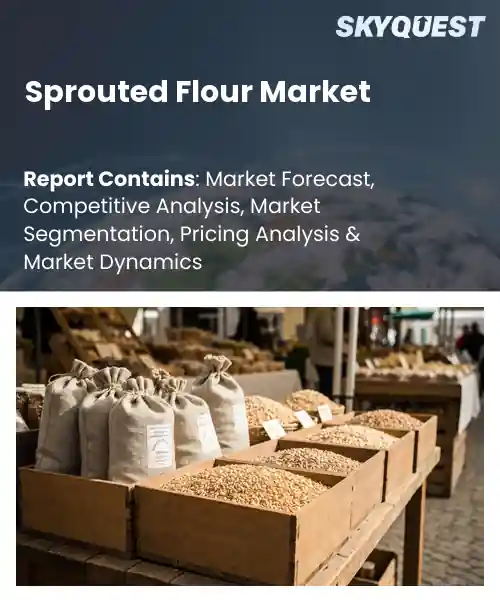
Sprouted Flour Market
Report ID: SQMIG30I3058
Report ID: SQMIG30I3058
[email protected]
USA +1 351-333-4748
Report ID:
SQMIG30I3058 |
Region:
Global |
Published Date: July, 2026
Pages:
157
|Tables:
172
|Figures:
79


Global Sprouted Flour Market size was valued at USD 342.6 Million in 2024 and is poised to grow from USD 397.76 Million in 2025 to USD 1313.04 Million by 2033, growing at a CAGR of 16.1% during the forecast period (2026-2033).
Global sprouted flour market produces flour from grains that are germinated before milling, a process that activates enzymes and raises protein, vitamin and mineral levels while lowering antinutrients. It matters because it satisfies growing consumer demand for clean‑label ingredients that aid gut health and align with sourcing. Originating in the early 2000s as a niche in health‑food stores, the segment expanded alongside functional‑food trend; by 2022 mainstream retailers such as Whole Foods and Tesco stocked sprouted‑whole‑grain and sprouted‑rye flour. Products like Bob’s Red Mill’s Sprouted Wheat Flour and sprouted quinoa flour demonstrate the shift from artisanal offerings to a commodity. The surge in food‑service innovation continually drives market growth because chefs and manufacturers pursue ingredients that combine nutrition with appealing texture. Replacing conventional flour with sprouted alternatives yields loaves with higher protein and a milder taste, prompting consumers to favor them and generating repeat purchases that motivate product line extensions. This positive feedback has drawn major CPG firms such as General Mills and Danone to fund sprouted‑grain research and collaborate with germination technology specialists. As a result, new opportunities expand in gluten‑reduced snack bars, protein‑rich pastries, and sustainable sourcing models that exploit shorter germination cycles to cut overall energy consumption.
How is AI-driven automation influencing product innovation in the sprouted flour market?
AI‑driven automation is reshaping sprouted flour innovation by linking sensor data from germination chambers to machine‑learning models that predict nutrient profiles and functional properties. These insights let millers adjust temperature, moisture and timing in real time, creating consistent flour with targeted protein and fiber levels. Automated grinding and sieving systems then fine‑tune particle size without manual intervention, speeding up prototype cycles. The technology also enables rapid formulation testing, where virtual simulations suggest blend ratios for gluten‑free or high‑rise applications before any physical batch is produced. As a result, companies can launch new products faster, reduce waste and respond to consumer trends for clean, functional ingredients.Sprout Foods June 2023, launched an AI‑powered platform that customizes sprouted flour blends for bakery use, cutting development time and expanding product variety while supporting market growth.
Market snapshot - (2026-2033)
Global Market Size
USD 342.6 Million
Largest Segment
Services
Fastest Growth
Software
Growth Rate
16.1% CAGR
To get more insights on this market click here to Request a Free Sample Report
Global sprouted flour market is segmented by offering, deployment mode, data type, application, enterprise size, end user industry and region. Based on offering, the market is segmented into Software and Services. Based on deployment mode, the market is segmented into Cloud-Based, On-Premises and Hybrid. Based on data type, the market is segmented into Structured Data, Unstructured Data and Semi-Structured Data. Based on application, the market is segmented into Data Governance, Regulatory Compliance, Data Lineage Management and Others. Based on enterprise size, the market is segmented into Small Enterprises, Medium Enterprises and Large Enterprises. Based on end user industry, the market is segmented into BFSI, Healthcare, IT & Telecommunications and Others. Based on region, the market is segmented into North America, Europe, Asia Pacific, Latin America and Middle East & Africa.
Software segment dominates because it enables manufacturers to digitize recipe development, optimize grain sprouting cycles, and integrate quality control sensors, delivering attributes that satisfy nutrition focused consumers. Time inventory tracking and demand forecasting align supply with purchasing peaks, cutting waste and boosting margins. It also connects R&D teams with supply chain partners through online collaboration tools, fostering improvement in sprouting techniques and ingredient sourcing. Such integration enhances traceability and builds consumer trust, reinforcing market appeal.
However, Services segment is witnessing the strongest growth momentum because consulting and managed support firms are helping grain processors adopt sustainable sprouting practices, certify organic status, and navigate evolving nutrition labeling rules, thereby lowering entry barriers for small producers. These value added services spur wider market participation and generate new revenue streams, accelerating overall market expansion.
Cloud-Based segment dominates because it grants sprouted flour producers instant access to scalable analytics platforms that monitor germination parameters, moisture levels, and microbial activity without heavy upfront hardware costs. This flexibility enables rapid experimentation with grain varieties and processing schedules, shortening product development cycles and improving batch consistency. Seamless integration with supplier portals and ecommerce channels also streamlines order fulfillment and traceability, driving broader adoption of digital tools across the industry.
Meanwhile, Hybrid segment is emerging as the key high growth area because it blends the agility of cloud services with the security of on premises infrastructure, satisfying manufacturers that handle sensitive proprietary grain formulations. This balanced approach encourages incremental digital adoption, supports legacy equipment integration, and opens avenues for collaborative research partnerships, fueling further market expansion.
To get detailed segments analysis, Request a Free Sample Report
North America’s leadership stems from a mature consumer base that prioritizes health‑focused eating and sustainability. Retail channels are highly integrated, enabling rapid product rollout across supermarkets, specialty stores, and online platforms. Food manufacturers invest heavily in research and innovation, creating diverse sprouted flour blends that cater to clean‑label trends. Regulatory frameworks support natural ingredient claims, reinforcing consumer confidence. Additionally, culinary culture embraces whole‑grain and sprouted options, driving consistent demand across baked goods, snacks, and ready‑to‑eat categories. The combination of strong distribution networks, proactive product development, and a health‑aware populace consolidates North America’s dominant position.
United States Sprouted Flour Market
Sprouted Flour Market in the United States benefits from a vibrant health‑food movement, where consumers actively seek nutrient‑dense alternatives. Leading bakeries and consumer packaged goods companies integrate sprouted flours into mainstream product lines, reinforcing visibility. Consumer education initiatives and influencer advocacy amplify awareness, while retail shelf space continues to expand. Supply chain collaborations with sprouting farms ensure quality and traceability, reinforcing the market’s credibility and encouraging broader adoption across diverse culinary applications.
Canada Sprouted Flour Market
Sprouted Flour Market in Canada is driven by strong consumer interest in functional foods and a robust natural products sector. Retail environments emphasize locally sourced, minimally processed ingredients, aligning with sprouted flour attributes. Food manufacturers experiment with hybrid formulations that combine traditional and sprouted grains, appealing to both artisanal and mass‑market segments. Collaborative research between academic institutions and industry supports continual product innovation, while sustainability narratives resonate with environmentally conscious shoppers, fostering steady market momentum.
Europe’s rapid expansion is propelled by increasing consumer demand for nutrient‑rich, environmentally responsible food choices. Regulatory support for clean‑label claims encourages manufacturers to adopt sprouted flour as a natural functional ingredient. Culinary traditions across the region prize grain diversity, making sprouted varieties an attractive addition to breads, pastries, and plant‑based products. Strong retail networks, coupled with a growing number of specialty health stores, amplify product exposure. Collaborative innovation between food processors and agritech firms enhances sprouting techniques, ensuring consistent quality and reinforcing consumer trust, while sustainability narratives align with the region’s broader eco‑conscious agenda.
Germany Sprouted Flour Market
Sprouted Flour Market in Germany thrives on a well‑established whole‑grain culture and a proactive approach to food innovation. Large‑scale bakeries and craft producers alike experiment with sprouted flour blends, highlighting nutritional benefits on packaging. Consumer awareness campaigns and culinary education reinforce the health narrative, while retail channels prioritize shelf placement for sprouted alternatives. Partnerships with local grain growers ensure supply chain transparency, supporting the market’s reputation for quality and sustainability.
United Kingdom Sprouted Flour Market
Sprouted Flour Market in the United Kingdom experiences accelerated growth through vibrant consumer interest in functional nutrition and plant‑based diets. Food manufacturers rapidly integrate sprouted flours into bakery, snack, and ready‑meal formats, responding to demand for natural protein and fiber sources. Influencer partnerships and media coverage amplify product visibility, while retail outlets expand dedicated sections for sprouted grain products. Collaborative research with agronomic institutes enhances sprouting efficiencies, reinforcing confidence in product consistency and supporting ongoing market expansion.
France Sprouted Flour Market
Sprouted Flour Market in France is emerging amid a strong tradition of artisanal baking and a rising focus on health‑forward ingredients. Boutique bakeries experiment with sprouted flours to create novel textures and flavors, positioning them as premium offerings. Consumer curiosity is nurtured by educational content emphasizing digestive benefits and natural nutrition. Retail distribution begins to feature sprouted flour options alongside conventional grains, while collaborations with local grain cooperatives foster sustainable sourcing, laying groundwork for future market growth.
Asia Pacific is strengthening its position through a convergence of rising health consciousness, expanding middle‑class consumer bases, and innovative food processing capabilities. Culinary practices that value grain diversity encourage the integration of sprouted flours into traditional and modern dishes. Governments and industry groups support research into sprouting technologies that enhance nutritional value while preserving local grain characteristics. Retail formats ranging from modern supermarkets to online platforms increase accessibility, and partnerships with agritech firms improve supply chain resilience. This blend of cultural affinity, technological advancement, and market accessibility is propelling the region toward a more prominent role in the global sprouted flour landscape.
Japan Sprouted Flour Market
Sprouted Flour Market in Japan benefits from a culture that values functional foods and precise nutrition. Food manufacturers incorporate sprouted flours into breads, noodles, and snack items, emphasizing natural health benefits. Consumer education through media and wellness programs enhances acceptance, while retail channels offer dedicated sections for sprouted grain products. Collaboration with domestic grain growers ensures high‑quality raw material, supporting product consistency and reinforcing Japan’s emerging leadership in innovative flour applications.
South Korea Sprouted Flour Market
Sprouted Flour Market in South Korea is driven by a growing appetite for wholesome, protein‑rich alternatives within a fast‑moving consumer goods environment. Food brands experiment with sprouted flours in bakery and convenience food lines, capitalizing on consumer trends toward natural nutrition. Online marketplaces and modern retail stores provide broad distribution, while university‑industry research projects refine sprouting processes to suit local grain varieties. This focus on innovation and accessibility underpins the country’s expanding presence in the regional sprouted flour sector.
To know more about the market opportunities by region and country, click here to
Buy The Complete Report
Increasing Consumer Focus on Nutrition
Adoption Of Clean‑Label Product Strategies
Higher Production Costs Limit Adoption
Regulatory Uncertainty Hinders Scale
Request Free Customization of this report to help us to meet your business objectives.
The competitive landscape is shaped by established brands such as Bob’s Red Mill Natural Foods, Arrowhead Mills, The Hain Celestial Group and Pure Living, which are expanding sprouted flour lines and leveraging clean‑label positioning to capture health‑focused consumers; Sprouted Flour Co. is differentiating through proprietary sprouting technology and strategic retail partnerships that accelerate market penetration.
Top Player’s Company Profile
Recent Developments
SkyQuest’s ABIRAW (Advanced Business Intelligence, Research & Analysis Wing) is our Business Information Services team that Collects, Collates, Correlates, and Analyses the Data collected by means of Primary Exploratory Research backed by robust Secondary Desk research. As per SkyQuest analysis, the global sprouted flour market is propelled primarily by rising consumer focus on nutrition, as shoppers seek higher‑protein, vitamin‑rich ingredients that fit clean‑label expectations; a second strong driver is the sustainability push that encourages producers to adopt energy‑efficient germination and local sourcing to meet eco‑conscious demand. The software segment leads the market because digital tools enable precise sprouting control, recipe optimization and traceability, giving manufacturers a competitive edge. North America dominates the landscape thanks to its health‑focused consumers, advanced retail channels and robust R&D investment. However, higher production costs associated with controlled germination and specialized equipment act as a restraint, tempering faster adoption.
| Report Metric | Details |
|---|---|
| Market size value in 2024 | USD 342.6 Million |
| Market size value in 2033 | USD 1313.04 Million |
| Growth Rate | 16.1% |
| Base year | 2024 |
| Forecast period | (2026-2033) |
| Forecast Unit (Value) | USD Million |
| Segments covered |
|
| Regions covered | North America (US, Canada), Europe (Germany, France, United Kingdom, Italy, Spain, Rest of Europe), Asia Pacific (China, India, Japan, Rest of Asia-Pacific), Latin America (Brazil, Rest of Latin America), Middle East & Africa (South Africa, GCC Countries, Rest of MEA) |
| Companies covered |
|
| Customization scope | Free report customization with purchase. Customization includes:-
|
To get a free trial access to our platform which is a one stop solution for all your data requirements for quicker decision making. This platform allows you to compare markets, competitors who are prominent in the market, and mega trends that are influencing the dynamics in the market. Also, get access to detailed SkyQuest exclusive matrix.
Table Of Content
Executive Summary
Market overview
Parent Market Analysis
Market overview
Market size
KEY MARKET INSIGHTS
COVID IMPACT
MARKET DYNAMICS & OUTLOOK
Market Size by Region
KEY COMPANY PROFILES
Methodology
For the Sprouted Flour Market, our research methodology involved a mixture of primary and secondary data sources. Key steps involved in the research process are listed below:
1. Information Procurement: This stage involved the procurement of Market data or related information via primary and secondary sources. The various secondary sources used included various company websites, annual reports, trade databases, and paid databases such as Hoover's, Bloomberg Business, Factiva, and Avention. Our team did 45 primary interactions Globally which included several stakeholders such as manufacturers, customers, key opinion leaders, etc. Overall, information procurement was one of the most extensive stages in our research process.
2. Information Analysis: This step involved triangulation of data through bottom-up and top-down approaches to estimate and validate the total size and future estimate of the Sprouted Flour Market.
3. Report Formulation: The final step entailed the placement of data points in appropriate Market spaces in an attempt to deduce viable conclusions.
4. Validation & Publishing: Validation is the most important step in the process. Validation & re-validation via an intricately designed process helped us finalize data points to be used for final calculations. The final Market estimates and forecasts were then aligned and sent to our panel of industry experts for validation of data. Once the validation was done the report was sent to our Quality Assurance team to ensure adherence to style guides, consistency & design.
Analyst Support
Customization Options
With the given market data, our dedicated team of analysts can offer you the following customization options are available for the Sprouted Flour Market:
Product Analysis: Product matrix, which offers a detailed comparison of the product portfolio of companies.
Regional Analysis: Further analysis of the Sprouted Flour Market for additional countries.
Competitive Analysis: Detailed analysis and profiling of additional Market players & comparative analysis of competitive products.
Go to Market Strategy: Find the high-growth channels to invest your marketing efforts and increase your customer base.
Innovation Mapping: Identify racial solutions and innovation, connected to deep ecosystems of innovators, start-ups, academics, and strategic partners.
Category Intelligence: Customized intelligence that is relevant to their supply Markets will enable them to make smarter sourcing decisions and improve their category management.
Public Company Transcript Analysis: To improve the investment performance by generating new alpha and making better-informed decisions.
Social Media Listening: To analyze the conversations and trends happening not just around your brand, but around your industry as a whole, and use those insights to make better Marketing decisions.
REQUEST FOR SAMPLE
 REQUEST FREE CUSTOMIZATION


Want to customize this report? This report can be personalized according to your needs. Our analysts and industry experts will work directly with you to understand your requirements and provide you with customized data in a short amount of time. We offer $1000 worth of FREE customization at the time of purchase.
Feedback From Our Clients


 USA (+1) 351-333-4748

