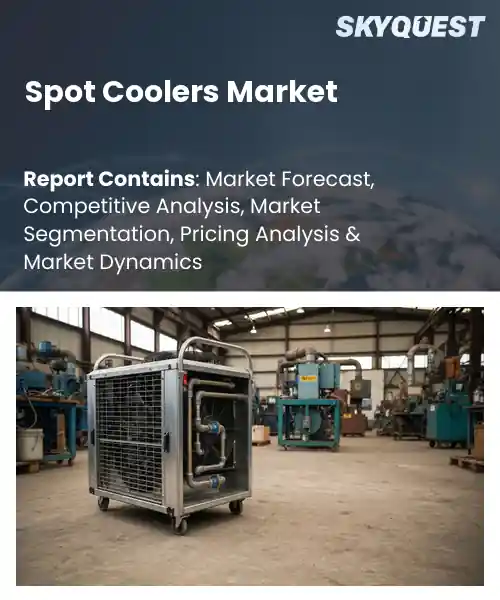
Spot Coolers Market
Report ID: SQMIG20I3336
Report ID: SQMIG20I3336
[email protected]
USA +1 351-333-4748
Report ID:
SQMIG20I3336 |
Region:
Global |
Published Date: July, 2026
Pages:
157
|Tables:
153
|Figures:
78


Global Spot Coolers Market size was valued at USD 987.40 Million in 2024 and is poised to grow from USD 1050.59 Million in 2025 to USD 1725.71 Million by 2033, growing at a CAGR of 6.4% during the forecast period (2026-2033).
The spot cooler market consists of small refrigeration units used to reduce temperatures in industrial processes, food service, and pharmaceutical storage. The significance of this is that it can preserve product integrity and consume less energy than conventional chillers. The main driver has been the increased need for precise thermal control in just-in-time manufacturing, where delayed cooling can lead to spoilage or loss of quality. The last decade has seen an accelerated adoption, as manufacturers have incorporated production lines, with beverage bottlers in Brazil adding spot coolers to reduce cycle times by 30 percent, for example, which is a testament to the way the technology has revolutionized operational efficiency and spurred market growth.
Indeed, one of the main drivers of the spot cooler market is the tightening of food safety regulations that demand rapid cooling after harvest and traceability. This pressure forces processors to replace old chillers with modular units right on the production floor, reducing thermal lag and compliance risk. The investment cycles are getting shorter, and manufacturers are introducing lean models with IoT that can generate temperature alerts and predictive maintenance. One example is an apple packer that reduced spoilage by 15 percent after installing networked spot coolers, which created opportunities for service contracts and new revenue streams along the supply chain.
How is AI-Powered Predictive Maintenance Reshaping the Spot Coolers Market?
AI-powered predictive maintenance is transforming how spot coolers are operated and maintained. Algorithms can gather sensor data from temperature, vibration and power use to predict component wear and alert technicians before a breakdown occurs. This method reduces unplanned downtime, repair costs and prolongs equipment life. Operators are able to plan service visits at convenient times instead of reacting to emergencies. The technology also optimizes cooling efficiency, saving energy while maintaining the required temperatures. IoT connectivity and edge computing integration allows for local analysis to provide fast insights even in remote facilities. With industries requiring more reliable and efficient cooling, AI driven maintenance is becoming a key differentiator.
Airrex’s compact spot cooler, which launched in September 2023, features an onboard sensor network and predictive maintenance software that allows operators to address issues before failure and improve overall system efficiency.
Market snapshot - (2026-2033)
Global Market Size
USD 987.4 Million
Largest Segment
Industrial Spot Coolers
Fastest Growth
Portable Spot Coolers
Growth Rate
6.4% CAGR
To get more insights on this market click here to Request a Free Sample Report
Global spot coolers market is segmented by product type, cooling capacity, application, end user, distribution channel and region. Based on product type, the market is segmented into portable spot coolers, stationary spot coolers, industrial spot coolers, commercial spot coolers and others. Based on cooling capacity, the market is segmented into up to 2 tons, 2–5 tons, 5–10 tons, above 10 tons and others. Based on application, the market is segmented into manufacturing facilities, data centers, commercial buildings, events & temporary cooling and others. Based on end user, the market is segmented into industrial facilities, commercial establishments, equipment rental companies, healthcare facilities and others. Based on distribution channel, the market is segmented into direct sales, HVAC distributors, rental providers and others. Based on region, the market is segmented into North America, Europe, Asia Pacific, Latin America and Middle East & Africa.
Portable spot coolers are the most popular segment as customers prefer flexibility and quick deployment for temporary cooling jobs. Lightweight and plug-and-play, they can be moved from location to location to meet the fast-paced needs of events, construction sites and emergency response. This convenience eliminates the requirement for permanent infrastructure, lowering capital expenditure and downtime, and driving high preference for mobile solutions in various environments as organizations look for agile climate control.
However, the stationary spot coolers segment is exhibiting the strongest growth momentum with companies expanding permanent cooling installations in data centers and manufacturing plants. The adoption of these units, which are critical infrastructure components that open new market avenues, is driven by the need for continuous temperature regulation and developments in energy efficient compressors.
The above 10 Tons segment is dominated by large scale industrial users requiring high capacity cooling to protect sensitive equipment and maintain process stability. High performance units with advanced refrigerant cycles and intelligent controls to efficiently meet demanding thermal loads. Their ability to deliver continuous operation in harsh conditions makes them indispensable for mission critical facilities, further reinforcing its strategic importance and driving long term investment decisions.
The 5 to 10 Tons segment is meanwhile emerging as the key high growth area as mid size facilities upgrade to more efficient cooling solutions. The combination of good capacity and lower energy usage is attractive to growing production lines and data hubs, leading to rapid purchasing and driving innovation in modular design that speeds up market growth.
To get detailed segments analysis, Request a Free Sample Report
North America leads the way, with its mature industrial infrastructure, high demand for temperature sensitive processes and extensive distribution networks. The United States relies on a broad array of food‑service operators, pharmaceutical manufacturers and logistics providers that depend on precise cooling solutions. The adoption of spot-cooling technologies is being driven by increasing consumer interest in product freshness. In Canada, regulatory regimes that value energy efficiency and sustainability encourage investment in modern cooling equipment. Both countries have strong supply chains that provide quick access to replacement parts and technical support, further assuring end users. Its emphasis on innovation in smart control, IoT connectivity and other areas further cements the region’s leading position.
Spot coolers market outlook in the United States is shaped by a high concentration of fast‑moving consumer goods producers and a dense network of retail outlets that require localized cooling. Manufacturers emphasize compact, energy‑saving designs to meet stringent environmental guidelines. Collaboration between equipment suppliers and service providers ensures swift installation and maintenance, while ongoing research into refrigerant alternatives supports continuous product refinement. This ecosystem sustains strong demand across multiple industry verticals.
Spot coolers market forecast in Canada reflects a strong emphasis on sustainability and strict energy‑efficiency standards that shape product selection. The food processing sector and cold‑chain logistics companies prioritize compact systems that minimize waste while maintaining product integrity. Local manufacturers focus on low‑global‑warming‑potential refrigerants, aligning with national climate objectives. Close coordination with regulatory bodies accelerates certification processes, and the trade network ensures reliable access to spare parts and technical expertise, fostering market growth.
Europe’s rapid growth is fueled by stringent environmental regulations, heightened consumer demand for product freshness, and a diversified industrial base that demands precise spot cooling. The demand for efficient units is very strong in Germany due to the country’s engineering excellence and sound automotive and pharmaceutical industries. A thriving food service industry and aggressive policies to reduce carbon accelerate adoption of energy saving technologies in the UK. Add to the momentum France’s renewed focus on artisanal food production and sustainability practices. Cross-border collaborations and a well-established supply chain across the region also enable fast technology transfer and market penetration, reinforcing Europe’s position as a dynamic growth hub.
Spot coolers market regional outlook in Germany is propelled by a sophisticated industrial base that demands precise temperature control across automotive, pharmaceutical, and food‑processing sectors. Strong environmental legislation pushes manufacturers toward energy‑efficient spot cooling systems, while a culture of engineering excellence drives adoption of advanced control features. Established distribution channels and close collaboration between equipment makers and end‑users ensure rapid deployment and reliable after‑sales support, reinforcing Germany’s leading position in the regional landscape.
Spot coolers market regional forecast in the United Kingdom is experiencing accelerated uptake due to a vibrant food‑service industry and a regulatory focus on reducing carbon footprints. Retail chains and hospitality venues seek modular, low‑energy spot coolers that can be easily integrated into existing premises. The market benefits from strong research collaboration between universities and manufacturers, fostering innovative solutions such as solar‑assisted cooling. Consumer expectations for freshness and safety further incentivize rapid adoption across the hospitality value chain.
Spot coolers market analysis in France is emerging as manufacturers respond to growing demand for fresh produce preservation and an expanding artisanal food sector. National initiatives that promote energy savings encourage the shift toward compact, refrigerant‑friendly spot cooling units. Collaboration between local design firms and international technology providers accelerates the introduction of smart monitoring capabilities. The increasing focus on reducing food waste aligns with consumer preferences, creating a supportive environment for market expansion.
The Asia Pacific region is fortifying its position in the spot coolers market, driven by a blend of fast industrialization, heightened food safety awareness, and government incentives for energy-efficient technologies. Japan and South Korea, among others, are building on their advanced manufacturing capabilities to create compact, high-performance cooling units that are specifically designed for densely populated urban areas. The increasing demand for e-commerce food delivery and complex cold-chain logistics require reliable spot cooling solutions to ensure the integrity of the products. The research partnerships on refrigerants having low global warming potential and smart connectivity are enhancing the market’s appeal and making the region a future hub for innovations and adoption.
Spot coolers market penetration in Japan benefits from a mature manufacturing sector that emphasizes precision engineering and high reliability standards. The country’s extensive network of convenience stores and vending machines creates a constant need for compact cooling solutions that operate efficiently in limited spaces. Government policies promoting reduced energy consumption accelerate the shift toward refrigerants with lower environmental impact. Ongoing collaboration between appliance makers and research institutes drives the integration of IoT monitoring, enhancing operational oversight and maintenance efficiency.
Spot coolers industry in South Korea is driven by a dynamic food‑service landscape and an aggressive push for smart home appliances. Urban dwellers and fast‑casual restaurant concepts demand spot cooling units that combine aesthetic design with low power draw. National sustainability targets encourage the adoption of refrigerants with minimal ozone‑depleting properties, while strong government‑industry partnerships accelerate certification of energy‑saving technologies. The emphasis on connectivity enables real‑time temperature monitoring, aligning with consumer expectations for quality and safety.
To know more about the market opportunities by region and country, click here to
Buy The Complete Report
Rising Demand for Energy Efficiency
Integration With Smart Building Systems
High Initial Capital Expenditure
Complex Installation and Maintenance Requirements
Request Free Customization of this report to help us to meet your business objectives.
The global spot coolers market is characterized by strong competition among established HVAC manufacturers and specialized portable cooling equipment providers. Leading companies are focusing on developing energy-efficient portable air conditioning systems, environmentally friendly refrigerants, smart temperature controls, and compact designs to address growing demand across industrial, commercial, healthcare, and event applications. Competition is increasingly driven by product innovation, geographic expansion, digital monitoring capabilities, and enhanced after-sales service networks, enabling manufacturers to differentiate their offerings through improved cooling performance, mobility, and energy efficiency.
Top Player’s Company Profile
Recent Developments in the Spot Coolers Market
SkyQuest’s ABIRAW (Advanced Business Intelligence, Research & Analysis Wing) is our Business Information Services team that Collects, Collates, Correlates, and Analyses the Data collected by means of Primary Exploratory Research backed by robust Secondary Desk research. As per SkyQuest analysis, the global spot coolers market is being propelled primarily by the rising demand for energy‑efficient cooling as manufacturers and data‑center operators seek to cut electricity use while meeting sustainability goals, a second important driver is the seamless integration of spot coolers with smart building systems that enable real‑time monitoring and automated temperature control. However, high upfront capital costs can delay investment decisions, especially for large‑scale retrofits. North America remains the dominant region thanks to its mature industrial base, strong regulatory support and extensive distribution networks, while portable spot coolers lead the segment mix because of their flexibility, quick deployment and low installation barrier.
| Report Metric | Details |
|---|---|
| Market size value in 2024 | USD 987.4 Million |
| Market size value in 2033 | USD 1725.71 Million |
| Growth Rate | 6.4% |
| Base year | 2024 |
| Forecast period | (2026-2033) |
| Forecast Unit (Value) | USD Million |
| Segments covered |
|
| Regions covered | North America (US, Canada), Europe (Germany, France, United Kingdom, Italy, Spain, Rest of Europe), Asia Pacific (China, India, Japan, Rest of Asia-Pacific), Latin America (Brazil, Rest of Latin America), Middle East & Africa (South Africa, GCC Countries, Rest of MEA) |
| Companies covered |
|
| Customization scope | Free report customization with purchase. Customization includes:-
|
To get a free trial access to our platform which is a one stop solution for all your data requirements for quicker decision making. This platform allows you to compare markets, competitors who are prominent in the market, and mega trends that are influencing the dynamics in the market. Also, get access to detailed SkyQuest exclusive matrix.
Table Of Content
Executive Summary
Market overview
Parent Market Analysis
Market overview
Market size
KEY MARKET INSIGHTS
COVID IMPACT
MARKET DYNAMICS & OUTLOOK
Market Size by Region
KEY COMPANY PROFILES
Methodology
For the Spot Coolers Market, our research methodology involved a mixture of primary and secondary data sources. Key steps involved in the research process are listed below:
1. Information Procurement: This stage involved the procurement of Market data or related information via primary and secondary sources. The various secondary sources used included various company websites, annual reports, trade databases, and paid databases such as Hoover's, Bloomberg Business, Factiva, and Avention. Our team did 45 primary interactions Globally which included several stakeholders such as manufacturers, customers, key opinion leaders, etc. Overall, information procurement was one of the most extensive stages in our research process.
2. Information Analysis: This step involved triangulation of data through bottom-up and top-down approaches to estimate and validate the total size and future estimate of the Spot Coolers Market.
3. Report Formulation: The final step entailed the placement of data points in appropriate Market spaces in an attempt to deduce viable conclusions.
4. Validation & Publishing: Validation is the most important step in the process. Validation & re-validation via an intricately designed process helped us finalize data points to be used for final calculations. The final Market estimates and forecasts were then aligned and sent to our panel of industry experts for validation of data. Once the validation was done the report was sent to our Quality Assurance team to ensure adherence to style guides, consistency & design.
Analyst Support
Customization Options
With the given market data, our dedicated team of analysts can offer you the following customization options are available for the Spot Coolers Market:
Product Analysis: Product matrix, which offers a detailed comparison of the product portfolio of companies.
Regional Analysis: Further analysis of the Spot Coolers Market for additional countries.
Competitive Analysis: Detailed analysis and profiling of additional Market players & comparative analysis of competitive products.
Go to Market Strategy: Find the high-growth channels to invest your marketing efforts and increase your customer base.
Innovation Mapping: Identify racial solutions and innovation, connected to deep ecosystems of innovators, start-ups, academics, and strategic partners.
Category Intelligence: Customized intelligence that is relevant to their supply Markets will enable them to make smarter sourcing decisions and improve their category management.
Public Company Transcript Analysis: To improve the investment performance by generating new alpha and making better-informed decisions.
Social Media Listening: To analyze the conversations and trends happening not just around your brand, but around your industry as a whole, and use those insights to make better Marketing decisions.
REQUEST FOR SAMPLE
 REQUEST FREE CUSTOMIZATION
Global Spot Coolers Market size was valued at USD 987.4 Million in 2024 and is poised to grow from USD 1050.59 Million in 2025 to USD 1725.71 Million by 2033, growing at a CAGR of 6.4% during the forecast period (2026-2033).
The competitive landscape of the global spot coolers market is shaped by aggressive M&A activity, strategic partnerships, and rapid technology integration, with leading firms acquiring niche manufacturers to broaden product portfolios and collaborating with HVAC distributors to accelerate market penetration. Recent joint development agreements focus on energy‑efficient compressor designs and IoT‑enabled temperature controls, driving differentiation in a market where cooling performance and operational cost savings are critical success factors. 'MovinCool (Denso Corporation)', 'Carrier Global Corporation', 'Trane Technologies plc', 'Daikin Industries, Ltd.', 'LG Electronics Inc.', 'Mitsubishi Electric Corporation', 'Blue Star Limited', 'OceanAire, Inc.', 'KwiKool Products, Inc.', 'Portacool, LLC', 'Airrex Global', 'Excel Air Ltd.', 'Broughton EAP Ltd.', 'Anden Corporation', 'Trotec GmbH', 'Dantherm Group A/S', 'Fral S.r.l.', 'Master Climate Solutions', 'Airefco, Inc.', 'Weltem Co., Ltd.'
Companies across manufacturing, data centers, and commercial facilities are increasingly prioritizing energy‑efficient cooling solutions to reduce operational costs and meet sustainability targets. Spot coolers, with their ability to provide targeted cooling only where needed, align well with these objectives, allowing users to avoid the waste associated with full‑scale HVAC systems. This alignment drives greater adoption of spot coolers as organizations seek to lower electricity consumption, improve equipment reliability, and demonstrate environmental responsibility, through improved thermal management practices, thereby expanding market demand.
Energy Efficiency Drives Adoption: Manufacturers and plant operators are prioritising energy‑saving technologies, positioning spot coolers as a preferred solution for process cooling due to their low power consumption and ability to recycle waste heat. This shift is prompting lifecycle assessments that favor compact, closed‑loop designs, encouraging vendors to integrate smart controls and variable‑speed drives. As sustainability targets become embedded in corporate policies, procurement teams increasingly view spot coolers as a means to reduce operational costs while supporting broader environmental commitments across diverse industrial sectors.
Why does North America Dominate the Global Spot Coolers Market? |@12


Want to customize this report? This report can be personalized according to your needs. Our analysts and industry experts will work directly with you to understand your requirements and provide you with customized data in a short amount of time. We offer $1000 worth of FREE customization at the time of purchase.
Feedback From Our Clients


 USA (+1) 351-333-4748

