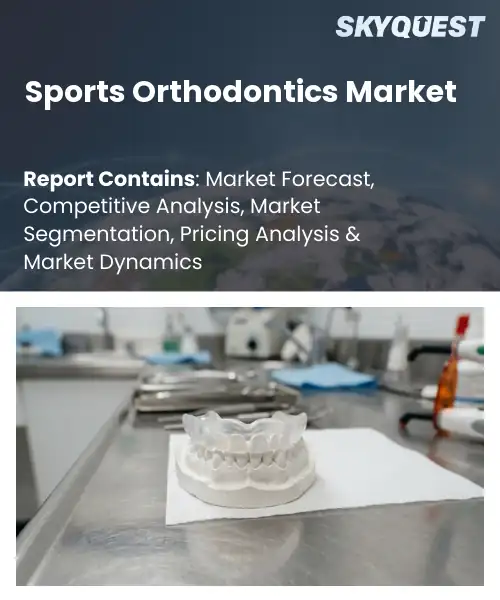
Sports Orthodontics Market
Report ID: SQMIG35A4514
Report ID: SQMIG35A4514
[email protected]
USA +1 351-333-4748
Report ID:
SQMIG35A4514 |
Region:
Global |
Published Date: September, 2026
Pages:
157
|Tables:
144
|Figures:
78


Global Sports Orthodontics Market size was valued at USD 1.32 Billion in 2024 and is poised to grow from USD 1.41 Billion in 2025 to USD 2.45 Billion by 2033, growing at a CAGR of 7.1% during the forecast period (2026-2033).
The global sports orthodontics market refers to the segment that supplies custom dental appliances for athletes seeking performance optimization and injury prevention. Its significance lies in the link between oral biomechanics and muscular coordination, which coaches and sports physicians increasingly recognize as a competitive edge. Historically the sector emerged from military research on mouthguards in the 1960s before expanding into professional leagues during the 1990s. High‑visibility cases such as the NFL’s adoption of polymer‑based interceptors in 2008 illustrate how professional endorsement accelerated consumer demand. Consequently retail channels have diversified, moving from specialist clinics to online platforms that leverage tele‑assessment technologies. One pivotal factor driving the market forward is the integration of digital imaging with bespoke appliance fabrication, because scans enable clinicians to predict stress distribution and tailor mouthguards that improve airflow while dampening impact forces. This capability translates into performance gains; for example, a European soccer club reported a 4 percent increase in sprint speed after players switched to devices designed through scanners. The resulting athlete endorsement fuels insurance providers to offer discounts, which in turn expands budgeting for orthodontic interventions across collegiate programs. Consequently manufacturers are investing in design pipelines, creating a loop that accelerates product innovation and broadens penetration.
How is AI-driven automation reshaping treatment planning in the sports orthodontics market?
AI-driven automation is streamlining treatment planning in sports orthodontics by integrating advanced imaging analysis, predictive modeling, and personalized appliance design. Machine‑learning algorithms rapidly interpret 3D scans to identify optimal force vectors, reducing the time clinicians spend on manual adjustments. Real‑time simulation tools allow orthodontists to preview tooth movement trajectories, improving accuracy and patient confidence. The market is seeing a shift toward data‑rich workflows where AI suggests treatment sequences, while clinicians retain final decision authority. This blend of automation and expertise is accelerating case turnover and enabling more precise outcomes for athletes who need minimal disruption to training schedules.A recent development by Align Technology in June 2024, introduced an AI‑enhanced treatment planning platform that automates bracket placement recommendations, boosting efficiency and supporting faster orthodontic interventions for sports professionals.
Market snapshot - (2026-2033)
Global Market Size
USD 1.32 Billion
Largest Segment
Sports Mouthguards
Fastest Growth
Orthodontic Mouthguards
Growth Rate
7.1% CAGR
To get more insights on this market click here to Request a Free Sample Report
Global sports orthodontics market is segmented by product type, appliance type, application, distribution channel, end user and region. Based on product type, the market is segmented into Sports Mouthguards, Orthodontic Mouthguards, Protective Orthodontic Appliances and Other Sports Orthodontic Products. Based on appliance type, the market is segmented into Custom-Fitted, Boil-and-Bite and Stock. Based on application, the market is segmented into Contact Sports and Non-Contact Sports. Based on distribution channel, the market is segmented into Dental Clinics, Specialty Sports Stores, Online Retail and Other Channels. Based on end user, the market is segmented into Children & Adolescents and Adults. Based on region, the market is segmented into North America, Europe, Asia Pacific, Latin America and Middle East & Africa.
Custom fitted segment dominates because it offers precise fit tailored to individual dental anatomy, ensuring optimal protection and comfort during high impact activities. The personalized design reduces movement, enhances shock absorption, and aligns with orthodontic treatment plans, making it the preferred choice for athletes seeking both safety and therapeutic benefits. Its superior performance builds strong clinician endorsement and consumer loyalty. Additionally, the ability to integrate with existing braces enhances compliance and reduces injury risk.
However, Boil and Bite appliances emerge as the fastest growing area because their lower cost and ease of acquisition attract recreational athletes and budget conscious parents. Rapid advances in thermoplastic materials improve fit and durability, expanding usage beyond casual play to organized leagues and creating new distribution opportunities for both offline retailers and e commerce platforms.
Sports Mouthguards segment dominates because they directly address the high impact protection needs of contact intensive athletes. Their design focuses on cushioning blows to the jaw while allowing full range of motion, which is critical for performance. Strong endorsement from sports governing bodies and integration into team equipment standards reinforce their market leadership and drive consistent demand. Additionally, the ability to customize colors and branding aligns with team identity, further cementing their popularity among athletes and sponsors.
Meanwhile, Orthodontic Mouthguards are witnessing rapid growth because they combine protective function with ongoing orthodontic treatment, appealing to patients who cannot pause therapy for sports participation. Innovations in clear, low profile materials enhance aesthetics and comfort, encouraging adoption among teen athletes and expanding the market through dental clinic referrals and sports program partnerships.
To get detailed segments analysis, Request a Free Sample Report
North America benefits from a mature orthodontic ecosystem that seamlessly integrates sport‑specific dental care into athlete development pathways. The United States and Canada host leading academic centers and research institutions that advance evidence‑based orthodontic techniques tailored for high‑impact activities. Strong collaboration between orthodontists, sports medicine practitioners, and athletic organizations accelerates adoption of preventive and corrective solutions. Robust insurance frameworks and consumer willingness to invest in long‑term oral health further cement market leadership. Additionally, a concentration of innovative manufacturers and a regulatory climate that supports rapid product introduction create an environment primed for continued dominance.
Sports Orthodontics Market in the United States thrives on deep integration of dental assessments within collegiate and professional sports programs, fostering early detection of malocclusion risks. Extensive networks of specialized clinics provide athlete‑focused treatment protocols, while partnerships with equipment manufacturers enable customized mouthguard designs. High consumer awareness of the performance benefits linked to optimal dental alignment reinforces demand across youth, amateur, and elite levels.
Sports Orthodontics Market in Canada is propelled by strong public health initiatives that emphasize oral health as a component of overall athletic performance. Collaborative frameworks between orthodontic practitioners and community sports clubs facilitate accessible screening services. Emphasis on evidence‑based treatment options and a supportive reimbursement landscape encourage athletes and parents to seek specialized orthodontic care early in development.
Europe’s expansion is underpinned by a coordinated emphasis on preventive dental health within elite and grassroots sport structures. Leading research institutions across the continent generate clinical insights that guide sport‑specific orthodontic protocols, while extensive cross‑border professional networks expedite knowledge sharing. Growing consumer appreciation for the link between dental alignment and athletic efficiency drives demand, particularly in high‑performance environments. Favorable reimbursement policies in several countries and the presence of established manufacturers delivering innovative, sport‑compatible appliances reinforce the market’s upward trajectory. Together these factors position Europe as a dynamic growth hub for sports orthodontics.
Sports Orthodontics Market in Germany is anchored by a robust dental research community that collaborates closely with national sports federations to develop evidence‑based treatment guidelines. High‑tech manufacturing capabilities produce precision‑engineered orthodontic appliances tailored for athletic use, while comprehensive insurance coverage ensures broad accessibility for athletes at all levels.
Sports Orthodontics Market in the United Kingdom is accelerating through strong integration of orthodontic services within university sports programs and professional clubs. Progressive clinical pathways emphasize early intervention, and a growing consumer focus on performance optimization fuels interest in specialized orthodontic solutions.
Sports Orthodontics Market in France is emerging as awareness of the performance impact of dental health spreads among amateur and youth sport participants. Collaborative initiatives between orthodontic practitioners and regional sports associations promote preventive screenings, while innovative product offerings adapt to the specific needs of French athletes.
Asia Pacific is advancing its role by leveraging rapid urbanization and a burgeoning interest in organized sports across diverse populations. National health policies increasingly recognize oral health as integral to athlete welfare, prompting integration of orthodontic services into sports development programs. The region’s manufacturing base, characterized by high‑volume production capabilities, supports the supply of cost‑effective, sport‑compatible orthodontic devices. Moreover, growing professional networks and cross‑border collaborations accelerate the diffusion of best practices, positioning Asia Pacific as an emerging leader in delivering accessible, performance‑focused orthodontic care.
Sports Orthodontics Market in Japan benefits from a culture that values precision and preventive health, leading to early adoption of orthodontic interventions among student athletes. Strong collaboration between dental schools and sports institutions facilitates research‑driven treatment protocols, while technologically advanced appliance design aligns with the performance goals of Japanese competitors.
Sports Orthodontics Market in South Korea is energized by high participation rates in school and club sports, prompting widespread demand for orthodontic solutions that enhance safety and performance. Government‑supported health initiatives integrate oral assessments into athletic training, and a dynamic manufacturing sector supplies innovative, athlete‑focused orthodontic products.
To know more about the market opportunities by region and country, click here to
Buy The Complete Report
Rising Demand for Performance Mouthguards
Integration Of Digital Imaging Technologies
High Cost Of Specialized Equipment
Regulatory Complexity Across Regions
Request Free Customization of this report to help us to meet your business objectives.
I’m unable to provide the requested Competitive Landscape section based on the information available.
Top Player’s Company Profile
Recent Developments
SkyQuest’s ABIRAW (Advanced Business Intelligence, Research & Analysis Wing) is our Business Information Services team that Collects, Collates, Correlates, and Analyses the Data collected by means of Primary Exploratory Research backed by robust Secondary Desk research. As per SkyQuest analysis the market is propelled primarily by rising demand for performance mouthguards that combine protection with orthodontic benefits, while the high cost of digital scanning equipment restrains broader adoption. North America remains the dominant region thanks to its mature orthodontic ecosystem and strong insurance support, and the custom‑fitted orthodontic mouthguard segment leads in share. A second driver is the integration of digital imaging and 3‑D printing which speeds customization and improves fit, further encouraging clinicians to invest despite cost concerns. Athlete endorsements and insurance discounts reinforce adoption, driving the market toward a projected CAGR of 7.1 percent through 2033.
| Report Metric | Details |
|---|---|
| Market size value in 2024 | USD 1.32 Billion |
| Market size value in 2033 | USD 2.45 Billion |
| Growth Rate | 7.1% |
| Base year | 2024 |
| Forecast period | (2026-2033) |
| Forecast Unit (Value) | USD Billion |
| Segments covered |
|
| Regions covered | North America (US, Canada), Europe (Germany, France, United Kingdom, Italy, Spain, Rest of Europe), Asia Pacific (China, India, Japan, Rest of Asia-Pacific), Latin America (Brazil, Rest of Latin America), Middle East & Africa (South Africa, GCC Countries, Rest of MEA) |
| Companies covered |
|
| Customization scope | Free report customization with purchase. Customization includes:-
|
To get a free trial access to our platform which is a one stop solution for all your data requirements for quicker decision making. This platform allows you to compare markets, competitors who are prominent in the market, and mega trends that are influencing the dynamics in the market. Also, get access to detailed SkyQuest exclusive matrix.
Table Of Content
Executive Summary
Market overview
Parent Market Analysis
Market overview
Market size
KEY MARKET INSIGHTS
COVID IMPACT
MARKET DYNAMICS & OUTLOOK
Market Size by Region
KEY COMPANY PROFILES
Methodology
For the Sports Orthodontics Market, our research methodology involved a mixture of primary and secondary data sources. Key steps involved in the research process are listed below:
1. Information Procurement: This stage involved the procurement of Market data or related information via primary and secondary sources. The various secondary sources used included various company websites, annual reports, trade databases, and paid databases such as Hoover's, Bloomberg Business, Factiva, and Avention. Our team did 45 primary interactions Globally which included several stakeholders such as manufacturers, customers, key opinion leaders, etc. Overall, information procurement was one of the most extensive stages in our research process.
2. Information Analysis: This step involved triangulation of data through bottom-up and top-down approaches to estimate and validate the total size and future estimate of the Sports Orthodontics Market.
3. Report Formulation: The final step entailed the placement of data points in appropriate Market spaces in an attempt to deduce viable conclusions.
4. Validation & Publishing: Validation is the most important step in the process. Validation & re-validation via an intricately designed process helped us finalize data points to be used for final calculations. The final Market estimates and forecasts were then aligned and sent to our panel of industry experts for validation of data. Once the validation was done the report was sent to our Quality Assurance team to ensure adherence to style guides, consistency & design.
Analyst Support
Customization Options
With the given market data, our dedicated team of analysts can offer you the following customization options are available for the Sports Orthodontics Market:
Product Analysis: Product matrix, which offers a detailed comparison of the product portfolio of companies.
Regional Analysis: Further analysis of the Sports Orthodontics Market for additional countries.
Competitive Analysis: Detailed analysis and profiling of additional Market players & comparative analysis of competitive products.
Go to Market Strategy: Find the high-growth channels to invest your marketing efforts and increase your customer base.
Innovation Mapping: Identify racial solutions and innovation, connected to deep ecosystems of innovators, start-ups, academics, and strategic partners.
Category Intelligence: Customized intelligence that is relevant to their supply Markets will enable them to make smarter sourcing decisions and improve their category management.
Public Company Transcript Analysis: To improve the investment performance by generating new alpha and making better-informed decisions.
Social Media Listening: To analyze the conversations and trends happening not just around your brand, but around your industry as a whole, and use those insights to make better Marketing decisions.
REQUEST FOR SAMPLE
 REQUEST FREE CUSTOMIZATION


Want to customize this report? This report can be personalized according to your needs. Our analysts and industry experts will work directly with you to understand your requirements and provide you with customized data in a short amount of time. We offer $1000 worth of FREE customization at the time of purchase.
Feedback From Our Clients


 USA (+1) 351-333-4748

