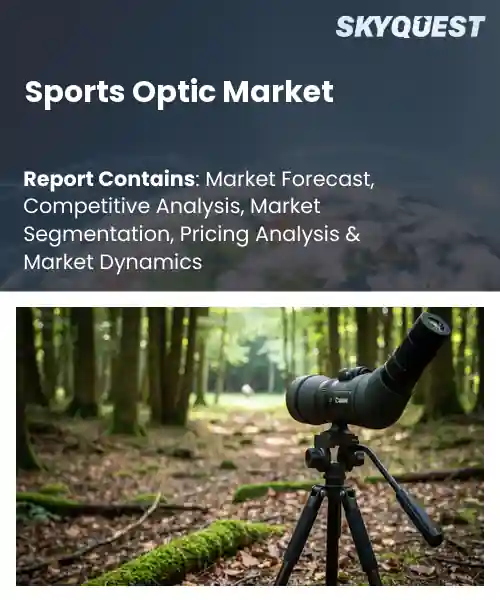
Sports Optic Market
Report ID: SQMIG25J2241
Report ID: SQMIG25J2241
[email protected]
USA +1 351-333-4748
Report ID:
SQMIG25J2241 |
Region:
Global |
Published Date: July, 2026
Pages:
157
|Tables:
125
|Figures:
77


Global Sports Optic Market size was valued at USD 2.07 Billion in 2024 and is poised to grow from USD 2.17 Billion in 2025 to USD 3.21 Billion by 2033, growing at a CAGR of 5.0% during the forecast period (2026-2033).
The global sports optic market covers lenses, frames, and protective eyewear built for athletes across disciplines, from cycling goggles to baseball batting helmets, even the ones with integrated visual enhancement. The importance is in making things safer, sharper, and more competitive, which is why equipment manufacturers and sports federations have been putting money into it, steadily, over time.
Now the major factor pushing the sports optic market growth forward is emerging augmented reality (AR) integration, because it takes passive protection and turns it into active, interactive performance feedback. Manufacturers start embedding micro displays and biometric sensors into lenses , so it offers data on head angle, speed , and visual focus. Coaches then use that information to fine tune technique or at least to nudge athletes in the right direction. This is already showing up in soccer: goalkeepers wearing AR-enabled glasses can overlay opponent trajectories and during trial phases this has reportedly delivered about a 12% improvement in save percentage. Because of that , suppliers are teaming up with technology firms to build platforms, and that opens the door to upgrades plus subscription based analytics services. So revenue doesn’t rely only on the major hardware sales, it spreads out a bit.
AI and IoT are making sports optics smarter and more connected, which changes a lot. AI algorithms can boost image clarity, adjust focus on the fly, and even help identify targets, giving athletes faster and more accurate visual information without as much hassle. IoT ties binoculars, scopes, and spotting devices to smartphones and cloud platforms, enabling real time data sharing, remote firmware updates, and performance analytics that can be reviewed later. On top of that, these tools allow predictive maintenance , so downtime goes down and the product life is extended. As manufacturers keep embedding AI and IoT, the market tends to see higher user engagement , and new revenue from subscriptions plus data insight services , which supports overall growth and differentiation too.
Market snapshot - (2026-2033)
Global Market Size
USD 2.07 Billion
Largest Segment
Binoculars
Fastest Growth
Night Vision Devices
Growth Rate
5.0% CAGR
To get more insights on this market click here to Request a Free Sample Report
The global sports optic market is segmented by product type, application, technology, distribution channel and region. Based on product type, the market is segmented into Binoculars, Riflescopes, Spotting Scopes, Rangefinders, Telescopes, Night Vision Devices and Others. Based on application, the market is segmented into Hunting, Bird Watching, Shooting Sports, Hiking & Camping, Water Sports and Others. Based on technology, the market is segmented into Traditional Optics, Digital & Smart Optics, Night Vision and Thermal Imaging. Based on distribution channel, the market is segmented into Specialty Stores, Online Retail and Mass Merchandise. Based on region, the market is segmented into North America, Europe, Asia Pacific, Latin America and Middle East & Africa.
As per the sports optic market analysis, binoculars lead the market in a way that feels, well, convenient; they give portable magnification that still covers the everyday needs of hunters, bird watchers, and hikers. People like how fast they can lock onto a target, and also the way they work through different lighting conditions, even when it’s not ideal. On top of that, manufacturers keep tuning the lens coatings plus updating the ergonomics so consumers end up sticking with them and binoculars get treated as the default choice across sports optics, for casual enthusiasts and more competitive folks worldwide right now.
Still, the spotting scopes segment is predicted to have the largest sports optic market share, mainly because people want more magnification for long‑range looking and for precision shooting. Lighter materials help, and features like integrated range‑finding reticles make them more appealing beyond the usual audience. This is also creating openings in trail monitoring activities and in competitive shooting events, across the space more broadly, today.
According to the sports optic market forecast, the Digital & smart optics segment is leading as well, because it brings electronic upgrades that feel beyond standard optics. Real time image processing, GPS overlays, and mobile connectivity help hunters and shooters get more precise targeting info plus better situational awareness. When optics mix with IoT platforms, consumers want these multifunction devices more , and constant software updates make the products feel current instead of “done”, so digital optics ends up acting like the main engine for market evolution in this ecosystem overall.
However, the thermal imaging is influencing growth opportunities by changing what “see clearly” means outdoors. It supports visibility in low light and during nasty weather, fog, smoke, rainy evenings- those situations where normal glass can struggle. As thermal sensors get smaller and battery life improves, portable thermal units are becoming cheaper and easier to carry. So instead of being only for night hunting, they start showing up in wider wildlife monitoring use cases too, which then broadens the customer base and adds fresh revenue angles for vendors in the sports optic market.
To get detailed segments analysis, Request a Free Sample Report
As per the sports optic market regional forecast, North America dominates the Market, mainly because the whole tech setup is advanced, plus there’s this long‑standing sports mindset and also consumers have enough buying strength to actually go after the latest stuff. The U.S. and Canada also have major research universities and optical labs that keep nudging lens capability, and material science forward. You’ll see strong ties between manufacturers and professional leagues too, and that high-visibility placement keeps brand prestige from fading. On top of that, the distribution system is stitched together, specialty retailers, big sporting goods chains, and e commerce sites all moving in parallel, so penetration happens quicker rather than later. And, people in the region stay excited about both classic outdoor activities and newer fitness habits, so the demand for high performing eyewear stays steady, and the leadership role just sticks.
United States Sports Optic Market
The Sports Optic sector in the United States is fueled by cutting edge research institutions, a sports legacy that’s deep roots, and a consumer base that actually wants tech boosted performance. Big manufacturers often cooperate with professional athletes, which makes product testing and iteration move faster, and the premium brand story lands harder. Distribution is spread across specialty shops, online channels, and high-visibility sponsorships, which keeps products easy to reach and supports ongoing enthusiasm among active users. Over time this also helps with loyalty, because community engagement keeps the relationship going.
Canada Sports Optic Market
The Canadian Sports Optic industry leans on health-centered lifestyles, and also on a climate that basically invites outdoor activity most of the year. When universities and optical companies work together on research, material innovation tends to pick up speed, and results feel practical, not just theoretical. Government backing for sporting initiatives also encourages more consumer adoption. Retail works through a mix of boutique specialty stores and digital outreach, while collaborations with winter sports organizations boost recognition. The result feels like a resilient setting, one that keeps interest alive across different athlete groups, even when preferences shift.
The European Sports Optic Market is expanding quickly because of a mix of cultural excitement for older sports as well as newer ones, plus refined design tastes and a real push toward sustainability. Across the continent, performance eyewear is increasingly seen as part of personal style , not just gear. That viewpoint drives interest in products that blend advanced optics with premium aesthetics. There’s also an ecosystem forming around material innovators, fashion houses, and top athletic institutions, so refinement doesn’t stop. Regulatory approaches that stress safety and environmental responsibility add credibility too. Put together, this lifestyle aspiration + tech progress + responsible production creates a strong base for accelerated growth throughout the region.
Germany Sports Optic Market
In Germany , the Sports Optic Market stands out because of engineering precision and premium craftsmanship, which fits the mindset of athletes who expect a lot. Domestic manufacturers link up with elite football and winter sport teams, pulling on technical know how to deliver high performance lenses. The supply chain connects component producers with apparel brands, and there’s also testing that reinforces why the product is credible. Overall, this network supports Germany reputation as a quality benchmark inside Europe, and it keeps future innovation moving.
United Kingdom Sports Optic Market
The Sports Optic Market penetration in the United Kingdom seems to gain speed from a blend of fashion influence and athletic performance, backed by a lively sports scene. Design studios collaborate with football academies and also with emerging e sports groups, so the eyewear ends up appealing to both participants and style focused consumers. Retail systems mix flagship boutiques with responsive online platforms. At the same time, an emphasis on safety standards strengthens confidence, which then helps market momentum keep rising across different age and demographic groups.
France Sports Optic Market
The French Sports Optic Market grows from heritage craftsmanship plus a rising consumer appetite for performance eyewear. Boutique lens artisans often partner with national football clubs, creating niche product lines where aesthetic elegance meets functional precision. Government incentives for innovative material research also make it easier to adopt lightweight composites, and that supports performance goals. Meanwhile, lifestyle driven retail concepts draw athletes in. This evolving ecosystem is shaping France into a stronger influence within the wider European market.
Asia Pacific is tightening its grip on the Sports Optic Market by using fast technology uptake, more middle class folks joining organized sports and a cultural push toward staying healthy, plus outdoor time. Japan and South Korea blend advanced manufacturing know how with a long standing habit of innovation, so they can ship polished lens solutions for top tier athletes and also normal day to day users. There are also joint government efforts, supporting work on lightweight composites and smart lens fitting, while local fashion trends nudge designs that look good yet stay useful. On top of that , expanding digital shopping channels and the rise of e sports communities mean brands can reach more people. So overall, the region feels like a fast moving part of how the global market evolves.
Japan Sports Optic Market
In Japan, the Sports Optic Market runs on precision engineering and on a cultural respect for athletic achievement. When lens makers team up with national sports associations, there are ongoing tweaks for better optical sharpness and stronger durability. Publicly supported studies lean into lighter materials and anti fog features, and this matches what buyers tend to want, especially for dependable wear across different weather patterns. Sales approaches mix hands on premium specialty stores with digital shopping tools, which keeps Japan reputation for high end and advanced sports eyewear solid.
South Korea Sports Optic Market
The Sports Optic Market outlook in South Korea tends to change through smart tech integration and a customer group that likes accessory-style add-ons. Partnerships between electronics companies and sports apparel brands help push development of lenses that carry sensors, and connectivity-style functions. Government incentives also back research into adaptive tinting, along with impact resistant polymer blends, fitting the safety centered expectations in the market. For getting products to people, South Korea leans on a blend of pop up retail concepts and online platforms, placing the country in the role of a innovation hub for sports eyewear.
To know more about the market opportunities by region and country, click here to
Buy The Complete Report
Increasing Consumer Focus on Performance
Advancements In Lens Material Technology
High Cost Of Advanced Optics
Regulatory Constraints on Lens Standards
Request Free Customization of this report to help us to meet your business objectives.
The competitive landscape is shaped by aggressive M&A, strategic partnerships and quick tech innovation, with companies buying small vision‑analytics teams and also teaming up with sports gear makers to put real‑time optical tracking directly into training gear, while the top players secure exclusive licensing for advanced lens tech to stay ahead of the high‑performance sport events, it all moves fast.
Top Player’s Company Profile
Recent Developments in the Sports Optic Market
SkyQuest’s ABIRAW (Advanced Business Intelligence, Research & Analysis Wing) is our Business Information Services team that Collects, Collates, Correlates, and Analyses the Data collected by means of Primary Exploratory Research backed by robust Secondary Desk research.
As per SkyQuest analysis, the global sports optic market is being driven mostly by a rising consumer focus on performance , where athletes want sharper vision reduced glare and quicker reaction times, so demand climbs across multiple product categories. Another big push is the fast adoption of smart lens and AI IoT technologies, where sensors, near real time analytics, and connectivity get built into the eyewear, essentially turning glasses into performance platforms. Still, there’s the restraint part , because advanced optics can be expensive, and that tends to slow adoption among recreational buyers who are more price sensitive. In terms of region, North America leads the market due to its strong tech ecosystem and a deep sports culture, while the binoculars segment stays at the front in volume since it’s versatile and appealing to a wider audience.
| Report Metric | Details |
|---|---|
| Market size value in 2024 | USD 2.07 Billion |
| Market size value in 2033 | USD 3.21 Billion |
| Growth Rate | 5.0% |
| Base year | 2024 |
| Forecast period | (2026-2033) |
| Forecast Unit (Value) | USD Billion |
| Segments covered |
|
| Regions covered | North America (US, Canada), Europe (Germany, France, United Kingdom, Italy, Spain, Rest of Europe), Asia Pacific (China, India, Japan, Rest of Asia-Pacific), Latin America (Brazil, Rest of Latin America), Middle East & Africa (South Africa, GCC Countries, Rest of MEA) |
| Companies covered |
|
| Customization scope | Free report customization with purchase. Customization includes:-
|
To get a free trial access to our platform which is a one stop solution for all your data requirements for quicker decision making. This platform allows you to compare markets, competitors who are prominent in the market, and mega trends that are influencing the dynamics in the market. Also, get access to detailed SkyQuest exclusive matrix.
Table Of Content
Executive Summary
Market overview
Parent Market Analysis
Market overview
Market size
KEY MARKET INSIGHTS
COVID IMPACT
MARKET DYNAMICS & OUTLOOK
Market Size by Region
KEY COMPANY PROFILES
Methodology
For the Sports Optic Market, our research methodology involved a mixture of primary and secondary data sources. Key steps involved in the research process are listed below:
1. Information Procurement: This stage involved the procurement of Market data or related information via primary and secondary sources. The various secondary sources used included various company websites, annual reports, trade databases, and paid databases such as Hoover's, Bloomberg Business, Factiva, and Avention. Our team did 45 primary interactions Globally which included several stakeholders such as manufacturers, customers, key opinion leaders, etc. Overall, information procurement was one of the most extensive stages in our research process.
2. Information Analysis: This step involved triangulation of data through bottom-up and top-down approaches to estimate and validate the total size and future estimate of the Sports Optic Market.
3. Report Formulation: The final step entailed the placement of data points in appropriate Market spaces in an attempt to deduce viable conclusions.
4. Validation & Publishing: Validation is the most important step in the process. Validation & re-validation via an intricately designed process helped us finalize data points to be used for final calculations. The final Market estimates and forecasts were then aligned and sent to our panel of industry experts for validation of data. Once the validation was done the report was sent to our Quality Assurance team to ensure adherence to style guides, consistency & design.
Analyst Support
Customization Options
With the given market data, our dedicated team of analysts can offer you the following customization options are available for the Sports Optic Market:
Product Analysis: Product matrix, which offers a detailed comparison of the product portfolio of companies.
Regional Analysis: Further analysis of the Sports Optic Market for additional countries.
Competitive Analysis: Detailed analysis and profiling of additional Market players & comparative analysis of competitive products.
Go to Market Strategy: Find the high-growth channels to invest your marketing efforts and increase your customer base.
Innovation Mapping: Identify racial solutions and innovation, connected to deep ecosystems of innovators, start-ups, academics, and strategic partners.
Category Intelligence: Customized intelligence that is relevant to their supply Markets will enable them to make smarter sourcing decisions and improve their category management.
Public Company Transcript Analysis: To improve the investment performance by generating new alpha and making better-informed decisions.
Social Media Listening: To analyze the conversations and trends happening not just around your brand, but around your industry as a whole, and use those insights to make better Marketing decisions.
REQUEST FOR SAMPLE
 REQUEST FREE CUSTOMIZATION
Global Sports Optic Market size was valued at USD 2.07 Billion in 2024 and is poised to grow from USD 2.17 Billion in 2025 to USD 3.21 Billion by 2033, growing at a CAGR of 5.0% during the forecast period (2026-2033).
The competitive landscape is shaped by aggressive M&A, strategic partnerships and rapid tech innovation, with firms acquiring vision‑analytics startups and teaming up with sports equipment manufacturers to embed real‑time optical tracking into training gear, while leading players secure exclusive licensing of advanced lens technologies to stay ahead in high‑performance sport events. 'Nikon Corporation', 'Carl Zeiss AG', 'Bushnell Corporation (Vista Outdoor)', 'Swarovski Optik KG', 'Leica Camera AG', 'Vortex Optics', 'Trijicon Inc.', 'Celestron LLC', 'Burris Optics', 'American Technologies Network Corporation', 'Leupold & Stevens Inc.', 'Schmidt & Bender GmbH', 'Hensoldt AG', 'Kowa Optronics Co. Ltd.', 'Kowa Optimed Inc.', 'Fujifilm Holdings Corporation', 'Olympus Corporation', 'Meade Instruments', 'Bogen Imaging (Manfrotto)', 'Sigma Corporation'
The growing emphasis among athletes and recreational users on enhancing visual clarity, depth perception, and reaction speed drives demand for specialized sports optics. Products that promise reduced glare, improved contrast, and adaptive lens technologies align with the desire to gain competitive advantage and safety. As consumers prioritize equipment that directly influences performance outcomes, manufacturers invest in research and development to create innovative frames and lenses, thereby expanding market adoption across a broad range of sports disciplines. These partnerships accelerate product cycles, ensuring timely delivery of performance‑enhancing eyewear.
Smart Lens Integration: Athletes and consumers increasingly demand eyewear that goes beyond vision correction, prompting manufacturers to embed sensors, connectivity modules, and real‑time data analytics into lenses and frames. These smart optics capture biometric signals such as heart rate, eye movement, and ambient lighting, feeding actionable insights to training apps and enhancing performance monitoring. Manufacturers are partnering with tech firms to ensure seamless software integration, secure data transmission, and battery‑efficient designs, positioning smart lens solutions as a differentiator in the competitive sports optics landscape.
Why does North America Dominate the Global Sports Optic Market? |@12


Want to customize this report? This report can be personalized according to your needs. Our analysts and industry experts will work directly with you to understand your requirements and provide you with customized data in a short amount of time. We offer $1000 worth of FREE customization at the time of purchase.
Feedback From Our Clients


 USA (+1) 351-333-4748

