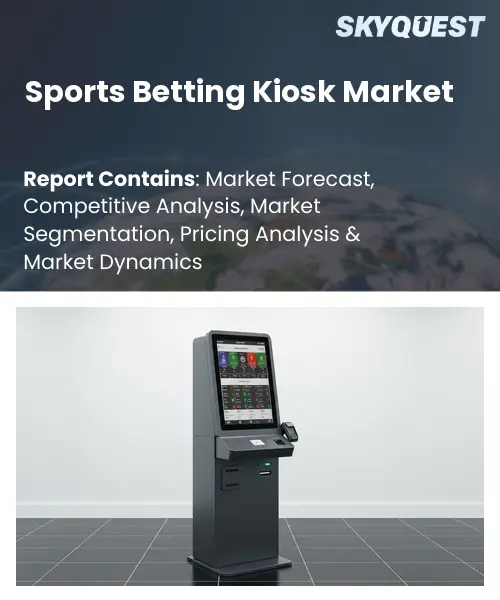
Sports Betting Kiosk Market
Report ID: SQMIG45A2758
Report ID: SQMIG45A2758
[email protected]
USA +1 351-333-4748
Report ID:
SQMIG45A2758 |
Region:
Global |
Published Date: June, 2026
Pages:
157
|Tables:
145
|Figures:
78


Global Sports Betting Kiosk Market size was valued at USD 2.5 Billion in 2024 and is poised to grow from USD 2.73 Billion in 2025 to USD 5.43 Billion by 2033, growing at a CAGR of 9.0% during the forecast period (2026-2033).
The primary driver of the sports betting kiosk market is regulatory liberalization paired with rising consumer demand for accessible retail wagering experiences. Kiosks are standalone, clustered terminals placed in casinos, racetracks, convenience stores and stadiums that enable quick bets on events with minimal staff involvement. The market matters because these units bridge online convenience and retail presence, expanding reach to demographics less likely to use apps. Over the last decade adoption expanded as jurisdictions such as UK and many U.S. states loosened rules, prompting deployments for NFL and Premier League bets while vendors improved security and payments.A key factor shaping the global sports betting kiosk market is omnichannel integration, since connecting kiosks to mobile accounts, odds feeds and cashless payments increases convenience and transaction volumes. When customers shift between app and terminal operators capture incremental wagers, raising gross gaming revenue and justifying more kiosk rollouts. Stadium kiosks accepting mobile vouchers drive impulse bets at halftime, lifting per-event income and encouraging venue-sportsbook partnerships. In convenience stores rapid ID checks and loyalty-linked offers convert occasional players into regulars, which lowers acquisition costs and creates merchandising and cross-sale revenue streams for both retailers and bookmakers, supporting sustainable market expansion.
How is AI improving user experience in the sports betting kiosk market?
AI improves user experience in sports betting kiosks by delivering clearer, faster and more personalized interactions. Key aspects include tailored bet suggestions, conversational interfaces, identity verification through computer vision, and dynamic odds updates that keep offerings relevant. Today kiosks complement mobile and in-person services in stadiums, bars and retail, providing accessible touchpoints for casual and experienced bettors. Operators use AI to reduce friction at checkout, strengthen responsible gambling controls and tie kiosks into loyalty and payment systems. Real world examples of AI driven retail tools and integrated kiosk platforms show the market moving toward more engaging and reliable in-person betting experiences.Bitcoin Depot March 2026, the company acquired social betting platform Kutt which brings AI enabled social features and personalized recommendations to its kiosk network, supporting growth by increasing engagement, streamlining cash and wallet flows and improving kiosk efficiency through data driven user journeys.
Market snapshot - (2026-2033)
Global Market Size
USD 2.5 Billion
Largest Segment
Hardware
Fastest Growth
Software
Growth Rate
9.0% CAGR
To get more insights on this market click here to Request a Free Sample Report
Global sports betting kiosk market is segmented by component, kiosk type, deployment location, betting type, end user and region. Based on component, the market is segmented into Hardware, Software and Services. Based on kiosk type, the market is segmented into Fixed Kiosks and Mobile / Portable Kiosks. Based on deployment location, the market is segmented into Casinos, Sports Betting Shops, Bars & Restaurants, Racecourses / Stadiums and Others. Based on betting type, the market is segmented into Fixed Odds Betting, Live / In-Play Betting and Pari-Mutuel Betting. Based on end user, the market is segmented into Commercial Operators (Casinos, Bookmakers) and Government / Lottery Operators. Based on region, the market is segmented into North America, Europe, Asia Pacific, Latin America and Middle East & Africa.
Hardware segment dominates because physical kiosks provide the dependable transaction infrastructure and tactile interfaces required in sports betting environments. Robust cabinets, printers, secure payment modules and touchscreens reduce transactional friction and build player trust while integrating with peripherals to handle high usage. Their durability and visible presence support regulatory compliance and operator uptime expectations, which reinforces venue adoption and steady revenue capture for bookmakers and venue owners.
However, software is the fastest growing area as cloud enabled platforms, analytics and personalization allow rapid feature deployment and omnichannel integration. Improved software reduces onsite maintenance, enables remote updates, targeted promotions and new wagering products, which expands kiosk functionality and opens scalable monetization and operator service opportunities.
Live in play betting segment dominates because its demand for real time wagering pushes kiosks to deliver constant odds updates, low latency interfaces and instant settlement functionality that keep patrons engaged throughout events. Kiosks optimized for rapid refreshes and intuitive event navigation raise transaction frequency and dwell time, while integration with feeds and risk tools helps operators manage exposure and offer dynamic markets that enhance in venue appeal.
However, fixed odds betting is emerging as the fastest growing area as its clear payoff structure and ease of use attract casual bettors and support diverse event markets on kiosks. Operators use fixed odds to streamline pricing, promote packaged bets and integrate loyalty incentives, broadening kiosk appeal, simplifying compliance and unlocking steady new revenue pathways.
To get detailed segments analysis, Request a Free Sample Report
North America leads due to a confluence of regulatory clarity, well established retail channels, and deep consumer engagement with sports betting as an entertainment category. Operators and kiosk manufacturers have formed strategic partnerships that accelerate deployment across diverse venue types, including casinos, stadiums, and convenience retail, creating high visibility and accessibility. Infrastructure strengths in payments, identity verification, and network connectivity enable reliable kiosk operations and seamless omnichannel integration with mobile platforms. Market participants prioritize compliance, responsible gambling tools, and user experience design, resulting in kiosks that meet regulatory requirements while appealing to a broad audience. Investment capacity and a competitive vendor ecosystem support ongoing innovation in hardware, software, and service models, reinforcing a leadership position that other regions seek to emulate.
Sports Betting Kiosk Market in United States is characterized by widespread venue integration and strong operator investment that drive kiosk proliferation across casinos, sportsbooks, and retail outlets. Focus on compliance, robust payment options, and advanced identity verification supports consumer confidence and regulatory alignment. Collaboration between technology vendors and established gaming operators yields feature rich kiosks with intuitive interfaces and omnichannel connectivity, enhancing convenience and retention while addressing local licensing and responsible gambling expectations.
Sports Betting Kiosk Market in Canada reflects province level regulatory frameworks and partnerships between national operators and regional retailers that facilitate targeted kiosk rollouts. Emphasis on bilingual interfaces and customer service tailored to diverse urban and suburban settings enhances accessibility. Operators focus on integrating kiosks with loyalty and payment ecosystems while implementing responsible gambling safeguards and localized content. The market benefits from collaboration among vendors, venue operators, and regulators to align user experience with compliance priorities.
Rapid expansion in Europe is driven by regulatory liberalization in select markets, an enduring retail betting culture, and strong demand for in person wagering experiences that complement mobile channels. Established betting shop networks and venue centric models provide a ready route for kiosk adoption, while operators pursue modernization programs to upgrade aging hardware and introduce intuitive interfaces. Cross border technology partnerships and localized content strategies enable rapid scaling in culturally diverse markets. Payment innovation, multilingual support, and a focus on safe play practices underpin trust and acceptance. The combination of operator investment, retailer collaboration, and regulatory engagement creates a fertile environment for kiosks to expand as part of broader omnichannel offerings.
Sports Betting Kiosk Market in Germany is responding to evolving regulation and growing consumer appetite for in person betting, prompting operators to modernize retail footprints and deploy contemporary kiosks. Emphasis on localized content, language support, and compliance with regulatory requirements guides vendor selection and deployment strategies. Partnerships with retail chains and sports venues enable broader access, while attention to payment integration and responsible gambling features ensures alignment with market expectations and trusted consumer experiences.
Sports Betting Kiosk Market in United Kingdom builds on a mature retail betting landscape with dense shop networks and experienced operators that continuously refine kiosk offerings to enhance customer experience. Kiosk deployments prioritize rapid transaction flows, strong identity checks, and seamless linkage with online accounts to support omnichannel play. The market emphasizes regulatory compliance, staff training, and responsible gambling measures, while innovation in kiosk design and service models maintains strong consumer engagement within established retail formats.
Sports Betting Kiosk Market in France is emerging through modernization initiatives that refresh retail outlets and introduce contemporary kiosk solutions suited to local preferences. Operators focus on experiential enhancements, language and content localization, and careful regulatory coordination to ensure responsible deployment. Collaborative efforts among vendors, venue operators, and regulators emphasize consumer protection and seamless integration with broader betting services, positioning kiosks as a growing complement to digital channels.
Asia Pacific is strengthening its role through targeted deployments in jurisdictions with regulated retail betting, investment in technology adapted to local payment habits, and partnerships that bridge international kiosk expertise with regional operator knowledge. Market participants emphasize secure payment processing, multilingual interfaces, and compliance with stringent regulatory and consumer protection standards. Operators adapt kiosk form factors and service flows to local venue types, integrating loyalty programs and mobile connectivity to create cohesive omnichannel experiences. Cross border supplier relationships and customization for cultural preferences accelerate adoption, while an emphasis on responsible gambling and reliable identity verification builds trust among regulators and consumers, supporting measured expansion across the region.
Sports Betting Kiosk Market in Japan is shaped by integration with established venue based wagering formats and a strong focus on reliability, user experience, and compliance. Operators prioritize kiosks that support cash and cashless payment options, clear multilingual interfaces, and venue specific workflows to align with local customer habits. Collaboration among vendors, venue operators, and regulatory bodies emphasizes responsible gambling tools and secure identity verification to ensure trusted adoption within traditional and emerging retail environments.
Sports Betting Kiosk Market in South Korea emphasizes strict regulatory compliance, advanced user interfaces, and close integration with digital wallets and local payment systems to meet consumer expectations. Operators and technology providers focus on seamless venue deployments, robust security, and localized content to align with cultural preferences. Strategic partnerships among vendors, entertainment venues, and regulators support pilot initiatives and controlled expansion, reinforcing a cautious but progressive approach to kiosk adoption that balances innovation with consumer protection.
To know more about the market opportunities by region and country, click here to
Buy The Complete Report
Expansion Of Retail Betting Networks
Advances In Interactive Technology
Stringent Regulatory Compliance Requirements
Public Concern Over Problem Gambling
Request Free Customization of this report to help us to meet your business objectives.
Competitive landscape in the global sports betting kiosk market is driven by venue first competition for retail footholds and rapid certification cycles. Incumbents and challengers use partnerships, platform integrations, and targeted acquisitions to secure market positions, for example United Tote supplying kiosks to Newgioco and Kiron partnering with Play Synergy to enter North America. Startups also launch certified turnkey kiosks to win operator contracts.
Top Player’s Company Profile
Recent Developments
SkyQuest’s ABIRAW (Advanced Business Intelligence, Research & Analysis Wing) is our Business Information Services team that Collects, Collates, Correlates, and Analyses the Data collected by means of Primary Exploratory Research backed by robust Secondary Desk research. As per SkyQuest analysis, the global sports betting kiosk market is being driven primarily by regulatory liberalization and rising consumer demand for accessible retail wagering, while rapid omnichannel integration serves as a second key driver by linking kiosks to mobile accounts, odds feeds and cashless payments to increase convenience and transaction volumes. However, stringent and variable regulatory compliance requirements remain a major restraint, elevating deployment complexity and operating costs. North America is the dominating region thanks to regulatory clarity, extensive retail channels and strong operator investment, and the hardware segment is the dominating segment as robust cabinets, touchscreens and secure payment modules provide the dependable transaction infrastructure operators require.
| Report Metric | Details |
|---|---|
| Market size value in 2024 | USD 2.5 Billion |
| Market size value in 2033 | USD 5.43 Billion |
| Growth Rate | 9.0% |
| Base year | 2024 |
| Forecast period | (2026-2033) |
| Forecast Unit (Value) | USD Billion |
| Segments covered |
|
| Regions covered | North America (US, Canada), Europe (Germany, France, United Kingdom, Italy, Spain, Rest of Europe), Asia Pacific (China, India, Japan, Rest of Asia-Pacific), Latin America (Brazil, Rest of Latin America), Middle East & Africa (South Africa, GCC Countries, Rest of MEA) |
| Companies covered |
|
| Customization scope | Free report customization with purchase. Customization includes:-
|
To get a free trial access to our platform which is a one stop solution for all your data requirements for quicker decision making. This platform allows you to compare markets, competitors who are prominent in the market, and mega trends that are influencing the dynamics in the market. Also, get access to detailed SkyQuest exclusive matrix.
Table Of Content
Executive Summary
Market overview
Parent Market Analysis
Market overview
Market size
KEY MARKET INSIGHTS
COVID IMPACT
MARKET DYNAMICS & OUTLOOK
Market Size by Region
KEY COMPANY PROFILES
Methodology
For the Sports Betting Kiosk Market, our research methodology involved a mixture of primary and secondary data sources. Key steps involved in the research process are listed below:
1. Information Procurement: This stage involved the procurement of Market data or related information via primary and secondary sources. The various secondary sources used included various company websites, annual reports, trade databases, and paid databases such as Hoover's, Bloomberg Business, Factiva, and Avention. Our team did 45 primary interactions Globally which included several stakeholders such as manufacturers, customers, key opinion leaders, etc. Overall, information procurement was one of the most extensive stages in our research process.
2. Information Analysis: This step involved triangulation of data through bottom-up and top-down approaches to estimate and validate the total size and future estimate of the Sports Betting Kiosk Market.
3. Report Formulation: The final step entailed the placement of data points in appropriate Market spaces in an attempt to deduce viable conclusions.
4. Validation & Publishing: Validation is the most important step in the process. Validation & re-validation via an intricately designed process helped us finalize data points to be used for final calculations. The final Market estimates and forecasts were then aligned and sent to our panel of industry experts for validation of data. Once the validation was done the report was sent to our Quality Assurance team to ensure adherence to style guides, consistency & design.
Analyst Support
Customization Options
With the given market data, our dedicated team of analysts can offer you the following customization options are available for the Sports Betting Kiosk Market:
Product Analysis: Product matrix, which offers a detailed comparison of the product portfolio of companies.
Regional Analysis: Further analysis of the Sports Betting Kiosk Market for additional countries.
Competitive Analysis: Detailed analysis and profiling of additional Market players & comparative analysis of competitive products.
Go to Market Strategy: Find the high-growth channels to invest your marketing efforts and increase your customer base.
Innovation Mapping: Identify racial solutions and innovation, connected to deep ecosystems of innovators, start-ups, academics, and strategic partners.
Category Intelligence: Customized intelligence that is relevant to their supply Markets will enable them to make smarter sourcing decisions and improve their category management.
Public Company Transcript Analysis: To improve the investment performance by generating new alpha and making better-informed decisions.
Social Media Listening: To analyze the conversations and trends happening not just around your brand, but around your industry as a whole, and use those insights to make better Marketing decisions.
REQUEST FOR SAMPLE
 REQUEST FREE CUSTOMIZATION


Want to customize this report? This report can be personalized according to your needs. Our analysts and industry experts will work directly with you to understand your requirements and provide you with customized data in a short amount of time. We offer $1000 worth of FREE customization at the time of purchase.
Feedback From Our Clients


 USA (+1) 351-333-4748

