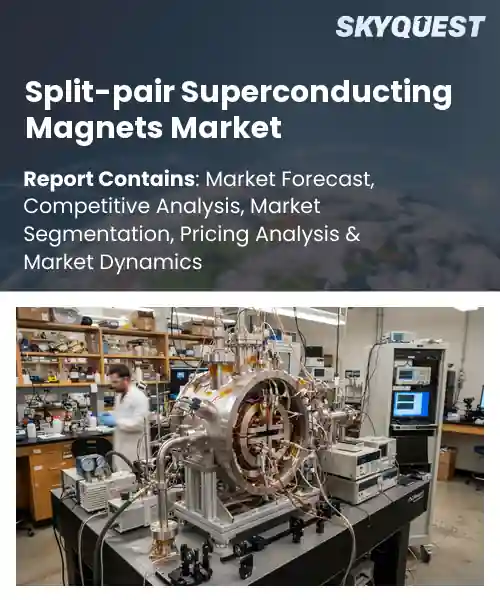
Split-pair Superconducting Magnets Market
Report ID: SQMIG45J2924
Report ID: SQMIG45J2924
[email protected]
USA +1 351-333-4748
Report ID:
SQMIG45J2924 |
Region:
Global |
Published Date: September, 2026
Pages:
157
|Tables:
144
|Figures:
78


Global Split-Pair Superconducting Magnets Market size was valued at USD 4.3 Billion in 2024 and is poised to grow from USD 4.69 Billion in 2025 to USD 9.42 Billion by 2033, growing at a CAGR of 9.1% during the forecast period (2026-2033).
Split‑pair superconducting magnets are devices that generate high magnetic fields with opposite polarity in a compact geometry, enabling precise beam steering and uniform field regions for scientific and industrial use. The market centers on manufacturers supplying these cryogenic systems to particle‑accelerator labs, medical imaging centers, and materials‑testing facilities. Its importance derives from the ability to reach field strengths above 10 tesla while limiting stray fields, a requirement for synchrotron sources and nuclear magnetic resonance spectrometers. In the 1990s demand was confined to government research; the early 2000s saw MRI makers adopt split‑pair designs for better homogeneity, spurring supplier growth globally today. The principal growth catalyst for the global split‑pair superconducting magnets market is the rising demand for high‑resolution particle‑beam therapy in oncology, which requires precisely controlled magnetic fields to shape proton and carbon‑ion beams. As clinical trials demonstrate increased treatment efficacy, hospitals invest in dedicated beam‑line facilities, creating a downstream need for compact, low‑stray‑field magnets that fit within existing gantries. This demand triggers manufacturers to innovate cryocooler integration, reducing operating costs and expanding the addressable customer base beyond research institutions to regional cancer centers. Consequently, supply chain collaborations and government subsidies accelerate adoption, unlocking new revenue streams in emerging economies significantly.
How is AI driving performance optimization in the split-pair superconducting magnets market?
AI is reshaping performance optimization in split pair superconducting magnets by enabling predictive modeling, real time control, and automated design refinement. Machine learning algorithms analyze material behavior under extreme fields, guiding engineers toward geometries that reduce losses and improve field uniformity. Digital twins simulate thermal and magnetic interactions, allowing rapid iteration without costly physical prototypes. Integration of AI driven monitoring systems detects drift and quench precursors, prompting adaptive adjustments that sustain peak performance. These capabilities shorten development cycles, lower operational risk, and enhance reliability, positioning the technology as a cornerstone for advanced research facilities and medical imaging platforms.At present no verifiable recent AI driven development has been publicly announced in the split pair superconducting magnets market, limiting concrete examples of how the technology directly supports market growth and efficiency. Nevertheless researchers continue to explore AI integration to improve thermal stability and field precision, anticipating future gains in performance and cost reduction.
Market snapshot - (2026-2033)
Global Market Size
USD 4.3 Billion
Largest Segment
Niobium-Titanium
Fastest Growth
High-Temperature Superconductors
Growth Rate
9.1% CAGR
To get more insights on this market click here to Request a Free Sample Report
Global split-pair superconducting magnets market is segmented by superconducting material, magnetic field strength, application, cooling method, end user and region. Based on superconducting material, the market is segmented into Niobium-Titanium, Niobium-Tin and High-Temperature Superconductors. Based on magnetic field strength, the market is segmented into Up to 5 Tesla, 5.1–10 Tesla and Above 10 Tesla. Based on application, the market is segmented into MRI, Particle Accelerators, Nuclear Magnetic Resonance and Research & Scientific Applications. Based on cooling method, the market is segmented into Liquid Helium-Cooled and Cryocooler-Based. Based on end user, the market is segmented into Healthcare Institutions, Research Institutes and Industrial Organizations. Based on region, the market is segmented into North America, Europe, Asia Pacific, Latin America and Middle East & Africa.
Niobium Titanium segment dominates because it offers a proven balance of performance, manufacturability, and cost efficiency that aligns closely with the engineering requirements of split pair superconducting magnets. Its well understood mechanical properties enable reliable coil winding and stable operation, while its critical current density meets the typical field specifications without demanding exotic processing. Consequently, designers and manufacturers preferentially select this material, reinforcing its market leadership in the industry today.
Meanwhile, High Temperature Superconductors segment emerges as the most rapidly expanding area in the split pair superconducting magnets market. Breakthroughs in material processing reduce cooling complexity, enabling operation at higher temperatures and attracting applications that demand compact, low maintenance systems. This momentum fuels new product development and broadens market opportunities.
Up to 5 Tesla segment dominates because it satisfies the majority of routine imaging and research requirements while offering a straightforward design envelope that minimizes engineering risk. The lower field intensity reduces the demand for extreme cryogenic infrastructure, allowing manufacturers to rely on conventional cooling solutions and standard coil geometries. This simplicity translates into faster time to market and lower total ownership costs, reinforcing its preferred status among industry stakeholders.
Conversely, Above 10 Tesla segment is witnessing the strongest growth momentum in the split pair superconducting magnets market. Emerging high energy physics projects and next generation imaging techniques require ultra high fields, prompting investment in advanced coil designs and specialized cooling. This demand accelerates technology adoption and opens revenue streams.
To get detailed segments analysis, Request a Free Sample Report
Europe leads the split-pair superconducting magnets market through a combination of advanced research ecosystems, strong industrial collaborations, and a mature supply chain. The region benefits from deep expertise in cryogenics and precision engineering cultivated by long‑standing academic institutions and specialized manufacturers. Policy frameworks that encourage high‑tech investment and cross‑border projects further reinforce capability development. Close proximity of component suppliers to system integrators reduces lead times and fosters iterative innovation. Standardized testing protocols and certification schemes streamline product acceptance across multiple sectors, while a highly skilled engineering workforce ensures rapid adaptation to emerging application demands. Ongoing public‑private funding mechanisms sustain long‑term research pipelines, allowing the region to stay ahead of competing technologies and maintain its leadership in the global landscape.
Split-pair Superconducting Magnets Market in Germany benefits from a dense network of precision engineering firms and world‑class research institutions that specialize in cryogenic technologies. Collaborative projects between universities and industrial players accelerate prototype validation, while established standards facilitate seamless integration into medical imaging and particle‑physics applications. The country's emphasis on high‑value manufacturing ensures component reliability, and a supportive export framework helps German solutions reach a broad international customer base global market.
Split-pair Superconducting Magnets Market in the United Kingdom is driven by strong links between national laboratories and niche manufacturers that focus on low‑temperature physics. The collaborative culture encourages rapid knowledge transfer, supporting bespoke magnet designs for research facilities and advanced medical devices. Government‑backed innovation hubs provide access to testing infrastructure, while an established supply chain for superconducting wire ensures material availability. This ecosystem fosters confidence among end users seeking customized, high‑performance solutions.
Split-pair Superconducting Magnets Market in France leverages a heritage of high‑precision instrumentation and a concentration of specialist firms in the aerospace and energy sectors. Close cooperation between technical universities and industrial consortia accelerates the translation of fundamental research into market‑ready magnet systems. Access to testing facilities ensures compliance with stringent safety and performance criteria, while a proactive export promotion strategy positions French manufacturers as preferred partners for international research infrastructures.
North America experiences rapid expansion of the split-pair superconducting magnets market due to a confluence of cutting‑edge research initiatives, substantial private‑sector investment, and a robust manufacturing base. Leading universities and national laboratories generate a steady pipeline of innovative magnet designs, while venture‑backed firms translate those concepts into commercial products for medical imaging, quantum research, and advanced materials testing. A well‑developed supply chain for high‑purity superconducting wire and cryogenic components shortens development cycles. Favorable regulatory environments and strategic partnerships between sensor manufacturers and end‑user industries further accelerate market adoption, positioning the region as a dynamic hub for next‑generation superconducting technologies. The collaborative ecosystem encourages shared risk and rapid prototyping, while a culture of open standards facilitates compatibility across diverse applications. Continuous talent influx from top engineering schools sustains a skilled workforce capable of addressing complex design challenges, reinforcing the region’s momentum.
Split-pair Superconducting Magnets Market in the United States is anchored by a concentration of research centers that blend physics, materials science, and engineering. Strong ties between federal laboratories and commercial spin‑offs enable commercialization of magnet prototypes for medical and scientific use. Access to a mature supply chain for superconducting wire ensures component reliability, while incentive programs accelerate scale‑up of manufacturing. This environment cultivates confidence among buyers seeking reliable magnet solutions.
Split-pair Superconducting Magnets Market in Canada benefits from a collaborative research environment linking national laboratories with a network of specialized manufacturers. Emphasis on sustainable cryogenic processes drives innovation in low‑loss magnet designs for both scientific instrumentation and energy applications. Government incentives support scaling of production capabilities, while a well‑integrated supply chain for superconducting materials ensures timely delivery. This synergy fosters a reputation for reliable, environmentally conscious magnet solutions among partners.
Asia Pacific is strengthening its position in the split-pair superconducting magnets market through a blend of strategic government initiatives, burgeoning high‑tech manufacturing, and a growing community of research institutions focused on low‑temperature physics. National programs that prioritize advanced materials and cryogenic engineering have attracted significant investment, enabling the establishment of dedicated production facilities for superconducting components. Close collaboration between universities and emerging start‑ups accelerates technology transfer, particularly for applications in medical diagnostics and particle‑accelerator research. The region’s emphasis on cost‑effective manufacturing techniques and supply‑chain resilience enhances competitiveness, allowing Asian providers to meet rising global demand for high‑performance magnet systems. In addition, trade agreements facilitate smoother export of magnet assemblies, while participation in international standards bodies ensures compatibility with global equipment. A focus on training programs cultivates a skilled engineering workforce capable of handling complex design and fabrication challenges, reinforcing the region’s ability to sustain long‑term leadership in this specialized technology.
Split-pair Superconducting Magnets Market in Japan is underpinned by expertise in manufacturing and a strong tradition of instrumentation development. Collaboration between leading universities and specialized firms accelerates the creation of magnet assemblies for applications ranging from medical imaging to physics experiments. Government support for cryogenic technology research enhances material quality, while a supply chain for superconducting wire reduces lead times. This combination positions Japan as a source of magnet solutions.
Split-pair Superconducting Magnets Market in South Korea is driven by advancement in semiconductor and aerospace sectors that demand magnetic fields. Close cooperation between research institutes and industrial partners streamlines development of compact magnet systems for medical and scientific use. Targeted government programs fund cryogenic research and promote domestic production of superconducting wire, strengthening supply reliability. This focused approach enables South Korea to deliver competitive magnet solutions tailored to high‑technology applications.
To know more about the market opportunities by region and country, click here to
Buy The Complete Report
Rising Demand for Compact Systems
Advancements in Cryogenic Technologies
High Capital Investment Requirements
Stringent Regulatory Approval Processes
Request Free Customization of this report to help us to meet your business objectives.
Oxford Instruments’ acquisition of Bruker Magnetics in 2021 sharpened its position in high‑field split‑pair systems, while American Magnetics’ 2022 partnership with CERN accelerated joint R&D on ultra‑low‑temperature magnet designs. Cryomagnetics’ 2023 launch of a compact, high‑precision split‑pair magnet highlighted tech‑driven differentiation, and Siemens Healthineers’ 2024 integration of superconducting magnet modules into its imaging portfolio underscored strategic expansion through product innovation. These moves intensify competition by consolidating expertise, expanding application reach, and accelerating performance breakthroughs.
Top Player’s Company Profile
Recent Developments
SkyQuest’s ABIRAW (Advanced Business Intelligence, Research & Analysis Wing) is our Business Information Services team that Collects, Collates, Correlates, and Analyses the Data collected by means of Primary Exploratory Research backed by robust Secondary Desk research. As per SkyQuest analysis, the global split‑pair superconducting magnets market is being propelled primarily by the rising demand for compact systems, which pushes manufacturers to develop smaller, lighter magnet solutions for medical imaging and accelerator applications. A second driver, continuous advancements in cryogenic technologies, is lowering operating costs and expanding deployment possibilities. The market is currently led by Europe, where strong research ecosystems and mature supply chains give it a clear advantage. Niobium‑Titanium remains the dominating segment thanks to its proven performance‑cost balance. However, the high capital investment required for material, equipment and expertise acts as a restraint, slowing entry of smaller players.
| Report Metric | Details |
|---|---|
| Market size value in 2024 | USD 4.3 Billion |
| Market size value in 2033 | USD 9.42 Billion |
| Growth Rate | 9.1% |
| Base year | 2024 |
| Forecast period | (2026-2033) |
| Forecast Unit (Value) | USD Billion |
| Segments covered |
|
| Regions covered | North America (US, Canada), Europe (Germany, France, United Kingdom, Italy, Spain, Rest of Europe), Asia Pacific (China, India, Japan, Rest of Asia-Pacific), Latin America (Brazil, Rest of Latin America), Middle East & Africa (South Africa, GCC Countries, Rest of MEA) |
| Companies covered |
|
| Customization scope | Free report customization with purchase. Customization includes:-
|
To get a free trial access to our platform which is a one stop solution for all your data requirements for quicker decision making. This platform allows you to compare markets, competitors who are prominent in the market, and mega trends that are influencing the dynamics in the market. Also, get access to detailed SkyQuest exclusive matrix.
Table Of Content
Executive Summary
Market overview
Parent Market Analysis
Market overview
Market size
KEY MARKET INSIGHTS
COVID IMPACT
MARKET DYNAMICS & OUTLOOK
Market Size by Region
KEY COMPANY PROFILES
Methodology
For the Split-pair Superconducting Magnets Market, our research methodology involved a mixture of primary and secondary data sources. Key steps involved in the research process are listed below:
1. Information Procurement: This stage involved the procurement of Market data or related information via primary and secondary sources. The various secondary sources used included various company websites, annual reports, trade databases, and paid databases such as Hoover's, Bloomberg Business, Factiva, and Avention. Our team did 45 primary interactions Globally which included several stakeholders such as manufacturers, customers, key opinion leaders, etc. Overall, information procurement was one of the most extensive stages in our research process.
2. Information Analysis: This step involved triangulation of data through bottom-up and top-down approaches to estimate and validate the total size and future estimate of the Split-pair Superconducting Magnets Market.
3. Report Formulation: The final step entailed the placement of data points in appropriate Market spaces in an attempt to deduce viable conclusions.
4. Validation & Publishing: Validation is the most important step in the process. Validation & re-validation via an intricately designed process helped us finalize data points to be used for final calculations. The final Market estimates and forecasts were then aligned and sent to our panel of industry experts for validation of data. Once the validation was done the report was sent to our Quality Assurance team to ensure adherence to style guides, consistency & design.
Analyst Support
Customization Options
With the given market data, our dedicated team of analysts can offer you the following customization options are available for the Split-pair Superconducting Magnets Market:
Product Analysis: Product matrix, which offers a detailed comparison of the product portfolio of companies.
Regional Analysis: Further analysis of the Split-pair Superconducting Magnets Market for additional countries.
Competitive Analysis: Detailed analysis and profiling of additional Market players & comparative analysis of competitive products.
Go to Market Strategy: Find the high-growth channels to invest your marketing efforts and increase your customer base.
Innovation Mapping: Identify racial solutions and innovation, connected to deep ecosystems of innovators, start-ups, academics, and strategic partners.
Category Intelligence: Customized intelligence that is relevant to their supply Markets will enable them to make smarter sourcing decisions and improve their category management.
Public Company Transcript Analysis: To improve the investment performance by generating new alpha and making better-informed decisions.
Social Media Listening: To analyze the conversations and trends happening not just around your brand, but around your industry as a whole, and use those insights to make better Marketing decisions.
REQUEST FOR SAMPLE
 REQUEST FREE CUSTOMIZATION


Want to customize this report? This report can be personalized according to your needs. Our analysts and industry experts will work directly with you to understand your requirements and provide you with customized data in a short amount of time. We offer $1000 worth of FREE customization at the time of purchase.
Feedback From Our Clients


 USA (+1) 351-333-4748

