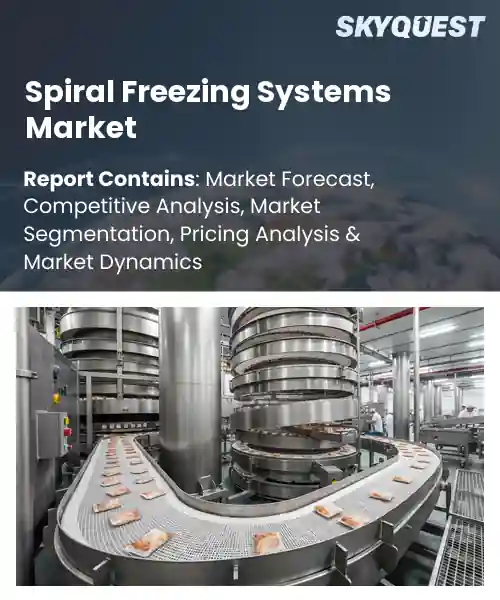
Spiral Freezing Systems Market
Report ID: SQMIG20I3386
Report ID: SQMIG20I3386
[email protected]
USA +1 351-333-4748
Report ID:
SQMIG20I3386 |
Region:
Global |
Published Date: July, 2026
Pages:
157
|Tables:
145
|Figures:
78


Global Spiral Freezing Systems Market size was valued at USD 1.72 Billion in 2024 and is poised to grow from USD 1.83 Billion in 2025 to USD 2.98 Billion by 2033, growing at a CAGR of 6.3% during the forecast period (2026-2033).
Energy efficiency drives the spiral freezing systems market because operating costs dominate processing expenses. When manufacturers adopt variable‑speed compressors and waste‑heat recovery, electricity demand falls, profit margins improve, and capacity can be expanded. A pork processor in Brazil retrofitted its line with a low‑temperature cascade system and recorded a 15 % reduction in power use while preserving quality. That outcome attracted Asian grain processors aiming to freeze high‑protein flours, prompting equipment suppliers to develop modular, scalable designs that meet varied volumes and sustainability goals. Consequently, demand for low‑energy solutions is accelerating market growth worldwide across both established and emerging markets significantly. The spiral freezing systems market encompasses equipment that freezes food products by driving them through a rotating chilled drum, a method that preserves integrity and extends shelf life. Its relevance stems from rising consumer demand for high‑quality, minimally processed foods and food‑safety regulations that compel manufacturers to adopt technologies ensuring uniform ice crystal formation. Historically, the market emerged in the 1970s as a niche solution for seafood, but accelerated growth occurred after the 2000s when processors integrated spiral freezers into lines for frozen vegetables, meals, and dairy desserts. Consequently, adoption rates have risen alongside advances in refrigerant efficiency and automation.
How is AI-driven automation influencing the Spiral Freezing Systems market?
AI-driven automation is reshaping spiral freezing systems by embedding intelligent sensors and adaptive control algorithms into the equipment. These technologies monitor temperature gradients, product flow and energy consumption in real time, allowing the system to fine‑tune its operation without human intervention. The result is more consistent ice crystal formation, reduced waste and lower operating costs, which makes the technology attractive to large‑scale food processors seeking to improve product quality and sustainability. As manufacturers integrate machine‑learning models that predict optimal freezing cycles, the overall reliability of the line improves, encouraging broader adoption across the sector and driving market momentum.In June 2026, a leading spiral freezer manufacturer introduced AI‑driven controls, enhancing efficiency and supporting market growth.
Market snapshot - (2026-2033)
Global Market Size
USD 1.72 Billion
Largest Segment
Single Drum Spiral Freezers
Fastest Growth
Multi-Drum Spiral Freezers
Growth Rate
6.3% CAGR
To get more insights on this market click here to Request a Free Sample Report
Global spiral freezing systems market is segmented by system type, refrigeration type, application, end user, capacity and region. Based on system type, the market is segmented into Single Drum Spiral Freezers, Twin Drum Spiral Freezers and Multi-Drum Spiral Freezers. Based on refrigeration type, the market is segmented into Mechanical Refrigeration and Cryogenic Refrigeration. Based on application, the market is segmented into Meat & Poultry, Seafood, Bakery Products, Dairy Products and Prepared Foods. Based on end user, the market is segmented into Food Processing Companies, Cold Storage Facilities and Contract Food Manufacturers. Based on capacity, the market is segmented into Small Capacity, Medium Capacity and Large Capacity. Based on region, the market is segmented into North America, Europe, Asia Pacific, Latin America and Middle East & Africa.
Twin drum spiral freezers segment leads because they combine high throughput with precise temperature control, enabling processors to handle larger product volumes while maintaining consistent ice crystal formation. This operational efficiency reduces labor intensity and energy waste, making the equipment attractive for large scale manufacturers seeking to boost productivity and product quality. Moreover, the robust design tolerates continuous operation, aligning with the demanding schedules of meat and poultry processing lines, which further strengthens its market leadership.
However, multi drum spiral freezers segment emerges as the fastest growing because manufacturers are investing in modular configurations that can be expanded as production needs evolve, allowing flexible scaling without major capital outlays. This adaptability appeals to processors aiming to diversify product lines, encouraging broader adoption and driving market expansion across multiple categories.
Seafood application segment dominates because frozen seafood requires rapid and uniform ice formation to preserve delicate textures and flavors, and spiral freezers deliver that through swift contact freezing. This capability meets stringent quality expectations, reduces waste, and supports supply chain reliability, making processors favor spiral technology for fish fillets, shellfish, and ready to cook items. The reliable preservation also enables exporters to meet international standards, reinforcing the segment’s pivotal role in market growth.
Meanwhile, bakery products application segment experiences the strongest growth because consumer demand for frozen dough and pastries is rising, and spiral freezers provide the quick freeze needed to retain crumb structure and freshness. This ability to lock in flavor and extend shelf life encourages manufacturers to expand frozen bakery lines, creating revenue streams and accelerating market momentum.
To get detailed segments analysis, Request a Free Sample Report
North America maintains its leadership through a combination of mature food‑processing ecosystems, substantial investment in research and development, and an extensive cold‑chain infrastructure that supports rapid product deployment. The market benefits from close collaboration between equipment manufacturers and major food producers, fostering continuous innovation in spiral freezing technology. Strong regulatory frameworks emphasize food safety and quality, encouraging adoption of advanced freezing solutions. Consumer preferences for premium frozen goods drive demand, while logistics networks ensure efficient distribution across diverse geographic regions. Together, these factors create a resilient environment that sustains North America’s dominant position.
United States Spiral Freezing Systems Market
Spiral Freezing Systems Market in United States benefits from a concentration of global equipment suppliers and a culture of technological experimentation. Leading manufacturers leverage sophisticated automation and digital integration to meet the precise needs of large‑scale food processors. The country’s expansive foodservice sector and retail chains demand consistent product quality, prompting widespread adoption of spiral freezing. Collaborative research initiatives with academic institutions further accelerate innovation, while robust distribution channels guarantee rapid market penetration.
Canada Spiral Freezing Systems Market
Spiral Freezing Systems Market in Canada is characterized by a focus on high‑value niche segments such as seafood, specialty meats, and dairy products. Emphasis on sustainability and energy efficiency shapes equipment design, aligning with national environmental objectives. Government programs support technology adoption among mid‑size producers, fostering a collaborative ecosystem that blends local expertise with international best practices. Strong export orientation drives continuous improvement, ensuring Canadian manufacturers remain competitive in global supply chains.
Europe’s rapid expansion is propelled by stringent food‑safety regulations, a strong emphasis on waste reduction, and growing consumer demand for high‑quality frozen convenience foods. Collaborative research networks across the continent facilitate knowledge transfer and accelerate product development, while funding mechanisms support the modernization of processing facilities. The region’s diversified culinary traditions create a broad spectrum of applications for spiral freezing, from gourmet desserts to ready‑to‑eat meals. Integrated supply chains and a commitment to sustainability further reinforce adoption, positioning Europe as a dynamic growth engine for the market.
Germany Spiral Freezing Systems Market
Spiral Freezing Systems Market in Germany leverages the nation’s reputation for precision engineering and advanced manufacturing. Industrial clusters integrate spiral freezing technology with automation and process control expertise, delivering highly efficient solutions for large‑scale food producers. Strong ties between equipment makers and research institutes drive continuous refinement of system performance. The German market also benefits from a robust logistics framework that ensures seamless distribution of frozen products throughout Europe and beyond.
United Kingdom Spiral Freezing Systems Market
Spiral Freezing Systems Market in United Kingdom experiences accelerated uptake driven by a vibrant foodservice landscape and a focus on convenience. Innovation hubs collaborate closely with culinary startups to tailor freezing solutions that preserve flavor and texture in fast‑moving consumer goods. Consumer trends toward ready‑made meals and premium frozen desserts create a fertile environment for technology adoption. Regulatory support for food safety and sustainability further encourages investment in modern spiral freezing equipment.
France Spiral Freezing Systems Market
Spiral Freezing Systems Market in France is emerging as producers seek to combine artisanal quality with the efficiency of modern freezing processes. The market reflects a growing appetite for gourmet frozen offerings that maintain the integrity of traditional recipes. Partnerships between boutique manufacturers and technology providers facilitate the customization of spiral freezing systems to meet specific product requirements. A cultural emphasis on culinary excellence drives ongoing exploration of innovative applications within the French food sector.
Asia Pacific strengthens its position by capitalizing on rapid urbanization, rising disposable incomes, and a cultural shift toward convenient yet high‑quality frozen foods. Significant investment in cold‑chain infrastructure enhances the reliability of product distribution, while government initiatives promote technology adoption across food‑processing industries. The region’s export‑oriented manufacturers increasingly integrate spiral freezing to meet international standards, boosting competitiveness. Collaborative efforts between local engineering firms and global equipment leaders accelerate the diffusion of advanced features, positioning Asia Pacific as a dynamic hub for market growth.
Japan Spiral Freezing Systems Market
Spiral Freezing Systems Market in Japan is distinguished by the integration of cutting‑edge robotics and precision control, reflecting the country’s broader technological leadership. Consumer expectations for impeccably preserved texture and flavor drive manufacturers to adopt highly refined spiral freezing solutions. Strong collaboration between equipment suppliers and food producers fosters continuous improvement in system efficiency and energy utilization. Japan’s export‑focused food industry leverages these capabilities to meet stringent quality requirements in overseas markets.
South Korea Spiral Freezing Systems Market
Spiral Freezing Systems Market in South Korea benefits from a culture of rapid innovation and a thriving convenience‑food sector. Domestic producers emphasize speed and consistency, prompting the deployment of advanced spiral freezing equipment that aligns with high‑throughput production lines. Government support for smart manufacturing encourages the integration of IoT and data analytics within freezing processes. The resulting efficiencies enhance product competitiveness both domestically and in key export destinations.
To know more about the market opportunities by region and country, click here to
Buy The Complete Report
Rising Demand For Frozen Foods
Adopting Advanced Cryogenic Techniques
High Capital Investment Costs
Limited Technical Expertise Availability
Request Free Customization of this report to help us to meet your business objectives.
GEA, RMF, John Bean Technologies, Van Abeelen and CES NV dominate the spiral freezing systems market, intensifying competition through continuous product upgrades and strategic collaborations with major food manufacturers, which drive faster time‑to‑market for high‑efficiency freezers and push rivals to accelerate innovation cycles.
Top Player’s Company Profile
Recent Developments
SkyQuest’s ABIRAW (Advanced Business Intelligence, Research & Analysis Wing) is our Business Information Services team that Collects, Collates, Correlates, and Analyses the Data collected by means of Primary Exploratory Research backed by robust Secondary Desk research. As per SkyQuest analysis the spiral freezing systems market is being propelled primarily by the rising demand for frozen foods, which pushes manufacturers to adopt technology that preserves texture and flavor; a second driver is the rapid infusion of AI‑driven automation that fine‑tunes temperature and energy use in real time, boosting efficiency and product consistency. The market is tempered by the restraint of high capital investment costs that limit adoption among smaller producers. North America remains the dominant region thanks to its mature food‑processing ecosystem and strong regulatory support, while twin‑drum spiral freezers dominate the product segment by offering high throughput and precise temperature control.
| Report Metric | Details |
|---|---|
| Market size value in 2024 | USD 1.72 Billion |
| Market size value in 2033 | USD 2.98 Billion |
| Growth Rate | 6.3% |
| Base year | 2024 |
| Forecast period | (2026-2033) |
| Forecast Unit (Value) | USD Billion |
| Segments covered |
|
| Regions covered | North America (US, Canada), Europe (Germany, France, United Kingdom, Italy, Spain, Rest of Europe), Asia Pacific (China, India, Japan, Rest of Asia-Pacific), Latin America (Brazil, Rest of Latin America), Middle East & Africa (South Africa, GCC Countries, Rest of MEA) |
| Companies covered |
|
| Customization scope | Free report customization with purchase. Customization includes:-
|
To get a free trial access to our platform which is a one stop solution for all your data requirements for quicker decision making. This platform allows you to compare markets, competitors who are prominent in the market, and mega trends that are influencing the dynamics in the market. Also, get access to detailed SkyQuest exclusive matrix.
Table Of Content
Executive Summary
Market overview
Parent Market Analysis
Market overview
Market size
KEY MARKET INSIGHTS
COVID IMPACT
MARKET DYNAMICS & OUTLOOK
Market Size by Region
KEY COMPANY PROFILES
Methodology
For the Spiral Freezing Systems Market, our research methodology involved a mixture of primary and secondary data sources. Key steps involved in the research process are listed below:
1. Information Procurement: This stage involved the procurement of Market data or related information via primary and secondary sources. The various secondary sources used included various company websites, annual reports, trade databases, and paid databases such as Hoover's, Bloomberg Business, Factiva, and Avention. Our team did 45 primary interactions Globally which included several stakeholders such as manufacturers, customers, key opinion leaders, etc. Overall, information procurement was one of the most extensive stages in our research process.
2. Information Analysis: This step involved triangulation of data through bottom-up and top-down approaches to estimate and validate the total size and future estimate of the Spiral Freezing Systems Market.
3. Report Formulation: The final step entailed the placement of data points in appropriate Market spaces in an attempt to deduce viable conclusions.
4. Validation & Publishing: Validation is the most important step in the process. Validation & re-validation via an intricately designed process helped us finalize data points to be used for final calculations. The final Market estimates and forecasts were then aligned and sent to our panel of industry experts for validation of data. Once the validation was done the report was sent to our Quality Assurance team to ensure adherence to style guides, consistency & design.
Analyst Support
Customization Options
With the given market data, our dedicated team of analysts can offer you the following customization options are available for the Spiral Freezing Systems Market:
Product Analysis: Product matrix, which offers a detailed comparison of the product portfolio of companies.
Regional Analysis: Further analysis of the Spiral Freezing Systems Market for additional countries.
Competitive Analysis: Detailed analysis and profiling of additional Market players & comparative analysis of competitive products.
Go to Market Strategy: Find the high-growth channels to invest your marketing efforts and increase your customer base.
Innovation Mapping: Identify racial solutions and innovation, connected to deep ecosystems of innovators, start-ups, academics, and strategic partners.
Category Intelligence: Customized intelligence that is relevant to their supply Markets will enable them to make smarter sourcing decisions and improve their category management.
Public Company Transcript Analysis: To improve the investment performance by generating new alpha and making better-informed decisions.
Social Media Listening: To analyze the conversations and trends happening not just around your brand, but around your industry as a whole, and use those insights to make better Marketing decisions.
REQUEST FOR SAMPLE
 REQUEST FREE CUSTOMIZATION


Want to customize this report? This report can be personalized according to your needs. Our analysts and industry experts will work directly with you to understand your requirements and provide you with customized data in a short amount of time. We offer $1000 worth of FREE customization at the time of purchase.
Feedback From Our Clients


 USA (+1) 351-333-4748

