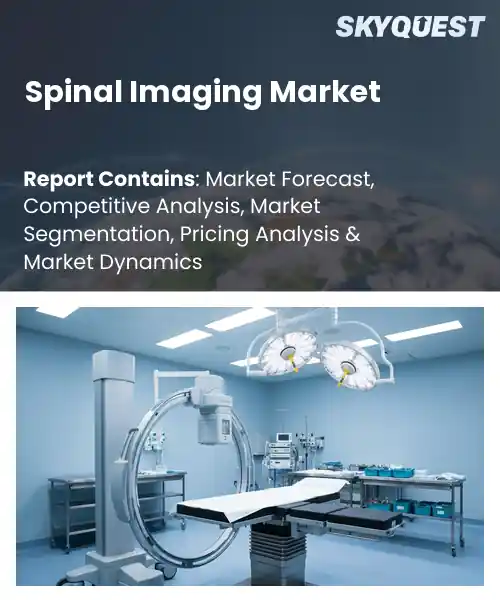
Spinal Imaging Market
Report ID: SQMIG35A3493
Report ID: SQMIG35A3493
[email protected]
USA +1 351-333-4748
Report ID:
SQMIG35A3493 |
Region:
Global |
Published Date: May, 2026
Pages:
157
|Tables:
182
|Figures:
79


Global Spinal Imaging Market size was valued at USD 1.8 Billion in 2024 and is poised to grow from USD 1.89 Billion in 2025 to USD 2.84 Billion by 2033, growing at a CAGR of 5.2% during the forecast period (2026-2033).
The primary driver of the spinal imaging market is rising prevalence of spinal disorders, which has steadily increased demand for precise diagnostic tools. Spinal imaging includes MRI, CT, X-ray and emerging intraoperative and dynamic imaging systems, and it matters because accurate visualization directly informs surgical planning, conservative care and outcome monitoring. Over the past two decades the market shifted from basic radiography to high-resolution MRI and 3D CT reconstructions with examples such as adoption of high-field MRI for disc pathology and intraoperative cone-beam CT for instrumentation. This evolution has attracted device manufacturers, radiology groups and health systems seeking diagnostic differentiation.A key growth factor in the global spinal imaging market is technological convergence, where improvements in scanners, analytics and surgical navigation generate measurable clinical value. When AI segmentation reduces reporting time and improves detection, radiology services increase throughput and more patients proceed to targeted intervention, prompting hospitals to acquire high-field MRI and intraoperative CT. The rise of minimally invasive spine surgery further increases demand for real-time imaging such as cone-beam CT and mobile 3D C-arms to confirm implant placement, seen in spinal fusion and tumor ablation. These cause-and-effect forces create opportunities in AI-enabled workflows, integrated imaging-navigation systems and expanding capacity.
How is AI enhancing diagnostic accuracy in the spinal imaging market?
AI is improving diagnostic accuracy in spinal imaging by automating segmentation, detecting subtle pathology, standardizing measurements, and reducing reader variability. These features increase sensitivity for findings that are easy to miss and accelerate interpretation while fitting into existing radiology workflows. The market is moving toward embedded AI that flags urgent studies, labels anatomical landmarks, and supports preoperative planning. Vendors are focusing on solutions for disc herniation, spinal stenosis and nerve root compression and on integrations that make reporting more consistent and reproducible, helping hospitals and imaging centers adopt AI with less friction.deepc March 2026, the company integrated an FDA cleared spine MRI AI from Remedy Logic into deepcOS, demonstrating scalable deployment that automates detection and labeling of disc and canal pathology to speed diagnosis and standardize reports, thereby supporting market uptake and operational efficiency.
Market snapshot - (2026-2033)
Global Market Size
USD 1.8 Billion
Largest Segment
Magnetic Resonance Imaging (MRI)
Fastest Growth
Magnetic Resonance Imaging (MRI)
Growth Rate
5.2% CAGR
To get more insights on this market click here to Request a Free Sample Report
Global spinal imaging market is segmented by imaging modality, application, technology, end user, patient type, device type and region. Based on imaging modality, the market is segmented into X-ray Imaging, Magnetic Resonance Imaging (MRI), Computed Tomography (CT), Ultrasound Imaging, Nuclear Imaging and Others. Based on application, the market is segmented into Degenerative Spine Disorders, Spinal Trauma, Spinal Tumors, Spinal Infections, Congenital Spine Disorders and Others. Based on technology, the market is segmented into 2D Imaging, 3D/4D Imaging, AI-Assisted Imaging, Image-Guided Navigation and Others. Based on end user, the market is segmented into Hospitals, Diagnostic Imaging Centers, Orthopedic Clinics, Ambulatory Surgical Centers and Others. Based on patient type, the market is segmented into Adult, Pediatric and Geriatric. Based on device type, the market is segmented into Fixed Imaging Systems, Portable Imaging Systems, Hybrid Imaging Systems and Others. Based on region, the market is segmented into North America, Europe, Asia Pacific, Latin America and Middle East & Africa.
Magnetic Resonance Imaging (MRI) segment dominates because MRI provides unmatched soft tissue contrast and multiplanar imaging that are critical for evaluating discs, spinal cord, nerve roots and complex degenerative conditions. Its non ionizing nature and versatility across indications encourage clinician preference and diagnostic confidence. Continuous advances in coil design, sequence optimization and compatibility with surgical planning workflows drive broad adoption by referring physicians and integration into standard diagnostic pathways.
However, Computed Tomography (CT) is the fastest growing modality due to rapid acquisition and superior bone detail for trauma and surgical planning. Advances in detector design and low dose reconstruction, along with AI enhanced workflows for image guided interventions, are driving broader adoption in acute and procedural settings and creating new clinical opportunities.
AI-Assisted Imaging segment stands out because artificial intelligence enhances image interpretation, automates complex spinal measurements and highlights subtle pathologies that challenge human readers. Improved diagnostic consistency and faster triage workflows reduce clinician burden and enable higher throughput. Strong vendor investment in validated algorithms, growing integration with PACS and reporting systems, and regulatory clearances for diagnostic support tools are driving clinician trust and embedding AI into routine spinal imaging practice.
However, Image-Guided Navigation is the fastest growing technology driven by demand for minimally invasive spinal procedures requiring precise instrument guidance. Improvements in intraoperative imaging fusion, tracking accuracy and operating room integration, together with surgeon acceptance and vendor deployment of hybrid systems, are accelerating adoption and creating new procedural planning and intraoperative support opportunities.
To get detailed segments analysis, Request a Free Sample Report
North America commands the global spinal imaging market through an integrated combination of technological leadership, concentrated provider networks, and high patient access to advanced diagnostic services. Robust adoption of high resolution imaging modalities and strong presence of leading device manufacturers sustain premium clinical uptake. Well established reimbursement frameworks and multidisciplinary care pathways drive routine integration of imaging into spine care. A mature ecosystem of research institutions and collaborative industry partnerships fosters continuous innovation. Significant private sector investment and specialized outpatient imaging centers shorten time to diagnosis and enhance throughput. High availability of trained radiologists and spine specialists supports advanced interpretation and procedural planning. Cross border collaborations and regional centers of excellence concentrate expertise and reinforce market depth. Integrated data systems and telemedicine link specialists with community providers to broaden service reach.
Spinal Imaging Market in United States is defined by broad availability of advanced imaging platforms, dense networks of specialist centers, and strong clinical expertise in spine care. Private investment in outpatient imaging and robust hospital imaging departments supports adoption of sophisticated modalities. Integration of imaging with multidisciplinary surgical planning and established referral pathways enhances utilization. Collaboration between academic research centers and industry accelerates technology validation and adoption across community providers.
Spinal Imaging Market in Canada benefits from integrated public healthcare systems that prioritize diagnostic access and equitable service distribution. Investment in regional imaging hubs supports standardized care pathways. Emphasis on workforce training and teleimaging collaborations extends specialist interpretation to remote areas. Policy frameworks encouraging technology evaluation and centralized procurement enable introduction of advanced imaging technologies while maintaining focus on clinical outcomes and cost effective service delivery across provinces and territories.
Europe is experiencing rapid expansion in spinal imaging driven by converging factors that elevate diagnostic demand and facilitate technology uptake. Harmonized regulatory pathways and supportive reimbursement decisions in several markets reduce barriers to clinical adoption, while increasing clinical emphasis on minimally invasive spine interventions raises the need for precise preoperative and intraoperative imaging. Strong clinical networks and centralized radiology services enable efficient deployment of advanced modalities across hospitals and specialty centers. Active collaboration between manufacturers, academic institutions, and clinical leaders accelerates validation of novel imaging applications. Investment in digital infrastructure and cross border teleimaging services extends specialist interpretation to underserved areas. Additionally, a competitive market landscape and growing focus on value based care models encourage technology enhancements that improve diagnostic confidence and workflow efficiency.
Spinal Imaging Market in Germany benefits from clinical expertise, concentrated research capacity, and advanced equipment. Hospitals and specialized spine centers integrate advanced modalities into diagnostic and surgical workflows. Supportive reimbursement policies and structured clinical pathways foster technology adoption across public and private providers. Collaboration between university hospitals and industry validates novel imaging techniques and guidance tools, reinforcing Germany as a center for clinical innovation in spine imaging and patient outcomes.
Spinal Imaging Market in United Kingdom is marked by adoption of advanced imaging modalities driven by health system initiatives and private investment. Expansion of outpatient diagnostic services, digital imaging infrastructure, and focus on minimally invasive procedures increase demand for precise imaging guidance. Collaboration between clinical networks and vendors accelerates pilots and clinical roll out. Emphasis on cost effectiveness and improved patient pathways supports integration across hospital and community care settings.
Spinal Imaging Market in France is evolving with increasing adoption of advanced imaging technologies driven by clinical demand for precision diagnostics. Strengthening hospital networks and investments in radiology services expand access to quality imaging. Emphasis on clinical research and collaborations with technology vendors supports evaluation of novel modalities. Policy focus on value based care and coordinated referral networks encourages measured adoption, with regional centers of expertise aiding technology diffusion broadly.
Asia Pacific is strengthening its position in spinal imaging through concentrated investment in advanced diagnostic technologies, expanding clinical capabilities, and growing collaboration between regional manufacturers and global vendors. Rapid modernization of hospital imaging suites in major markets supports uptake of high fidelity modalities and intraoperative imaging solutions. Emphasis on procedural imaging to support minimally invasive spine surgery and navigation is increasing clinical demand. Cross border clinical collaborations, technology transfer agreements, and targeted workforce training programs enhance local interpretation capacity. Government initiatives and supportive procurement policies in several markets encourage clinical evaluations and wider introductions. Together, these elements create a diverse and increasingly sophisticated regional market that complements established players and contributes novel solutions to global spinal imaging practice. This regional momentum is attracting further research collaborations and capital.
Spinal Imaging Market in Japan is anchored by technological innovation from domestic manufacturers and hospital systems that adopt precision imaging and intraoperative guidance. Strong ties between industry and academic centers support device refinement and clinical validation. Integration with surgical navigation and minimally invasive approaches drives demand for specialized imaging solutions. Training programs and a culture of clinical adoption enable translation of novel imaging capabilities into routine spine care and diagnostics.
Spinal Imaging Market in South Korea is driven by integration of advanced imaging technologies supported by strong electronics and medical industries. Hospitals and clinics adopt innovative imaging modalities and intraoperative systems to support precision spine procedures. Private sector investment and agile regulatory processes facilitate clinical evaluation of new solutions. Collaboration between manufacturers and hospitals promotes improvement, while digital platforms and teleimaging expand specialist interpretation across regional healthcare networks and beyond.
To know more about the market opportunities by region and country, click here to
Buy The Complete Report
Advancements In Imaging Modalities
Rising Prevalence Of Spinal Disorders
High Cost Of Advanced Systems
Regulatory Approval Complexity
Request Free Customization of this report to help us to meet your business objectives.
Competitive activity in spinal imaging centers on consolidation, platform partnerships, and clinical grade AI. Established vendors pursue acquisitions such as Alphatec Spine's agreement to acquire EOS imaging and Stryker's purchase of Mobius Imaging to gain intraoperative capability. New entrants drive technology shifts with FDA cleared solutions like Verdure Imaging's SpineUs three dimensional ultrasound and Remedy Logic's AI for spine MRI, prompting partnership led distribution strategies.
Top Player’s Company Profile
Recent Developments
SkyQuest’s ABIRAW (Advanced Business Intelligence, Research & Analysis Wing) is our Business Information Services team that Collects, Collates, Correlates, and Analyses the Data collected by means of Primary Exploratory Research backed by robust Secondary Desk research. As per SkyQuest analysis, a key driver of the global spinal imaging market is rising prevalence of spinal disorders, with technological convergence and AI-enabled workflows serving as a second driver that boosts diagnostic throughput and procedural guidance. A significant restraint remains the high acquisition and maintenance cost of advanced imaging systems, which limits adoption in smaller and resource-constrained settings. The dominating region is North America thanks to technological leadership and strong reimbursement, while the dominating segment is Magnetic Resonance Imaging given its superior soft tissue contrast and clinical versatility. Together these forces favor investment in AI-enabled MRI and intraoperative imaging despite adoption headwinds.
| Report Metric | Details |
|---|---|
| Market size value in 2024 | USD 1.8 Billion |
| Market size value in 2033 | USD 2.84 Billion |
| Growth Rate | 5.2% |
| Base year | 2024 |
| Forecast period | (2026-2033) |
| Forecast Unit (Value) | USD Billion |
| Segments covered |
|
| Regions covered | North America (US, Canada), Europe (Germany, France, United Kingdom, Italy, Spain, Rest of Europe), Asia Pacific (China, India, Japan, Rest of Asia-Pacific), Latin America (Brazil, Rest of Latin America), Middle East & Africa (South Africa, GCC Countries, Rest of MEA) |
| Companies covered |
|
| Customization scope | Free report customization with purchase. Customization includes:-
|
To get a free trial access to our platform which is a one stop solution for all your data requirements for quicker decision making. This platform allows you to compare markets, competitors who are prominent in the market, and mega trends that are influencing the dynamics in the market. Also, get access to detailed SkyQuest exclusive matrix.
Table Of Content
Executive Summary
Market overview
Parent Market Analysis
Market overview
Market size
KEY MARKET INSIGHTS
COVID IMPACT
MARKET DYNAMICS & OUTLOOK
Market Size by Region
KEY COMPANY PROFILES
Methodology
For the Spinal Imaging Market, our research methodology involved a mixture of primary and secondary data sources. Key steps involved in the research process are listed below:
1. Information Procurement: This stage involved the procurement of Market data or related information via primary and secondary sources. The various secondary sources used included various company websites, annual reports, trade databases, and paid databases such as Hoover's, Bloomberg Business, Factiva, and Avention. Our team did 45 primary interactions Globally which included several stakeholders such as manufacturers, customers, key opinion leaders, etc. Overall, information procurement was one of the most extensive stages in our research process.
2. Information Analysis: This step involved triangulation of data through bottom-up and top-down approaches to estimate and validate the total size and future estimate of the Spinal Imaging Market.
3. Report Formulation: The final step entailed the placement of data points in appropriate Market spaces in an attempt to deduce viable conclusions.
4. Validation & Publishing: Validation is the most important step in the process. Validation & re-validation via an intricately designed process helped us finalize data points to be used for final calculations. The final Market estimates and forecasts were then aligned and sent to our panel of industry experts for validation of data. Once the validation was done the report was sent to our Quality Assurance team to ensure adherence to style guides, consistency & design.
Analyst Support
Customization Options
With the given market data, our dedicated team of analysts can offer you the following customization options are available for the Spinal Imaging Market:
Product Analysis: Product matrix, which offers a detailed comparison of the product portfolio of companies.
Regional Analysis: Further analysis of the Spinal Imaging Market for additional countries.
Competitive Analysis: Detailed analysis and profiling of additional Market players & comparative analysis of competitive products.
Go to Market Strategy: Find the high-growth channels to invest your marketing efforts and increase your customer base.
Innovation Mapping: Identify racial solutions and innovation, connected to deep ecosystems of innovators, start-ups, academics, and strategic partners.
Category Intelligence: Customized intelligence that is relevant to their supply Markets will enable them to make smarter sourcing decisions and improve their category management.
Public Company Transcript Analysis: To improve the investment performance by generating new alpha and making better-informed decisions.
Social Media Listening: To analyze the conversations and trends happening not just around your brand, but around your industry as a whole, and use those insights to make better Marketing decisions.
REQUEST FOR SAMPLE
 REQUEST FREE CUSTOMIZATION


Want to customize this report? This report can be personalized according to your needs. Our analysts and industry experts will work directly with you to understand your requirements and provide you with customized data in a short amount of time. We offer $1000 worth of FREE customization at the time of purchase.
Feedback From Our Clients


 USA (+1) 351-333-4748

