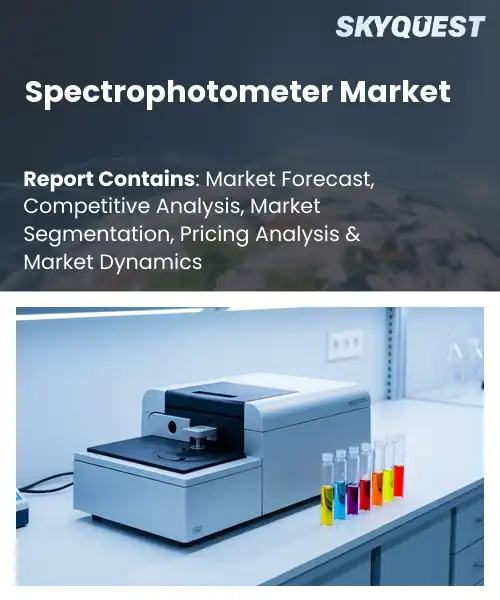
Spectrophotometer Market
Report ID: SQMIG15A2695
Report ID: SQMIG15A2695
[email protected]
USA +1 351-333-4748
Report ID:
SQMIG15A2695 |
Region:
Global |
Published Date: February, 2026
Pages:
157
|Tables:
152
|Figures:
78


Global Spectrophotometer Market size was valued at USD 1.63 Billion in 2024 and is poised to grow from USD 1.7 Billion in 2025 to USD 2.36 Billion by 2033, growing at a CAGR of 4.2% during the forecast period (2026-2033).
Increased demand for accurate quantitative analysis due to regulatory oversight and the growth of life science research has driven the growth of the spectrophotometer industry, which measures both absorption and reflectance of light to determine concentration and/or color. Due to their versatility, spectrophotometers have become essential in many fields, including pharmaceutical quality control, environmental testing, and manufacturing. The last 30 years have seen dramatic changes in design: spectrophotometers have gone from being large UV Visible laboratory bench-top instruments, to modular and portable systems that can be integrated into other software applications for fully automated workflows.
A key trend driving global spectrophotometer sector is integration with digital analytics, causing broader adoption because data workflows improve speed and reproducibility. As instruments added wireless interfaces and cloud enabled software, manufacturers deployed remote monitoring for environmental compliance and allowed field teams to transmit spectra to central labs for faster decisions. That capability raised demand for handheld devices in water quality testing and for automated plate readers in high throughput drug discovery, generating opportunities for vendors to offer bundled instruments, software licenses and analytics subscriptions. As a result Asia Pacific and Latin America accelerated uptake driven by cost effective diagnostics.
How is AI Improving Analytical Accuracy in the Spectrophotometer Market?
AI is improving analytical accuracy in the spectrophotometer market by addressing key aspects. It enhances signal recovery by denoising raw spectra and correcting baseline drift. It strengthens pattern recognition so overlapping peaks are separated and compound identification becomes more reliable. It boosts instrument reliability through predictive maintenance and automated calibration transfer. Today vendors embed AI in analysis software and cloud services to reduce operator variability and speed workflows across pharmaceuticals, food testing and materials research. Examples in practice of adaptive measurement procedures and learning/spectral libraries that improve the precision of models by using data from actual runs to enhance their reproducibility and decrease false positives.
PerkinElmer announced March 2025 new Automated FTIR and LCMS systems with paired AI-enabled software for automated analysis and quality control. These new developments demonstrate the impact of AI-driven preprocessing and cloud-based monitoring by providing improved spectral accuracy, decreased reliance on manual calibration, and increased speed through the use of automated methods thereby resulting in the wider use of FTIR and LCMS in laboratories.
Market snapshot - 2026-2033
Global Market Size
USD 1.63 Billion
Largest Segment
UV-Visible Spectrometry
Fastest Growth
Near Infrared Spectrometry
Growth Rate
4.2% CAGR
To get more insights on this market click here to Request a Free Sample Report
Global spectrophotometer market is segmented by product type, technology, application, end user industry, distribution channel and region. Based on product type, the market is segmented into UV-visible spectrometry, ir-spectrometry, nuclear magnetic resonance (NMR), near infrared spectrometry, raman spectrometry and others. Based on technology, the market is segmented into Molecular Spectroscopy, Atomic Spectroscopy and Mass Spectroscopy. Based on application, the market is segmented into Pharmaceutical, Biotechnological, Industrial, Environmental and Others. Based on end user industry, the market is segmented into Pharmaceutical Industry, Biotechnological Industry, Government Agencies, Academic & Research Institutes, Healthcare Industry, Chemical & Petrochemical Industry and Others. Based on distribution channel, the market is segmented into Online and Offline. Based on region, the market is segmented into North America, Europe, Asia Pacific, Latin America and Middle East & Africa.
Based on the global spectrophotometer market forecast, UV Visible Spectrometry segment dominates because it offers broad applicability across routine assays, quality control and method development, pairing simple optics with reproducible measurements that labs rely on daily. Due to its maturity, the technology is less complex, resulting in reduced expenses and encouraging many to purchase and deploy this type of technology. The familiarity of this technology has led suppliers to focus on making small incremental improvements and creating service ecosystems for use support, which continues to reinforce the procurement cycle and further solidify the technology as the preferred method for most spectrophotometric measurements.
Global spectrophotometer market to see NIR spectral measurements, which are growing in use and market share, because of their applications for near-infrared (NIR) spectroscopy. Examples would include real-time monitoring of processes, pharmaceutical Analytical Technology (PAT) compliance, as well as food quality analysis and agricultural evaluation. Its non-destructive nature, rapid results, minimal sample preparation, and rising integration into portable and inline systems are accelerating adoption across industries.
Atomic Spectroscopy technology is witnessing strong innovation through advanced ICP-MS systems with collision/reaction cells, improved detection limits, automation, and portable elemental analyzers for field applications. Increased enforcement of rules and regulation relating to environmental analysis; pharmaceutical testing; food quality control; mining is driving increased acceptance of these things because they can provide precise measurement of multiple elements at trace levels (with high reliability). This is why Atomic Spectroscopy continues to be the dominant revenue and industry dependent player in global spectrophotometer systems.
Mass Spectroscopy technology is projected to be the fastest-growing segment in the global spectrophotometer market due to rising demand in proteomics, metabolomics, pharmaceutical R&D, and clinical diagnostics. The worldwide uptake of these systems is being enhanced by their outstanding sensitivity and ability to deliver high data volumes, as well as developments in terms of the compactness of these systems, the versatility of these systems and increasing ways in which these systems can be employed for biomarkers and precision medicine.
To get detailed segments analysis, Request a Free Sample Report
As per the global spectrophotometer market analysis, countries with the most highly developed places to do advanced research are concentrated in North America with a strong environment for healthcare, pharmaceuticals, and an environment where industrial and academia work very closely together and utilize high precision measurement instruments extensively. Due to the extensive number of instrument companies, specialized service companies, and well-funded end users, rapid innovation and extensive after-sales support are provided. The regulatory atmosphere requires quality and also requires extensive testing helps grow the demand for highly reliable spectrophotometric measurements used for clinical diagnostics, drug development, environmental monitoring, and materials analysis. Market saturation also helps support investments in automation, the assimilation of digital laboratory workflows, and technician training programs that help promote maximum use of laboratory equipment. There are strong university to industry collaborations and a concentration of capital in this region.
Spectrophotometer Market in United States is characterized by high demand from pharmaceutical and biotechnology sectors, advanced clinical laboratories, and extensive research institutions. A mature supply chain of manufacturers and service partners delivers rapid instrument deployment and robust maintenance networks. Strong emphasis on quality assurance and method validation encourages adoption of premium instruments and integrated software. Continuous collaboration between industry and academia fosters innovation in instrument performance and application breadth continually.
Spectrophotometer Market in Canada benefits from concentrated research hubs, strong environmental monitoring programs, and an expanding clinical diagnostics base. Local manufacturers and distributors provide instrument solutions that fit the needs of each customer, as well as timely service. Collaborative projects between academia and technology providers create opportunities for method development and the expansion of how methods are used. As regulators encourage data quality and regulate the environmental impact of analytical measurements, this stimulates a growing need for reliable analytical equipment and a broader application of spectrophotometric instruments in many industries within the United States.
Rapid expansion in Europe is driven by a combination of strong industrial demand, progressive regulatory frameworks, and an emphasis on innovation across life sciences and materials research. There is a large, dense network of specialty instrument makers and application laboratories within the industry that shows a strong commitment toward providing custom solutions for industrial quality control, pharmaceutical analysis, and environmental assessment. In addition, many cross border collaborative efforts and EU funded research projects work together to help promote standardization in analytical methods and facilitate technology transfer. Increased investment in automated laboratory workflows and their integration with digital data management has resulted in made instruments more useful to end users as well. An established market has also created a means for refurbished and service-oriented products to become widely adopted; this ultimately allows a variety of different end users to regularly utilize spectroscopy techniques as a result of the advancement of the overall market.
Spectrophotometer Market in Germany is anchored by a strong manufacturing base, precision engineering expertise, and deep integration between industrial users and instrument developers. The technical excellence culture established an infrastructure for calibration and servicing promotes the adoption of high-performance systems among these industries. The establishment of collaborative research clusters for research and development has resulted in the acceleration of the number of new applications that have been invented; they also ensure that local suppliers remain competitive in the global marketplace and within European supply chains.
Spectrophotometer Market in United Kingdom is marked by rapid adoption across clinical diagnostics and industrial testing services. Start-ups, innovative instrument manufacturers and analytical service firms all work together to develop and deploy new types (platforms) at an accelerated rate. Digital lab transformation and the methods used to buy (procurement) provide a foundation for integrating spectroscopy with data analysis. Working together, commercial laboratories and universities offer the ability to quickly apply advances in methodology to everyday use and create a larger population of possible applications for the new methodologies.
Spectrophotometer Market in France is emerging through growing demand in pharmaceutical research, cosmetics testing, and food quality assurance. Strong academic research programs and specialized analytical service companies support method development and tailored instrument applications. Regulatory emphasis on safety and product traceability encourages routine analytical screening. Regional clusters that combine laboratory expertise with small scale manufacturing foster adoption of adaptable spectrophotometers and create pathways for wider commercialization across neighboring markets regionally.
Asia Pacific is strengthening its position through targeted investments in research capabilities, growing industrial analytical needs, and increasing collaboration between regional manufacturers and global technology providers. There is a surge in the adoption of a diverse range of instruments due to the expansion of life science research facilities; increased emphasis on quality control in both the pharmaceutical industry and electronic manufacturing; and the additional pressure of increased environmental monitoring projects across the globe. Companies in-country are improving their manufacturing capabilities as well as the level of after-sales support they provide their customers. Furthermore, partnerships between domestic companies and multi-national companies are helping these companies transfer technologies and provide localized solutions to their customers. There has been a strong focus on training, developing applications for instruments, and integrating instruments with laboratory information systems to improve usability at the customer’s facility.
Spectrophotometer Market in Japan benefits from advanced optics and instrument engineering talent, strong demand from electronics and materials research, and sophisticated laboratory automation. Precision and reliability are paramount to domestic manufacturers in developing specialized products that meet the specific needs of industrial process control and throughput research. Working closely with their customers to create custom products and streamline the development and calibration of those products, many domestic manufacturers have created an established service infrastructure that promotes instrument longevity and supports the evolution of more integrated spectral analysis processes.
Spectrophotometer Market in South Korea is shaped by strong demand from semiconductor and display manufacturing, materials research, and quality control in precision industries. Calibration and customized measurement procedures are provided by instrument suppliers/distributors, in collaboration with manufacturers. Due to the emphasis on miniaturization, speed analysis, and use of small sized spectrophotometers; there has been a greater focus on hiring skilled (technician) lab personnel. The investment in lab personnel & application development will enhance the number of applications from factories to research labs.
To know more about the market opportunities by region and country, click here to
Buy The Complete Report
Increasing Need For Analytical Accuracy
Spectrophotometers are gaining popularity as an effective tool for providing accurate measurements to characterize samples, thus ensuring consistent quality of manufactured products and compliance with regulations in analytical laboratory environments. The increased demand for accuracy in analytical measurements has resulted in many organizations purchasing state-of-the-art instruments that can provide reliable, reproducible results, simplify lab processes and provide better validation of methods used in the laboratory. Organizations are continuously looking for ways to decrease variation in their processes while increasing their confidence in the decision-making process.
Expansion In Pharmaceutical And Biotech Applications
Growth in pharmaceutical and biotechnology research elevates demand for spectrophotometers because these instruments enable critical assays for purity assessment, concentration determination, and kinetic studies that underpin drug development and quality control processes. With regards to formulation development, stability testing and production monitoring, accurate optical measurements are vital to laboratory success. In order for laboratories to achieve this objective, there is an incentive to utilize instrumentation that provides a broader wavelength range, increased sensitivity, and better data management software. Additionally, companies are trying to speed up development through investment in reliable spectrophotometric instruments as a means of achieving operational efficiency & scientific rigor while satisfying their regulatory requirements.
High Cost Of Advanced Systems
The high initial purchase price and overall cost of ownership for complex spectrophotometers have limited the growth of the market since labs on a tight budget and new research centers may choose not to upgrade to advanced models for a lower-cost or older spectrophotometer. The combination of the initial investment and the perception of on-going costs associated with maintenance, calibration, and training may elongate the procurement cycle and lower the number of units purchased per cycle. The resulting high cost of the spectrophotometer will limit penetration into smaller institutions and also limit the availability of funds in underfunded markets.
Complexity Of Operation And Maintenance
Operational complexity and ongoing maintenance requirements limit market growth because laboratories may lack the skilled personnel, time, or service support necessary to utilize advanced spectrophotometers effectively. Periods of inactivity can occur plus the need to develop operational methods regularly from constant calibration and/or routine servicing; both of these create a level of resource depletion for productivity. Increased operational burden due to the increased need for specialized training and reliable technical support means that an organization is more reluctant to implement sophisticated operating models. Thus, many organizations may tend to favour the use of simpler operating instruments or outsource to third-party laboratories/testing services thereby reducing internal maintenance requirements and subsequently slowing down the global spectrophotometer market growth.
Request Free Customization of this report to help us to meet your business objectives.
Competitive intensity in the global spectrophotometer market outlook is rising as incumbent instrument makers pursue acquisitions and platform partnerships while startups push miniaturized sensors and field ready instruments. For example Agilent completed a targeted acquisition in 2023 and Thermo Fisher introduced cloud enabled UV Vis models, pressuring rivals to adopt IoT and AI integrations and to form strategic alliances and licensing deals.
SkyQuest’s ABIRAW (Advanced Business Intelligence, Research & Analysis Wing) is our Business Information Services team that Collects, Collates, Correlates, and Analyses the Data collected by means of Primary Exploratory Research backed by robust Secondary Desk research.
As per SkyQuest analysis, the global spectrophotometer industry is propelled by accelerating demand for precise quantitative analysis as a key driver, while a restraint is the high cost of advanced systems that limits uptake in smaller labs. The dominating region is North America because of concentrated research infrastructure and strong pharmaceutical demand, and the dominating segment is UV-Visible spectrometry given its broad applicability and lower operating complexity. A second driver is integration with digital analytics and AI, which improves accuracy, automates workflows and broadens adoption through cloud connectivity and predictive maintenance, and this dynamic encourages vendors to offer bundled instruments, software subscriptions and service models to address cost and usability concerns.
| Report Metric | Details |
|---|---|
| Market size value in 2024 | USD 1.63 Billion |
| Market size value in 2033 | USD 2.36 Billion |
| Growth Rate | 4.2% |
| Base year | 2024 |
| Forecast period | 2026-2033 |
| Forecast Unit (Value) | USD Billion |
| Segments covered |
|
| Regions covered | North America (US, Canada), Europe (Germany, France, United Kingdom, Italy, Spain, Rest of Europe), Asia Pacific (China, India, Japan, Rest of Asia-Pacific), Latin America (Brazil, Rest of Latin America), Middle East & Africa (South Africa, GCC Countries, Rest of MEA) |
| Companies covered |
|
| Customization scope | Free report customization with purchase. Customization includes:-
|
To get a free trial access to our platform which is a one stop solution for all your data requirements for quicker decision making. This platform allows you to compare markets, competitors who are prominent in the market, and mega trends that are influencing the dynamics in the market. Also, get access to detailed SkyQuest exclusive matrix.
Table Of Content
Executive Summary
Market overview
Parent Market Analysis
Market overview
Market size
KEY MARKET INSIGHTS
COVID IMPACT
MARKET DYNAMICS & OUTLOOK
Market Size by Region
KEY COMPANY PROFILES
Methodology
For the Spectrophotometer Market, our research methodology involved a mixture of primary and secondary data sources. Key steps involved in the research process are listed below:
1. Information Procurement: This stage involved the procurement of Market data or related information via primary and secondary sources. The various secondary sources used included various company websites, annual reports, trade databases, and paid databases such as Hoover's, Bloomberg Business, Factiva, and Avention. Our team did 45 primary interactions Globally which included several stakeholders such as manufacturers, customers, key opinion leaders, etc. Overall, information procurement was one of the most extensive stages in our research process.
2. Information Analysis: This step involved triangulation of data through bottom-up and top-down approaches to estimate and validate the total size and future estimate of the Spectrophotometer Market.
3. Report Formulation: The final step entailed the placement of data points in appropriate Market spaces in an attempt to deduce viable conclusions.
4. Validation & Publishing: Validation is the most important step in the process. Validation & re-validation via an intricately designed process helped us finalize data points to be used for final calculations. The final Market estimates and forecasts were then aligned and sent to our panel of industry experts for validation of data. Once the validation was done the report was sent to our Quality Assurance team to ensure adherence to style guides, consistency & design.
Analyst Support
Customization Options
With the given market data, our dedicated team of analysts can offer you the following customization options are available for the Spectrophotometer Market:
Product Analysis: Product matrix, which offers a detailed comparison of the product portfolio of companies.
Regional Analysis: Further analysis of the Spectrophotometer Market for additional countries.
Competitive Analysis: Detailed analysis and profiling of additional Market players & comparative analysis of competitive products.
Go to Market Strategy: Find the high-growth channels to invest your marketing efforts and increase your customer base.
Innovation Mapping: Identify racial solutions and innovation, connected to deep ecosystems of innovators, start-ups, academics, and strategic partners.
Category Intelligence: Customized intelligence that is relevant to their supply Markets will enable them to make smarter sourcing decisions and improve their category management.
Public Company Transcript Analysis: To improve the investment performance by generating new alpha and making better-informed decisions.
Social Media Listening: To analyze the conversations and trends happening not just around your brand, but around your industry as a whole, and use those insights to make better Marketing decisions.
REQUEST FOR SAMPLE
 REQUEST FREE CUSTOMIZATION
Global Spectrophotometer Market size was valued at USD 1.63 Billion in 2024 and is poised to grow from USD 1.7 Billion in 2025 to USD 2.36 Billion by 2033, growing at a CAGR of 4.2% during the forecast period (2026-2033).
Competitive intensity in the global spectrophotometer market is rising as incumbent instrument makers pursue acquisitions and platform partnerships while startups push miniaturized sensors and field ready instruments. For example Agilent completed a targeted acquisition in 2023 and Thermo Fisher introduced cloud enabled UV Vis models, pressuring rivals to adopt IoT and AI integrations and to form strategic alliances and licensing deals. 'Agilent Technologies', 'Thermo Fisher Scientific', 'Hitachi High-Tech', 'Shimadzu Corporation', 'PerkinElmer', 'Hach Company', 'Beckman Coulter', 'Xylem', 'VWR International', 'Biochrom (part of Eppendorf)', 'Analytik Jena', 'JASCO Corporation', 'BioTek Instruments', 'Bibby Scientific', 'PG Instruments', 'B&W Tek', 'INESA Scientific Instruments', 'Spectrum Instruments', 'Shanghai Lab-Spectrum Instruments', 'ABB (Analytical instruments division)'
Spectrophotometers are increasingly adopted because their precise measurement capabilities enable more reliable sample characterization, supporting consistent product quality and regulatory compliance across analytical laboratories. This demand for analytical accuracy drives procurement of advanced instruments that offer reproducible results, streamlined workflows, and enhanced method validation. As organizations prioritize reducing variability and improving decision confidence, investment in spectrophotometric technologies grows to meet these operational needs, encouraging manufacturers to innovate and supply instruments with improved optics, software integration, and usability features that align with laboratory requirements.
North America Dominate the Global Spectrophotometer Market?


Want to customize this report? This report can be personalized according to your needs. Our analysts and industry experts will work directly with you to understand your requirements and provide you with customized data in a short amount of time. We offer $1000 worth of FREE customization at the time of purchase.
Feedback From Our Clients


 USA (+1) 351-333-4748

