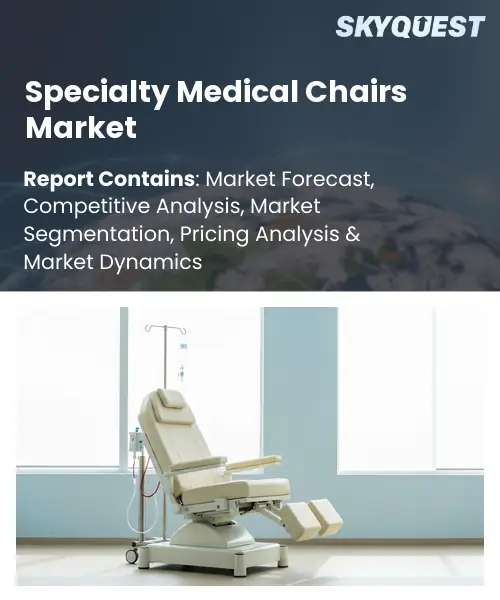
Specialty Medical Chairs Market
Report ID: SQMIG35A3998
Report ID: SQMIG35A3998
[email protected]
USA +1 351-333-4748
Report ID:
SQMIG35A3998 |
Region:
Global |
Published Date: June, 2026
Pages:
157
|Tables:
147
|Figures:
78


Global Specialty Medical Chairs Market size was valued at USD 3.7 Billion in 2024 and is poised to grow from USD 3.98 Billion in 2025 to USD 7.09 Billion by 2033, growing at a CAGR of 7.5% during the forecast period (2026-2033).
The specialty medical chairs market is driven by increasing demand for patient-centric seating solutions that improve safety, accessibility and clinical workflow as populations age and the prevalence of chronic disease increases. The market includes chairs for dialysis, dental, ophthalmic, bariatric and procedure-specific applications, and it matters, because seating directly impacts treatment efficacy, caregiver ergonomics and infection control. Historically, manufacturers have progressed from simple fixed chairs to complex, highly adjustable, motorized, and infection resistant designs with integrated monitoring technology, such as hospital-grade dialysis recliners and electrically-actuated surgical stools. The improvements led to fewer injuries to caregivers and a higher patient throughput, boosting market momentum and profitability.
Technology is a game-changer, transforming chairs from passive furniture to active clinical assets with sensors, motorized controls and IoT connectivity, with obvious efficiency benefits and new revenue streams. As manufacturers incorporate remote monitoring and patient positioning presets into the devices, clinicians reduce prep time and complications, spurring adoption among ambulatory surgery centers, dialysis clinics and home-care providers looking to boost throughput and reduce staff injury rates. This cause-and-effect opens up opportunities for subscription-based models, retrofittable modules for emerging markets, and partnerships with telehealth platforms, leading to scalable use cases such as monitored home dialysis and faster turnover in outpatient suites.
How is IoT enhancing functionality in the specialty medical chairs market?
IoT is revolutionizing specialty medical chairs, turning passive seating into active care tools by combining embedded sensors with wireless connectivity and cloud analytics. Key features include continuous pressure mapping, posture sensing, biometric signals and remote telemetry that enable clinicians to monitor risk and fine tune support without an in person visit. The market is moving away from mechanical-only designs to integrated systems that allow predictive maintenance, remote troubleshooting and individual seating programs. Real world examples include chairs that alert for pressure risk, receive firmware updates and feed usage data into clinical workflows, making them more valuable in rehabilitation and long term care.
Permobil unveiled new TiLite TR and TiLite ZR models in March 2026 that underscore ongoing product renewal and align with connected wheelchair strategies. IoT-enabled diagnostics and usage telemetry tied to such launches improves servicing efficiency and enables tailored seating adjustments that support market growth and broader adoption.
Market snapshot - (2026-2033)
Global Market Size
USD 3.7 Billion
Largest Segment
Examination Chairs
Fastest Growth
Rehabilitation and Bariatric Chairs
Growth Rate
7.5% CAGR
To get more insights on this market click here to Request a Free Sample Report
Global specialty medical chairs market is segmented by product type, technology focus, end-user, material focus, sales channel and region. Based on product type, the market is segmented into Examination Chairs, Treatment Chairs, Rehabilitation and Bariatric Chairs and Others. Based on technology focus, the market is segmented into Fully Electric Programmable Models, Semi-Electric and Hydraulic Systems, IoT Connected Sensor-Enabled Chairs and Others. Based on end-user, the market is segmented into Hospitals, Clinics and Dental Practices, Ambulatory Surgery Centers and Others. Based on material focus, the market is segmented into Fire-Safe Actuator Components, Antimicrobial Upholstery and Others. Based on sales channel, the market is segmented into Direct Enterprise Sales, Medical Infrastructure Providers and Others. Based on region, the market is segmented into North America, Europe, Asia Pacific, Latin America and Middle East & Africa.
Fully Electric Programmable Models segment holds the largest share, due to the preference for accurate positioning, repeatable automated functions, and seamless workflow integration that improves procedural efficiency and clinician ergonomics by healthcare providers. Programmability cuts down on manual adjustments and procedure time, enabling care teams to develop standardized protocols and alleviate caregiver strain. Manufacturers’ attention to reliable motors and safety interlocks further builds trust, leading to procurement preference, and a virtuous cycle of adoption and ongoing feature investment.
However, IoT Connected Sensor-Enabled Chairs is the fastest growing area due to demand for remote monitoring, predictive maintenance and data-driven patient positioning. The inclusion of sensors provides tracking of outcomes and integration with electronic health records, which is appealing to value-minded buyers and generates cross-industry partnerships that speed product iterations and new applications.
Rehabilitation and bariatric chairs are leading this segment. Demographics and clinical requirements necessitate high weight capacity designs and therapeutic adjustability to accommodate a wide range of mobility impairments. They are equipped with more durable frames, wider platforms, and adjustable support features that decrease transfer risk and increase therapeutic time. These are reinforced by rehabilitation providers and specialty clinics for patient safety and staff efficiency. This guides manufacturer investment to durability and modular support systems.
Treatment Chairs are the fastest growing, however, as minimally invasive therapies and outpatient care grow, the need for flexible seating with quick adjustability and hygienic surfaces to accommodate procedures is increasing. These multiuse design and clinician access benefits speed up procurement in high-throughput environments, driving new ergonomic and cost-efficiency innovations.
To get detailed segments analysis, Request a Free Sample Report
North American leadership is driven by deep clinical expertise, large procedural volumes and a sophisticated healthcare infrastructure that supports fast adoption of specialized equipment. Chairs are subject to buyer demands for ergonomics, customizability, and integration across complex care pathways in hospitals, ambulatory centers, and specialty clinics. Innovation, clinical validation and comprehensive after sales service thanks to strong domestic manufacturing base and established global suppliers. Structured procurement practices and reimbursement frameworks enable procurement of premium solutions Close collaboration between clinicians, manufacturers and distributor enable accelerated product refinement and long term maintenance relationships which reinforce market leadership.
The US Specialty Medical Chairs Market is driven by advanced clinical infrastructure, significant research activities and high expectations for ergonomic designs. The provider is searching for solutions that can be adapted to complex procedures in the outpatient clinic and hospital. Payer frameworks and procurement practices are facilitating the adoption of premium products. Local manufacturers and global suppliers compete on innovation, service and clinical validation leading to a mature buying environment that favors differentiated features and long-term partnerships.
Specialty Medical Chairs Market in Canada: How universal access frameworks and provincial purchasing are shaping procurement Hospitals and community clinics prefer durable, serviceable chairs that offer clinical utility and manageable life cycle costs. Preference will be given to vendors providing reliable after sales service, training and flexible financing. Demand is for flexibility to various procedures and refurbishment possibilities. Broader adoption across institutional and ambulatory settings is facilitated by close supplier relationships and regulatory alignment.
Europe is booming, thanks to clinical modernisation, procurement reforms and a strong focus on ergonomics and patient experience. Health systems are looking for equipment that supports higher procedure throughput, shorter stays and staff wellbeing, requiring modular, compliant designs and robust service models. Regional manufacturers and specialized distributors respond with custom offerings for public and private providers, while harmonized regulations and cross border clinical collaboration speed diffusion of validated products. Tendering practices and value-oriented procurement encourage suppliers to offer life-cycle services and clinical partnerships that are consistent with institutional priorities and operational objectives. Buyers are increasingly looking for clinical evidence, outcome data and integrated maintenance and training packages and suppliers are investing in product validation, service networks and clinician education to support adoption across different care pathways.
Specialty Medical Seating Germany’s market benefits from a strong manufacturing ecosystem, as well as sophisticated hospital infrastructure and technical standards. Providers seek engineering quality, reliable service networks and products that meet stringent compliance and certification expectations. Procurement processes are favoring suppliers that demonstrate clinical validation and lifecycle value. Demand comes from hospitals, specialized clinics and rehabilitation centers. Local OEMs work with clinical teams to provide customized solutions and maintenance and training programs.
United Kingdom Specialty Medical Chairs Market is characterized by active public sector investment in outpatient and day surgery and dynamic procurement. Clinicians want proven, flexible solutions to improve throughput and staff ergonomics. We favour suppliers who can provide integrated service contracts and training and demonstration programmes. Interest in modular designs and partnership models from hospital trusts and independent treatment centres looking for operational efficiency and a better patient experience are driving uptake.
Medical Specialty Chairs France is seeing the market emerge through the modernization of clinical facilities and growing interest from private clinics and regional hospital groups. Buyers are looking for patient comfort, clinician ergonomics and equipment that can cope with multiprocedural workflows. Suppliers that demonstrate clinical relevance, offer local distribution and service, and pilot with clinical teams, gain traction. Proven and value-based procurement drives adoption across regional and urban care settings.
Asia Pacific is cementing its position with strategic manufacturing, targeted clinical partnerships and accelerated adoption of efficient care models. Regional suppliers are raising product design and quality to international standards, while remaining cost-competitive, so that they can be more widely adopted across different health-care systems. Hospitals, specialty clinics invest in ergonomics, flexible equipment that works for ambulatory and inpatient workflows. Cross border collaboration, distributor expansion and emphasis on after sales service and clinician training support sustained adoption. Government programs and private capital are funding facility upgrades and specialized procedure centers, creating sustained demand for chairs with durability and clinician-centric features. In different markets, financing options further reduce adoption barriers, along with comprehensive service agreements.
The Japan Specialty Medical Chairs Market is defined by precision engineering, high quality standards and close collaboration between clinicians and manufacturers. Hospitals and specialty clinics want ergonomics, reliability and aesthetic that fit procedural needs For domestic OEMs, durability and strict quality control are the main focus areas, and working with international companies offers opportunities for technology transfer and the development of specialized products. In the purchasing environment, sales service and training of clinicians are important aspects of adoption.
South Korea Specialty Medical Chairs Market is driven by technologically advanced manufacturers, clinical innovation and distribution networks. Hospitals and specialty centers choose chairs that are ergonomically optimized and fit procedural workflows. Suppliers are stressing rapid product iteration, local service and joint pilots with clinical teams to show performance. The producers who focus on exports use validation as a way to grow their footprint and leasing and service models to reach smaller clinics and emerging specialty units.
To know more about the market opportunities by region and country, click here to
Buy The Complete Report
Growing Geriatric Patient Population
Rise In Ambulatory Care Settings
High Acquisition and Maintenance Costs
Stringent Regulatory Approval Processes
Request Free Customization of this report to help us to meet your business objectives.
The competitive landscape is defined by consolidation and tech driven differentiation. Recent M&A such as Baxter’s acquisition of Hillrom in 2021 is an example of consolidation. Manufacturers are chasing product innovation for example Planmeca announced the Pro50 chair in 2022. Channel strategies like Adec’s 2024 Certified Pre Owned program facilitate wider reach. New players such as SmartChair AI and 10X Retro-fit chairs with sensors and AR immersion.
SkyQuest’s ABIRAW (Advanced Business Intelligence, Research & Analysis Wing) is our Business Information Services team that Collects, Collates, Correlates, and Analyses the Data collected by means of Primary Exploratory Research backed by robust Secondary Desk research.
SkyQuest’s analysis indicates that the increasing prevalence of chronic diseases and the growing geriatric population are driving demand for patient-centric seating solutions that improve safety and clinical workflow, thus propelling the global specialty medical chairs market. Additionally, growth is supported by fast adoption of technology and IoT enabled functionality turning chairs into active care assets. The high acquisition cost and ongoing maintenance results in higher total cost of ownership for many of the providers, adding to the barrier of adoption. North America’s dominance continues to be driven by advanced healthcare infrastructure and strong procurement frameworks. The fully electric programmable model is the leading product segment, as precision positioning and workflow automation resonate with provider priorities. Manufacturers should also consider service models and retrofit paths to extend the reach.
| Report Metric | Details |
|---|---|
| Market size value in 2024 | USD 3.7 Billion |
| Market size value in 2033 | USD 7.09 Billion |
| Growth Rate | 7.5% |
| Base year | 2024 |
| Forecast period | (2026-2033) |
| Forecast Unit (Value) | USD Billion |
| Segments covered |
|
| Regions covered | North America (US, Canada), Europe (Germany, France, United Kingdom, Italy, Spain, Rest of Europe), Asia Pacific (China, India, Japan, Rest of Asia-Pacific), Latin America (Brazil, Rest of Latin America), Middle East & Africa (South Africa, GCC Countries, Rest of MEA) |
| Companies covered |
|
| Customization scope | Free report customization with purchase. Customization includes:-
|
To get a free trial access to our platform which is a one stop solution for all your data requirements for quicker decision making. This platform allows you to compare markets, competitors who are prominent in the market, and mega trends that are influencing the dynamics in the market. Also, get access to detailed SkyQuest exclusive matrix.
Table Of Content
Executive Summary
Market overview
Parent Market Analysis
Market overview
Market size
KEY MARKET INSIGHTS
COVID IMPACT
MARKET DYNAMICS & OUTLOOK
Market Size by Region
KEY COMPANY PROFILES
Methodology
For the Specialty Medical Chairs Market, our research methodology involved a mixture of primary and secondary data sources. Key steps involved in the research process are listed below:
1. Information Procurement: This stage involved the procurement of Market data or related information via primary and secondary sources. The various secondary sources used included various company websites, annual reports, trade databases, and paid databases such as Hoover's, Bloomberg Business, Factiva, and Avention. Our team did 45 primary interactions Globally which included several stakeholders such as manufacturers, customers, key opinion leaders, etc. Overall, information procurement was one of the most extensive stages in our research process.
2. Information Analysis: This step involved triangulation of data through bottom-up and top-down approaches to estimate and validate the total size and future estimate of the Specialty Medical Chairs Market.
3. Report Formulation: The final step entailed the placement of data points in appropriate Market spaces in an attempt to deduce viable conclusions.
4. Validation & Publishing: Validation is the most important step in the process. Validation & re-validation via an intricately designed process helped us finalize data points to be used for final calculations. The final Market estimates and forecasts were then aligned and sent to our panel of industry experts for validation of data. Once the validation was done the report was sent to our Quality Assurance team to ensure adherence to style guides, consistency & design.
Analyst Support
Customization Options
With the given market data, our dedicated team of analysts can offer you the following customization options are available for the Specialty Medical Chairs Market:
Product Analysis: Product matrix, which offers a detailed comparison of the product portfolio of companies.
Regional Analysis: Further analysis of the Specialty Medical Chairs Market for additional countries.
Competitive Analysis: Detailed analysis and profiling of additional Market players & comparative analysis of competitive products.
Go to Market Strategy: Find the high-growth channels to invest your marketing efforts and increase your customer base.
Innovation Mapping: Identify racial solutions and innovation, connected to deep ecosystems of innovators, start-ups, academics, and strategic partners.
Category Intelligence: Customized intelligence that is relevant to their supply Markets will enable them to make smarter sourcing decisions and improve their category management.
Public Company Transcript Analysis: To improve the investment performance by generating new alpha and making better-informed decisions.
Social Media Listening: To analyze the conversations and trends happening not just around your brand, but around your industry as a whole, and use those insights to make better Marketing decisions.
REQUEST FOR SAMPLE
 REQUEST FREE CUSTOMIZATION
Global Specialty Medical Chairs Market size was valued at USD 3.7 Billion in 2024 and is poised to grow from USD 3.98 Billion in 2025 to USD 7.09 Billion by 2033, growing at a CAGR of 7.5% during the forecast period (2026-2033).
Competitive landscape is marked by consolidation and tech driven differentiation: recent M&A such as Baxter’s 2021 acquisition of Hillrom shows consolidation. Manufacturers pursue product innovation, for example Planmeca announced the Pro50 chair in 2022. Channel strategies such as A dec’s 2024 Certified Pre Owned program expand reach. New entrants retrofit chairs with sensors and augmented reality; examples include SmartChair AI and 10X Immersive. 'Invacare', 'Hillrom', 'Stryker', 'Dentsply Sirona', 'Planmeca', 'Danaher', 'A-dec', 'Midmark', 'Drive DeVilbiss', 'Permobil', 'Sunrise Medical', 'Pride Mobility', 'Winco Mfg', 'Buro Seating', 'Herman Miller', 'Forest Dental', 'Nemschoff', 'Techno-Gaz', 'Euroclinic', 'Topcon'
An expanding geriatric population elevates demand for specialty medical chairs because older adults more frequently require seating that addresses mobility limitations, pressure management, and ergonomic support. As patient care shifts toward prolonged home and outpatient based services, caregivers and healthcare providers increasingly seek chairs that improve comfort, reduce fall risk, and support rehabilitation. Manufacturers respond by developing adjustable, easy to use solutions tailored to age related needs, which expands product offerings, encourages adoption across care settings, and drives investment in design and distribution focused on elder care requirements.
Ergonomic Customization Demand: Manufacturers and providers are focusing on personalized ergonomic solutions to meet evolving clinical and patient needs, driving demand for chairs that accommodate diverse body types, mobility limitations, and procedural preferences. Emphasis on adjustable support, modular components, and materials that balance comfort with infection control is encouraging product differentiation. Collaboration with clinicians informs design iterations, while service offerings for fitting and training enhance value. This shift toward tailored ergonomics influences procurement priorities and stimulates innovation throughout the specialty medical chair ecosystem.
Why does North America Dominate the Global Specialty Medical Chairs Market? |@12


Want to customize this report? This report can be personalized according to your needs. Our analysts and industry experts will work directly with you to understand your requirements and provide you with customized data in a short amount of time. We offer $1000 worth of FREE customization at the time of purchase.
Feedback From Our Clients


 USA (+1) 351-333-4748

