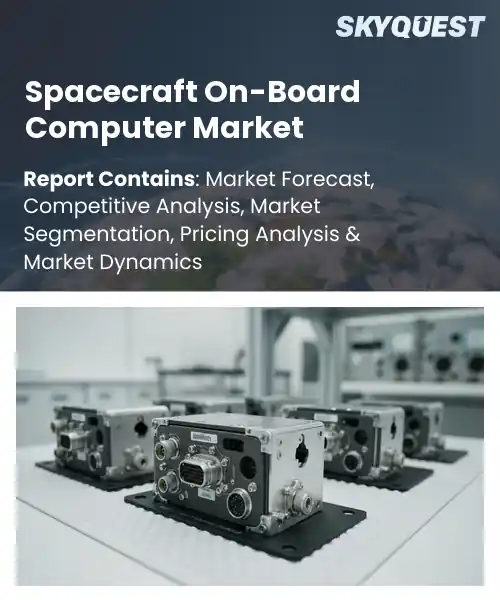
Spacecraft On-Board Computer Market
Report ID: SQMIG20A2879
Report ID: SQMIG20A2879
[email protected]
USA +1 351-333-4748
Report ID:
SQMIG20A2879 |
Region:
Global |
Published Date: August, 2026
Pages:
157
|Tables:
148
|Figures:
78


Global Spacecraft On-Board Computer Market size was valued at USD 1.96 Billion in 2024 and is poised to grow from USD 2.17 Billion in 2025 to USD 4.94 Billion by 2033, growing at a CAGR of 10.8% during the forecast period (2026-2033).
Demand for reliable, radiation‑tolerant processing hardware drives the spacecraft on‑board computer market. The market includes processors, memory, and software that manage attitude, navigation, payload, and communications on orbital platforms. Its significance lies in the direct link between computational resilience and mission success, especially as satellites now host complex payloads such as high‑resolution imaging and broadband transponders. Early on, computers were bulky, single‑purpose units aboard 1990s geostationary satellites; today, multicore, miniaturized systems power CubeSats and mega‑constellations alike. SpaceX’s Starlink satellites use a radiation‑hardened processor for real‑time routing, while NASA’s Artemis lander depends on a fault‑tolerant computer for autonomous descent during landing.
The accelerating deployment of mega‑constellations constitutes market’s growth catalyst. As launch providers lower price per kilogram, operators such as OneWeb and Planet Labs proliferate dozens of satellites, which forces designers to prioritize high‑throughput on‑board computers capable of handling autonomous orbit maintenance and data compression. This pressure induces a shift toward modular, software‑defined architectures that can be re‑programmed after lift‑off, thereby extending mission life and reducing ground‑segment expenses. Consequently, manufacturers invest in radiation‑hardened FPGAs and multicore processors that support edge‑AI workloads. The resulting capability enables Earth‑observation constellations to deliver near‑instant imagery, a service that commands premium pricing and fuels market expansion.
How is AI-driven Automation Impacting The Spacecraft On-board Computer Market?
AI-driven automation is reshaping spacecraft on‑board computers by embedding intelligent decision‑making directly into flight‑critical hardware. Modern processors now run machine‑learning models that can predict subsystem failures, optimize power usage, and adjust navigation trajectories without ground intervention. This shift reduces latency, enhances mission resilience, and lowers the need for redundant hardware. Developers are integrating edge‑AI frameworks that streamline software updates and enable autonomous fault detection, making systems more adaptable to deep‑space environments. As launch rates increase, manufacturers are prioritizing modular designs that support AI workloads, fostering a competitive market where performance and reliability are tightly linked.
Market snapshot - (2026-2033)
Global Market Size
USD 1.96 Billion
Largest Segment
Hardware
Fastest Growth
Software
Growth Rate
10.8% CAGR
To get more insights on this market click here to Request a Free Sample Report
Global spacecraft on-board computer market is segmented by component, spacecraft type, processing capability, application, end user and region. Based on component, the market is segmented into Hardware, Software and Integration & Support Services. Based on spacecraft type, the market is segmented into Satellites, Launch Vehicles, Deep Space Probes and Crewed Spacecraft. Based on processing capability, the market is segmented into Single-Core, Multi-Core and AI-Enabled Computing. Based on application, the market is segmented into Command & Data Handling, Guidance, Navigation & Control, Payload Management, Communications and Fault Detection & Recovery. Based on end user, the market is segmented into Commercial, Government & Civil Space Agencies and Defense. Based on region, the market is segmented into North America, Europe, Asia Pacific, Latin America and Middle East & Africa.
Hardware segment dominates because the physical resilience and radiation‑hardening of onboard computers are foundational to mission success. Spacecraft demand processors that can survive extreme temperature cycles, high‑energy particles, and vibration, prompting manufacturers to prioritize ruggedized circuit boards, power modules, and thermal solutions. This focus drives supplier investment in advanced materials and testing regimes, ensuring that hardware reliability sustains the overall market while enabling complex payloads and extended mission durations.
Meanwhile, AI‑Enabled Computing segment emerges as the key high‑growth area because autonomous decision‑making and onboard data analysis are becoming mission‑critical. Lightweight neural networks and radiation‑tolerant AI chips let spacecraft process sensor streams in real time, reducing ground‑link dependence and opening new commercial and deep‑space opportunities that expand the market.
Command & Data Handling segment dominates because it orchestrates all spacecraft functions, linking avionics, subsystems, and payloads through a unified processing framework. Designers prioritize robust C&DH architectures to ensure deterministic data flow, time‑critical command execution, and reliable telemetry, which are essential for mission integrity. This emphasis drives investment in fault‑tolerant processors, modular software stacks, and standardized interfaces, making C&DH the cornerstone that sustains overall market demand and technical advancement.
Conversely, Fault Detection & Recovery segment is witnessing strong growth because rising mission complexity and longer durations demand self‑healing capabilities. Improved diagnostic algorithms and redundant designs let spacecraft autonomously isolate failures and reconfigure operations, reducing downtime. These advances broaden market opportunities for intelligent health‑monitoring solutions, spurring adoption across commercial constellations and deep‑space missions.
To get detailed segments analysis, Request a Free Sample Report
North America’s leadership stems from a confluence of deep aerospace heritage, substantial government investment, and a vibrant private sector that together drive relentless innovation. The region benefits from world‑class research institutions and a highly skilled engineering workforce that continuously push the boundaries of processing power, radiation tolerance, and miniaturization. Strong collaboration between defense agencies, commercial launch providers, and leading technology firms creates a robust supply chain and accelerates the transition of cutting‑edge components into flight‑qualified systems. A regulatory environment that balances safety with rapid certification further enhances market agility, while the presence of multiple high‑profile satellite constellations fuels ongoing demand for advanced on‑board computing solutions.
Spacecraft On-Board Computer Market in the United States thrives on a deep integration of defense research, commercial launch activity, and academic excellence. Leading universities and national laboratories generate breakthrough processor designs, while major aerospace corporations translate these advances into reliable flight hardware. Government programs provide sustained funding for next‑generation missions, encouraging private firms to develop high‑performance, fault‑tolerant systems that meet stringent reliability standards.
Spacecraft On-Board Computer Market in Canada is bolstered by a strong emphasis on collaborative research and a supportive innovation ecosystem. Federal initiatives and partnerships with international space agencies foster the development of resilient computing architectures suited for harsh space environments. Emerging private enterprises leverage this foundation to deliver specialized solutions, while a skilled talent pool ensures continuous advancement in software reliability and hardware robustness.
Europe’s rapid expansion is propelled by a cohesive network of governmental agencies, research consortia, and industrial leaders that prioritize safety, sustainability, and technological excellence. The European space agency’s strategic programs encourage cross‑border collaboration, enabling shared development of high‑integrity computing platforms. Strong defense and telecommunications sectors demand resilient, high‑performance processors, while a focus on miniaturization and energy efficiency aligns with emerging satellite constellations. Robust standards and certification pathways streamline market entry, and a culture of precision engineering ensures that European solutions remain at the forefront of reliability and innovation.
Spacecraft On-Board Computer Market in Germany benefits from a deep engineering tradition and a dense cluster of specialized suppliers. Collaborative projects between research institutes and aerospace manufacturers drive the creation of radiation‑hardened processors and advanced fault‑tolerant architectures. Government support for space exploration and satellite services sustains a pipeline of demand, while a skilled workforce ensures high‑quality production and continuous improvement.
Spacecraft On-Board Computer Market in the United Kingdom is energized by a dynamic mix of academic research, defense initiatives, and a burgeoning commercial launch sector. Innovative startups leverage cutting‑edge processor technologies to address the needs of small satellite constellations, while established aerospace firms focus on high‑reliability solutions for larger missions. Strategic investment in research hubs accelerates the development of next‑generation computing platforms, positioning the United Kingdom as a fast‑growing hub for space‑grade electronics.
Spacecraft On-Board Computer Market in France draws strength from a strong national space agency and a network of high‑tech manufacturers. Emphasis on precision engineering and rigorous testing yields robust computing modules suited for both scientific and commercial missions. Collaborative ventures with European partners enhance technology sharing, while sustained public funding underpins research into advanced processing capabilities and system integration.
Asia Pacific is strengthening its position through aggressive government‑backed space programs, rapid commercialization of launch services, and a focus on cutting‑edge semiconductor technologies. Nations in the region invest heavily in research and development, fostering partnerships between academic institutions and private firms that accelerate the creation of high‑performance, low‑power computing solutions. Emphasis on miniaturization and integration supports the growth of small satellite constellations, while a competitive manufacturing base ensures cost‑effective production of radiation‑tolerant components. This combination of strategic policy, innovative engineering, and expanding market demand propels the region toward greater influence in the global arena.
Spacecraft On-Board Computer Market in Japan is driven by a long‑standing commitment to precision electronics and a robust aerospace heritage. Government space initiatives collaborate closely with leading universities and industry leaders to develop highly reliable, radiation‑hard processors. The integration of advanced materials and meticulous quality control practices ensures that Japanese solutions meet the stringent demands of both domestic and international missions.
Spacecraft On-Board Computer Market in South Korea benefits from a fast‑growing private space sector and strong governmental support for high‑technology research. Partnerships between semiconductor manufacturers and aerospace firms enable the rapid adoption of cutting‑edge processing technologies. Focus on miniaturized, energy‑efficient designs aligns with the region’s expanding constellation deployments, positioning South Korea as an emerging hub for innovative space‑grade computing solutions.
To know more about the market opportunities by region and country, click here to
Buy The Complete Report
Increasing Satellite Constellation Deployments
Adoption Of AI‑Enabled Processing
Stringent Radiation Certification Requirements
High Development Cost and Complexity
Request Free Customization of this report to help us to meet your business objectives.
The competitive landscape is shaped by intense rivalry among legacy aerospace giants and agile newcomers, driving rapid innovation in radiation‑hardening, modular architectures, and AI‑enabled fault tolerance. Recent M&A activity, such as Airbus acquiring a niche OBC specialist, and partnerships like Lockheed Martin teaming with a silicon‑photonic firm, illustrate how firms are securing technology edge and expanding market reach. These moves accelerate product differentiation and reinforce the market’s focus on next‑generation deep‑space missions.
SkyQuest’s ABIRAW (Advanced Business Intelligence, Research & Analysis Wing) is our Business Information Services team that Collects, Collates, Correlates, and Analyses the Data collected by means of Primary Exploratory Research backed by robust Secondary Desk research.
As per SkyQuest analysis the global spacecraft on‑board computer market is expanding rapidly, driven primarily by the surge in satellite constellation deployments that demand compact, radiation‑tolerant processors for navigation, data handling and payload control. A second powerful catalyst is the adoption of AI‑enabled processing, which pushes manufacturers to embed edge‑AI accelerators for autonomous decision‑making and fault detection. The hardware component segment remains the dominant share because ruggedized circuits and radiation‑hardening are essential for mission success. North America leads the market due to its strong aerospace heritage, government funding and vibrant private‑sector ecosystem. However, stringent radiation‑certification requirements act as a restraint, extending development cycles and increasing costs.
| Report Metric | Details |
|---|---|
| Market size value in 2024 | USD 1.96 Billion |
| Market size value in 2033 | USD 4.94 Billion |
| Growth Rate | 10.8% |
| Base year | 2024 |
| Forecast period | (2026-2033) |
| Forecast Unit (Value) | USD Billion |
| Segments covered |
|
| Regions covered | North America (US, Canada), Europe (Germany, France, United Kingdom, Italy, Spain, Rest of Europe), Asia Pacific (China, India, Japan, Rest of Asia-Pacific), Latin America (Brazil, Rest of Latin America), Middle East & Africa (South Africa, GCC Countries, Rest of MEA) |
| Companies covered |
|
| Customization scope | Free report customization with purchase. Customization includes:-
|
To get a free trial access to our platform which is a one stop solution for all your data requirements for quicker decision making. This platform allows you to compare markets, competitors who are prominent in the market, and mega trends that are influencing the dynamics in the market. Also, get access to detailed SkyQuest exclusive matrix.
Table Of Content
Executive Summary
Market overview
Parent Market Analysis
Market overview
Market size
KEY MARKET INSIGHTS
COVID IMPACT
MARKET DYNAMICS & OUTLOOK
Market Size by Region
KEY COMPANY PROFILES
Methodology
For the Spacecraft On-Board Computer Market, our research methodology involved a mixture of primary and secondary data sources. Key steps involved in the research process are listed below:
1. Information Procurement: This stage involved the procurement of Market data or related information via primary and secondary sources. The various secondary sources used included various company websites, annual reports, trade databases, and paid databases such as Hoover's, Bloomberg Business, Factiva, and Avention. Our team did 45 primary interactions Globally which included several stakeholders such as manufacturers, customers, key opinion leaders, etc. Overall, information procurement was one of the most extensive stages in our research process.
2. Information Analysis: This step involved triangulation of data through bottom-up and top-down approaches to estimate and validate the total size and future estimate of the Spacecraft On-Board Computer Market.
3. Report Formulation: The final step entailed the placement of data points in appropriate Market spaces in an attempt to deduce viable conclusions.
4. Validation & Publishing: Validation is the most important step in the process. Validation & re-validation via an intricately designed process helped us finalize data points to be used for final calculations. The final Market estimates and forecasts were then aligned and sent to our panel of industry experts for validation of data. Once the validation was done the report was sent to our Quality Assurance team to ensure adherence to style guides, consistency & design.
Analyst Support
Customization Options
With the given market data, our dedicated team of analysts can offer you the following customization options are available for the Spacecraft On-Board Computer Market:
Product Analysis: Product matrix, which offers a detailed comparison of the product portfolio of companies.
Regional Analysis: Further analysis of the Spacecraft On-Board Computer Market for additional countries.
Competitive Analysis: Detailed analysis and profiling of additional Market players & comparative analysis of competitive products.
Go to Market Strategy: Find the high-growth channels to invest your marketing efforts and increase your customer base.
Innovation Mapping: Identify racial solutions and innovation, connected to deep ecosystems of innovators, start-ups, academics, and strategic partners.
Category Intelligence: Customized intelligence that is relevant to their supply Markets will enable them to make smarter sourcing decisions and improve their category management.
Public Company Transcript Analysis: To improve the investment performance by generating new alpha and making better-informed decisions.
Social Media Listening: To analyze the conversations and trends happening not just around your brand, but around your industry as a whole, and use those insights to make better Marketing decisions.
REQUEST FOR SAMPLE
 REQUEST FREE CUSTOMIZATION
Global Spacecraft On-Board Computer Market size was valued at USD 1.96 Billion in 2024 and is poised to grow from USD 2.17 Billion in 2025 to USD 4.94 Billion by 2033, growing at a CAGR of 10.8% during the forecast period (2026-2033).
The competitive landscape is shaped by intense rivalry among legacy aerospace giants and agile newcomers, driving rapid innovation in radiation‑hardening, modular architectures, and AI‑enabled fault tolerance. Recent M&A activity, such as Airbus acquiring a niche OBC specialist, and partnerships like Lockheed Martin teaming with a silicon‑photonic firm, illustrate how firms are securing technology edge and expanding market reach. These moves accelerate product differentiation and reinforce the market’s focus on next‑generation deep‑space missions. 'BAE Systems plc', 'Airbus SE', 'Lockheed Martin Corporation', 'Northrop Grumman Corporation', 'Thales S.A.', 'L3Harris Technologies, Inc.', 'Honeywell International Inc.', 'RTX Corporation', 'Teledyne Technologies Incorporated', 'Curtiss-Wright Corporation', 'Cobham Limited', 'Leonardo S.p.A.', 'OHB SE', 'GomSpace Group AB', 'Beyond Gravity AG', 'AAC Clyde Space AB', 'MDA Space Ltd.', 'Redwire Corporation', 'Sierra Space Corporation', 'Blue Canyon Technologies, Inc.'
Satellite operators are launching large constellations to provide global connectivity, Earth observation, and scientific services. Each spacecraft requires a reliable, high‑performance onboard computer to manage navigation, data handling, and mission‑critical functions. As the number of satellites in orbit expands, manufacturers must scale production of compact, radiation‑tolerant processors and associated software. This scaling drives demand for advanced onboard computer solutions, encouraging suppliers to invest in research, diversify product lines, and accelerate time‑to‑market, thereby supporting overall market growth through collaborative efforts across the aerospace ecosystem.
Ai-Driven Autonomy Integration: The rise of artificial intelligence and machine learning is reshaping spacecraft on‑board computers, enabling real‑time decision making, fault detection, and adaptive mission planning without ground intervention. Manufacturers are embedding AI accelerators and neural‑network processors to handle complex navigation, payload management, and autonomous docking tasks. This shift reduces latency, enhances resilience against unexpected conditions, and opens new commercial opportunities such as on‑demand data processing and in‑orbit servicing, positioning AI‑enabled computers as a strategic differentiator for next‑generation space missions in the industry.
Why does North America Dominate the Global Spacecraft On-Board Computer Market? |@12


Want to customize this report? This report can be personalized according to your needs. Our analysts and industry experts will work directly with you to understand your requirements and provide you with customized data in a short amount of time. We offer $1000 worth of FREE customization at the time of purchase.
Feedback From Our Clients


 USA (+1) 351-333-4748

