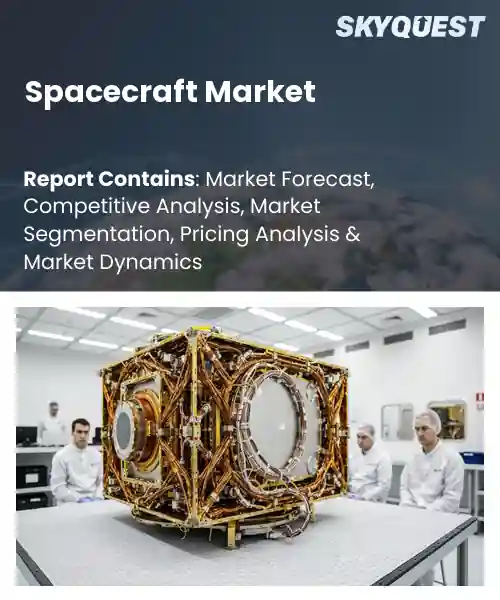
Spacecraft Market
Report ID: SQMIG20A2723
Report ID: SQMIG20A2723
[email protected]
USA +1 351-333-4748
Report ID:
SQMIG20A2723 |
Region:
Global |
Published Date: July, 2026
Pages:
157
|Tables:
94
|Figures:
76


Global Spacecraft Market size was valued at USD 6.9 Billion in 2024 and is poised to grow from USD 7.29 Billion in 2025 to USD 11.7 Billion by 2033, growing at a CAGR of 5.7% during the forecast period (2026-2033).
The spacecraft market includes the design, manufacture and launch of orbital and suborbital vehicles for commercial, governmental and scientific missions. Its importance is in the increasing dependence on satellite services for communications, navigation and Earth observation that in turn drives demand for new platforms. The sector has grown from government programs of the Cold War era into a diverse ecosystem with private firms such as SpaceX and Blue Origin competing for contracts. The main driver for the shift was the lowering of launch costs through reusable rockets. This has allowed markets such as Starlink and smaller payload providers to emerge. The main driver of growth today is the rising demand for satellite constellations to provide broadband internet, connectivity for IoT, and Earth monitoring applications.
As populations migrate to digital economies, providers want resilient, low-latency coverage, which is driving investors to fund fleets like OneWeb and Amazon’s Kuiper, which is driving the production of medium-class spacecraft that are optimized for turnaround. The chain of cause and effect gives more importance to component suppliers, drives standardization of bus designs in modules and cuts unit costs, making space access cheaper for research institutions and telecom operators. This, in turn, accelerates the adoption of satellite services in emerging markets in Africa and Southeast Asia, increasing the overall market size.
How is AI-driven Automation Reshaping Satellite Manufacturing Within The Global Spacecraft Market?
Automation driven by AI is making satellite production more efficient, from design through to final testing. Machine-learning models produce the top component layouts, reducing engineering cycles for thermal and structural integrity. Robotic assembly lines handle delicate integrations, reducing human error and build times. Real-time data analytics monitor quality and allow for instant adjustments to keep factories agile as demand spikes. The global spacecraft market is growing at a fast pace with manufacturers increasing output to keep up with the rise of large constellations and sovereign programmes, so speed and precision are key to competitive advantage.
In May, 2026, Seraphim reported record levels of private capital being poured into projects that embed AI automation into satellite factories, highlighting how the technology is driving growth and improving efficiency across the sector.
Market snapshot - (2026-2033)
Global Market Size
USD 6.9 Billion
Largest Segment
Satellites
Fastest Growth
Crewed Spacecraft
Growth Rate
5.7% CAGR
To get more insights on this market click here to Request a Free Sample Report
Global spacecraft market is segmented by type, application, end user and region. Based on type, the market is segmented into Satellites, Cargo Spacecraft, Crewed Spacecraft and Probes and Landers. Based on application, the market is segmented into Communications, Remote Sensing, Navigation, Exploration, Scientific Research and Defense and Security. Based on end user, the market is segmented into Commercial, Government and Military. Based on region, the market is segmented into North America, Europe, Asia Pacific, Latin America and Middle East & Africa.
The communications sector is the big winner as it provides the essential backbone for global data exchange, from broadband internet to critical defense connections. The demand from commercial, governmental and defense sectors is pervasive and it ensures a steady stream of orders that encourages manufacturers to focus on high throughput, robust designs. It is the key revenue earner in the spacecraft market for stakeholders today and continued upgrades in bandwidth, frequency reuse and anti-jamming capabilities further reinforce its strategic relevance.
The Remote Sensing segment is, meanwhile, the fastest growing area, driven by the increasing demand for high-resolution Earth observation in agriculture, climate monitoring and disaster response. Developments in sensor miniaturization and AI-enabled data analytics are lowering costs and accelerating deployment, unlocking new commercial contracts and fuelling wider market growth.
The cargo segment is ahead because it is the logistics backbone for moving satellites, propulsion modules and ancillary hardware from manufacturing sites to launch facilities. Its reliability and cost-effective reuse models allow for rapid payload turnover to drive higher launch cadence and enable the scaling of satellite constellations. Cargo services are a strategic differentiator that underpin the growth today globally of the broader spacecraft ecosystem by reducing lead times and operational risk.
Conversely, Crewed spacecraft are exhibiting the strongest growth, driven by renewed human spaceflight interest, commercial tourism and national crewed programs. Demand is driven by reusable launch systems, private-sector investment, and the growth of orbital habitats to create a pipeline of missions that grows manufacturing capabilities and spurs ancillary markets. Crewed craft act as a catalyst for the spacecraft industry.
To get detailed segments analysis, Request a Free Sample Report
North America is well ahead with a strong industrial ecosystem, solid government support and a cluster of innovative private companies. Robust funding mechanisms and an innovation culture enable rapid development of launch capabilities, satellite constellations and advanced propulsion systems. Synergy is generated by the combination of research institutions, defense agencies and commercial actors, which accelerates technology transfer and reduces the time to market. Its strategic geographic location offers optimal launch sites with good weather patterns and free access to multiple orbital inclinations. The region also boasts a highly skilled workforce and a regulatory framework that strikes the right balance between safety and commercial flexibility, further cementing its leadership and attracting global partnerships. Further solidifying the region’s leadership is continued investment in reusable launch technology, and a focus on autonomous spacecraft operations. These dynamics create a self-perpetuating cycle that reinforces market dominance.
The spacecraft market in the United States feeds off a network of aerospace manufacturers, startups and veteran defense contractors. Research capabilities at leading universities and a federal procurement strategy that encourages commercial participation help the ecosystem. Collaboration across innovation hubs and launch sites drives prototyping, and a flexible regulatory environment supports testing. This mix fosters pipeline of next-generation spacecraft concepts and establishes United States as launchpad for missions around world.
The Canadian spacecraft market benefits from strong government support, a collaborative aerospace cluster and access to major North American launch corridors. Federal programs support research and development in satellite technology and propulsion. A nascent private sector builds on expertise in robotics and communications. Partnerships with indigenous communities enhance sustainability programs, and a regulatory framework encourages commercial launch services. The ecosystem supports creative spacecraft solutions that enhance the broader continental capabilities.
Europe’s spacecraft market expands rapidly because of coordinated governmental frameworks, substantial research investment, and a diversified industrial base that blends legacy aerospace expertise with emerging commercial ventures. Collaborative programs across member states encourage joint development of launch vehicles, satellite constellations and advanced propulsion, reducing duplication and fostering shared risk. Strong emphasis on sustainability and reusable technology aligns with regional policy goals, while a mature regulatory environment provides clear pathways for certification and commercial operations. The presence of world‑class research institutions and a skilled engineering workforce fuels continuous innovation, attracting multinational partnerships and positioning Europe as a competitive hub for both governmental and private space activities.
Spacecraft Market in Germany benefits from an industrial heritage, engineering talent and public‑private collaborations. Federal initiatives fund research in propulsion and miniaturized satellite platforms, while established manufacturers partner with innovative startups to accelerate product cycles. Emphasis on reliability and precision supports demand from defense and commercial sectors. Integration with European launch infrastructure and a focus on sustainability further strengthen Germany’s role as a key contributor to the continent’s space ambitions.
Spacecraft Market in the United Kingdom is driven by a startup ecosystem, research funding and aerospace expertise. Government programmes target low‑earth orbit services and reusable launch technologies, encouraging collaborations between universities, established contractors and new entrants. The UK’s favorable regulatory stance and spaceport infrastructure streamline commercialization. Emphasis on satellite communications and data analytics aligns with broader digital strategies, positioning the United Kingdom as a fast‑moving hub for innovative spacecraft solutions.
Spacecraft Market in France remains dominant through a blend of aerospace capability, strong state investment and a commercial sector. National agencies champion ambitious satellite constellations and deep‑space missions, while partnerships with European launch providers ensure reliable access to orbit. French firms excel in propulsion, avionics and manufacturing, supporting both defense and civilian applications. A regulatory approach and emphasis on sustainability reinforce France’s position as a cornerstone of European space ambition.
Asia Pacific is strengthening its spacecraft position by leveraging rapid technological adoption, growing domestic launch capabilities and expanding commercial demand for satellite services. Governmental policies across the region emphasize self‑reliance, encouraging investment in reusable launch systems, miniaturized payloads and in‑orbit servicing. A surge of entrepreneurial ventures collaborates closely with established aerospace firms, accelerating knowledge transfer and fostering a competitive supply chain. Strategic location near equatorial launch corridors provides efficiency advantages, while rising investment in research institutions cultivates a skilled workforce. These dynamics collectively enhance the region’s ability to deliver end‑to‑end space solutions and increase its influence on global space activities.
Spacecraft Market in Japan combines aerospace expertise with a strong focus on miniaturized and resilient satellite platforms. Government programmes support the development of reusable launch vehicles and advanced propulsion, while private firms drive innovation in small‑satellite constellations and Earth‑observation services. Collaboration between universities and industry accelerates technology maturity, and a supply chain ensures reliability. This integrated approach positions Japan as a leader in precision spacecraft engineering and commercial space services.
Spacecraft Market in South Korea is driven by government investment, a private sector and focus on satellite communications and defense. National initiatives support indigenous launch vehicles and payloads, while research collaborations with universities advance materials and autonomous navigation. A supportive regulatory framework encourages commercial launch services and the development of spaceports. These measures create an ecosystem that scales capabilities and positions South Korea as an emerging hub for innovative spacecraft technologies.
To know more about the market opportunities by region and country, click here to
Buy The Complete Report
Increasing Government Space Investment
Emergence Of Commercial Launch Services
High Development Cost Barriers
Regulatory Compliance Complexities
Request Free Customization of this report to help us to meet your business objectives.
Intensifying rivalry for low‑cost, high‑frequency launch services is reshaping the spacecraft market, prompting incumbents and newcomers to accelerate technology rollouts and forge strategic alliances. Stoke Space leveraged a partnership with a leading launch services provider to test its reusable second‑stage engine, while Samara Aerospace secured a $10 million seed investment to advance on‑orbit servicing capabilities, illustrating how capital infusion and collaborations are key competitive levers.
SkyQuest’s ABIRAW (Advanced Business Intelligence, Research & Analysis Wing) is our Business Information Services team that Collects, Collates, Correlates, and Analyses the Data collected by means of Primary Exploratory Research backed by robust Secondary Desk research.
As per SkyQuest analysis, the global spacecraft market is propelled primarily by rising government space investment that fuels demand for new constellations and advanced platforms, while the rapid growth of commercial launch services provides a second boost by lowering access costs and enabling frequent deployments. The communications segment remains the revenue leader, driven by its essential role in broadband, defense and navigation networks. North America dominates the market, due to its mature industrial base and pioneering private firms. However, high development costs pose a significant restraint, limiting entry for smaller players and slowing some project timelines.
| Report Metric | Details |
|---|---|
| Market size value in 2024 | USD 6.9 Billion |
| Market size value in 2033 | USD 11.7 Billion |
| Growth Rate | 5.7% |
| Base year | 2024 |
| Forecast period | (2026-2033) |
| Forecast Unit (Value) | USD Billion |
| Segments covered |
|
| Regions covered | North America (US, Canada), Europe (Germany, France, United Kingdom, Italy, Spain, Rest of Europe), Asia Pacific (China, India, Japan, Rest of Asia-Pacific), Latin America (Brazil, Rest of Latin America), Middle East & Africa (South Africa, GCC Countries, Rest of MEA) |
| Companies covered |
|
| Customization scope | Free report customization with purchase. Customization includes:-
|
To get a free trial access to our platform which is a one stop solution for all your data requirements for quicker decision making. This platform allows you to compare markets, competitors who are prominent in the market, and mega trends that are influencing the dynamics in the market. Also, get access to detailed SkyQuest exclusive matrix.
Table Of Content
Executive Summary
Market overview
Parent Market Analysis
Market overview
Market size
KEY MARKET INSIGHTS
COVID IMPACT
MARKET DYNAMICS & OUTLOOK
Market Size by Region
KEY COMPANY PROFILES
Methodology
For the Spacecraft Market, our research methodology involved a mixture of primary and secondary data sources. Key steps involved in the research process are listed below:
1. Information Procurement: This stage involved the procurement of Market data or related information via primary and secondary sources. The various secondary sources used included various company websites, annual reports, trade databases, and paid databases such as Hoover's, Bloomberg Business, Factiva, and Avention. Our team did 45 primary interactions Globally which included several stakeholders such as manufacturers, customers, key opinion leaders, etc. Overall, information procurement was one of the most extensive stages in our research process.
2. Information Analysis: This step involved triangulation of data through bottom-up and top-down approaches to estimate and validate the total size and future estimate of the Spacecraft Market.
3. Report Formulation: The final step entailed the placement of data points in appropriate Market spaces in an attempt to deduce viable conclusions.
4. Validation & Publishing: Validation is the most important step in the process. Validation & re-validation via an intricately designed process helped us finalize data points to be used for final calculations. The final Market estimates and forecasts were then aligned and sent to our panel of industry experts for validation of data. Once the validation was done the report was sent to our Quality Assurance team to ensure adherence to style guides, consistency & design.
Analyst Support
Customization Options
With the given market data, our dedicated team of analysts can offer you the following customization options are available for the Spacecraft Market:
Product Analysis: Product matrix, which offers a detailed comparison of the product portfolio of companies.
Regional Analysis: Further analysis of the Spacecraft Market for additional countries.
Competitive Analysis: Detailed analysis and profiling of additional Market players & comparative analysis of competitive products.
Go to Market Strategy: Find the high-growth channels to invest your marketing efforts and increase your customer base.
Innovation Mapping: Identify racial solutions and innovation, connected to deep ecosystems of innovators, start-ups, academics, and strategic partners.
Category Intelligence: Customized intelligence that is relevant to their supply Markets will enable them to make smarter sourcing decisions and improve their category management.
Public Company Transcript Analysis: To improve the investment performance by generating new alpha and making better-informed decisions.
Social Media Listening: To analyze the conversations and trends happening not just around your brand, but around your industry as a whole, and use those insights to make better Marketing decisions.
REQUEST FOR SAMPLE
 REQUEST FREE CUSTOMIZATION
Global Spacecraft Market size was valued at USD 6.9 Billion in 2024 and is poised to grow from USD 7.29 Billion in 2025 to USD 11.7 Billion by 2033, growing at a CAGR of 5.7% during the forecast period (2026-2033).
Intensifying rivalry for low‑cost, high‑frequency launch services is reshaping the spacecraft market, prompting incumbents and newcomers to accelerate technology rollouts and forge strategic alliances. Stoke Space leveraged a partnership with a leading launch services provider to test its reusable second‑stage engine, while Samara Aerospace secured a $10 million seed investment to advance on‑orbit servicing capabilities, illustrating how capital infusion and collaborations are key competitive levers. 'SpaceX Corporation', 'Northrop Grumman Corporation', 'Lockheed Martin Corporation', 'Airbus Defence and Space SAS', 'Thales Alenia Space SpA', 'Maxar Technologies Inc', 'OHB SE', 'Sierra Space Corporation', 'Rocket Lab USA Inc', 'Blue Origin LLC', 'Nordson Corporation', 'China Aerospace Science and Technology', 'Indian Space Research Organisation', 'Roscosmos State Corporation', 'Surrey Satellite Technology Limited', 'Boeing Defense Space and Security', 'Redwire Corporation', 'Intuitive Machines Inc', 'Firetrail Space Systems', 'Astroscale Holdings Inc'
The growing commitment of national space agencies and defense departments to expand exploration, satellite constellations, and scientific missions fuels demand for advanced spacecraft, prompting manufacturers to scale production, innovate designs, and secure contracts, thereby accelerating market growth through sustained funding streams and strategic priorities that prioritize resilience, autonomy, and broader mission capabilities across civil and military domains. These investments also encourage collaborative ecosystems, stimulate private sector participation, and support the development of reusable technologies that lower launch costs and enhance mission flexibility, further reinforcing the trajectory of the spacecraft market.
Reusable Launch Infrastructure: The industry is rapidly embracing reusable launch systems, shifting the paradigm from single‑use rockets to durable, refurbishable vehicles. This transition reduces turnaround time, lowers launch costs, and expands mission flexibility, encouraging more frequent payload deployments. Operators are collaborating on shared recovery assets and standardizing refurbishment processes, which builds a sustainable launch ecosystem. The resulting confidence in repeatable performance is unlocking new commercial services, from satellite constellations to rapid‑response logistics, and driving broader participation across the aerospace value chain worldwide markets.
Why does North America Dominate the Global Spacecraft Market? |@12


Want to customize this report? This report can be personalized according to your needs. Our analysts and industry experts will work directly with you to understand your requirements and provide you with customized data in a short amount of time. We offer $1000 worth of FREE customization at the time of purchase.
Feedback From Our Clients


 USA (+1) 351-333-4748

