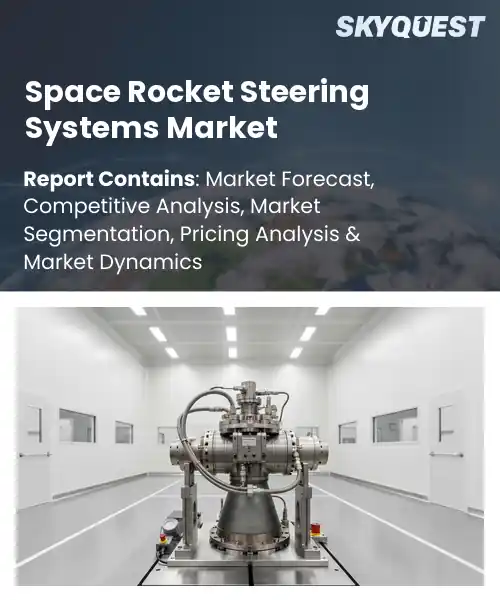
Space Rocket Steering Systems Market
Report ID: SQMIG20A2882
Report ID: SQMIG20A2882
[email protected]
USA +1 351-333-4748
Report ID:
SQMIG20A2882 |
Region:
Global |
Published Date: August, 2026
Pages:
157
|Tables:
119
|Figures:
77


Global Space Rocket Steering Systems Market size was valued at USD 2.14 Billion in 2024 and is poised to grow from USD 2.41 Billion in 2025 to USD 6.33 Billion by 2033, growing at a CAGR of 12.8% during the forecast period (2026-2033).
Space rocket steering systems involve designing, manufacturing, and installing thrust-vector control components, gimballed nozzles, reaction control thrusters, and control software that enable the proper orientation of launch vehicles from lift-off through orbital insertion. This market is significant because attitude control influences the precision and safety of missions. The market started developing in the 1960s with the US and Soviet development of the first basic gimbal systems on the Apollo and Vostok missions. Later, electro-hydraulic actuators were installed in the Space Shuttle, while thrust vector control systems using liquid metal became standard for commercial launch vehicles, including those used by SpaceX such as the Merlin engine.
Increase in reusable launch vehicles is one of the major factors responsible for the high potential in the market because flying the same rocket again and again requires the use of steers that have to survive multiple cycles of heat stress. Both Blue Origin and SpaceX have put in place strong gimbal designs and reusable reaction control systems to prove that reliability will reduce turnaround time and bring down launch costs per kilogram. There is now an opening for manufacturers of advanced materials, additive manufacturing of actuator housing, and guidance software using artificial intelligence to produce lighter and self-healing components that enhance longevity.
How is AI-driven Automation Reshaping the Space Rocket Steering Systems Market?
Artificial intelligence (AI) enabled automation is changing the way rockets navigate during launch, take off, and reentry. These include real time sensor fusion, predictive control and autonomous actuation mechanisms. The market has seen providers incorporating neural networks into guidance navigation and control modules for reduction of latency and improvement in accuracy. The current technology incorporates adaptive algorithms replacing fixed parameter loops responding to changes in aerodynamics and engine dynamics. This is leading to the production of compact hardware reducing weight and testing time. Providers indicate smooth adjustments of trajectories and improved mission success as advantages of integration of AI in their systems.
Market snapshot - (2026-2033)
Global Market Size
USD 2.14 Billion
Largest Segment
Thrust Vector Control Systems
Fastest Growth
Aerodynamic Control Systems
Growth Rate
12.8% CAGR
To get more insights on this market click here to Request a Free Sample Report
Global space rocket steering systems market is segmented by product type, component, launch vehicle type, end user and region. Based on product type, the market is segmented into Thrust Vector Control Systems, Aerodynamic Control Systems, Reaction Control Systems and Gimbaled Steering Systems. Based on component, the market is segmented into Actuators, Control Electronics, Sensors and Steering Mechanisms. Based on launch vehicle type, the market is segmented into Small Launch Vehicles, Medium Launch Vehicles and Heavy Launch Vehicles. Based on end user, the market is segmented into Commercial Space Organizations, Government Space Agencies and Defense Organizations. Based on region, the market is segmented into North America, Europe, Asia Pacific, Latin America and Middle East & Africa.
Thrust Vector Control System market segment leads due to the fact that this technology allows direct control of the thrust direction and is the one that provides the required accuracy of trajectory management necessary for today’s space launches. In conjunction with advanced avionics, the segment offers dependable maneuverability during different stages of the operation and becomes the best option for both commercial and governmental customers.
But the Reaction Control System category has been the fastest-growing of all, owing to the need for highly accurate attitude corrections for satellite constellations and on-orbit servicing that are beyond the scope of basic thrusters. Thruster miniaturization and propellant optimization technologies have increased its relevance to small and medium launch systems.
The Actuator segment holds significant share in the market due to the fact that actuators convert control signals to motion which is a vital process in moving rocket stages. Its efficiency during high vibrations and temperature helps maintain the performance of the steering system and improvements in electrical and hydraulic technology increases application potential on various launch platforms. This makes Actuator segment dominant in the Space Rocket Steering Systems Market.
Whereas, Sensor segment can be considered to be the major high growth segment due to the fact that sensors play an important role in precise navigation and in-time health monitoring that is now necessary for autonomous flights. Miniaturization of inertial measurement unit and thermal sensors expands their applications to more sophisticated navigation processes.
To get detailed segments analysis, Request a Free Sample Report
The strong presence of North America in the Space Rocket Steering Systems market can be attributed to the combination of established aerospace facilities, consistent investments by governments, and active engagement of the private sector. In the United States, there is an extensive presence of legacy rocket launchers, research centers, and supply chains with innovative materials, actuation, and controls technologies used. Canada offers complementary knowledge in cryogenic rocket propulsion and highly reliable parts due to cooperation in the defense industry. Together, this ensures quick prototyping and extensive testing of innovations, increasing confidence in such systems on the side of satellite owners and defense agencies. The region provides a favorable regulatory framework for development while requiring strict adherence to safety regulations, which also contributes to the dominant position of North America in the market. Having many talented specialists in various areas of engineering, coupled with close collaboration between governmental research laboratories and commercial enterprises, allows fast transfer of innovations from one company to another and quick time-to-market of innovations.
Space Rocket Steering Systems Market in the United States benefits from integration of aerospace research universities and leading launch providers. Collaborative programs link advanced control algorithms with actuators, while defense contracts ensure testing standards. The ecosystem encourages iteration, allowing firms to translate novel steering concepts into flight‑qualified hardware. This synergy of academic insight, industrial capability, and support sustains a pipeline of solutions that meet demanding requirements of commercial and strategic missions.
Market of Space Rocket Steering Systems in Canada relies on its experience in cryogenic fluids and manufacturing, acquired from its aerospace and defense industries. Cluster cooperation links part manufacturers with research institutions engaged in the study of actuation and thermal management systems. Special government encouragement for such projects that help in technology transfer, and closeness to US rocket launching sites ensure integration of Canadian steering systems.
The European Space Rocket Steering Systems market is driven by a combination of the historical strength in the aerospace industry, government coordination, and a healthy supplier base. Countries like Germany, UK, and France spend considerable amounts of money on developing research that integrates precise actuation with digital navigation systems, resulting in components that are highly reliable. The EU’s focus on collaborative projects ensures that there is no duplication of efforts and that technologies are shared. Increasing concerns over environmental responsibility in launching rockets have created a demand for light-weight steering technologies and reusability. There is a constant supply of talent through the presence of good universities and validation through defense and commercial launch projects.
Space Rocket Steering Systems Market in Germany is anchored by an industrial base renowned for precision engineering and actuation components. Collaboration between automotive manufacturers, aerospace firms, and research institutes accelerates development of steering algorithms and reliable hardware. Government‑backed programs emphasize modularity and reusability, encouraging suppliers to adopt advanced materials and twins. This ecosystem cultivates a reputation for dependable, mission‑critical steering solutions that serve commercial launch providers and defense customers across Europe.
Space Rocket Steering Systems Market in the United Kingdom is emerging through a blend of startups and aerospace contractors. Initiatives provide funding for actuation technologies and encourage partnerships with satellite operators to validate steering performance. Centers excel in simulation and control theory, feeding talent into sector. The focus on prototyping and modular designs enables UK firms to respond to launch demands, positioning country as a rising contributor to Europe’s steering ecosystem.
Space Rocket Steering Systems Market in France is the fastest‑growing segment, driven by ambitions and a cluster of propulsion specialists. Government programs prioritize reusable launch vehicles, prompting advancement of lightweight steering mechanisms and integrated control software. Collaboration between aerospace giants and SMEs accelerates technology transfer, while research universities supply expertise in materials and navigation. This ecosystem fuels a surge in demand for French‑engineered steering solutions across commercial and defense launch programs.
In terms of the Space Rocket Steering Systems market, Asia Pacific is becoming more prominent through a combination of high levels of manufacturing, favorable government support, and emergence of an ecosystem of commercial launch providers. The Japanese companies benefit from their heritage in precise engineering and reliability of components and employ advanced guidance systems in their compact steering systems. The fast rise of South Korean space industry is driven by massive investments in aerospace R&D and development of modular and reusable launch vehicles that require complex actuation systems. Collaborative efforts among countries in the region such as joint testing sites and supply chains help to increase efficiency and promote technology dissemination. Increased interest in satellite constellations and regional security measures create additional demand for high-performance steering devices.
Space Rocket Steering Systems Market in Japan benefits from a heritage of precision manufacturing and an emphasis on reliability for civil and defense launch programs. Collaboration between aerospace firms and component suppliers drives integration of guidance algorithms with actuation hardware. Government initiatives support development of reusable launch vehicles, encouraging steering solutions that can be refurbished. This ecosystem sustains Japan’s reputation for delivering dependable steering systems that meet stringent performance criteria worldwide.
The Space Rocket Steering Systems Market in South Korea is growing fast, as there is investment in space technologies and the use of reusable launching systems. The collaboration of conglomerates and startups leads to the rapid development of light-weight actuator devices and navigation software. Prototyping and certification processes, supported by government initiatives, decrease the amount of time needed to bring steering systems to the market.
To know more about the market opportunities by region and country, click here to
Buy The Complete Report
Growing Commercial Launch Activities
Adoption of Autonomous Navigation Technologies
Stringent Regulatory Certification Requirements
High Production Cost of Precision Components
Request Free Customization of this report to help us to meet your business objectives.
The competitive landscape is shaped by a handful of established integrators and a surge of newer entrants that are leveraging advanced materials, digital twins and AI‑driven guidance algorithms. Recent M&A activity, such as the acquisition of a precision actuator firm by a leading engine supplier, underscores the drive to consolidate steering‑technology capabilities. Strategic partnerships, for example a joint venture between a major launch service provider and a navigation‑software specialist, are accelerating the rollout of next‑generation thrust‑vector control units that promise higher reliability and lighter mass.
SkyQuest’s ABIRAW (Advanced Business Intelligence, Research & Analysis Wing) is our Business Information Services team that Collects, Collates, Correlates, and Analyses the Data collected by means of Primary Exploratory Research backed by robust Secondary Desk research.
As per SkyQuest analysis, the market drivers for the Global Space Rocket Steering Systems market can be attributed to increased commercial launch services driving the demand for better accuracy and reliability. Another prominent market driver can be attributed to the quick adoption of autonomous navigation systems equipped with real-time control and AI-based sensors. The thrust vector control systems hold the dominant position due to the reason that the system actually controls the direction of the rocket engine’s thrust. North America leads the global market due to a developed aerospace industry and high investments from the private sector.
| Report Metric | Details |
|---|---|
| Market size value in 2024 | USD 2.14 Billion |
| Market size value in 2033 | USD 6.33 Billion |
| Growth Rate | 12.8% |
| Base year | 2024 |
| Forecast period | (2026-2033) |
| Forecast Unit (Value) | USD Billion |
| Segments covered |
|
| Regions covered | North America (US, Canada), Europe (Germany, France, United Kingdom, Italy, Spain, Rest of Europe), Asia Pacific (China, India, Japan, Rest of Asia-Pacific), Latin America (Brazil, Rest of Latin America), Middle East & Africa (South Africa, GCC Countries, Rest of MEA) |
| Companies covered |
|
| Customization scope | Free report customization with purchase. Customization includes:-
|
To get a free trial access to our platform which is a one stop solution for all your data requirements for quicker decision making. This platform allows you to compare markets, competitors who are prominent in the market, and mega trends that are influencing the dynamics in the market. Also, get access to detailed SkyQuest exclusive matrix.
Table Of Content
Executive Summary
Market overview
Parent Market Analysis
Market overview
Market size
KEY MARKET INSIGHTS
COVID IMPACT
MARKET DYNAMICS & OUTLOOK
Market Size by Region
KEY COMPANY PROFILES
Methodology
For the Space Rocket Steering Systems Market, our research methodology involved a mixture of primary and secondary data sources. Key steps involved in the research process are listed below:
1. Information Procurement: This stage involved the procurement of Market data or related information via primary and secondary sources. The various secondary sources used included various company websites, annual reports, trade databases, and paid databases such as Hoover's, Bloomberg Business, Factiva, and Avention. Our team did 45 primary interactions Globally which included several stakeholders such as manufacturers, customers, key opinion leaders, etc. Overall, information procurement was one of the most extensive stages in our research process.
2. Information Analysis: This step involved triangulation of data through bottom-up and top-down approaches to estimate and validate the total size and future estimate of the Space Rocket Steering Systems Market.
3. Report Formulation: The final step entailed the placement of data points in appropriate Market spaces in an attempt to deduce viable conclusions.
4. Validation & Publishing: Validation is the most important step in the process. Validation & re-validation via an intricately designed process helped us finalize data points to be used for final calculations. The final Market estimates and forecasts were then aligned and sent to our panel of industry experts for validation of data. Once the validation was done the report was sent to our Quality Assurance team to ensure adherence to style guides, consistency & design.
Analyst Support
Customization Options
With the given market data, our dedicated team of analysts can offer you the following customization options are available for the Space Rocket Steering Systems Market:
Product Analysis: Product matrix, which offers a detailed comparison of the product portfolio of companies.
Regional Analysis: Further analysis of the Space Rocket Steering Systems Market for additional countries.
Competitive Analysis: Detailed analysis and profiling of additional Market players & comparative analysis of competitive products.
Go to Market Strategy: Find the high-growth channels to invest your marketing efforts and increase your customer base.
Innovation Mapping: Identify racial solutions and innovation, connected to deep ecosystems of innovators, start-ups, academics, and strategic partners.
Category Intelligence: Customized intelligence that is relevant to their supply Markets will enable them to make smarter sourcing decisions and improve their category management.
Public Company Transcript Analysis: To improve the investment performance by generating new alpha and making better-informed decisions.
Social Media Listening: To analyze the conversations and trends happening not just around your brand, but around your industry as a whole, and use those insights to make better Marketing decisions.
REQUEST FOR SAMPLE
 REQUEST FREE CUSTOMIZATION
Global Space Rocket Steering Systems Market size was valued at USD 2.14 Billion in 2024 and is poised to grow from USD 2.41 Billion in 2025 to USD 6.33 Billion by 2033, growing at a CAGR of 12.8% during the forecast period (2026-2033).
The competitive landscape is shaped by a handful of established integrators and a surge of newer entrants that are leveraging advanced materials, digital twins and AI‑driven guidance algorithms. Recent M&A activity, such as the acquisition of a precision actuator firm by a leading engine supplier, underscores the drive to consolidate steering‑technology capabilities. Strategic partnerships, for example a joint venture between a major launch service provider and a navigation‑software specialist, are accelerating the rollout of next‑generation thrust‑vector control units that promise higher reliability and lighter mass. 'RTX Corporation', 'L3Harris Technologies, Inc.', 'Moog Inc.', 'Honeywell International Inc.', 'Safran S.A.', 'Thales S.A.', 'BAE Systems plc', 'Northrop Grumman Corporation', 'The Boeing Company', 'Lockheed Martin Corporation', 'General Dynamics Corporation', 'ArianeGroup SAS', 'Avio S.p.A.', 'OHB SE', 'Mitsubishi Heavy Industries, Ltd.', 'Kongsberg Defence & Aerospace AS', 'SENER Aeroespacial S.A.', 'GMV Innovating Solutions S.L.', 'Redwire Corporation', 'Rocket Lab Corporation'
The surge in commercial launch activities drives demand for advanced steering systems as operators seek higher precision, reliability, and adaptability across diverse mission profiles. Enhanced system capabilities enable efficient trajectory adjustments, reduce propellant consumption, and improve payload safety, encouraging launch service providers to invest in next‑generation technology. This investment cycle accelerates research and development, fosters supplier collaborations, and expands the overall market by creating new applications for both orbital and sub‑orbital ventures, thereby reinforcing growth momentum in the evolving global aerospace sector.
Autonomous Navigation Integration: Satellite‑based GNSS augmentation, combined with advanced AI‑driven flight control algorithms, is driving the incorporation of fully autonomous navigation capabilities into rocket steering systems. Manufacturers are embedding predictive attitude adjustment modules that continuously process real‑time telemetry, reducing reliance on ground‑based commands. This evolution enhances mission flexibility, shortens launch windows, and improves safety margins by enabling immediate corrective actions during ascent, positioning steering technology as a strategic differentiator in competitive launch services and fostering greater confidence among commercial payload customers worldwide today.
Why does North America Dominate the Global Space Rocket Steering Systems Market? |@12


Want to customize this report? This report can be personalized according to your needs. Our analysts and industry experts will work directly with you to understand your requirements and provide you with customized data in a short amount of time. We offer $1000 worth of FREE customization at the time of purchase.
Feedback From Our Clients


 USA (+1) 351-333-4748

