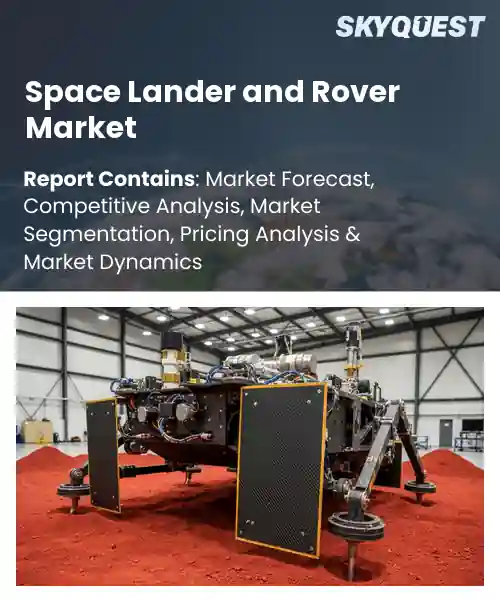
Space Lander and Rover Market
Report ID: SQMIG20A2732
Report ID: SQMIG20A2732
[email protected]
USA +1 351-333-4748
Report ID:
SQMIG20A2732 |
Region:
Global |
Published Date: July, 2026
Pages:
157
|Tables:
203
|Figures:
80


Global Space Lander And Rover Market size was valued at USD 2.2 Billion in 2024 and is poised to grow from USD 2.41 Billion in 2025 to USD 5.06 Billion by 2033, growing at a CAGR of 9.7% during the forecast period (2026-2033).
The space lander and rover market seems to be moving because there are more investments, both from governments and from private companies, a steady climb. People keep wanting more planetary exploration missions, like Moon , Mars, and even those other distant celestial places, so the need for better landers and rovers is just rising. Also, robotics tech is improving in a big way, plus artificial intelligence, autonomous navigation, and lighter materials are making the missions more capable and dependable. And more international collaboration, along with commercial space programs, driving the space lander and rover market growth.
On top of that, lunar resource exploration is getting serious, and there are even plans for human habitation, so companies want more sophisticated surface mobility systems, not just “good enough”. More money for science research, satellite support efforts, and deep space exploration programs also pushes innovation forward. And when governments keep offering supportive policies and long term space strategies, well, that keeps accelerating the rollout of new generation landers and rovers around the globe.
AI-driven autonomy is reshaping the space lander and rover market outlook by letting the spacecraft decide things on its own, in real time, without having a human constantly step in. It helps with less waiting, less mission risk, and it also stretches what rovers can do on planetary surfaces. Right now, agencies and commercial teams are putting machine-learning navigation, hazard detection and avoidance, and adaptive energy management into fresh lander designs. NASA’s recent contracts show this change, where partners like Astrolab and Lunar Outpost are being tasked with autonomous payload handling and terrain traversal. The outcome is a faster development cycle and more flexible platforms, which tends to pull in investment and spread market reach.
Market snapshot - (2026-2033)
Global Market Size
USD 2.2 Billion
Largest Segment
Space Rovers
Fastest Growth
Space Rovers
Growth Rate
9.7% CAGR
To get more insights on this market click here to Request a Free Sample Report
The global space lander and rover market is segmented by product type, target celestial body, payload capacity class, mobility mechanism type, power source, application focus, end user and region. Based on product type, the market is segmented into Space Landers and Space Rovers. Based on target celestial body, the market is segmented into Moon, Mars, Asteroids, Comets and Others. Based on payload capacity class, the market is segmented into Light Payload Systems, Medium Payload Systems and Heavy Payload Systems. Based on mobility mechanism type, the market is segmented into Wheeled Mobility Systems, Hopper Landing Mechanisms and Fixed Station Landers. Based on power source, the market is segmented into Solar Arrays, Fuel Cell Solutions and Radioisotope Thermoelectric Generators. Based on application focus, the market is segmented into Scientific Research, Planetary Exploration, Resource Prospecting, Technology Demonstration and Commercial Payload Delivery. Based on end user, the market is segmented into Government Space Agencies, Private Aerospace Companies, Defense Organizations, Academic Institutions and Research Institutes. Based on region, the market is segmented into North America, Europe, Asia Pacific, Latin America and Middle East & Africa.
As per the space lander and rover market analysis, the Solar Arrays segment still dominates, since the reliable long duration power it delivers lines up neatly with the endurance needs for lunar and Martian missions. Like, the whole photovoltaic tech is more mature now, and because mass keeps dropping while efficiency goes up, designers can shift more of the budget toward payload and mobility , instead of leaning so hard into power storage. So mission architects tend to favor solar‑powered platforms, not only to keep risk lower but also to stretch the surface operational windows and tap into proven heritage across several programs.
However, the Fuel Cell Solutions segment is seeing the strongest growth momentum, mostly because planners are looking for higher energy density for night time runs and deep shadowed areas. New-ish hydrogen storage improvements plus modular design approaches are reducing system complexity, which in turn makes agencies and commercial firms more willing to adopt fuel cells when they need power beyond simple sunlight. That shift, basically keeps opening up more market opportunity.
According to the space lander and rover market forecast, the Scientific Research segment stands out because it drives the main goals behind most lunar and Martian lander and rover programs. It focuses on geology, astrobiology, and environmental monitoring in a way that matters for almost every mission, so funding bodies and agencies usually prioritize efforts that expand fundamental knowledge. That means continuing investment in sensor suites, sample acquisition tools, and data handling, and as a result there is steady demand for platforms that can maneuver precisely while also returning high‑fidelity data. All of this reinforces the segment’s central market position, like the backbone of the whole stack.
Whereas the Commercial Payload Delivery segment shows up as the fastest-growing area, since private companies are trying to launch satellite constellations and even tourism cargo from lunar bases. Rising profitability in space logistics, paired with evolving regulatory frameworks, is pushing investment toward versatile landers that can move commercial goods around. So in effect it unlocks new revenue streams, and also speeds up overall market expansion.
To get detailed segments analysis, Request a Free Sample Report
As per the space lander and rover market regional forecast, North America dominates the market, because there is uniquely connected ecosystem, where a lot of governmental support blends in with a mature commercial launch scene and world‑class research groups. The United States is the main driver, with its huge agency portfolios. It helps to enable high‑risk, high‑reward missions that keep pushing technological limits. Meanwhile Canada brings in complementary strengths around autonomous systems, plus more sustainable mission planning, and they usually lean on very close coordination with their U.S. partners, which makes the whole thing move faster than it should. Both countries basically share a deep supply chain, better manufacturing practices, and a mindset that favors rapid prototyping. This mix of people, capital, and infrastructure creates a self-feeding cycle, so leadership sticks around and international collaborators come looking for advanced planetary mobility solutions. Also, the region tends to support open data sharing, and commercial partnerships, which keeps making the innovation loop go quicker , so advanced rover technologies keep coming.
United States Space Lander and Rover Market
The Space Lander and Rover sector in the United States benefits from a deep ecosystem that includes governmental agencies, commercial launch providers, and advanced research universities. Strong public private partnerships push rapid iteration, while the mature supply chain helps with component fabrication and testing. Having flagship programs, plus an overall culture of innovation, supports risk taking, and pulls in global talent. All that reinforces the United States as a hub for next generation planetary exploration hardware systems.
Canada Space Lander and Rover Market
The Space Lander and Rover industry in Canada leverages a collaborative model between federal research agencies, aerospace companies, and a lively university ecosystem. There is strong focus on sustainable mission design and autonomous navigation, which fits with national priorities on technology sovereignty. Robust testing facilities, and a supportive regulatory environment, allow quick prototyping. Strategic alliances with U.S. partners also broaden market access, and help build a cross border innovation ecosystem that basically strengthens Canada’s position in planetary exploration capabilities.
Asia Pacific is seeing a rapid space lander and rover market penetration due to strategic government funding, a growing private sector, and serious precision engineering knowledge. Japan uses its legacy of lunar exploration, plus advanced robotics, to produce mobility platforms that are very reliable. South Korea takes advantage of its semiconductor strengths and AI know how, then turns that into sophisticated guidance systems. Regional collaboration frameworks help with technology transfer across borders, and more launch facilities also lowers the entry barriers. The emphasis on sustainable mission architecture, along with industrial diversification, encourages local suppliers to step into the planetary mobility value chain. That ends up producing a virtuous cycle where capability grows and market growth follows. On top of that, universities across the region keep intensifying work on autonomous navigation, so the innovation pipeline stays strong.
Japan Space Lander and Rover Market
The Space Lander and Rover market in Japan is propelled by long-standing government space initiatives, backed by a lively private sector that is focused on miniaturization and precision engineering. The country puts heavy emphasis on lunar and asteroid missions, so demand rises for robust mobility platforms. At the same time, Japan’s robotics expertise supports autonomy solutions. Collaborative research clusters, connecting universities, manufacturers, and launch service providers, help accelerate technology transfer. This positions Japan as a leading source for high reliability planetary rover systems.
South Korea Space Lander and Rover Market
The Space Lander and Rover market in South Korea benefits from a strategic national roadmap that ties space exploration to broader industrial policy. Government investment in launch infrastructure and deep space research gets an extra boost from a rising base of semiconductor and AI talent. That combo helps enable more advanced guidance and navigation capabilities. Partnerships with international agencies, plus a proactive approach to commercial venture creation, speeds up development of adaptable rovers for different planetary conditions.
Europe is increasing its space lander and rover market share due to coordinated policy frameworks and a deep aerospace heritage , plus also more and more cross border projects that actually get stitched together. The European Space Agency seems to push modular, reusable designs , so member states can pool money, share exposure and basically build a more sturdy ecosystem of specialized suppliers. On top of that, investment in AI driven autonomy and advanced materials science boosts rover performance and resilience, especially when rovers are headed toward difficult terrains that are not forgiving. Then there are those civil military partnerships, and the attention to sustainable launch practices, which should improve efficiency and make global customers take notice. Taken together, this integrated approach not only lifts Europe technological standing a fair bit, but also helps secure Europe influence in how planetary exploration will be shaped later. European universities and research institutes add even more, delivering cutting edge experiments on autonomy, sensor fusion and energy management, so there’s a constant stream of new ideas that flow into commercial development.
Germany Space Lander and Rover Market
The Space Lander and Rover Market in Germany is anchored by a long national engineering tradition, and by coordinated national space agency initiatives that underline modular design along with reusability. There are strong industrial clusters, especially around automotive and precision manufacturing, and that know how turns into durable rover chassis and mobility systems. Collaborative frameworks that link research institutes with defense contractors and start ups keep cross disciplinary innovation moving, so Germany stays a key supplier of high performance exploration platforms, for European missions and also for non European ones.
United Kingdom Space Lander and Rover Market
The Space Lander and Rover Market in the United Kingdom thrives on a convergence between space agency ambition, and a lively aerospace supply chain that uses advanced materials science. Heritage in robotics and autonomous systems supports development of navigation suites, while incubators connect universities with commercial firms , so prototype validation happens faster. When the United Kingdom participates in lunar and Martian programs, it gains visibility and it nudges the country toward a leadership position in planetary mobility solutions.
France Space Lander and Rover Market
The Space Lander and Rover Market in France is shaped by a national space agency vision that mixes scientific discovery with competitiveness. When aerospace expertise meets AI research, more sophisticated autonomy plus terrain analysis capabilities are offered. Collaborative clusters around Toulouse and Paris bring research labs together with defense contractors and start-ups, which then enables quick system integration. France's role within European mission consortia reinforces its position as a key contributor to planetary mobility platforms, for what comes next in the future
To know more about the market opportunities by region and country, click here to
Buy The Complete Report
Increasing Private Mission Funding
Advancements In Autonomous Navigation
High Development Cost Barriers
Regulatory and Export Control Constraints
Request Free Customization of this report to help us to meet your business objectives.
The space lander and rover market is a battlefield because companies keep chasing those limited lunar contract slots, so everything gets sped up, M&A deals here and there, strategic co-ops with everyone , and quick tech launches that stack up. There is a pattern in recent moves too like AstroForge teaming up with a European space agency to run trials on a three meter lander, plus Lux Capital buying a smaller rover outfit, while other players scramble to bolt on autonomous navigation and do on site resource processing.
Top Player’s Company Profile
Recent Developments in the Space Lander and Rover Market
SkyQuest’s ABIRAW (Advanced Business Intelligence, Research & Analysis Wing) is our Business Information Services team that Collects, Collates, Correlates, and Analyses the Data collected by means of Primary Exploratory Research backed by robust Secondary Desk research.
According to SkyQuest analysis, the market is pulled mostly by an increase in private mission funding, which feeds demand for flexible lander and rover platforms. Then another driver shows up from recent autonomous navigation improvements, letting surface operations run longer while also lowering risk. Solar Arrays still dominate the power source part, mainly because their efficiency plus heritage makes mission design simpler. North America stays out front too, due to its tight government industry setup, along with a deep supply chain. Still, high development cost barriers hold back many potential entrants, so participation ends up mostly with well financed agencies and big companies, and that slows the overall market momentum a bit. Meanwhile, the growing commercial payload delivery slice is opening up extra possibilities for reusable lander architectures.
| Report Metric | Details |
|---|---|
| Market size value in 2024 | USD 2.2 Billion |
| Market size value in 2033 | USD 5.06 Billion |
| Growth Rate | 9.7% |
| Base year | 2024 |
| Forecast period | (2026-2033) |
| Forecast Unit (Value) | USD Billion |
| Segments covered |
|
| Regions covered | North America (US, Canada), Europe (Germany, France, United Kingdom, Italy, Spain, Rest of Europe), Asia Pacific (China, India, Japan, Rest of Asia-Pacific), Latin America (Brazil, Rest of Latin America), Middle East & Africa (South Africa, GCC Countries, Rest of MEA) |
| Companies covered |
|
| Customization scope | Free report customization with purchase. Customization includes:-
|
To get a free trial access to our platform which is a one stop solution for all your data requirements for quicker decision making. This platform allows you to compare markets, competitors who are prominent in the market, and mega trends that are influencing the dynamics in the market. Also, get access to detailed SkyQuest exclusive matrix.
Table Of Content
Executive Summary
Market overview
Parent Market Analysis
Market overview
Market size
KEY MARKET INSIGHTS
COVID IMPACT
MARKET DYNAMICS & OUTLOOK
Market Size by Region
KEY COMPANY PROFILES
Methodology
For the Space Lander and Rover Market, our research methodology involved a mixture of primary and secondary data sources. Key steps involved in the research process are listed below:
1. Information Procurement: This stage involved the procurement of Market data or related information via primary and secondary sources. The various secondary sources used included various company websites, annual reports, trade databases, and paid databases such as Hoover's, Bloomberg Business, Factiva, and Avention. Our team did 45 primary interactions Globally which included several stakeholders such as manufacturers, customers, key opinion leaders, etc. Overall, information procurement was one of the most extensive stages in our research process.
2. Information Analysis: This step involved triangulation of data through bottom-up and top-down approaches to estimate and validate the total size and future estimate of the Space Lander and Rover Market.
3. Report Formulation: The final step entailed the placement of data points in appropriate Market spaces in an attempt to deduce viable conclusions.
4. Validation & Publishing: Validation is the most important step in the process. Validation & re-validation via an intricately designed process helped us finalize data points to be used for final calculations. The final Market estimates and forecasts were then aligned and sent to our panel of industry experts for validation of data. Once the validation was done the report was sent to our Quality Assurance team to ensure adherence to style guides, consistency & design.
Analyst Support
Customization Options
With the given market data, our dedicated team of analysts can offer you the following customization options are available for the Space Lander and Rover Market:
Product Analysis: Product matrix, which offers a detailed comparison of the product portfolio of companies.
Regional Analysis: Further analysis of the Space Lander and Rover Market for additional countries.
Competitive Analysis: Detailed analysis and profiling of additional Market players & comparative analysis of competitive products.
Go to Market Strategy: Find the high-growth channels to invest your marketing efforts and increase your customer base.
Innovation Mapping: Identify racial solutions and innovation, connected to deep ecosystems of innovators, start-ups, academics, and strategic partners.
Category Intelligence: Customized intelligence that is relevant to their supply Markets will enable them to make smarter sourcing decisions and improve their category management.
Public Company Transcript Analysis: To improve the investment performance by generating new alpha and making better-informed decisions.
Social Media Listening: To analyze the conversations and trends happening not just around your brand, but around your industry as a whole, and use those insights to make better Marketing decisions.
REQUEST FOR SAMPLE
 REQUEST FREE CUSTOMIZATION
Global Space Lander And Rover Market size was valued at USD 2.2 Billion in 2024 and is poised to grow from USD 2.41 Billion in 2025 to USD 5.06 Billion by 2033, growing at a CAGR of 9.7% during the forecast period (2026-2033).
The space lander and rover market is shaped by intense rivalry as firms chase limited lunar contract slots, prompting accelerated M&A, strategic partnerships and rapid technology rollouts. Recent examples include AstroForge’s alliance with a European space agency to test a three meter lander and Lux Capital’s acquisition of a niche rover developer, while competitors race to integrate autonomous navigation and in situ resource processing. 'Lockheed Martin Corporation', 'Northrop Grumman Corporation', 'Airbus SE', 'Blue Origin Enterprises L.P.', 'ispace Inc.', 'Intuitive Machines LLC', 'Astrobotic Technology Inc.', 'Space Exploration Technologies Corp.', 'Thales Alenia Space', 'Firefly Aerospace Inc.', 'Dynetics Inc.', 'Moon Express Inc.', 'Sierra Space Corporation', 'Maxar Technologies Inc.', 'Oshkosh Corporation', 'Teledyne Brown Engineering Inc.', 'Surrey Satellite Technology Ltd.', 'QinetiQ Group plc', 'OHB SE', 'Team Indus'
The surge in private capital allocated to lunar and planetary missions is expanding the demand for versatile lander and rover platforms, enabling faster development cycles and encouraging innovative design approaches. As commercial entities pursue strategic objectives, they prioritize modular systems that can be adapted across multiple missions, thereby creating a sustained pipeline of procurement opportunities that fuel market expansion and drive collaborative technology advancements across the industry. These investments also stimulate ancillary services such as testing infrastructure, software integration, and mission support, further broadening the ecosystem and attracting new participants who contribute additional expertise and resources.
Lunar Reuse Infrastructure: The emergence of reusable lander and rover components is reshaping mission economics, as agencies and commercial players prioritize modular designs that can be refurbished and redeployed across multiple lunar sorties, reducing the need for dedicated launch builds each time. This shift encourages partnerships around shared service platforms, standard interfaces, and in‑situ maintenance capabilities, fostering a nascent ecosystem where hardware turnover is minimized, operational timelines are compressed, and overall program risk is mitigated through proven, repeatable hardware cycles for future exploration.
Why does North America Dominate the Global Space Lander and Rover Market? |@12


Want to customize this report? This report can be personalized according to your needs. Our analysts and industry experts will work directly with you to understand your requirements and provide you with customized data in a short amount of time. We offer $1000 worth of FREE customization at the time of purchase.
Feedback From Our Clients


 USA (+1) 351-333-4748

