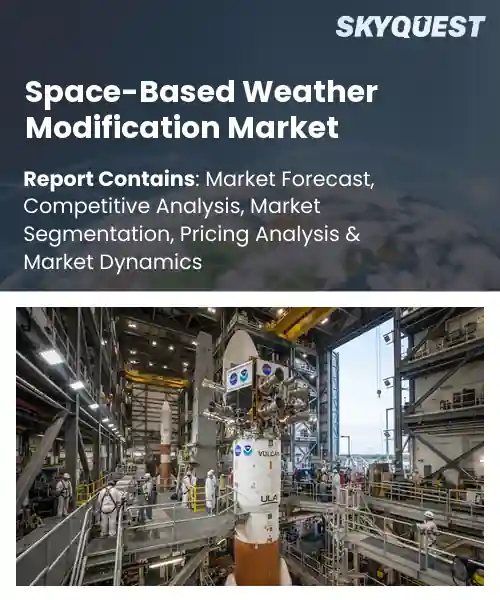
Space-Based Weather Modification Market
Report ID: SQMIG20A2916
Report ID: SQMIG20A2916
[email protected]
USA +1 351-333-4748
Report ID:
SQMIG20A2916 |
Region:
Global |
Published Date: August, 2026
Pages:
157
|Tables:
118
|Figures:
77


Global Space-Based Weather Modification Market size was valued at USD 254.0 Million in 2024 and is poised to grow from USD 306.83 Million in 2025 to USD 1391.35 Million by 2033, growing at a CAGR of 20.8% during the forecast period (2026-2033).
Space‑based weather modification refers to the deployment of satellites that can influence atmospheric conditions through techniques such as cloud seeding, solar radiation management, or ionospheric heating. The primary driver behind this nascent market is the growing frequency of extreme climate events, which pressures governments and insurers to seek proactive mitigation tools. Early experiments by the United States and China in the 2010s demonstrated modest precipitation enhancement, establishing proof of concept and prompting private investors to fund constellations. As climate‑risk models become sophisticated, stakeholders recognize that space assets offer a global reach unattainable by terrestrial interventions, thereby cementing the market’s relevance.
Building on this relevance, the dominant growth factor is the convergence of commercial satellite‑as‑a‑service platforms with geo‑engineering algorithms, which together lower entry barriers and accelerate deployment cycles. When operators integrate climate analytics into payload designs, they can tailor aerosol dispersal or electro‑dynamic cloud activation to drought hotspots, turning models into interventions. This capability has attracted agricultural cooperatives in Australia, where pilot missions reduced water stress on wheat fields by up to fifteen percent. The resulting risk‑transfer contracts give insurers measurable loss mitigation, spurring capital and prompting policy makers to draft supportive regulations that could unlock a significant global billion‑dollar market.
How are AI and IoT improving accuracy in space-based weather modification systems?
AI and IoT are reshaping space based weather modification by turning raw sensor streams into actionable insights. AI algorithms ingest data from satellite borne lidar, hyperspectral imagers and distributed IoT nodes on high altitude platforms, then predict cloud dynamics and precipitation potential with far greater fidelity. IoT devices provide continuous telemetry on atmospheric humidity, temperature gradients and aerosol concentrations, creating a dense mesh that feeds the AI models in real time. This feedback loop reduces uncertainty, enables precise seeding timing and allows operators to adjust payloads on orbit without ground delay. The market is responding with increased investment as stakeholders seek more reliable climate interventions.
Market snapshot - (2026-2033)
Global Market Size
USD 254.0 Million
Largest Segment
Satellite-Based Atmospheric Monitoring
Fastest Growth
Climate Intervention Technologies
Growth Rate
20.8% CAGR
To get more insights on this market click here to Request a Free Sample Report
Global space-based weather modification market is segmented by technology, application, end user, mission type and region. Based on technology, the market is segmented into Satellite-Based Atmospheric Monitoring, Space-Based Energy Transmission Systems and Climate Intervention Technologies. Based on application, the market is segmented into Weather Monitoring, Weather Modification Research, Disaster Mitigation and Climate Research. Based on end user, the market is segmented into Government Agencies, Defense Organizations, Research Institutions and Commercial Space Companies. Based on mission type, the market is segmented into Research Missions and Operational Missions. Based on region, the market is segmented into North America, Europe, Asia Pacific, Latin America and Middle East & Africa.
Satellite‑Based Atmospheric Monitoring segment dominates because it provides the foundational data needed to detect, model, and predict atmospheric conditions from orbit, enabling precise intervention strategies. Its ability to deliver continuous, high resolution observations drives confidence among stakeholders, supports regulatory compliance, and underpins the credibility of any weather modification effort. The reliability and breadth of its measurements make it the cornerstone of market activity. These capabilities also attract investment and foster collaborative research across agencies.
However, Space‑Based Energy Transmission Systems segment is witnessing the strongest growth momentum as advances in wireless power beaming enable direct fueling of atmospheric actuators, reducing reliance on ground based infrastructure. Emerging commercial interest and decreasing launch costs accelerate deployment, creating new revenue streams and expanding the market’s operational envelope. This acceleration fuels broader adoption of weather modification concepts and opens pathways for scalable solutions.
Weather Monitoring segment dominates because it delivers the essential real time insights that validate any modification effort, allowing operators to assess baseline conditions and measure impact with precision. Continuous observation builds trust among users, supports decision making, and justifies investment by demonstrating tangible outcomes. Its integration with existing forecasting frameworks ensures seamless adoption and reinforces the market’s credibility, making it the primary driver of activity. This pervasive reliance also encourages cross sector partnerships that further embed the technology into operational workflows.
Meanwhile, Climate Research segment is emerging as the key high growth area as scientists leverage space based interventions to study atmospheric dynamics and validate geoengineering models. Growing academic interest, funding for experimental trials, and the need for robust data to inform policy accelerate its expansion. This momentum creates new market opportunities for specialized payloads and analytical services, propelling overall market growth.
To get detailed segments analysis, Request a Free Sample Report
North America benefits from an extensive legacy of aerospace innovation combined with deep government and private sector commitment to climate resilience technologies. Robust research universities and national laboratories provide a continuous pipeline of expertise, while mature launch infrastructure ensures rapid deployment of satellite constellations. Strong regulatory frameworks encourage responsible experimentation and commercial scaling. Collaboration among defense agencies, meteorological services, and emerging tech firms creates an ecosystem that accelerates solution development. Access to substantial capital resources supports long‑term research and the integration of advanced data analytics, positioning the region as a leader in translating space‑derived insights into actionable weather modification strategies.
Space-Based Weather Modification Market in the United States is propelled by a convergence of federal research initiatives, commercial launch capabilities, and a vibrant venture ecosystem focused on atmospheric engineering. Leading space agencies partner with private innovators to test precipitation enhancement techniques, while agricultural and disaster‑management stakeholders adopt satellite‑driven forecasts to refine intervention timing. The country’s extensive ground‑sensor networks complement space observations, creating a comprehensive data environment that fuels continuous improvement of modification methodologies.
Space-Based Weather Modification Market in Canada leverages strong ties between academic research centers and government climate programs to advance satellite‑based weather influence concepts. Emphasis on northern climate challenges drives investment in precise atmospheric monitoring, while collaborations with indigenous communities ensure culturally appropriate application of technologies. Canadian aerospace firms contribute launch and payload expertise, enhancing the nation’s capacity to field experimental missions that support agriculture, water management, and wildfire mitigation across diverse ecosystems.
The Asia Pacific region experiences heightened urgency to address climate variability that directly impacts dense populations and agriculture‑dependent economies. Government commitments to sustainable development encourage the adoption of space‑enabled weather control as a tool for enhancing food security and protecting critical infrastructure. Rapid growth of satellite manufacturing capabilities, especially in technologically advanced economies, reduces reliance on external providers and accelerates program timelines. Strong public‑private partnerships foster innovative research, while regional collaboration platforms facilitate knowledge exchange, positioning the area for swift adoption of weather modification techniques to mitigate extreme events.
Space-Based Weather Modification Market in Japan benefits from a sophisticated space industry and a national focus on disaster risk reduction. Integration of high‑resolution satellite imagery with advanced modeling supports precise targeting of precipitation enhancement efforts, particularly for rice cultivation and flood control. Collaborative projects between governmental meteorological agencies and private technology firms drive iterative testing, while strong regulatory oversight ensures responsible deployment aligned with environmental safeguards.
Space-Based Weather Modification Market in South Korea is energized by a strategic emphasis on smart agriculture and resilient urban planning. The country’s emerging satellite constellations provide frequent revisit times, enabling real‑time assessment of atmospheric conditions for rapid intervention. Partnerships between research institutes, defense establishments, and venture capital entities accelerate the development of cloud‑seeding technologies tailored to regional monsoon patterns, reinforcing South Korea’s commitment to harnessing space assets for climate adaptation.
Europe advances its role through coordinated policy frameworks that align climate objectives with space technology initiatives across member states. Investment in next‑generation satellite platforms, combined with a legacy of precision engineering, equips the continent with high‑fidelity atmospheric data essential for targeted weather modification. Cross‑border research consortia pool expertise from atmospheric science, aerospace, and data analytics, fostering innovative trial designs and validation methods. Emphasis on sustainability and ethical governance ensures that development proceeds within robust societal and environmental parameters, enhancing Europe’s reputation as a responsible leader in the emerging field.
Space-Based Weather Modification Market in Germany draws on a strong engineering base and a proactive climate action agenda. Collaborative networks linking federal research institutes, automotive industry innovators, and meteorological services emphasize the translation of satellite observations into actionable modification strategies for flood prevention and renewable energy optimization. Germany’s commitment to open data standards enhances interoperability across European projects, reinforcing its influence in shaping regional best practices.
Space-Based Weather Modification Market in the United Kingdom is shaped by a vibrant space sector and rigorous academic research culture. Governmental climate resilience programs encourage the integration of satellite‑derived atmospheric insights with ground‑level interventions for agriculture and coastal protection. Partnerships between leading universities, defense research establishments, and emerging startups accelerate the prototyping of cloud‑seeding techniques, positioning the United Kingdom as a hub for innovative weather control solutions.
Space-Based Weather Modification Market in France benefits from a consolidated aerospace industry and a national emphasis on environmental stewardship. State‑led space agencies collaborate closely with meteorological institutes to develop targeted precipitation enhancement experiments that support vineyard management and river basin regulation. French research laboratories focus on refining atmospheric models, ensuring that any modification efforts are grounded in robust scientific validation and aligned with broader EU climate objectives.
To know more about the market opportunities by region and country, click here to
Buy The Complete Report
Increasing Demand for Climate Resilience
Advancements in Satellite Propulsion Technologies
Regulatory Uncertainty Around Atmospheric Intervention
High Costs of Satellite Deployment
Request Free Customization of this report to help us to meet your business objectives.
The competitive landscape is shaped by established aerospace firms leveraging partnerships with climate‑tech entities to field atmospheric‑intervention payloads, while a wave of agile startups introduces reusable launch platforms and low‑cost deployment models that intensify rivalry for government and commercial contracts. Strategic collaborations, such as joint development of aerosol‑dispersal satellites, and rapid‑cycle technology innovation are driving market momentum and pressuring incumbents to accelerate M&A and alliance activities.
SkyQuest’s ABIRAW (Advanced Business Intelligence, Research & Analysis Wing) is our Business Information Services team that Collects, Collates, Correlates, and Analyses the Data collected by means of Primary Exploratory Research backed by robust Secondary Desk research.
As per SkyQuest analysis the global space‑based weather modification market is propelled by the rising demand for climate‑resilience solutions that push governments and insurers toward satellite‑enabled interventions, while breakthroughs in satellite propulsion and electric thrust are the second catalyst accelerating low‑cost, precise deployments. Regulatory uncertainty surrounding intentional atmospheric alteration remains the main restraint, slowing investment until clear frameworks emerge. North America leads the market thanks to its mature aerospace ecosystem, robust funding and supportive policies. The satellite‑based atmospheric monitoring segment dominates because it supplies the high‑resolution data essential for accurate targeting and validation of weather‑modification missions, anchoring growth across applications.
| Report Metric | Details |
|---|---|
| Market size value in 2024 | USD 254.0 Million |
| Market size value in 2033 | USD 1391.35 Million |
| Growth Rate | 20.8% |
| Base year | 2024 |
| Forecast period | (2026-2033) |
| Forecast Unit (Value) | USD Million |
| Segments covered |
|
| Regions covered | North America (US, Canada), Europe (Germany, France, United Kingdom, Italy, Spain, Rest of Europe), Asia Pacific (China, India, Japan, Rest of Asia-Pacific), Latin America (Brazil, Rest of Latin America), Middle East & Africa (South Africa, GCC Countries, Rest of MEA) |
| Companies covered |
|
| Customization scope | Free report customization with purchase. Customization includes:-
|
To get a free trial access to our platform which is a one stop solution for all your data requirements for quicker decision making. This platform allows you to compare markets, competitors who are prominent in the market, and mega trends that are influencing the dynamics in the market. Also, get access to detailed SkyQuest exclusive matrix.
Table Of Content
Executive Summary
Market overview
Parent Market Analysis
Market overview
Market size
KEY MARKET INSIGHTS
COVID IMPACT
MARKET DYNAMICS & OUTLOOK
Market Size by Region
KEY COMPANY PROFILES
Methodology
For the Space-Based Weather Modification Market, our research methodology involved a mixture of primary and secondary data sources. Key steps involved in the research process are listed below:
1. Information Procurement: This stage involved the procurement of Market data or related information via primary and secondary sources. The various secondary sources used included various company websites, annual reports, trade databases, and paid databases such as Hoover's, Bloomberg Business, Factiva, and Avention. Our team did 45 primary interactions Globally which included several stakeholders such as manufacturers, customers, key opinion leaders, etc. Overall, information procurement was one of the most extensive stages in our research process.
2. Information Analysis: This step involved triangulation of data through bottom-up and top-down approaches to estimate and validate the total size and future estimate of the Space-Based Weather Modification Market.
3. Report Formulation: The final step entailed the placement of data points in appropriate Market spaces in an attempt to deduce viable conclusions.
4. Validation & Publishing: Validation is the most important step in the process. Validation & re-validation via an intricately designed process helped us finalize data points to be used for final calculations. The final Market estimates and forecasts were then aligned and sent to our panel of industry experts for validation of data. Once the validation was done the report was sent to our Quality Assurance team to ensure adherence to style guides, consistency & design.
Analyst Support
Customization Options
With the given market data, our dedicated team of analysts can offer you the following customization options are available for the Space-Based Weather Modification Market:
Product Analysis: Product matrix, which offers a detailed comparison of the product portfolio of companies.
Regional Analysis: Further analysis of the Space-Based Weather Modification Market for additional countries.
Competitive Analysis: Detailed analysis and profiling of additional Market players & comparative analysis of competitive products.
Go to Market Strategy: Find the high-growth channels to invest your marketing efforts and increase your customer base.
Innovation Mapping: Identify racial solutions and innovation, connected to deep ecosystems of innovators, start-ups, academics, and strategic partners.
Category Intelligence: Customized intelligence that is relevant to their supply Markets will enable them to make smarter sourcing decisions and improve their category management.
Public Company Transcript Analysis: To improve the investment performance by generating new alpha and making better-informed decisions.
Social Media Listening: To analyze the conversations and trends happening not just around your brand, but around your industry as a whole, and use those insights to make better Marketing decisions.
REQUEST FOR SAMPLE
 REQUEST FREE CUSTOMIZATION
Global Space-Based Weather Modification Market size was valued at USD 254.0 Million in 2024 and is poised to grow from USD 306.83 Million in 2025 to USD 1391.35 Million by 2033, growing at a CAGR of 20.8% during the forecast period (2026-2033).
The competitive landscape is shaped by established aerospace firms leveraging partnerships with climate‑tech entities to field atmospheric‑intervention payloads, while a wave of agile startups introduces reusable launch platforms and low‑cost deployment models that intensify rivalry for government and commercial contracts. Strategic collaborations, such as joint development of aerosol‑dispersal satellites, and rapid‑cycle technology innovation are driving market momentum and pressuring incumbents to accelerate M&A and alliance activities. 'Space Exploration Technologies Corp.', 'Rocket Lab Corporation', 'Blue Origin, LLC', 'Planet Labs PBC', 'Spire Global, Inc.', 'Maxar Technologies Inc.', 'Airbus SE', 'Thales S.A.', 'Lockheed Martin Corporation', 'Northrop Grumman Corporation', 'L3Harris Technologies, Inc.', 'MDA Space Ltd.', 'OHB SE', 'ICEYE Oy', 'BlackSky Technology Inc.', 'GeoOptics, Inc.', 'Satellogic Inc.', 'RTX Corporation', 'Kongsberg Gruppen ASA', 'Voyager Technologies, Inc.'
Governments and private entities are investing heavily in climate resilience solutions, recognizing that space‑based weather modification can mitigate extreme events and protect critical infrastructure. This growing demand drives the adoption of satellite platforms capable of influencing atmospheric conditions, prompting technology developers to expand research and production capacities. As stakeholders seek reliable methods to reduce economic losses from storms, droughts, and heatwaves, the market experiences heightened interest, fostering partnerships and accelerating the commercialization of advanced weather‑control services. These initiatives also encourage regulatory frameworks that support innovative deployment.
Ai‑Driven Cloud Seeding Optimization: Satellite platforms equipped with advanced AI algorithms are now able to process real‑time atmospheric data, predict optimal seeding windows, and autonomously adjust payload release patterns. This capability reduces human intervention, improves precision of cloud modification, and shortens project cycles. Operators can respond to emerging drought conditions faster, while investors see higher confidence in outcome reliability. The convergence of AI and space assets is reshaping service delivery models, fostering collaborative ecosystems between meteorological agencies and private technology firms for global resilience
Why does North America Dominate the Global Space-Based Weather Modification Market? |@12


Want to customize this report? This report can be personalized according to your needs. Our analysts and industry experts will work directly with you to understand your requirements and provide you with customized data in a short amount of time. We offer $1000 worth of FREE customization at the time of purchase.
Feedback From Our Clients


 USA (+1) 351-333-4748

