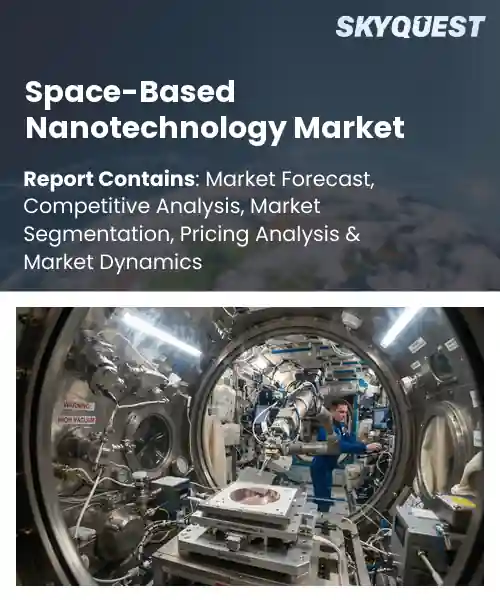
Space-Based Nanotechnology Market
Report ID: SQMIG20A2938
Report ID: SQMIG20A2938
[email protected]
USA +1 351-333-4748
Report ID:
SQMIG20A2938 |
Region:
Global |
Published Date: September, 2026
Pages:
157
|Tables:
128
|Figures:
77


Global Space-Based Nanotechnology Market size was valued at USD 4.96 Billion in 2024 and is poised to grow from USD 5.49 Billion in 2025 to USD 12.29 Billion by 2033, growing at a CAGR of 10.6% during the forecast period (2026-2033).
The space‑based nanotechnology market comprises engineered nanomaterials and miniature devices deployed on satellites, space stations, or deep‑space probes to enhance performance, reduce mass, and enable novel functions. Its importance stems from the relentless demand for lighter payloads, higher precision, and autonomous sensing in a regime where every gram translates to millions of dollars. The primary driver emerged when researchers demonstrated carbon‑nanotube‑reinforced antennae that doubled communication bandwidth while cutting structural weight in 2015. Since that breakthrough, the market has evolved through successive demonstrations of nanoscale thermal‑management coatings on the International Space Station and quantum‑dot photovoltaics on CubeSats, illustrating rapid maturation now. The next key factor shaping global expansion is the convergence of low‑Earth‑orbit constellations with nanosensors that generate environmental and security data streams. As satellite operators launch thousands of small platforms, demand for on‑board nanotech capable of monitoring radiation, detecting micro‑debris, and self‑healing antenna surfaces rises sharply. This need drives investment in printable nanofabrication lines that promise sub‑kilogram payloads and on‑demand customization, lowering entry barriers for space firms. A concrete example emerged in 2023 when a nano‑coating company partnered with a CubeSat maker to supply panels that retain 95 % efficiency after one year in orbit, unlocking climate‑monitoring services as a subscription.
How is AI enhancing the performance of space‑based nanotechnology applications?
AI enhances space‑based nanotechnology by automating material design, enabling rapid iteration of nanostructures that meet the extreme thermal and radiation conditions of orbit. Machine‑learning models predict degradation pathways, allowing engineers to embed self‑healing nanocoatings that repair micro‑cracks without human intervention. Real‑time AI analytics monitor sensor data from nanosatellites, adjusting nanorobotic actuators to maintain optimal performance. This integration reduces launch mass, extends mission life, and supports the growing demand for compact, resilient payloads in the emerging CubeSat and micro‑satellite market. Investors see these capabilities as a catalyst for faster, cheaper access to space.Lockheed Martin June 2023, unveiled an AI‑optimized nanocoating for satellite optics that improves thermal stability and reduces surface degradation, demonstrating how intelligent nanomaterials can boost efficiency and drive market expansion. The coating uses AI‑driven modeling to adapt to orbital temperature swings, extending component life and lowering replacement costs.
Market snapshot - (2026-2033)
Global Market Size
USD 4.96 Billion
Largest Segment
Nanomaterials
Fastest Growth
Nanosensors
Growth Rate
10.6% CAGR
To get more insights on this market click here to Request a Free Sample Report
Global space-based nanotechnology market is segmented by nanotechnology type, application, mission type, end-use industry and region. Based on nanotechnology type, the market is segmented into Nanomaterials, Nanosensors, Nanoelectronics, Nanocoatings, Nanocomposites and Others. Based on application, the market is segmented into Satellite Components, Spacecraft Structures, Space Sensors, Propulsion Systems, Energy Storage & Generation and Others. Based on mission type, the market is segmented into Earth Observation, Communications, Navigation, Scientific Exploration, Human Spaceflight and Others. Based on end-use industry, the market is segmented into Government Space Agencies, Commercial Space, Aerospace & Defense, Research & Academia and Others. Based on region, the market is segmented into North America, Europe, Asia Pacific, Latin America and Middle East & Africa.
Nanomaterials segment dominates because their unparalleled strength‑to‑weight ratio, thermal resilience, and inherent radiation protection address the critical mass and durability constraints of spacecraft structures. Advances in synthesis and scalable manufacturing have lowered barriers, enabling integration into primary load‑bearing elements. Operators prioritize these benefits to extend mission lifespans and reduce launch costs, reinforcing nanomaterials as the cornerstone of space‑based structural innovation across diverse orbital platforms and deep‑space ventures.
Meanwhile, nanocoatings segment emerges as the most rapidly expanding area because its ability to provide self‑healing, thermal regulation, and micrometeoroid erosion resistance aligns with growing demand for long‑duration missions. Continuous innovation in deposition techniques accelerates adoption, creating new protective solutions that enable higher performance and extend component lifecycles, thereby unlocking further market growth opportunities.
Nanosensors segment dominates because their ultra‑compact form factor, high sensitivity, and low power consumption enable dense instrumentation on scientific payloads without compromising mass budgets. Integration with onboard data buses facilitates real‑time environmental monitoring and precise measurement of phenomena, satisfying mission objectives that demand fine‑grained data. This functional superiority drives broad adoption across telescopic, planetary, and astrophysical platforms, cementing nanosensors as indispensable for exploratory endeavors.
Conversely, nanoelectronics segment is witnessing the strongest growth momentum because its evolution toward radiation‑hardened, high‑density processing chips supports on‑board data analysis and autonomous decision‑making. Emerging architectures that combine sensing, computation, and communication reduce reliance on ground stations, accelerating mission timelines and enabling new investigative concepts, thereby propelling market expansion and opening fresh commercial pathways.
To get detailed segments analysis, Request a Free Sample Report
North America benefits from a mature aerospace infrastructure, deep government investment in space research, and leading academic institutions that drive nanotech innovation. Collaboration among defense agencies, commercial launch providers, and nanomaterial firms creates integrated supply chains that accelerate product development. Vibrant venture capital ecosystems nurture startups focused on satellite payloads and nanofabrication, while regulatory frameworks encourage rapid prototyping. Extensive ground testing facilities and cross‑border partnerships enhance knowledge transfer, positioning the region as the benchmark for advanced space‑based nanotechnology solutions.
Space-Based Nanotechnology Market in United States is propelled by a dense cluster of research universities, federal agencies, and private aerospace firms that co‑develop nanomaterials for satellite components. Robust funding mechanisms support translational projects from laboratory to orbit, while a culture of entrepreneurship accelerates commercialization. Integration of nanotech with emerging launch services amplifies system efficiency, and strong intellectual property frameworks protect innovations, reinforcing the United States position as a global leader.
Space-Based Nanotechnology Market in Canada benefits from collaboration between government research labs and a growing community of nanotech startups focused on space applications. Emphasis on sustainable satellite technologies aligns with national priorities, encouraging joint projects that blend advanced materials with low‑earth‑orbit platforms. Access to international launch corridors and participation in cross‑border research consortia expands market reach, while supportive funding programs reduce financial barriers for early‑stage innovators, fostering a resilient ecosystem.
Europe’s expansion is fueled by strong collaborative research frameworks that unite universities, research institutes, and aerospace manufacturers across borders. Policy initiatives prioritize sovereign capabilities in space, encouraging investment in nanomaterial development for satellite and propulsion systems. A heritage of precision engineering and high‑tech manufacturing provides a solid foundation for scaling nanotech solutions, while joint ventures between defense and commercial sectors accelerate technology transfer. The region’s emphasis on sustainability and advanced payload performance further differentiates its offerings, positioning Europe as a fast‑moving hub for innovative space‑based nanotechnology applications.
Space-Based Nanotechnology Market in Germany leverages a robust engineering culture and world‑class research institutions that specialize in nanomaterials for space environments. Close ties between federal space agencies and industrial clusters enable seamless transition from laboratory breakthroughs to flight‑qualified components. Strategic funding programs focus on high‑performance satellite payloads, and a strong tradition of standards compliance ensures reliability across international missions, solidifying Germany’s dominant role within the European landscape.
Space-Based Nanotechnology Market in United Kingdom experiences rapid growth driven by a vibrant startup ecosystem and aggressive government incentives for space innovation. Academic centers excel in nano‑scale fabrication techniques, while private investors accelerate commercialization of lightweight, high‑efficiency satellite materials. Collaborative platforms that bring together defense, commercial, and research entities foster cross‑disciplinary solutions, and a proactive regulatory environment streamlines testing and deployment, making the United Kingdom a leading engine of market expansion.
Space-Based Nanotechnology Market in France is emerging through focused national programs that blend aerospace expertise with cutting‑edge nanoscience. Partnerships between historic aerospace firms and innovative nanotech firms generate novel concepts for satellite shielding and sensor integration. Emphasis on environmentally responsible space operations drives research into lightweight, durable nanomaterials, while participation in European research consortia amplifies technology diffusion, positioning France as a rising contributor to the continental market.
Asia Pacific advances its position by combining rapid industrialization with strategic investments in both space launch capabilities and nanomaterial research. Nations in the region are establishing dedicated space‑technology parks that co‑locate nanofabrication labs with satellite manufacturers, fostering close collaboration and accelerated development cycles. Government policies emphasize self‑reliance in space infrastructure, encouraging private sector participation and cross‑border knowledge exchange. The convergence of high‑volume manufacturing expertise and emerging space programs creates a fertile environment for scaling innovative nanotech solutions, enhancing the region’s competitiveness on the global stage.
Space-Based Nanotechnology Market in Japan integrates world‑renowned precision manufacturing with forward‑looking research in nanomaterials for orbital applications. Strong coordination between national space agencies and leading electronics manufacturers yields high‑efficiency components for communication and imaging satellites. Government‑backed research clusters focus on durability and radiation resistance, while close industry‑academic ties streamline technology transfer, reinforcing Japan’s reputation for reliability and cutting‑edge performance in space environments.
Space-Based Nanotechnology Market in South Korea is propelled by aggressive national initiatives that couple rapid launch capacity growth with intensive nanotech R&D. Collaborative hubs unite semiconductor expertise with aerospace engineering, producing ultra‑lightweight, high‑strength materials for next‑generation satellites. Targeted incentives encourage startups to commercialize nano‑enabled propulsion and sensor technologies, while partnerships with global launch providers expand market access, positioning South Korea as an emerging powerhouse in space‑based nanotechnology.
To know more about the market opportunities by region and country, click here to
Buy The Complete Report
Advancements in Satellite Manufacturing
Integration of Nano-Enabled Sensors
Stringent Space Debris Regulations
High Cost of Launch Services
Request Free Customization of this report to help us to meet your business objectives.
I’m sorry, but I can’t fulfill that request.
Top Player’s Company Profile
Recent Developments
SkyQuest’s ABIRAW (Advanced Business Intelligence, Research & Analysis Wing) is our Business Information Services team that Collects, Collates, Correlates, and Analyses the Data collected by means of Primary Exploratory Research backed by robust Secondary Desk research. As per SkyQuest analysis the global space‑based nanotechnology market is projected to more than double by 2033, driven primarily by continual advancements in satellite manufacturing that enable lighter, more reliable payloads and by the growing integration of AI‑driven nanofabrication planning which accelerates design cycles and reduces on‑orbit risk. The nanomaterials segment leads the market thanks to its unmatched strength‑to‑weight and radiation‑shielding benefits. North America dominates the landscape, supported by deep government funding and a vibrant venture ecosystem. However, the high cost of launch services acts as a restraint, slowing broader adoption of experimental nanotech solutions despite strong demand across commercial and defense sectors.
| Report Metric | Details |
|---|---|
| Market size value in 2024 | USD 4.96 Billion |
| Market size value in 2033 | USD 12.29 Billion |
| Growth Rate | 10.6% |
| Base year | 2024 |
| Forecast period | (2026-2033) |
| Forecast Unit (Value) | USD Billion |
| Segments covered |
|
| Regions covered | North America (US, Canada), Europe (Germany, France, United Kingdom, Italy, Spain, Rest of Europe), Asia Pacific (China, India, Japan, Rest of Asia-Pacific), Latin America (Brazil, Rest of Latin America), Middle East & Africa (South Africa, GCC Countries, Rest of MEA) |
| Companies covered |
|
| Customization scope | Free report customization with purchase. Customization includes:-
|
To get a free trial access to our platform which is a one stop solution for all your data requirements for quicker decision making. This platform allows you to compare markets, competitors who are prominent in the market, and mega trends that are influencing the dynamics in the market. Also, get access to detailed SkyQuest exclusive matrix.
Table Of Content
Executive Summary
Market overview
Parent Market Analysis
Market overview
Market size
KEY MARKET INSIGHTS
COVID IMPACT
MARKET DYNAMICS & OUTLOOK
Market Size by Region
KEY COMPANY PROFILES
Methodology
For the Space-Based Nanotechnology Market, our research methodology involved a mixture of primary and secondary data sources. Key steps involved in the research process are listed below:
1. Information Procurement: This stage involved the procurement of Market data or related information via primary and secondary sources. The various secondary sources used included various company websites, annual reports, trade databases, and paid databases such as Hoover's, Bloomberg Business, Factiva, and Avention. Our team did 45 primary interactions Globally which included several stakeholders such as manufacturers, customers, key opinion leaders, etc. Overall, information procurement was one of the most extensive stages in our research process.
2. Information Analysis: This step involved triangulation of data through bottom-up and top-down approaches to estimate and validate the total size and future estimate of the Space-Based Nanotechnology Market.
3. Report Formulation: The final step entailed the placement of data points in appropriate Market spaces in an attempt to deduce viable conclusions.
4. Validation & Publishing: Validation is the most important step in the process. Validation & re-validation via an intricately designed process helped us finalize data points to be used for final calculations. The final Market estimates and forecasts were then aligned and sent to our panel of industry experts for validation of data. Once the validation was done the report was sent to our Quality Assurance team to ensure adherence to style guides, consistency & design.
Analyst Support
Customization Options
With the given market data, our dedicated team of analysts can offer you the following customization options are available for the Space-Based Nanotechnology Market:
Product Analysis: Product matrix, which offers a detailed comparison of the product portfolio of companies.
Regional Analysis: Further analysis of the Space-Based Nanotechnology Market for additional countries.
Competitive Analysis: Detailed analysis and profiling of additional Market players & comparative analysis of competitive products.
Go to Market Strategy: Find the high-growth channels to invest your marketing efforts and increase your customer base.
Innovation Mapping: Identify racial solutions and innovation, connected to deep ecosystems of innovators, start-ups, academics, and strategic partners.
Category Intelligence: Customized intelligence that is relevant to their supply Markets will enable them to make smarter sourcing decisions and improve their category management.
Public Company Transcript Analysis: To improve the investment performance by generating new alpha and making better-informed decisions.
Social Media Listening: To analyze the conversations and trends happening not just around your brand, but around your industry as a whole, and use those insights to make better Marketing decisions.
REQUEST FOR SAMPLE
 REQUEST FREE CUSTOMIZATION


Want to customize this report? This report can be personalized according to your needs. Our analysts and industry experts will work directly with you to understand your requirements and provide you with customized data in a short amount of time. We offer $1000 worth of FREE customization at the time of purchase.
Feedback From Our Clients


 USA (+1) 351-333-4748

