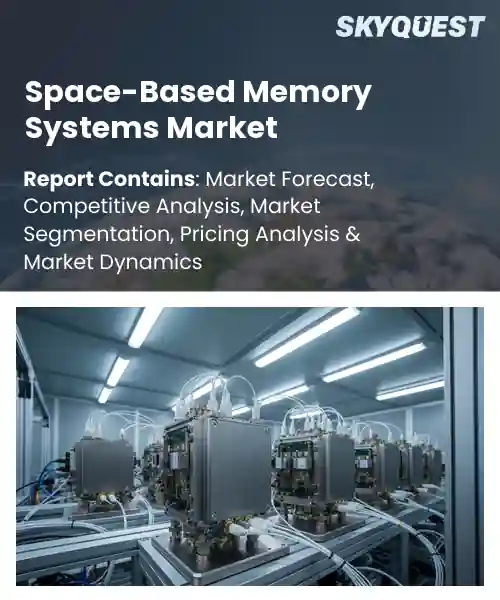
Space-Based Memory Systems Market
Report ID: SQMIG45O2200
Report ID: SQMIG45O2200
[email protected]
USA +1 351-333-4748
Report ID:
SQMIG45O2200 |
Region:
Global |
Published Date: August, 2026
Pages:
157
|Tables:
117
|Figures:
77


Global Space-Based Memory Systems Market size was valued at USD 4.82 Billion in 2024 and is poised to grow from USD 5.76 Billion in 2025 to USD 23.77 Billion by 2033, growing at a CAGR of 19.4% during the forecast period (2026-2033).
Space-based memory systems include the DRAM, NAND flash, and the next-gen non-volatile memory systems that are deployed in satellites, space probes, and stations. It is due to the fact that there has been an increase in data produced by Earth observation constellations, broadband LEO networks, and probes in space that need robust space-based memory for storage purposes between collection and transfer phases. The first key driver behind the growth of the global market is represented by the proliferation of satellite constellations, starting with the CubeSats launched in the early 2010s and continuing when the costs of commercial launch decreased. Currently, the 4 TB of payload in each Starlink satellite and the imagery of Planet on a daily basis show the development of the market from a defense niche to a commercial one.
As memory densities increase, more raw images and telemetry will be stored aboard satellites, lowering dependency on ground stations and allowing edge analytics like automatic collision avoidance. Such causal-effect relationships allow chances for defense organizations to gain low-latency reconnaissance, telecom companies to deploy in-orbit data centers, and interplanetary spacecraft to store weeks’ worth of readings before transmission back to Earth. The NASA Mars 2020 rover features a 64 GB radiation-resistant solid-state drive, while Starship from SpaceX is looking into petabytes of data storage for the Moon base mission.
How are AI and IoT Advancements Shaping the Space-based Memory Systems Market?
AI algorithms have also been integrated into the satellite controllers to predict memory aging and to optimize data routing before any errors happen. The IoT sensors attached to the satellites send data on the condition of the satellite so the power and the temperature can be regulated remotely from the ground stations to ensure constant monitoring and optimization. This technology allows the creation of the self-healing loop which will prolong the life cycle of the modules and reduce the costs associated with their replacement. In this way, the market will shift from the reactive approach to a proactive one, which will bring investments and encourage innovative solutions.
Market snapshot - (2026-2033)
Global Market Size
USD 4.82 Billion
Largest Segment
DRAM
Fastest Growth
MRAM
Growth Rate
19.4% CAGR
To get more insights on this market click here to Request a Free Sample Report
Global space-based memory systems market is segmented by memory type, radiation hardening, application, end user and region. Based on memory type, the market is segmented into SRAM, DRAM, Flash Memory and MRAM. Based on radiation hardening, the market is segmented into Radiation-Hardened and Radiation-Tolerant. Based on application, the market is segmented into Satellites, Spacecraft and Deep Space Missions. Based on end user, the market is segmented into Space Agencies, Defense and Commercial Space Companies. Based on region, the market is segmented into North America, Europe, Asia Pacific, Latin America and Middle East & Africa.
SRAM segment dominates because it delivers the fastest read and write speeds while consuming minimal power, qualities essential for onboard processors that operate under strict energy budgets. Its inherent volatility is mitigated by redundant architectures, allowing spacecraft to maintain data integrity during mission critical operations. Designers favor SRAM for its predictable timing and resistance to radiation induced errors, which together streamline system verification and reduce overall hardware complexity. Moreover, the deterministic performance of SRAM simplifies thermal management and enables tighter integration with flight computers, making it the preferred choice for navigation, attitude control, and payload data handling subsystems across a wide range of missions.
However, DRAM segment is emerging as the key high growth area in the space based memory systems market. Continued advancements in error correction and shielding technologies are expanding its suitability for larger capacity storage, while the push for higher resolution imaging and onboard processing drives demand for the larger memory footprints that DRAM uniquely provides.
The satellites segment represents the largest market due to the fact that most of the satellites use reliable memory for performing communication, earth observation, and navigation purposes. The constant launches of satellites ensure the high demand for memory, which is small in size and power consumption and which can withstand thermal and radiation cycles. Memory, which is reliable and lightweight, is needed in order to fulfill the agreement about services and to extend missions.
Nevertheless, the Deep Space Missions segment represents the market sector with the highest growth dynamics in the space based memory systems market. The need of radiation resistant memory for conducting exploration missions makes the manufacturers design special memory modules.
To get detailed segments analysis, Request a Free Sample Report
North America’s prominence stems from a confluence of deep technological expertise, mature satellite launch ecosystems, and robust government and private investment in advanced computing for space. Leading research universities generate pioneering work in radiation‑hard memory architectures, while major aerospace contractors integrate these solutions into high‑value payloads. A supportive regulatory framework accelerates commercial licensing, and venture capital channels fuel innovative startups that specialize in low‑latency, high‑capacity memory modules for satellite constellations. The United States benefits from entrenched defense programs that demand reliable, high‑performance storage, creating spill‑over effects for civilian applications. Canada contributes a growing talent pool and collaborative research parks that focus on low‑power, resilient memory designs, reinforcing the regional advantage. This blend of innovation, capital, and strategic policy underpins North America’s leadership.
US Space-based Memory Systems Market succeeds due to the existence of a dense ecosystem of defense organizations, NASA, and commercial space launches, which fuel a sustained requirement for high-performing and radiation-resilient memory solutions. Collaboration between the academic and business sector spurs the process of prototyping, and the entrepreneurial ecosystem is constantly pushing the limits with low-power and high-density memory technology. Continued investment in test laboratories further solidifies the reliability of such technology for use in orbit.
Space-Based Memory Systems Market in Canada is anchored by a collaborative research landscape that blends university expertise with emerging aerospace firms focused on resilient memory technologies. Government innovation grants nurture low‑power design strategies suited for small satellite constellies, while regional clusters encourage knowledge exchange across electronics and space disciplines. This supportive framework cultivates a pipeline of specialized talent that bolsters global supply chains for reliable memory solutions in orbit.
Rapid growth in Europe is driven by policy synergies, rich history of engineering, and sustainable space operation culture. EU initiatives foster collaboration between nations, thus facilitating common use of research facilities and development of memory hardware which is designed to be radiation tolerant. Clusters of industries in Germany, the UK, and France bring together the legacy aerospace engineering know-how and modern semiconductor research and create memory products for mega-constellations and scientific expeditions. Growing venture ecosystems in Europe ensure funding for specialized niche companies working on fast high-capacity storage technology. Furthermore, harmonization of regulations helps to minimize entry barriers into the market for both existing manufacturers and start-ups, thus ensuring large-scale production.
Space-Based Memory Systems Market in Germany benefits from a robust industrial base and a strong tradition of precision engineering. Leading automotive and aerospace suppliers extend their expertise to develop radiation‑tolerant memory modules, while research institutes collaborate on advanced packaging techniques that enhance reliability. Government‑backed innovation programs stimulate joint projects between universities and firms, accelerating the transition from prototype to flight‑qualified products. This ecosystem sustains Germany’s reputation as the dominant force within the European market.
Space-Based Memory Systems Market in the United Kingdom is characterized by a vibrant start‑up culture and aggressive commercialization of space technologies. Interdisciplinary hubs in Cambridge and London fuse AI research with memory chip design, producing low‑power, high‑throughput solutions for satellite constellations. Government incentives target rapid scaling of manufacturing capacity, while partnerships with launch service providers ensure immediate application of new memory products. This dynamic environment drives the fastest‑growing momentum across Europe.
Memory-Based Systems Market in Space for France has developed from the strategic development of aerospace clusters and niche semiconductor companies. Research partnerships between public research institutions and private companies target small size and energy-saving memory systems that can be used in CubeSats. Increased interest in modular and reconfigurable systems corresponds to the goals of France to be one of the leading suppliers for European space programs. Technology transfer will lead to greater participation of France in the general market.
Asia Pacific is bolstering its capabilities through utilization of high manufacturing capability, space programs of individual nations, and the emergence of private satellite firms. The expertise of Japan in materials science and precision engineering leads to extremely reliable memory units that satisfy all the requirements of launching missions. The proficiency of South Korea in semiconductors allows the creation of extremely dense low-power memory units that suit agile satellites. Collaboration mechanisms help in common testing and standardization processes while government support facilitates market entry for new players. It is through the marriage of world-class chip-making and space deployment plans that the region is becoming ripe for expansion of space-qualified memory units.
The Space-Based Memory Systems Market in Japan benefits from rich tradition of reliable electronic components and long history of experimentation in orbit. Joint ventures involving state research organizations and prominent semiconductor producers concentrate their efforts on technology that ensures extended life of memory in the severe space environment through radiation hardening. Flexibility of substrates allows creating new forms of satellites, whereas official space missions ensure stable demand for durable memory. Such combination preserves Japan as an important participant in regional memory innovation.
Space-Based Memory Systems Market in South Korea leverages its global leadership in semiconductor fabrication to produce ultra‑dense, power‑efficient memory suited for next‑generation satellite constellations. Domestic launch providers and commercial operators create a ready market for cutting‑edge storage that can handle high data throughput. Joint ventures between academia and industry accelerate the commercialization of novel memory architectures, while national policy incentives encourage rapid scaling of production facilities. This proactive ecosystem positions South Korea as an accelerating force within the Asia Pacific landscape.
To know more about the market opportunities by region and country, click here to
Buy The Complete Report
Increasing Satellite Data Demand
Advancements in Radiation Hardened Memory
High Launch Cost Barriers
Regulatory and Spectrum Allocation Uncertainty
Request Free Customization of this report to help us to meet your business objectives.
The competitive environment is formed by aggressive M&A deals, strategic collaboration with satellite producers, as well as rapid development of technology for launch cost cutting and orbital data storage capability increase; examples of this include a merger of two companies that deal with re-usable launches and have expertise in propulsion and cooperation between a satellite imaging producer and a company producing memory modules for embedding into satellites.
SkyQuest’s ABIRAW (Advanced Business Intelligence, Research & Analysis Wing) is our Business Information Services team that Collects, Collates, Correlates, and Analyses the Data collected by means of Primary Exploratory Research backed by robust Secondary Desk research.
As per SkyQuest analysis, the growth of the global space-based memory systems market can be attributed to the rising demand for satellite data that makes the space companies opt for bigger and faster onboard memories. Apart from this, another factor influencing this market is the innovations taking place in the area of radiation-tolerant memories, providing better density at lower power and weight. One of the factors restraining the growth of this market is the cost involved in the process of launch that keeps the weight of the payload low and restricts the investment in advanced modules. North America is one of the leading markets due to the advanced technology infrastructure and launches carried out by government and private companies in this region. SRAM takes the lead in terms of segment hierarchy.
| Report Metric | Details |
|---|---|
| Market size value in 2024 | USD 4.82 Billion |
| Market size value in 2033 | USD 23.77 Billion |
| Growth Rate | 19.4% |
| Base year | 2024 |
| Forecast period | (2026-2033) |
| Forecast Unit (Value) | USD Billion |
| Segments covered |
|
| Regions covered | North America (US, Canada), Europe (Germany, France, United Kingdom, Italy, Spain, Rest of Europe), Asia Pacific (China, India, Japan, Rest of Asia-Pacific), Latin America (Brazil, Rest of Latin America), Middle East & Africa (South Africa, GCC Countries, Rest of MEA) |
| Companies covered |
|
| Customization scope | Free report customization with purchase. Customization includes:-
|
To get a free trial access to our platform which is a one stop solution for all your data requirements for quicker decision making. This platform allows you to compare markets, competitors who are prominent in the market, and mega trends that are influencing the dynamics in the market. Also, get access to detailed SkyQuest exclusive matrix.
Table Of Content
Executive Summary
Market overview
Parent Market Analysis
Market overview
Market size
KEY MARKET INSIGHTS
COVID IMPACT
MARKET DYNAMICS & OUTLOOK
Market Size by Region
KEY COMPANY PROFILES
Methodology
For the Space-Based Memory Systems Market, our research methodology involved a mixture of primary and secondary data sources. Key steps involved in the research process are listed below:
1. Information Procurement: This stage involved the procurement of Market data or related information via primary and secondary sources. The various secondary sources used included various company websites, annual reports, trade databases, and paid databases such as Hoover's, Bloomberg Business, Factiva, and Avention. Our team did 45 primary interactions Globally which included several stakeholders such as manufacturers, customers, key opinion leaders, etc. Overall, information procurement was one of the most extensive stages in our research process.
2. Information Analysis: This step involved triangulation of data through bottom-up and top-down approaches to estimate and validate the total size and future estimate of the Space-Based Memory Systems Market.
3. Report Formulation: The final step entailed the placement of data points in appropriate Market spaces in an attempt to deduce viable conclusions.
4. Validation & Publishing: Validation is the most important step in the process. Validation & re-validation via an intricately designed process helped us finalize data points to be used for final calculations. The final Market estimates and forecasts were then aligned and sent to our panel of industry experts for validation of data. Once the validation was done the report was sent to our Quality Assurance team to ensure adherence to style guides, consistency & design.
Analyst Support
Customization Options
With the given market data, our dedicated team of analysts can offer you the following customization options are available for the Space-Based Memory Systems Market:
Product Analysis: Product matrix, which offers a detailed comparison of the product portfolio of companies.
Regional Analysis: Further analysis of the Space-Based Memory Systems Market for additional countries.
Competitive Analysis: Detailed analysis and profiling of additional Market players & comparative analysis of competitive products.
Go to Market Strategy: Find the high-growth channels to invest your marketing efforts and increase your customer base.
Innovation Mapping: Identify racial solutions and innovation, connected to deep ecosystems of innovators, start-ups, academics, and strategic partners.
Category Intelligence: Customized intelligence that is relevant to their supply Markets will enable them to make smarter sourcing decisions and improve their category management.
Public Company Transcript Analysis: To improve the investment performance by generating new alpha and making better-informed decisions.
Social Media Listening: To analyze the conversations and trends happening not just around your brand, but around your industry as a whole, and use those insights to make better Marketing decisions.
REQUEST FOR SAMPLE
 REQUEST FREE CUSTOMIZATION
Global Space-Based Memory Systems Market size was valued at USD 4.82 Billion in 2024 and is poised to grow from USD 5.76 Billion in 2025 to USD 23.77 Billion by 2033, growing at a CAGR of 19.4% during the forecast period (2026-2033).
The competitive landscape is shaped by aggressive M&A activity, strategic partnerships with satellite operators, and rapid tech innovation aimed at reducing launch costs and enabling high‑capacity data storage in orbit; recent examples include a merger between two reusable‑launch firms to consolidate propulsion expertise and a joint venture between a satellite‑imaging company and a memory‑module developer to integrate on‑board storage solutions, accelerating market entry and differentiation. 'BAE Systems plc', 'Microchip Technology Incorporated', 'Infineon Technologies AG', 'STMicroelectronics N.V.', 'Renesas Electronics Corporation', 'Texas Instruments Incorporated', 'Honeywell International Inc.', 'Cobham Advanced Electronic Solutions', 'Teledyne Technologies Incorporated', '3D PLUS', 'Micross Components, Inc.', 'Avalanche Technology, Inc.', 'RAMXEED Limited', 'GSI Technology, Inc.', 'Alliance Memory, Inc.', 'NanoXplore Inc.', 'NVIDIA Corporation', 'L3Harris Technologies, Inc.', 'Northrop Grumman Corporation', 'CAES Systems LLC'
Growing demand for real‑time high‑resolution imagery and scientific observations is prompting satellite operators to seek larger, faster storage solutions, thereby fueling the adoption of space‑based memory systems. As missions expand in complexity, the need for reliable on‑board data retention becomes critical, encouraging manufacturers to innovate in capacity and durability. This demand drives investment in research and development, accelerates product launches, and creates a feedback loop where enhanced memory capabilities enable more ambitious satellite applications, further reinforcing market growth global sector.
Electronic Memory Integration: Satellite operators are increasingly embedding high‑density memory modules into each spacecraft, enabling on‑board data buffering and rapid processing before downlink. This shift reduces latency for time‑critical applications such as Earth observation and defense surveillance, while also mitigating bandwidth constraints. Manufacturers are tailoring radiation‑hardened, low‑power memory solutions to fit modular bus architectures, fostering a new ecosystem where memory performance becomes a differentiator for constellation providers seeking competitive edge in data‑rich services and expanding commercial partnerships across aerospace, telecom, and analytics sectors.
Why does North America Dominate the Global Space-Based Memory Systems Market? |@12


Want to customize this report? This report can be personalized according to your needs. Our analysts and industry experts will work directly with you to understand your requirements and provide you with customized data in a short amount of time. We offer $1000 worth of FREE customization at the time of purchase.
Feedback From Our Clients


 USA (+1) 351-333-4748

