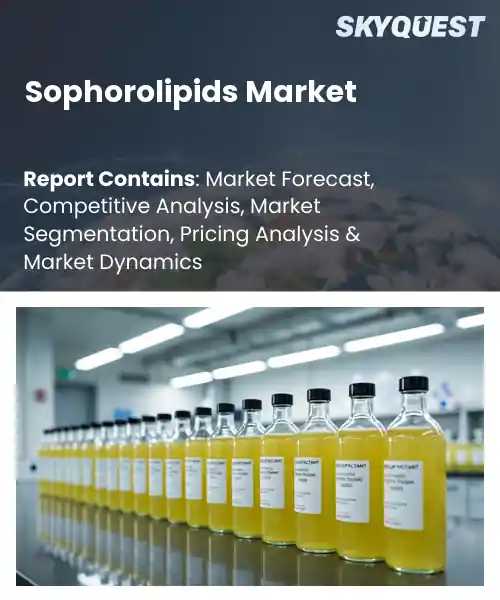
Sophorolipids Market
Report ID: SQMIG15E3887
Report ID: SQMIG15E3887
[email protected]
USA +1 351-333-4748
Report ID:
SQMIG15E3887 |
Region:
Global |
Published Date: July, 2026
Pages:
157
|Tables:
177
|Figures:
79


Global Sophorolipids Market size was valued at USD 523.49 Million in 2024 and is poised to grow from USD 550.71 Million in 2025 to USD 826.13 Million by 2033, growing at a CAGR of 5.2% during the forecast period (2026-2033).
The global sophorolipids market includes biologically derived surfactants produced by yeast that replace petroleum-based chemicals in cleaning, cosmetics and agriculture. It is important due to the increasing demand for low toxicity biodegradable ingredients that comply with the stringent environmental regulations worldwide. This is largely due to the increasing awareness of plastic pollution among consumers, which has forced manufacturers to opt for greener alternatives. In the early 2000s, the market was still niche, confined to specialty cleaners but the launch of eco-friendly laundry detergents by the majors in 2015 accelerated adoption. Biotech companies’ collaborations with multinational fast-moving consumer goods (FMCG) firms have since turned sophorolipids from laboratory curiosities to ubiquitous commodities worldwide. Another major driver in the sophorolipids market is the growing number of end‑use applications that provide real growth opportunities.
The emulsifying power and acute biodegradability of sophorolipids are leading to their adoption by personal care and oil field manufacturers, directly reducing disposal costs and enabling brand sustainability narratives, as regulatory restrictions on synthetic surfactants increase. One example is a major cosmetics chain replacing petrochemical foams with sophorolipid-based textures, cutting water-based waste by 30%. This cause-effect chain control leads to replacement and cost savings that drive broader use and stimulate funding of large-scale fermentation facilities, thereby boosting supply capacity and enhancing global market dynamics among industry players.
How is AI-driven Process Automation Influencing Cost Efficiency In The Sophorolipids Market?
Real-time data is being combined with the production controls, and AI-enabled process automation is changing the sophorolipid value chain. Machine learning models predict the best conditions for fermentation to cut down the trial-and-error cycle and energy consumption. Integrated sensors monitor substrate use and product purity, allowing immediate adjustments for high yields and low waste streams. “The digital overlay reduces batch times and allows skilled operators to focus on higher value tasks, resulting in a leaner operation that aligns with sustainability goals.
This leads to a more predictable cost structure, which in turn will allow for wider adoption of sophorolipids for personal care and industrial applications. Novozymes introduced an AI-enhanced fermentation platform in June 2024 that demonstrates how automated process insights can reduce production costs and accelerate growth to market.
Market snapshot - (2026-2033)
Global Market Size
USD 523.49 Million
Largest Segment
Lactonic Sophorolipids
Fastest Growth
Acidic Sophorolipids
Growth Rate
5.2% CAGR
To get more insights on this market click here to Request a Free Sample Report
Global sophorolipids market is segmented by type, source, form, application, end user industry, distribution channel and region. Based on type, the market is segmented into Lactonic Sophorolipids and Acidic Sophorolipids. Based on source, the market is segmented into Yeast-Derived Sophorolipids, Plant Oil-Based Sophorolipids, Waste Feedstock-Based Sophorolipids and Others. Based on form, the market is segmented into Liquid, Powder and Paste. Based on application, the market is segmented into Household Detergents & Cleaners, Personal Care & Cosmetics, Agriculture, Food & Beverage Processing, Oilfield Chemicals, Pharmaceuticals and Others. Based on end user industry, the market is segmented into Home Care Industry, Personal Care & Cosmetics Industry, Agriculture Industry, Food & Beverage Industry, Pharmaceutical Industry and Others. Based on distribution channel, the market is segmented into Direct Sales and Distributors & Traders. Based on region, the market is segmented into North America, Europe, Asia Pacific, Latin America and Middle East & Africa.
The lactonic sophorolipid fraction dominates, because it has the highest surface activity and the lowest critical micelle concentration, giving the best cleaning ability and yet being biodegradable. This chemical profile fits with the consumer demand for effective and environmentally friendly surfactants and it forms a priority for formulators in detergents and personal care. It also provides manufacturers with stability in a wide pH range, which makes formulation easier, and requires less additives, further establishing its position in the market.
However, the Acidic Sophorolipids segment is witnessing the strongest growth momentum owing to their increased solubility in aqueous systems, which enables better application in oilfield chemicals and agricultural formulations. Innovative blending techniques are unlocking new performance attributes, attracting producers seeking multifunctional surfactants, and driving market growth through new use cases.
The Sophorolipids segment from yeast is dominant due to well-established microbial production pathways that ensure consistent yields and high purity, meeting stringent quality standards in a wide range of applications. The familiar nature of fermentation processes reduces operational risk, while scalable bioreactors allow cost-effective manufacturing at large volumes, furthering its preferred position among formulators and boosting market confidence. Moreover, the capacity to adjust metabolic pathways enables producers to customize fatty acid profiles, improving functionality in cosmetics and pharmaceuticals, cementing its leadership.
On the other hand, the Waste Feedstock Based Sophorolipids segment is expected to be the major high growth area because of the circular economy incentives promoting the valorization of agricultural residues into value added surfactants. Companies are using low cost feedstocks and green chemistry to reduce production costs, attracting brands and creating new opportunities in sustainable packaging, leading to rapid market growth.
To get detailed segments analysis, Request a Free Sample Report
Asia Pacific is the leading region in the global sophorolipids market, due to the combination of advanced bioprocessing technology, government support for sustainable chemicals, and a mature consumer base that favors ecological solutions. The region is a hub of a dense network of research institutions and industrial clusters catalysing product innovation and scale-up. Biotech startups that partner with big consumer product makers can build a pipeline of applications in areas such as cosmetics, detergents and food ingredients. Additionally, supportive regulatory frameworks lower market entry hurdles, and growing corporate commitments to green supply chains increase demand. Investment in renewable bio-based projects continues, with capacity build-out in the region ongoing.
Japan’s sophorolipids market is driven by a solid tradition of precision manufacturing and a regulatory environment conducive to bio-based alternatives. Sophorolipids are actively included in personal care lines by leading consumer product companies and academic-industrial consortia encourage research on novel functional properties. The existence of well-established lipid fermentation facilities allows for rapid scale-up, strengthening Japan’s position as a key hub for high-value applications and supporting export of technology to neighboring markets.
South Korea Sophorolipids Market is fuelled by investments in green chemistry and a policy framework that promotes bio-based surfactants. Conglomerates are adding sophorolipids to cleaning and personal care products to satisfy consumer demand for sustainable alternatives. Research centers link universities with biotech companies, speeding up the discovery of custom lipid structures. South Korea’s manufacturing infrastructure and export-oriented strategies position it as an emerging leader in the regional sophorolipids supply chain.
The European sophorolipids market expands rapidly due to stringent environmental regulations, heightened consumer awareness of green ingredients, and strong collaborative networks among research institutes and chemical manufacturers. Policies that restrict conventional petrochemical surfactants create a clear impetus for bio‑based replacements, while major retailers demand certified sustainable labels. Cross‑border initiatives foster knowledge sharing, accelerating formulation breakthroughs for cosmetics, food preservation and industrial cleaning. Investment in scalable fermentation facilities is supported by a mature venture ecosystem, enabling companies to move from pilot to commercial production. Together these forces generate a fertile environment where innovation and market adoption reinforce each other, positioning Europe as a dynamic hub for sophorolipids growth. Industry associations also coordinate standards development, further building consumer confidence and facilitating cross‑regional trade.
Sophorolipids Market in Germany is anchored by a robust chemical sector that embraces bio‑based transformation. Leading manufacturers incorporate sophorolipids into detergent and personal care formulations to comply with eco‑labeling standards. Government-funded research programs focus on optimizing yeast production pathways, enhancing cost competitiveness. Strong logistics networks and proximity to key consumer markets accelerate product rollout. The convergence of industrial expertise and sustainability mandates makes Germany a cornerstone of European sophorolipids activity.
Sophorolipids Market in the United Kingdom accelerates through start‑up ecosystems and strong demand from personal care brands. Tax incentives for green chemistry encourage newcomers to develop sophorolipid grades. Collaborative platforms link academic labs with industry, driving prototyping of applications in cleaning and textile sectors. Consumer preference for ingredients expands retail shelf space, while export initiatives push UK‑origin sophorolipids into European markets. This synergy fuels fastest significant expansion pace within continent.
Sophorolipids Market in France is emerging as a niche hub driven by strong academic research and government incentives for bio‑based innovation. Collaborative clusters bring together food scientists and cosmetic formulators to test sophorolipids as natural emulsifiers. Early adoption by boutique brands highlights consumer appetite for environmentally friendly ingredients. Funding programs support scale‑up of pilot plants, enabling France to transition from experimental use to broader commercial supply in the domestic market.
North America reinforces its sophorolipids position through a blend of strong research funding, growing corporate sustainability agendas, and an agile consumer goods sector that swiftly incorporates bio‑based surfactants. Federal and state programs encourage low‑carbon chemistry, providing grants that de‑risk large‑scale fermentation projects. Leading retailers demand verified green ingredients, prompting suppliers to develop high‑purity sophorolipid grades compatible with existing formulations. Partnerships between universities and specialty chemical firms accelerate downstream processing improvements, while venture capital flows nurture a pipeline of innovative start‑ups. This ecosystem of policy support, market demand and technological advancement converts North America into a pivotal arena for sophorolipids commercialization and export. Collaborative consortia also focus on lifecycle assessment, ensuring that product development aligns with broader environmental objectives and enhances market credibility.
Sophorolipids Market in the United States benefits from extensive biotech infrastructure and a consumer culture that prizes natural cleaning solutions. Major detergent manufacturers experiment with sophorolipids to reduce ecological footprints, while food processors explore them as biodegradable preservatives. Federal research initiatives fund enzyme engineering to boost production yields. Robust venture ecosystems back start‑ups focused on niche applications, creating a dynamic pipeline that expands market reach across multiple industries globally today.
Sophorolipids Market in Canada leverages a energy agenda and grants to advance bio‑surfactant production. Provincial programs incentivize the establishment of fermentation facilities, attracting companies seeking manufacturing routes. Collaboration between agricultural research centres and chemical firms taps into renewable feedstocks, enhancing sustainability credentials. Consumer interest in household products drives demand, while export partnerships open pathways to European and Asian markets, positioning Canada as a growing contributor to the sophorolipids supply chain.
To know more about the market opportunities by region and country, click here to
Buy The Complete Report
Increasing Demand for Green Surfactants
Regulatory Push Toward Biodegradables
High Production Cost Compared
Limited Awareness Among End Users
Request Free Customization of this report to help us to meet your business objectives.
The competitive landscape of the global sophorolipids market is shaped by active M&A activity, strategic partnerships, and rapid technology innovation. Recent acquisitions have enabled firms to broaden their biosurfactant portfolios, while collaborations with specialty chemical manufacturers accelerate product development and market penetration. Companies are investing in advanced fermentation processes and renewable feedstock sourcing to differentiate their offerings and meet growing demand for sustainable surfactants.
SkyQuest’s ABIRAW (Advanced Business Intelligence, Research & Analysis Wing) is our Business Information Services team that Collects, Collates, Correlates, and Analyses the Data collected by means of Primary Exploratory Research backed by robust Secondary Desk research.
As per SkyQuest analysis, the global sophorolipids market is being propelled primarily by the rising demand for green surfactants as manufacturers seek biodegradable alternatives that match performance, while a second strong catalyst is the tightening regulatory landscape that mandates higher biodegradability and offers incentives for bio‑based ingredients. The market’s fastest growth is seen in Asia Pacific, where advanced bioprocessing capabilities and supportive policies drive adoption. Within product types, lactonic sophorolipids dominate due to their superior surface activity and formulation stability. However, high production costs remain a notable restraint, limiting broader uptake until economies of scale and cost‑effective feedstocks become widespread.
| Report Metric | Details |
|---|---|
| Market size value in 2024 | USD 523.49 Million |
| Market size value in 2033 | USD 826.13 Million |
| Growth Rate | 5.2% |
| Base year | 2024 |
| Forecast period | (2026-2033) |
| Forecast Unit (Value) | USD Million |
| Segments covered |
|
| Regions covered | North America (US, Canada), Europe (Germany, France, United Kingdom, Italy, Spain, Rest of Europe), Asia Pacific (China, India, Japan, Rest of Asia-Pacific), Latin America (Brazil, Rest of Latin America), Middle East & Africa (South Africa, GCC Countries, Rest of MEA) |
| Companies covered |
|
| Customization scope | Free report customization with purchase. Customization includes:-
|
To get a free trial access to our platform which is a one stop solution for all your data requirements for quicker decision making. This platform allows you to compare markets, competitors who are prominent in the market, and mega trends that are influencing the dynamics in the market. Also, get access to detailed SkyQuest exclusive matrix.
Table Of Content
Executive Summary
Market overview
Parent Market Analysis
Market overview
Market size
KEY MARKET INSIGHTS
COVID IMPACT
MARKET DYNAMICS & OUTLOOK
Market Size by Region
KEY COMPANY PROFILES
Methodology
For the Sophorolipids Market, our research methodology involved a mixture of primary and secondary data sources. Key steps involved in the research process are listed below:
1. Information Procurement: This stage involved the procurement of Market data or related information via primary and secondary sources. The various secondary sources used included various company websites, annual reports, trade databases, and paid databases such as Hoover's, Bloomberg Business, Factiva, and Avention. Our team did 45 primary interactions Globally which included several stakeholders such as manufacturers, customers, key opinion leaders, etc. Overall, information procurement was one of the most extensive stages in our research process.
2. Information Analysis: This step involved triangulation of data through bottom-up and top-down approaches to estimate and validate the total size and future estimate of the Sophorolipids Market.
3. Report Formulation: The final step entailed the placement of data points in appropriate Market spaces in an attempt to deduce viable conclusions.
4. Validation & Publishing: Validation is the most important step in the process. Validation & re-validation via an intricately designed process helped us finalize data points to be used for final calculations. The final Market estimates and forecasts were then aligned and sent to our panel of industry experts for validation of data. Once the validation was done the report was sent to our Quality Assurance team to ensure adherence to style guides, consistency & design.
Analyst Support
Customization Options
With the given market data, our dedicated team of analysts can offer you the following customization options are available for the Sophorolipids Market:
Product Analysis: Product matrix, which offers a detailed comparison of the product portfolio of companies.
Regional Analysis: Further analysis of the Sophorolipids Market for additional countries.
Competitive Analysis: Detailed analysis and profiling of additional Market players & comparative analysis of competitive products.
Go to Market Strategy: Find the high-growth channels to invest your marketing efforts and increase your customer base.
Innovation Mapping: Identify racial solutions and innovation, connected to deep ecosystems of innovators, start-ups, academics, and strategic partners.
Category Intelligence: Customized intelligence that is relevant to their supply Markets will enable them to make smarter sourcing decisions and improve their category management.
Public Company Transcript Analysis: To improve the investment performance by generating new alpha and making better-informed decisions.
Social Media Listening: To analyze the conversations and trends happening not just around your brand, but around your industry as a whole, and use those insights to make better Marketing decisions.
REQUEST FOR SAMPLE
 REQUEST FREE CUSTOMIZATION
Global Sophorolipids Market size was valued at USD 523.49 Million in 2024 and is poised to grow from USD 550.71 Million in 2025 to USD 826.13 Million by 2033, growing at a CAGR of 5.2% during the forecast period (2026-2033).
The competitive landscape of the global sophorolipids market is shaped by active M&A activity, strategic partnerships, and rapid technology innovation. Recent acquisitions have enabled firms to broaden their biosurfactant portfolios, while collaborations with specialty chemical manufacturers accelerate product development and market penetration. Companies are investing in advanced fermentation processes and renewable feedstock sourcing to differentiate their offerings and meet growing demand for sustainable surfactants. 'Evonik Industries AG', 'Saraya Co., Ltd.', 'Holiferm Limited', 'Allied Carbon Solutions Co., Ltd.', 'Jeneil Biotech, Inc.', 'Givaudan Active Beauty', 'Soliance S.A.S.', 'Locus Performance Ingredients', 'Deguan Biosurfactant Supplier', 'Agae Technologies, LLC', 'Stearinerie Dubois', 'Biotensidon GmbH', 'Ecoverde S.A.', 'AmphiStar NV', 'Kaneka Corporation', 'SyntheZyme LLC', 'TeeGene Biotech Co., Ltd.', 'Toyobo Co., Ltd.', 'Sino Lion (USA) Ltd.', 'MG Intobio Co., Ltd.'
Consumers and manufacturers are shifting toward environmentally responsible ingredients, and sophorolipids offer comparable performance with reduced ecological impact, encouraging formulation scientists to replace petroleum‑based surfactants. This transition is driven by corporate sustainability pledges and consumer preference for biodegradable products, creating a reinforcing loop where market acceptance fuels further research and product diversification, thereby expanding the overall market opportunity. Additionally, the lower toxicity profile of sophorolipids facilitates compliance with stringent safety standards across personal care, food, and industrial applications, further enhancing their attractiveness to brand owners seeking risk‑averse solutions.
Sustainable Ingredient Preference: Consumers and manufacturers are increasingly prioritizing environmentally friendly surfactants, positioning sophorolipids as a preferred alternative to petro‑based counterparts. Their biodegradability, low toxicity, and renewable origin align with corporate sustainability pledges and green branding strategies. As retailers demand cleaner product formulations, formulators are integrating sophorolipids across personal care, household, and industrial applications. This shift is accelerating collaborative R&D initiatives that enhance functional performance while maintaining ecological credentials, thereby expanding market acceptance and driving steady demand growth through global supply chain integration.
Why does Asia Pacific Dominate the Global Sophorolipids Market? |@12


Want to customize this report? This report can be personalized according to your needs. Our analysts and industry experts will work directly with you to understand your requirements and provide you with customized data in a short amount of time. We offer $1000 worth of FREE customization at the time of purchase.
Feedback From Our Clients


 USA (+1) 351-333-4748

