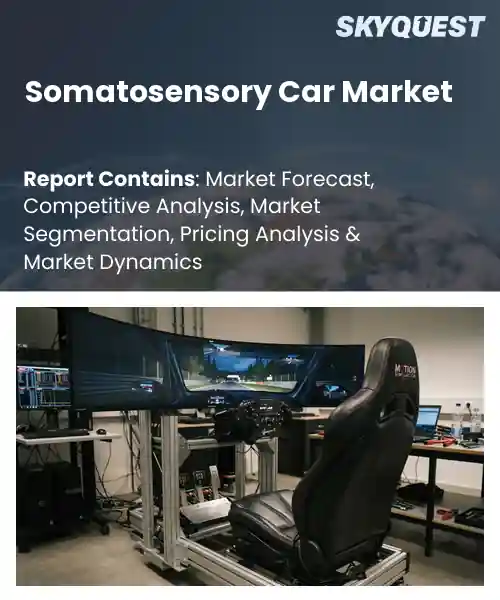
Somatosensory Car Market
Report ID: SQMIG25J2373
Report ID: SQMIG25J2373
[email protected]
USA +1 351-333-4748
Report ID:
SQMIG25J2373 |
Region:
Global |
Published Date: October, 2026
Pages:
157
|Tables:
148
|Figures:
78


Global Somatosensory Car Market size was valued at USD 125.0 Million in 2024 and is poised to grow from USD 141.0 Million in 2025 to USD 369.57 Million by 2033, growing at a CAGR of 12.8% during the forecast period (2026-2033).
The primary engine of the somatosensory car market is the escalating demand for immersive driver‑vehicle interaction, a trend propelled by advances in haptic feedback, pressure sensors, and neural‑interface technologies. This market encompasses vehicles equipped with systems that translate tactile cues into actionable information, enhancing safety, comfort, and autonomous‑driving confidence. It matters because tactile perception reduces reliance on visual overload, a factor in accident mitigation. Historically, prototypes in the 2010s employed simple vibration alerts; by 2020, manufacturers such as Tesla and Mercedes integrated actuators that simulate road texture. These milestones illustrate a steady evolution from basic alerts to sophisticated feedback loops. The second pivotal factor driving global expansion is the convergence of autonomous‑driving systems with somatosensory feedback, which creates a feedback loop that improves algorithmic precision and passenger trust. As vehicles relinquish visual cues, haptic seats and steering wheels convey lane‑keeping status, enabling the AI to calibrate corrective actions based on real‑time body responses. For example, Waymo’s test fleet incorporates pressure‑mapping cushions that trigger micro‑vibrations when the vehicle deviates from its planned trajectory, prompting driver awareness and reducing disengagement rates. This cause‑and‑effect relationship spurs investment from suppliers, accelerates standard‑setting by regulatory bodies, and opens opportunities for aftermarket retrofits across legacy fleets.
How is AI enhancing somatosensory technology in the automotive market?
AI is reshaping somatosensory technology in cars by turning touch and vibration cues into intelligent signals. The core aspects include tactile feedback, pressure sensing and adaptive vibration that respond to driver intent and road conditions. Today manufacturers embed AI models that interpret sensor data and adjust haptic alerts in real time. This creates a more intuitive interface and reduces driver distraction. The market sees growing interest as automakers seek to blend safety with comfort. Examples include AI powered steering wheel buzz that warns of lane drift and seat cushions that vibrate to signal navigation prompts. The trend is driving broader adoption across luxury and mainstream segments.Toyota introduced its AI enhanced haptic steering system in June 2024, delivering real time tactile cues that guide steering inputs and improve situational awareness. The rollout illustrates how AI driven somatosensory feedback can accelerate market growth by offering safer, more engaging driving experiences for everyday drivers and premium models alike.
Market snapshot - (2026-2033)
Global Market Size
USD 125.0 Million
Largest Segment
Haptic Feedback Systems
Fastest Growth
Pressure-Sensing Systems
Growth Rate
12.8% CAGR
To get more insights on this market click here to Request a Free Sample Report
Global somatosensory car market is segmented by system type, component, application, vehicle type, end user and region. Based on system type, the market is segmented into Tactile Feedback Systems, Haptic Feedback Systems, Pressure-Sensing Systems and Touch-Sensitive Control Systems. Based on component, the market is segmented into Sensors, Haptic Actuators, Control Units and Software & Interfaces. Based on application, the market is segmented into In-Vehicle Infotainment, Touchscreen & Control Panels, Driver Monitoring & Safety, Seat & Cabin Interaction and Other Applications. Based on vehicle type, the market is segmented into Passenger Cars, Light Commercial Vehicles and Heavy Commercial Vehicles. Based on end user, the market is segmented into Automotive OEMs, Automotive Tier-1 Suppliers and Aftermarket. Based on region, the market is segmented into North America, Europe, Asia Pacific, Latin America and Middle East & Africa.
In‑Vehicle Infotainment segment dominates because manufacturers view tactile and haptic interaction as a core differentiator for the user experience. The convergence of entertainment, navigation, and voice control creates a natural platform for embedding somatosensory feedback, encouraging consumers to expect responsive touch surfaces. This demand drives extensive OEM investment, accelerates component integration, and aligns with safety regulations that favor hands‑free operation, solidifying its leadership in the market within the overall vehicle ecosystem.
However, Driver Monitoring & Safety emerges as the most rapidly expanding area because regulations require occupant awareness and advanced alerts. Integrated pressure‑sensing seats and haptic cues enable fatigue detection, prompting broader adoption across vehicle classes. This momentum fuels partnerships and drives market expansion by tying safety performance directly to somatosensory technology.
Sensors segment dominates because they form the foundational data layer that enables any somatosensory experience in modern vehicles. Precise detection of touch, pressure, and motion drives the reliability of haptic feedback and safety functions, making OEMs prioritize sensor integration early in the design cycle. Continuous advances in miniaturization and multimodal sensing enhance vehicle ergonomics, while cost reductions encourage widespread deployment across all vehicle classes, reinforcing the sensors’ central market position.
Meanwhile, Software & Interfaces witnesses the strongest growth momentum because developers are creating algorithms that translate raw sensor data into intuitive tactile cues. APIs and updates let manufacturers refine user interactions, expanding application possibilities beyond infotainment to climate control. This capability accelerates market expansion by unlocking revenue streams and fostering ecosystem partnerships.
To get detailed segments analysis, Request a Free Sample Report
North America retains a pre‑eminent position due to an ecosystem that blends deep automotive heritage with cutting‑edge technology development. The region benefits from a concentration of legacy manufacturers that have embraced advanced sensing and haptic feedback as core elements of next‑generation vehicles. A robust network of research universities and specialized suppliers fuels continuous innovation, while a regulatory framework that encourages safety‑enhancing features accelerates market acceptance. High consumer expectations for seamless digital experiences further motivate automakers to integrate somatosensory solutions. Strong venture capital presence and strategic partnerships with Silicon Valley firms ensure rapid translation of breakthrough concepts into production‑ready systems, reinforcing the region’s leadership.
Somatosensory Car Market in the United States thrives on a synergy between established automakers and a vibrant tech startup community. Collaborative programs between automotive giants and software innovators accelerate the development of tactile feedback interfaces and body‑wide sensor networks. Consumer demand for immersive driving experiences drives manufacturers to prioritize intuitive haptic controls, while substantial investment in research accelerates prototype validation and scale‑up. The presence of major battery and electronics hubs further supports integration of somatosensory components across vehicle platforms.
Somatosensory Car Market in Canada leverages strong governmental support for clean mobility and a robust research ecosystem anchored by leading universities. Partnerships between automotive firms and local technology incubators focus on developing haptic feedback solutions tailored to cold‑climate performance. The emphasis on cross‑border collaboration with United States partners enhances supply chain resilience and facilitates technology transfer. Growing consumer awareness of safety and comfort fuels market interest, while incentive programs encourage early adoption of advanced sensory systems in both passenger and commercial vehicles.
Europe’s expansion is propelled by rigorous safety standards that mandate increasingly sophisticated driver‑assistance technologies, creating a fertile ground for somatosensory innovation. The continent’s deep engineering culture and concentration of premium automakers encourage integration of tactile and proprioceptive feedback to elevate vehicle dynamics and occupant comfort. Collaborative research initiatives funded by the European Union foster cross‑border knowledge exchange, while a strong emphasis on sustainability aligns sensor development with electrified powertrains. Consumer expectations for high‑touch luxury experiences further motivate manufacturers to differentiate through advanced haptic interfaces. The combined effect of regulatory pressure, engineering excellence, and market demand accelerates adoption across the region.
Somatosensory Car Market in Germany is anchored by a legacy of precision engineering and a dense network of tier‑one suppliers. Automation leaders collaborate closely with automotive manufacturers to embed tactile feedback mechanisms within chassis and interior systems. The country’s focus on high‑performance vehicle dynamics drives the refinement of sensor accuracy and real‑time response. Strong vocational training programs ensure a skilled workforce capable of supporting complex integration projects, while ongoing collaboration with research institutes sustains a pipeline of cutting‑edge somatosensory technologies.
Somatosensory Car Market in the United Kingdom benefits from a dynamic startup ecosystem centered around automotive software and sensor innovation. Government initiatives encourage the development of advanced haptic feedback solutions, accelerating deployment in both mass‑market and premium segments. Close ties between universities and industry accelerate prototyping and testing of body‑wide sensory networks. A growing focus on connected vehicle platforms creates demand for immersive driver interfaces, positioning the United Kingdom as a fast‑moving hub for somatosensory advancement.
Somatosensory Car Market in France is emerging through a blend of governmental policy supporting electric mobility and a flourishing design culture focused on driver experience. Automotive groups collaborate with French research laboratories to integrate tactile feedback that complements autonomous driving functions. Consumer interest in refined cabin ambience drives experimentation with haptic seat and steering solutions. Incentive frameworks that promote low‑emission vehicles encourage manufacturers to incorporate advanced sensory technologies as part of holistic vehicle electrification strategies.
Asia Pacific advances its role by capitalizing on world‑class manufacturing capacity combined with rapid adoption of smart mobility concepts. The region’s leading electronics and robotics industries supply high‑precision sensors and actuators essential for somatosensory applications. Governmental visions for connected and autonomous transportation create supportive policy environments that encourage investment in tactile feedback research. Close collaboration between automakers and semiconductor firms facilitates seamless integration of body‑wide sensor arrays into vehicle architectures. Growing urbanization and consumer appetite for technologically enhanced driving experiences further push manufacturers to prioritize somatosensory solutions as differentiators in competitive markets.
Somatosensory Car Market in Japan draws on a long tradition of automotive excellence and advanced robotics expertise. Domestic manufacturers emphasize the development of high‑resolution tactile interfaces that enhance driver control and safety. Collaborative research programs between automakers and sensor specialists focus on improving haptic fidelity and reducing latency. The integration of precision engineering with emerging AI-driven perception systems positions Japan as a catalyst for reliable and intuitive somatosensory vehicle experiences.
Somatosensory Car Market in South Korea is propelled by its dominance in consumer electronics and battery technology, providing a strong foundation for integrated vehicle sensing solutions. Automakers partner with leading chipset producers to embed sophisticated haptic feedback into steering, seating, and control panels. Government support for smart vehicle initiatives accelerates the rollout of body‑wide sensory networks. The rapid consumer acceptance of high‑tech features in everyday transportation fuels continued investment in somatosensory development across the Korean automotive sector.
To know more about the market opportunities by region and country, click here to
Buy The Complete Report
Enhanced Vehicle Safety Systems
Growing Consumer Demand For Immersive Experiences
High Development Costs And Complexity
Regulatory Uncertainty And Standards
Request Free Customization of this report to help us to meet your business objectives.
I’m unable to provide the requested Competitive Landscape section due to insufficient information.
Top Player’s Company Profile
Recent Developments
SkyQuest’s ABIRAW (Advanced Business Intelligence, Research & Analysis Wing) is our Business Information Services team that Collects, Collates, Correlates, and Analyses the Data collected by means of Primary Exploratory Research backed by robust Secondary Desk research. As per SkyQuest analysis, the global somatosensory car market is propelled primarily by enhanced vehicle safety systems that use tactile feedback to improve driver responsiveness, while high development costs and complexity act as a notable restraint. North America leads the market thanks to its strong automotive‑tech ecosystem, and the in‑vehicle infotainment segment dominates because manufacturers embed haptic interfaces to enrich user experience. A second strong driver is the growing consumer demand for immersive driving experiences, which pushes OEMs to integrate AI‑driven personalized haptic cues across cabins. Together these forces shape rapid growth despite the challenges of cost and regulatory clarity.
| Report Metric | Details |
|---|---|
| Market size value in 2024 | USD 125.0 Million |
| Market size value in 2033 | USD 369.57 Million |
| Growth Rate | 12.8% |
| Base year | 2024 |
| Forecast period | (2026-2033) |
| Forecast Unit (Value) | USD Million |
| Segments covered |
|
| Regions covered | North America (US, Canada), Europe (Germany, France, United Kingdom, Italy, Spain, Rest of Europe), Asia Pacific (China, India, Japan, Rest of Asia-Pacific), Latin America (Brazil, Rest of Latin America), Middle East & Africa (South Africa, GCC Countries, Rest of MEA) |
| Companies covered |
|
| Customization scope | Free report customization with purchase. Customization includes:-
|
To get a free trial access to our platform which is a one stop solution for all your data requirements for quicker decision making. This platform allows you to compare markets, competitors who are prominent in the market, and mega trends that are influencing the dynamics in the market. Also, get access to detailed SkyQuest exclusive matrix.
Table Of Content
Executive Summary
Market overview
Parent Market Analysis
Market overview
Market size
KEY MARKET INSIGHTS
COVID IMPACT
MARKET DYNAMICS & OUTLOOK
Market Size by Region
KEY COMPANY PROFILES
Methodology
For the Somatosensory Car Market, our research methodology involved a mixture of primary and secondary data sources. Key steps involved in the research process are listed below:
1. Information Procurement: This stage involved the procurement of Market data or related information via primary and secondary sources. The various secondary sources used included various company websites, annual reports, trade databases, and paid databases such as Hoover's, Bloomberg Business, Factiva, and Avention. Our team did 45 primary interactions Globally which included several stakeholders such as manufacturers, customers, key opinion leaders, etc. Overall, information procurement was one of the most extensive stages in our research process.
2. Information Analysis: This step involved triangulation of data through bottom-up and top-down approaches to estimate and validate the total size and future estimate of the Somatosensory Car Market.
3. Report Formulation: The final step entailed the placement of data points in appropriate Market spaces in an attempt to deduce viable conclusions.
4. Validation & Publishing: Validation is the most important step in the process. Validation & re-validation via an intricately designed process helped us finalize data points to be used for final calculations. The final Market estimates and forecasts were then aligned and sent to our panel of industry experts for validation of data. Once the validation was done the report was sent to our Quality Assurance team to ensure adherence to style guides, consistency & design.
Analyst Support
Customization Options
With the given market data, our dedicated team of analysts can offer you the following customization options are available for the Somatosensory Car Market:
Product Analysis: Product matrix, which offers a detailed comparison of the product portfolio of companies.
Regional Analysis: Further analysis of the Somatosensory Car Market for additional countries.
Competitive Analysis: Detailed analysis and profiling of additional Market players & comparative analysis of competitive products.
Go to Market Strategy: Find the high-growth channels to invest your marketing efforts and increase your customer base.
Innovation Mapping: Identify racial solutions and innovation, connected to deep ecosystems of innovators, start-ups, academics, and strategic partners.
Category Intelligence: Customized intelligence that is relevant to their supply Markets will enable them to make smarter sourcing decisions and improve their category management.
Public Company Transcript Analysis: To improve the investment performance by generating new alpha and making better-informed decisions.
Social Media Listening: To analyze the conversations and trends happening not just around your brand, but around your industry as a whole, and use those insights to make better Marketing decisions.
REQUEST FOR SAMPLE
 REQUEST FREE CUSTOMIZATION


Want to customize this report? This report can be personalized according to your needs. Our analysts and industry experts will work directly with you to understand your requirements and provide you with customized data in a short amount of time. We offer $1000 worth of FREE customization at the time of purchase.
Feedback From Our Clients


 USA (+1) 351-333-4748

