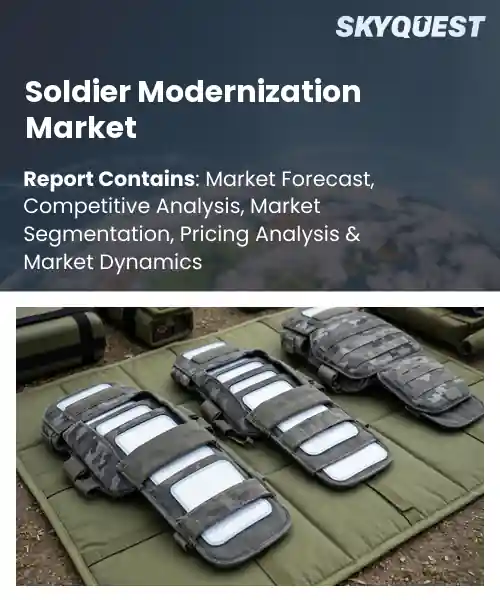
Soldier Modernization Market
Report ID: SQMIG20I2841
Report ID: SQMIG20I2841
[email protected]
USA +1 351-333-4748
Report ID:
SQMIG20I2841 |
Region:
Global |
Published Date: April, 2026
Pages:
157
|Tables:
120
|Figures:
77


Global Soldier Modernization Market size was valued at USD 15.4 Billion in 2024 and is poised to grow from USD 16.35 Billion in 2025 to USD 15.4 Billion by 2033, growing at a CAGR of 6.2% during the forecast period (2026-2033).
The primary driver of the soldier modernization market is the imperative to fuse advanced electronics, communications, and lethality into a cohesive, networked combatant capable of operating in complex environments. This market encompasses integrated soldier systems including wearable sensors, secure radios, precision weapon interfaces, powered armor elements and situational-awareness software, and it matters because modern conflicts prioritize information dominance and survivability over raw numbers. Historically, programs evolved from standalone night-vision and body-armor purchases during the Cold War to systemic initiatives such as the U.S. Nett Warrior, French FELIN and Israeli IDF upgrades that illustrate convergence of sensors, C4ISR and human-machine interfaces.A key factor driving market expansion is rapid technological maturation, which causes armed forces to prioritize modular, software-defined systems that can be upgraded faster than hardware replacement cycles. As commercial advances in miniaturized sensors, low-power processors and AI analytics become accessible, armies invest in scalable architectures such as MOSA-compliant radios and open-architecture soldier kits, leading vendors like Elbit, Thales and Raytheon to accelerate R&D. In practice this creates opportunities for integrated drone-to-soldier links that shorten decision loops, wearable power and cooling solutions that extend patrol endurance, and sold-to-cloud data fusion that improves mission planning while reducing lifecycle costs and sustainment.
How is AI enhancing situational awareness in the soldier modernization market?
AI is transforming situational awareness in the soldier modernization market through sensor fusion, edge inference, predictive analytics and augmented reality. Key aspects are combining thermal, visible and electronic sensor feeds into a unified tactical picture, running classification models at the edge to minimize latency, and presenting concise cues to reduce cognitive burden. The market is in an agile adoption phase with prototypes and limited fielding, requiring interoperability and trusted AI design. Examples include helmet mounted heads up displays that overlay friend and foe indicators and drone imagery pipelines that auto detect threats and feed actionable alerts into squad radios and command systems.Anduril Industries October 2025, unveiled EagleEye, an AI powered mixed reality helmet that fuses multispectral sensors and runs edge inference to deliver mission command level overlays to dismounted soldiers, demonstrating how AI reduces decision time, lowers cognitive load and accelerates fielding of soldier systems, supporting market growth and procurement efficiency.
Market snapshot - (2026-2033)
Global Market Size
USD 15.4 Billion
Largest Segment
Protection & Survivability (Body Armor/Exoskeletons)
Fastest Growth
Power & Data Management Systems
Growth Rate
6.2% CAGR
To get more insights on this market click here to Request a Free Sample Report
Global soldier modernization market is segmented by system category, platform capability, component layer, procurement type and region. Based on system category, the market is segmented into C4I (Command, Control, Comm, Computer & Intelligence), Protection & Survivability (Body Armor/Exoskeletons), Lethality (Personal Weapons/Smart Munitions) and Power & Data Management Systems. Based on platform capability, the market is segmented into Dismounted Soldier Systems, Special Operations Forces (SOF) Kits and Integrated Visual Augmentation Systems (IVAS/AR). Based on component layer, the market is segmented into Night Vision & Thermal Imaging Devices, Tactical Communication & Navigation (GPS/GIS) and Advanced Ruggedized Wearables & Textiles. Based on procurement type, the market is segmented into New Generation Full-suit Programs and Incremental Component Upgrades. Based on region, the market is segmented into North America, Europe, Asia Pacific, Latin America and Middle East & Africa.
Night Vision & Thermal Imaging Devices segment dominates because these sensors form the foundational sensory layer that enables continuous situational awareness across day and night and degraded visibility operations. Their proven mission impact on detection, target acquisition, and survivability drives procurement prioritization and integration into fire control and command architectures. Ongoing improvements in resolution, sensor fusion, and lower SWaP reinforce vendor investment and sustainment planning, shaping upgrade cycles across soldier modernization programs.
However, Tactical Communication & Navigation (GPS/GIS) is emerging as the fastest growing area as networked operations demand resilient positioning and secure data routing. Advances in miniaturized radios, anti jam navigation solutions, and software defined networking accelerate adoption across soldier kits. This uptake strengthens integrated command and control capabilities and creates new opportunities for linked sensors, real time mapping, and logistics aware decision tools.
Integrated Visual Augmentation Systems (IVAS/AR) segment stands out because immersive display and sensor fusion capabilities directly redefine how soldiers perceive, decide, and engage in complex environments. By overlaying contextual data and improving target recognition, these systems reduce cognitive load and shorten decision cycles, prompting program level prioritization. Their dual use for training, mission rehearsal, and live operations drives procurement focus and fosters ecosystems that integrate optics, software, and tactical communications.
Meanwhile, Special Operations Forces (SOF) Kits are witnessing the strongest growth momentum as operational units demand highly modular, mission tailored ensembles. Rapid adoption is driven by requirements for lightweight integration of specialized sensors, communications, and sustainment packages, which accelerates innovation cycles. This focus creates opportunities for bespoke solutions, agile supplier relationships, and faster fielding of experimental technologies into wider soldier systems.
To get detailed segments analysis, Request a Free Sample Report
North America commands global leadership in soldier modernization through a combination of deep defense procurement ecosystems, strong industry innovation, and integrated military doctrine that emphasizes networked, multi domain capabilities. Established prime contractors collaborate closely with government research organizations and specialized suppliers to translate advanced sensor, communications, and power technologies into fieldable solutions. Sustained investment in training, simulation, and interoperability programs reinforces adoption and scalability across services. Robust testing infrastructure and close industry government feedback loops accelerate capability maturation, while programmatic continuity and emphasis on upgradeable architectures make platforms attractive for long term deployment and allied interoperability. Large domestic market demand enables firms to sustain long research and development cycles and field iterative upgrades informed by operational feedback. Emphasis on secure communication layers, power efficiency, and human centered design ensures soldier systems align with evolving mission concepts.
Soldier Modernization Market in United States is driven by advanced research networks and a large defense industrial base that enables rapid prototyping and integration of sensors, communications, and force protection solutions. Established procurement pathways and close collaboration between program offices and prime contractors support wide scale adoption. Emphasis on interoperability with allied forces and investment in soldier centered design continues to shape procurement priorities and sustain innovation and operational readiness.
Soldier Modernization Market in Canada emphasizes interoperability, adaptable solutions for diverse environments, and close alignment with allied standards. Industry and government partnerships focus on tailored mission equipment, power management, and communications that accommodate expeditionary and domestic operations. Procurement strategies favor modular, upgradeable systems that can integrate with coalition platforms. Emphasis on domestic supplier development and joint testing programs supports technology maturation while ensuring requirements reflect operational realities and user feedback.
Europe soldier modernization market is expanding rapidly due to strategic alignment with alliance interoperability needs, renewed emphasis on ground force readiness, and strengthened cooperation among national research agencies and defense industries. Cross border programs and standardization efforts reduce duplication and encourage shared development of communication suites, situational awareness tools, and survivability systems. A growing ecosystem of specialized suppliers and technology startups complements established primes, accelerating adoption of modular platforms and soldier centered interfaces. Increasing focus on urban, multi domain, and expeditionary operations has steered procurement toward adaptable, upgradeable systems, while coordinated testing and joint exercises provide operational feedback that refines requirements and accelerates fielding across member states. National modernization strategies emphasize digital transformation, secure netcentric architectures, and integrated training regimes, enabling scalable procurement and cooperation that leverage both mature suppliers and innovative small firms.
Soldier Modernization Market in Germany is characterized by accelerated procurement of modular soldier systems and a flourishing ecosystem of high tech suppliers. Focused investment in sensor fusion, secure communications, and soldier protection drives rapid capability maturation. Collaborative development programs bring together primes, midsize firms, and specialized startups to deliver interoperable solutions. Emphasis on rigorous testing, industrial cooperation, and export potential supports sustained expansion and deepening of industrial capabilities and resilience.
Soldier Modernization Market in United Kingdom is anchored by a mature defense industrial base and coordinated procurement frameworks. Collaboration between program offices and established primes delivers integrated soldier systems emphasizing protection, situational awareness, and secure communications. National programs prioritize interoperability with allies and upgradeable architectures, while investment in training and simulation ensures fielded solutions align with operational needs and remain adaptable across varied deployment contexts and foster strong industry partnerships.
Soldier Modernization Market in France is emerging through targeted modernization that prioritizes modular equipment, advanced communications, and enhanced soldier protection. Research establishments and firms collaborate to develop specialized solutions tailored to expeditionary and joint operations. Procurement emphasis on adaptability and sovereign capability encourages local supply chain growth. Continued focus on interoperability with allies and expanded testing programs supports adoption of modernized soldier systems and strengthens national technology base and resilience.
Asia Pacific is strengthening its position in soldier modernization through concentrated efforts in indigenous capability development, deep integration of advanced electronics, and close collaboration with established defense partners. Regional militaries prioritize adaptation of autonomous systems, resilient communications, and enhanced mobility suitable for diverse geographic environments. Domestic industries and research institutions accelerate technology transfer into practical soldier systems, while governments promote supplier consolidation and joint exercises to validate performance. Emphasis on localized production, human centered design, and modular architectures enables scalable deployment and positions regional firms to contribute to both national needs and international partnerships. Investment in advanced training environments, simulation, and cyber resilient network layers supports operational integration and user acceptance. Collaboration between primes, startups, and academic centers nurtures rapid prototyping and improvements. Focus on exportable solutions and compatibility with partner force structures encourages regional consolidation of capabilities and opens pathways for cooperative procurement and joint exercises with established allies.
Soldier Modernization Market in Japan benefits from domestic electronics and robotics expertise combined with close industry defense collaboration. Priorities include autonomous support systems, advanced sensors, and secure communications translated into deployable soldier kits. Emphasis on ergonomic design, power efficiency, and interoperability with allied platforms guides procurement. Partnerships between primes and research institutions speed technology maturation and create pathways for international collaboration and selective export of specialized systems and sustained investment.
Soldier Modernization Market in South Korea is driven by a robust domestic technology sector, strong government support, and active collaboration between defense agencies and commercial firms. Focus areas include integrated command and control, advanced optics, unmanned systems, and resilient communications tailored to peninsula defense scenarios. Emphasis on rapid prototyping, rigorous field trials, and modular equipment enables swift adaptation. Export orientation and interoperability efforts with allied forces reinforce industrial capability growth.
To know more about the market opportunities by region and country, click here to
Buy The Complete Report
Advancements In Wearable Soldier Systems
Increased Demand For Integrated Communications
High Cost Of Advanced Systems
Interoperability And Integration Challenges
Request Free Customization of this report to help us to meet your business objectives.
Competitive landscape in global soldier modernization is shaped by rivalry between large primes and rapid defense startups, driven by urgent demand for AI enabled situational awareness and quicker fielding. Companies deploy M&A, government partnerships, and product innovation; examples include Rebellion Defense scaling battlefield software through major funding, Vannevar Labs securing a DIU production contract for generative AI, and Shield AI buying Heron Systems.
Top Player’s Company Profile
Recent Developments
SkyQuest’s ABIRAW (Advanced Business Intelligence, Research & Analysis Wing) is our Business Information Services team that Collects, Collates, Correlates, and Analyses the Data collected by means of Primary Exploratory Research backed by robust Secondary Desk research. As per SkyQuest analysis, the global soldier modernization market is being propelled by rapid technological maturation that enables modular, software-defined soldier systems as a key driver, while a second driver is growing demand for integrated communications and AI-enhanced situational awareness. The market is tempered by the high cost of advanced systems, which constrains procurement and favors incremental upgrades over full-suite fielding. North America remains the dominating region due to deep defense procurement ecosystems and close industry-government collaboration, and Night Vision and Thermal Imaging Devices are the dominating segment because they provide the foundational sensory capability for day and night operations. Overall, opportunities center on scalable, upgradeable architectures.
| Report Metric | Details |
|---|---|
| Market size value in 2024 | USD 15.4 Billion |
| Market size value in 2033 | USD 15.4 Billion |
| Growth Rate | 6.2% |
| Base year | 2024 |
| Forecast period | (2026-2033) |
| Forecast Unit (Value) | USD Billion |
| Segments covered |
|
| Regions covered | North America (US, Canada), Europe (Germany, France, United Kingdom, Italy, Spain, Rest of Europe), Asia Pacific (China, India, Japan, Rest of Asia-Pacific), Latin America (Brazil, Rest of Latin America), Middle East & Africa (South Africa, GCC Countries, Rest of MEA) |
| Companies covered |
|
| Customization scope | Free report customization with purchase. Customization includes:-
|
To get a free trial access to our platform which is a one stop solution for all your data requirements for quicker decision making. This platform allows you to compare markets, competitors who are prominent in the market, and mega trends that are influencing the dynamics in the market. Also, get access to detailed SkyQuest exclusive matrix.
Table Of Content
Executive Summary
Market overview
Parent Market Analysis
Market overview
Market size
KEY MARKET INSIGHTS
COVID IMPACT
MARKET DYNAMICS & OUTLOOK
Market Size by Region
KEY COMPANY PROFILES
Methodology
For the Soldier Modernization Market, our research methodology involved a mixture of primary and secondary data sources. Key steps involved in the research process are listed below:
1. Information Procurement: This stage involved the procurement of Market data or related information via primary and secondary sources. The various secondary sources used included various company websites, annual reports, trade databases, and paid databases such as Hoover's, Bloomberg Business, Factiva, and Avention. Our team did 45 primary interactions Globally which included several stakeholders such as manufacturers, customers, key opinion leaders, etc. Overall, information procurement was one of the most extensive stages in our research process.
2. Information Analysis: This step involved triangulation of data through bottom-up and top-down approaches to estimate and validate the total size and future estimate of the Soldier Modernization Market.
3. Report Formulation: The final step entailed the placement of data points in appropriate Market spaces in an attempt to deduce viable conclusions.
4. Validation & Publishing: Validation is the most important step in the process. Validation & re-validation via an intricately designed process helped us finalize data points to be used for final calculations. The final Market estimates and forecasts were then aligned and sent to our panel of industry experts for validation of data. Once the validation was done the report was sent to our Quality Assurance team to ensure adherence to style guides, consistency & design.
Analyst Support
Customization Options
With the given market data, our dedicated team of analysts can offer you the following customization options are available for the Soldier Modernization Market:
Product Analysis: Product matrix, which offers a detailed comparison of the product portfolio of companies.
Regional Analysis: Further analysis of the Soldier Modernization Market for additional countries.
Competitive Analysis: Detailed analysis and profiling of additional Market players & comparative analysis of competitive products.
Go to Market Strategy: Find the high-growth channels to invest your marketing efforts and increase your customer base.
Innovation Mapping: Identify racial solutions and innovation, connected to deep ecosystems of innovators, start-ups, academics, and strategic partners.
Category Intelligence: Customized intelligence that is relevant to their supply Markets will enable them to make smarter sourcing decisions and improve their category management.
Public Company Transcript Analysis: To improve the investment performance by generating new alpha and making better-informed decisions.
Social Media Listening: To analyze the conversations and trends happening not just around your brand, but around your industry as a whole, and use those insights to make better Marketing decisions.
REQUEST FOR SAMPLE
 REQUEST FREE CUSTOMIZATION


Want to customize this report? This report can be personalized according to your needs. Our analysts and industry experts will work directly with you to understand your requirements and provide you with customized data in a short amount of time. We offer $1000 worth of FREE customization at the time of purchase.
Feedback From Our Clients


 USA (+1) 351-333-4748

