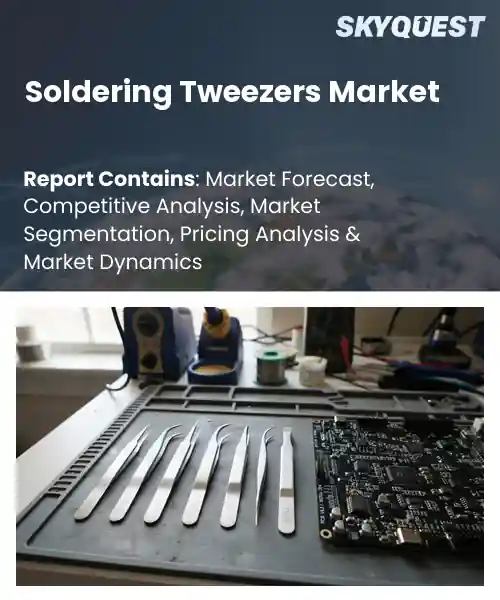
Soldering Tweezers Market
Report ID: SQMIG20I3736
Report ID: SQMIG20I3736
[email protected]
USA +1 351-333-4748
Report ID:
SQMIG20I3736 |
Region:
Global |
Published Date: August, 2026
Pages:
157
|Tables:
90
|Figures:
76


Global Soldering Tweezers Market size was valued at USD 136.0 Million in 2024 and is poised to grow from USD 143.62 Million in 2025 to USD 222.09 Million by 2033, growing at a CAGR of 5.6% during the forecast period (2026-2033).
The soldering tweezers market revolves around tools that combine fine mechanical grip with localized heating to join miniature components. Its importance stems from the relentless miniaturization of electronic devices, which demands reliable solder joints that manual irons cannot achieve. Over the past two decades the market has evolved from simple steel tweezers to ergonomically designed, temperature‑controlled instruments featuring interchangeable tips and integrated sensors. For instance, smartphone manufacturers such as Apple have adopted soldering‑tweezer stations to assemble printed‑circuit boards, while automotive suppliers use them for sensor modules. This shift toward precision assembly has become the primary significant driver of market growth. Building on the precision‑assembly impetus, the emergence of Industry 4.0 automation represents the next key factor accelerating the soldering tweezers market. Manufacturers that integrate robotic arms with temperature‑feedback tweezers can achieve higher throughput while reducing human error, which directly lowers defect rates and warranty costs. A notable case is a European automotive supplier that deployed a fully automated soldering‑tweezer cell for Li‑ion battery management units, cutting cycle time by 30 % and enabling scalable production of electric‑vehicle components. This operational efficiency creates demand for modular tip libraries and IoT‑enabled monitoring platforms, opening lucrative significant opportunities for equipment vendors and software providers alike.
How is AI-driven automation impacting the growth of the soldering tweezers market?
AI driven automation is reshaping the soldering tweezers market by embedding smart sensors and machine learning algorithms into the hand tools. These features allow real time temperature monitoring and adaptive pressure control which improve joint quality and reduce operator error. Manufacturers are pairing vision systems with tactile feedback to guide users through complex component placement making the process faster and more reliable. The shift toward intelligent tweezers aligns with the broader move toward automated assembly lines in electronics where precision and repeatability are critical. As a result demand for such advanced tools is rising as producers seek to meet tighter design tolerances and higher production volumes.In March 2026, a leading soldering equipment maker launched AI enabled tweezers, showcasing how predictive heating and automatic grip adjustment cut cycle time and improve yield, reinforcing market growth.
Market snapshot - (2026-2033)
Global Market Size
USD 136.0 Million
Largest Segment
Standard Soldering Tweezers
Fastest Growth
Heated Soldering Tweezers
Growth Rate
5.6% CAGR
To get more insights on this market click here to Request a Free Sample Report
Global soldering tweezers market is segmented by product type, tip type, end use and region. Based on product type, the market is segmented into Standard Soldering Tweezers, Heated Soldering Tweezers and ESD-Safe Soldering Tweezers. Based on tip type, the market is segmented into Replaceable Tips and Fixed Tips. Based on end use, the market is segmented into Electronics Manufacturing, Repair & Maintenance, Research Laboratories and Educational Institutions. Based on region, the market is segmented into North America, Europe, Asia Pacific, Latin America and Middle East & Africa.
Heated Soldering Tweezers segment dominates because manufacturers prioritize thermal precision for fine‑pitch components, enabling rapid heat transfer directly at the tip. This capability reduces thermal lag and minimizes component stress, meeting the stringent reliability standards of modern electronics production. The integrated heating also streamlines workflow by eliminating separate soldering tools, which enhances operator productivity and aligns with lean manufacturing practices, while supporting continuous 24/7 production cycles and ensuring consistent joint quality across diverse board architectures.
Meanwhile, ESD Safe Soldering Tweezers segment emerges as the most rapidly expanding because rising sensitivity of semiconductor devices drives demand for electrostatic discharge protection during handling. Incorporating conductive materials mitigates charge buildup, appealing to manufacturers focused on yield improvement and compliance with stringent reliability guidelines, thereby fueling market growth.
Replaceable Tips segment leads because users value flexibility to switch between tip geometries without discarding the entire tool. This adaptability supports rapid changeover across varying component sizes, minimizing downtime and extending equipment lifespan. The ability to source inexpensive aftermarket tips also lowers total cost of ownership, encouraging broader adoption across diverse production environments and facilitates compliance with cleanroom protocols by reducing particulate generation when changing tools.
However, Fixed Tips segment is witnessing the strongest growth momentum because certain high volume assembly lines require consistent tip performance with no interruption for tip changes. The durability of fixed designs reduces maintenance complexity and aligns with automation systems that favor tool less setups, driving investment in robust tweezers for continuous production
To get detailed segments analysis, Request a Free Sample Report
Asia Pacific leads the global soldering tweezers market through a combination of deep manufacturing expertise, extensive electronics assembly ecosystems, and relentless innovation. The region hosts a concentration of high‑volume contract manufacturers that require precise, reliable tools for advanced miniaturized assemblies, driving consistent demand. Strong R&D investment by both established firms and emerging startups fosters rapid product enhancements, while close integration of component suppliers ensures efficient supply chains. Competitive labor costs paired with sophisticated automation capabilities further strengthen cost‑effectiveness. Additionally, supportive trade policies and a culture of technical excellence encourage adoption of premium ergonomic designs, cementing the region’s dominant position. These factors also attract multinational equipment providers seeking regional partnerships, amplifying technology transfer and reinforcing the ecosystem’s resilience. The convergence of low‑cost production with high‑precision capabilities creates a unique competitive advantage that continues to draw both original equipment manufacturers and aftermarket distributors.
Soldering Tweezers Market in Japan benefits from a long tradition of precision engineering and a dense network of electronics manufacturers that prioritize quality and reliability. Local firms emphasize ergonomic design and durability, aligning with the country’s rigorous certification standards. Close collaboration between tool makers and semiconductor assemblers accelerates feedback loops, while extensive training programs ensure skilled technicians maximize tool performance, reinforcing Japan’s reputation for premium soldering solutions in the global.
Soldering Tweezers Market in South Korea thrives on a robust electronics export sector and aggressive adoption of advanced manufacturing techniques. Korean manufacturers favor high‑precision, lightweight tools that support rapid production cycles and intricate component placement. Strong government incentives for automation encourage continuous upgrades, while close ties with major display and smartphone assemblers drive iterative product improvements. This synergy creates a dynamic environment where innovation and efficiency reinforce each other globally.
Europe soldering tweezers market is propelled by a strong heritage of precision tooling, stringent quality standards, and a diversified industrial base that spans automotive, aerospace, and medical device sectors. The region’s emphasis on sustainability and ergonomic design drives manufacturers to integrate advanced materials and smart features into their product lines. Collaborative R&D initiatives among universities, research institutes, and equipment suppliers foster continuous innovation, while robust intellectual property frameworks protect novel designs. Comprehensive regulatory regimes ensure consistent performance and safety, enhancing customer confidence. Together, these factors create a fertile environment for rapid market expansion and position Europe as a leader in high‑value, technologically sophisticated soldering solutions. In addition, growing demand for miniaturized electronics in renewable energy installations and electric vehicle components further fuels the need for precise, reliable tweezers, reinforcing Europe’s competitive edge.
Soldering Tweezers Market in Germany is anchored by a world‑renowned engineering culture and a dense cluster of high‑tech manufacturers serving automotive and industrial automation sectors. German firms prioritize precision, durability, and compliance with rigorous safety standards, fostering trust among OEMs. Strong collaboration between tool producers and leading research institutions accelerates the incorporation of new alloys and micro‑sensor technologies, while a well‑established distribution network ensures rapid market penetration across the country.
Soldering Tweezers Market in United Kingdom experiences accelerated growth driven by a vibrant aerospace and defense ecosystem that demands high‑precision assembly tools. Close ties between academic research hubs and innovative manufacturers foster rapid prototyping of ergonomic, smart‑connected tweezers. Strong health and safety emphasis encourages adoption of tools that reduce operator fatigue, while a flexible supply chain supports swift response to emerging technology trends, positioning the United Kingdom as a fast‑moving contributor to market expansion.
Soldering Tweezers Market in France is emerging through a blend of high‑value manufacturing and growing adoption of Industry 4.0 practices within precision assembly lines. French producers focus on lightweight, ergonomic designs that align with strict labor safety directives. Collaborative projects between tooling companies and national research laboratories drive incorporation of nanocoatings and sensor integration, enhancing tool longevity and performance. This combination of innovation and regulatory alignment nurtures a promising trajectory for soldering tweezers within the French market.
North America fortifies its stance in the soldering tweezers market through a potent mix of cutting‑edge research, expansive consumer electronics manufacturing, and a thriving defense sector that demands exacting assembly precision. Leading technology hubs foster collaboration between universities, startup incubators, and established tool manufacturers, accelerating the rollout of smart‑enabled, ergonomically optimized tweezers. Robust supply chain infrastructure and widespread distribution networks ensure rapid availability of new products across both industrial and hobbyist segments. A strong culture of continuous improvement and stringent quality certifications drives companies to prioritize durability and performance. Combined with increasing focus on workforce safety and productivity, these dynamics enable North America to continually advance its market position and influence global standards for soldering tool excellence. It also drives regional export growth.
Soldering Tweezers Market in United States benefits from an ecosystem of electronics manufacturers and a culture of entrepreneurship. U.S. firms prioritize integration of interfaces and data analytics into tweezers, enabling monitoring of temperature and force. Partnerships with defense contractors and aerospace firms demand exceptionally reliable tools, while training programs ensure skilled application. This confluence of innovation, rigorous standards, and distribution sustains the United States as a pivotal hub for advanced soldering solutions.
Soldering Tweezers Market in Canada is shaped by a strong aerospace and medical device manufacturing base that values precision and compliance with strict regulatory frameworks. Canadian suppliers emphasize ergonomic design and the incorporation of sustainable materials, reflecting growing environmental awareness. Collaborative research initiatives with national universities drive advancements in sensor‑enabled tweezers, while a well‑organized distribution channel ensures timely delivery to both industrial users and specialized repair services, reinforcing Canada’s role as a reliable source of high‑quality soldering tools.
To know more about the market opportunities by region and country, click here to
Buy The Complete Report
Increasing Demand For Miniaturized Electronics
The surge in miniaturized electronic devices drives the need for precise assembly techniques, and soldering tweezers provide the fine control required for handling tiny components. Manufacturers adopt these tools to improve solder joint quality, reduce rework rates, and enhance production efficiency. As product form factors shrink, the ability to manipulate leads and connectors within confined spaces becomes critical, encouraging broader adoption of specialized tweezers across consumer, automotive, and medical device sectors, thereby expanding market demand. These advantages also support faster time‑to‑market and lower overall manufacturing costs.
Advancements In Ergonomic Tweezer Design
Recent developments in ergonomic design enhance user comfort and reduce fatigue during prolonged soldering operations, making tweezers more attractive to skilled technicians. Features such as lightweight alloys, anti‑slip grips, and adjustable tension mechanisms enable precise manipulation while minimizing strain. This improvement in operator experience encourages broader acceptance in high‑volume manufacturing environments, where productivity and quality are paramount. Consequently, manufacturers are more likely to invest in advanced tweezers, reinforcing market growth through sustained demand for ergonomic tooling solutions. The resulting efficiency gains also support higher throughput and consistent product reliability.
High Initial Cost Of Precision Tools
The upfront investment required for high‑precision soldering tweezers can be prohibitive for small and medium‑size enterprises, limiting widespread adoption. Specialized materials, intricate manufacturing processes, and rigorous quality certifications contribute to elevated price points. When budget constraints dominate purchasing decisions, firms may opt for less expensive, generic alternatives that lack the same level of performance and durability. This cost sensitivity slows market expansion, as potential customers defer acquisitions until financial conditions improve or until lower‑cost options become available. Consequently, the overall market penetration remains modest in cost‑sensitive regions.
Limited Availability Of Skilled Operators
Effective utilization of soldering tweezers demands a high degree of manual dexterity and technical training, which are not uniformly available across all manufacturing hubs. The specialized skill set required to achieve consistent solder joint quality often necessitates dedicated training programs and experienced personnel. In regions where such expertise is scarce, companies may resort to automated alternatives or avoid intricate manual processes altogether. This shortage of qualified operators constrains market growth by reducing demand for precision tweezers in certain geographies. Addressing this gap through vocational initiatives could moderate the restraint.
Request Free Customization of this report to help us to meet your business objectives.
The market is dominated by established equipment makers such as Hakko Corporation, Metcal, Apex Tool Group, Koki Company Limited, JBC Tools and American Hakko Products, which are intensifying competition through strategic partnerships with OEMs, targeted acquisitions of niche tweezers specialists and rapid rollout of advanced temperature‑control and ergonomic designs to meet rising demand for precision soldering in electronics manufacturing.
Top Player’s Company Profile
Recent Developments
SkyQuest’s ABIRAW (Advanced Business Intelligence, Research & Analysis Wing) is our Business Information Services team that Collects, Collates, Correlates, and Analyses the Data collected by means of Primary Exploratory Research backed by robust Secondary Desk research. As per SkyQuest analysis the market is propelled chiefly by the surge in miniaturized electronic devices that require the fine control offered by heated soldering tweezers, making the heated‑tweezer segment the clear leader, while Asia Pacific dominates sales thanks to its dense manufacturing ecosystem. A second important driver is the rapid progress in ergonomic design that reduces operator fatigue and boosts productivity. However, the high initial cost of precision tools restrains adoption among smaller firms and limits faster market penetration. Together these forces shape a market that is expanding steadily as manufacturers seek tighter thermal control and comfortable handling in high‑mix production environments.
| Report Metric | Details |
|---|---|
| Market size value in 2024 | USD 136.0 Million |
| Market size value in 2033 | USD 222.09 Million |
| Growth Rate | 5.6% |
| Base year | 2024 |
| Forecast period | (2026-2033) |
| Forecast Unit (Value) | USD Million |
| Segments covered |
|
| Regions covered | North America (US, Canada), Europe (Germany, France, United Kingdom, Italy, Spain, Rest of Europe), Asia Pacific (China, India, Japan, Rest of Asia-Pacific), Latin America (Brazil, Rest of Latin America), Middle East & Africa (South Africa, GCC Countries, Rest of MEA) |
| Companies covered |
|
| Customization scope | Free report customization with purchase. Customization includes:-
|
To get a free trial access to our platform which is a one stop solution for all your data requirements for quicker decision making. This platform allows you to compare markets, competitors who are prominent in the market, and mega trends that are influencing the dynamics in the market. Also, get access to detailed SkyQuest exclusive matrix.
Table Of Content
Executive Summary
Market overview
Parent Market Analysis
Market overview
Market size
KEY MARKET INSIGHTS
COVID IMPACT
MARKET DYNAMICS & OUTLOOK
Market Size by Region
KEY COMPANY PROFILES
Methodology
For the Soldering Tweezers Market, our research methodology involved a mixture of primary and secondary data sources. Key steps involved in the research process are listed below:
1. Information Procurement: This stage involved the procurement of Market data or related information via primary and secondary sources. The various secondary sources used included various company websites, annual reports, trade databases, and paid databases such as Hoover's, Bloomberg Business, Factiva, and Avention. Our team did 45 primary interactions Globally which included several stakeholders such as manufacturers, customers, key opinion leaders, etc. Overall, information procurement was one of the most extensive stages in our research process.
2. Information Analysis: This step involved triangulation of data through bottom-up and top-down approaches to estimate and validate the total size and future estimate of the Soldering Tweezers Market.
3. Report Formulation: The final step entailed the placement of data points in appropriate Market spaces in an attempt to deduce viable conclusions.
4. Validation & Publishing: Validation is the most important step in the process. Validation & re-validation via an intricately designed process helped us finalize data points to be used for final calculations. The final Market estimates and forecasts were then aligned and sent to our panel of industry experts for validation of data. Once the validation was done the report was sent to our Quality Assurance team to ensure adherence to style guides, consistency & design.
Analyst Support
Customization Options
With the given market data, our dedicated team of analysts can offer you the following customization options are available for the Soldering Tweezers Market:
Product Analysis: Product matrix, which offers a detailed comparison of the product portfolio of companies.
Regional Analysis: Further analysis of the Soldering Tweezers Market for additional countries.
Competitive Analysis: Detailed analysis and profiling of additional Market players & comparative analysis of competitive products.
Go to Market Strategy: Find the high-growth channels to invest your marketing efforts and increase your customer base.
Innovation Mapping: Identify racial solutions and innovation, connected to deep ecosystems of innovators, start-ups, academics, and strategic partners.
Category Intelligence: Customized intelligence that is relevant to their supply Markets will enable them to make smarter sourcing decisions and improve their category management.
Public Company Transcript Analysis: To improve the investment performance by generating new alpha and making better-informed decisions.
Social Media Listening: To analyze the conversations and trends happening not just around your brand, but around your industry as a whole, and use those insights to make better Marketing decisions.
REQUEST FOR SAMPLE
 REQUEST FREE CUSTOMIZATION


Want to customize this report? This report can be personalized according to your needs. Our analysts and industry experts will work directly with you to understand your requirements and provide you with customized data in a short amount of time. We offer $1000 worth of FREE customization at the time of purchase.
Feedback From Our Clients


 USA (+1) 351-333-4748

