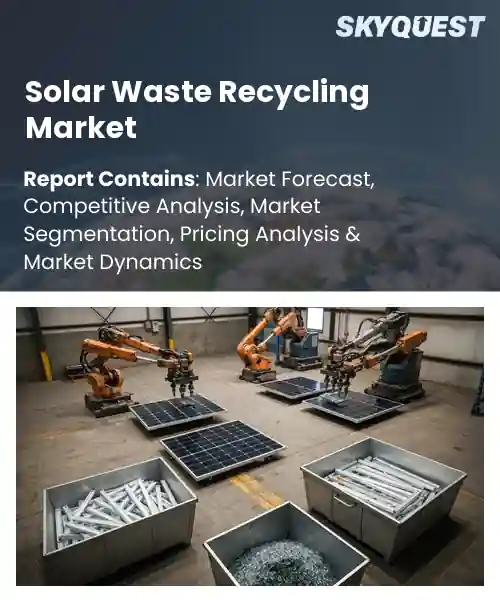
Solar Waste Recycling Market
Report ID: SQMIG55F2103
Report ID: SQMIG55F2103
[email protected]
USA +1 351-333-4748
Report ID:
SQMIG55F2103 |
Region:
Global |
Published Date: June, 2026
Pages:
157
|Tables:
144
|Figures:
78


Global Solar Waste Recycling Market size was valued at USD 480.0 Million in 2024 and is poised to grow from USD 549.6 Million in 2025 to USD 1623.64 Million by 2033, growing at a CAGR of 14.5% during the forecast period (2026-2033).
The primary driver of the solar waste recycling industry is the rapid accumulation of end‑of‑life photovoltaic panels alongside strengthening regulatory and corporate commitments to circularity. The market includes collection logistics, mechanical and chemical separation processes and downstream purification of glass, aluminum, silicon and precious metals, and it matters for resource recovery, environmental protection and supply chain security. Over time the sector shifted from informal landfill disposal to organized takeback schemes operated by manufacturers such as First Solar and by governments in Europe and China; concurrent advances in hydrometallurgy and thermal delamination increased recovery rates while lowering processing costs and sustainability.
A central factor shaping the global solar waste recycling market is the economics of material recovery, which creates a cause-and-effect chain from volume to viability. As cumulative decommissioned capacity rises, scale economies reduce per‑ton processing costs and attract private investment, spurring improvements in separation and purification. Lower recycling costs make secondary materials such as glass, aluminum and silver price‑competitive, prompting manufacturers to integrate recycled feedstock and design modules for easier disassembly. Policy instruments like extended producer responsibility magnify this effect by imposing end‑of‑life costs on producers, catalyzing circular procurement, new recycling facilities near generation hubs and supply chains and jobs.
How is AI improving efficiency in the solar waste recycling market?
AI improves efficiency in the solar waste recycling market by automating the hardest steps in the value chain. Machine learning and vision systems identify and separate glass, metals, silicon and plastics more accurately than manual sorting. Spectroscopy and hyperspectral imaging paired with AI reduce contamination and raise the quality of recovered materials. Robotics and process optimization driven by predictive analytics speed disassembly and lower downtime. The current market is moving from pilot projects to industrial scale and AI helps make that transition feasible by boosting throughput and improving end product purity while reducing labor intensity and unpredictable losses.
Comstock Inc in February 2026, the company received regulatory approval for a California recycling facility, and integrating AI enabled sorting and process control with that infrastructure supports faster scaling and higher material recovery which strengthens market efficiency and growth.
Market snapshot - (2026-2033)
Global Market Size
USD 480.0 Million
Largest Segment
Monocrystalline Panels
Fastest Growth
Monocrystalline Panels
Growth Rate
14.5% CAGR
To get more insights on this market click here to Request a Free Sample Report
Global solar waste recycling market is segmented by type, process, material recovered, shelf life, end-use industry and region. Based on type, the market is segmented into Monocrystalline Panels, Polycrystalline Panels and Thin-film Panels. Based on process, the market is segmented into Mechanical Recycling, Thermal Recycling and Chemical Recycling. Based on material recovered, the market is segmented into Silicon, Glass, Metals and Plastics. Based on shelf life, the market is segmented into Early Loss and Normal Loss. Based on end-use industry, the market is segmented into Solar Energy Companies, Waste Management & Recycling Firms and Utilities & Power Producers. Based on region, the market is segmented into North America, Europe, Asia Pacific, Latin America and Middle East & Africa.
Monocrystalline panels segment dominates with global solar waste recycling market share because widespread deployment of high-efficiency monocrystalline modules has created a consistent end-of-life stream that incentivizes dedicated recycling infrastructure. Their relatively uniform cell architecture and high-purity silicon content simplify material separation and enable higher-value recovery, which draws investment in specialized processing technologies. Regulatory emphasis on reclaiming critical materials and established collection channels further reinforce commercial viability, lowering per-unit processing costs and strengthening recycler economics.
As per global solar waste recycling market outlook, thin-film panels are emerging as the most rapidly expanding area because growing adoption in flexible and building-integrated installations drives demand for tailored recycling. Advances in delamination and recovery methods for non-silicon substrates are prompting recyclers to develop new processes and value chains, unlocking novel material streams and service offerings that expand market opportunity beyond traditional module types.
Chemical recycling segment leads because advanced solvent and reagent-based approaches can selectively dissolve encapsulants and separate cell layers to reclaim high-purity silicon and constituent metals, overcoming contamination and material quality barriers that limit reuse. That capability creates higher-value output streams, attracts investment, and aligns with circular economy directives, enabling manufacturers and recyclers to justify specialized facilities and sustain supply of recovered feedstock for new module production.
On the other hand, mechanical recycling is witnessing the strongest growth momentum because low-cost shredding and separation techniques enable rapid processing of diverse panel types and seamless integration with existing waste infrastructure. Improvements in automation and operational efficiency are spurring recyclers to scale mechanical capabilities, unlocking near-term capacity expansion and broadening access to recovered glass and metal commodities.
To get detailed segments analysis, Request a Free Sample Report
Asia Pacific dominates the global solar waste recycling market due to concentrated manufacturing of photovoltaic components, well developed recycling infrastructure in key markets, and coordinated policy approaches that prioritize end of life management. Strong domestic supply chains and established reverse logistics networks enable effective collection and processing of decommissioned modules. Advanced technology adoption and investment in specialized recycling facilities support material recovery and reuse. Collaboration between industry, research institutions, and government agencies accelerates innovation and operational scale up. Regional trade patterns and high cumulative deployment of solar assets generate a sustained feedstock stream that underpins commercial recycling operations and attracts service providers seeking economies of scale and technical expertise. Market maturity in certain urban centers and evolving corporate responsibility expectations further strengthen the region role as a global hub for circular photovoltaic value chains.
As per global solar waste recycling market regional outlook, Japan combines advanced material processing capabilities, supportive regulatory measures, and a network of research institutions to drive end of life solutions. Established electronics recycling expertise is adapted for photovoltaic modules, enabling recovery of critical materials. Strong industry collaboration, targeted investments in facility upgrades, and product stewardship create an environment where circular supply chain initiatives can scale and integrate with export manufacturing clusters and domestic reuse pathways.
As per global solar waste recycling market regional forecast, South Korea leverages advanced manufacturing strengths, strong industrial clustering, and focused technology development to advance module recycling capabilities. End of life strategies are integrated with national industrial policy and export oriented supply chains to support efficient material recovery. Partnerships between manufacturers, recyclers, and research centers foster process innovation and pilots. Emphasis on high value material reclamation and streamlined reverse logistics supports commercial viability and service expansion.
Europe is experiencing rapid expansion in solar waste recycling due to a combination of stringent regulatory frameworks, clear end of life obligations, and a strong policy emphasis on circular economy principles. Extended producer responsibility models and harmonized waste management standards encourage industry to develop recovery capacity and invest in advanced recycling technologies. Well established waste collection networks, active participation by established recycling firms, and a dense innovation ecosystem accelerate commercialization of process improvements. Cross border collaboration and alignment of standards facilitate efficient logistics and scale, while increasing corporate sustainability commitments drive demand for certified recycling solutions and value chain transparency. Public private partnerships and targeted investments enable scaling of specialized processing facilities, while consolidation among service providers leads to standardized processes and certification pathways. Demand from corporate buyers for traceable reclaimed materials supports development of downstream markets and integrated reverse logistics.
Germany benefits from an advanced industrial base, comprehensive waste management systems, and strong policy frameworks that prioritize material recovery. Established recycling companies and specialized processing facilities combine technical expertise to manage end of life photovoltaic modules. Collaboration among manufacturers, recyclers, and research institutions effectively supports process optimization and standardization. Leadership in certification practices and integration with downstream manufacturing secures Germany position as a regional processing hub.
United Kingdom is marked by dynamic growth driven by policy incentives, increasing industry engagement, and development of collection and processing capabilities. New service providers and technology ventures introduce innovative recovery processes and business models for diverse waste streams. Emphasis on transparency, material traceability, and certification attracts corporate buyers seeking sustainable sourcing. Collaboration among regulators, private investors, and research organizations accelerates commercialization and strengthens regional logistics networks.
France is emerging with growing policy focus, pilot programs and research collaboration establishing sustainable end of life pathways. Investments in specialized processing and circular design approaches support development of domestic capabilities. Public private initiatives foster technology transfer from broader electronics recycling experience to photovoltaic applications. Strengthening collection networks and certification frameworks is important for connecting reclamation processes with downstream manufacturing and secondary material markets and domestic reuse.
North America is strengthening its position in the solar waste recycling market through coordinated advances in technology development, growing private sector engagement, and increasing focus on sustainable supply chains. Investment by recycling firms and technology developers is enhancing processing capabilities while corporate procurement demands for responsibly sourced materials support development of downstream markets. Municipal and state level initiatives coupled with industry led collection programs improve feedstock aggregation and logistics. Collaboration among research institutions, equipment manufacturers, and service providers drives operational optimization and cost reduction. Cross border trade links and partnerships with manufacturing clusters further integrate recovered materials into domestic and regional value chains, increasing market resilience and commercial attractiveness. Development of voluntary standards and certification pathways is building buyer confidence and supporting scale up. Public private research consortia and pilot demonstrations accelerate transfer of lab scale methods to full scale operations.
United States is characterized by active private investment, a growing network of technology providers, and a landscape of collection and processing initiatives. State and local programs alongside private sector logistics solutions improve aggregation for recycling. Innovation from startups and recyclers focuses on scalable recovery processes and material certification. Corporate sustainability requirements and expanding downstream demand create commercial opportunities for integrated recycling services and circular material sourcing.
Canada is advancing through coordinated provincial initiatives, research partnerships, and investments in processing capacity. Emphasis on integrating module recycling with existing electronics and battery streams enables transfer of know how and infrastructure. Proximity to manufacturing and recycling hubs supports cross border logistics and material flows. Collaboration among industry associations, research centers, and service providers fosters pilot projects and certification work that underpin scaling and market confidence.
To know more about the market opportunities by region and country, click here to
Buy The Complete Report
Rising Solar Panel Installations
Supportive Regulatory Frameworks
High Recycling Processing Costs
Fragmented Collection and Logistics
Request Free Customization of this report to help us to meet your business objectives.
The competitive landscape is consolidating as recyclers, asset owners, and integrators pursue vertical integration through acquisitions and partnerships while technology innovators push advanced delamination and glass recovery methods. Examples include SOLARCYCLE securing processing agreements with major asset owners and industrial partners, and Australian consolidators expanding via acquisition of recycling specialists such as Scipher by Sircel, illustrating M&A, partnership deals, and process innovation driving differentiation.
SkyQuest’s ABIRAW (Advanced Business Intelligence, Research & Analysis Wing) is our Business Information Services team that Collects, Collates, Correlates, and Analyses the Data collected by means of Primary Exploratory Research backed by robust Secondary Desk research.
As per SkyQuest analysis, the global solar waste recycling market growth is driven primarily by a rising volume of end-of-life photovoltaic panels that creates feedstock and commercial incentive, and a secondary driver is strengthening regulatory and corporate commitments to circularity that encourage takeback and investment. Growth is concentrated in Asia Pacific where manufacturing, policy alignment and logistics produce scale advantages, and monocrystalline panels dominate the recoverable stream because their uniform architecture and high-purity silicon yield higher-value outputs. A key restraint remains high recycling processing costs which limit new facility investment and slow scaling despite improving separation technologies and digital traceability that enhance feedstock quality and operational efficiency.
| Report Metric | Details |
|---|---|
| Market size value in 2024 | USD 480.0 Million |
| Market size value in 2033 | USD 1623.64 Million |
| Growth Rate | 14.5% |
| Base year | 2024 |
| Forecast period | (2026-2033) |
| Forecast Unit (Value) | USD Million |
| Segments covered |
|
| Regions covered | North America (US, Canada), Europe (Germany, France, United Kingdom, Italy, Spain, Rest of Europe), Asia Pacific (China, India, Japan, Rest of Asia-Pacific), Latin America (Brazil, Rest of Latin America), Middle East & Africa (South Africa, GCC Countries, Rest of MEA) |
| Companies covered |
|
| Customization scope | Free report customization with purchase. Customization includes:-
|
To get a free trial access to our platform which is a one stop solution for all your data requirements for quicker decision making. This platform allows you to compare markets, competitors who are prominent in the market, and mega trends that are influencing the dynamics in the market. Also, get access to detailed SkyQuest exclusive matrix.
Table Of Content
Executive Summary
Market overview
Parent Market Analysis
Market overview
Market size
KEY MARKET INSIGHTS
COVID IMPACT
MARKET DYNAMICS & OUTLOOK
Market Size by Region
KEY COMPANY PROFILES
Methodology
For the Solar Waste Recycling Market, our research methodology involved a mixture of primary and secondary data sources. Key steps involved in the research process are listed below:
1. Information Procurement: This stage involved the procurement of Market data or related information via primary and secondary sources. The various secondary sources used included various company websites, annual reports, trade databases, and paid databases such as Hoover's, Bloomberg Business, Factiva, and Avention. Our team did 45 primary interactions Globally which included several stakeholders such as manufacturers, customers, key opinion leaders, etc. Overall, information procurement was one of the most extensive stages in our research process.
2. Information Analysis: This step involved triangulation of data through bottom-up and top-down approaches to estimate and validate the total size and future estimate of the Solar Waste Recycling Market.
3. Report Formulation: The final step entailed the placement of data points in appropriate Market spaces in an attempt to deduce viable conclusions.
4. Validation & Publishing: Validation is the most important step in the process. Validation & re-validation via an intricately designed process helped us finalize data points to be used for final calculations. The final Market estimates and forecasts were then aligned and sent to our panel of industry experts for validation of data. Once the validation was done the report was sent to our Quality Assurance team to ensure adherence to style guides, consistency & design.
Analyst Support
Customization Options
With the given market data, our dedicated team of analysts can offer you the following customization options are available for the Solar Waste Recycling Market:
Product Analysis: Product matrix, which offers a detailed comparison of the product portfolio of companies.
Regional Analysis: Further analysis of the Solar Waste Recycling Market for additional countries.
Competitive Analysis: Detailed analysis and profiling of additional Market players & comparative analysis of competitive products.
Go to Market Strategy: Find the high-growth channels to invest your marketing efforts and increase your customer base.
Innovation Mapping: Identify racial solutions and innovation, connected to deep ecosystems of innovators, start-ups, academics, and strategic partners.
Category Intelligence: Customized intelligence that is relevant to their supply Markets will enable them to make smarter sourcing decisions and improve their category management.
Public Company Transcript Analysis: To improve the investment performance by generating new alpha and making better-informed decisions.
Social Media Listening: To analyze the conversations and trends happening not just around your brand, but around your industry as a whole, and use those insights to make better Marketing decisions.
REQUEST FOR SAMPLE
 REQUEST FREE CUSTOMIZATION
Global Solar Waste Recycling Market size was valued at USD 480.0 Million in 2024 and is poised to grow from USD 549.6 Million in 2025 to USD 1623.64 Million by 2033, growing at a CAGR of 14.5% during the forecast period (2026-2033).
The competitive landscape is consolidating as recyclers, asset owners, and integrators pursue vertical integration through acquisitions and partnerships while technology innovators push advanced delamination and glass recovery methods. Examples include SOLARCYCLE securing processing agreements with major asset owners and industrial partners, and Australian consolidators expanding via acquisition of recycling specialists such as Scipher by Sircel, illustrating M&A, partnership deals, and process innovation driving differentiation. 'First Solar Inc.', 'Veolia', 'SUEZ', 'Recycle PV Solar', 'ROSI Solar', 'Silcontel Ltd.', 'Envaris GmbH', 'PV Cycle', 'Sunicon GmbH', 'Rinovasol Group', 'NPC Incorporated', 'Canadian Solar Inc.', 'Trina Solar', 'JinkoSolar', 'SolarWorld AG', 'Cleanlites Recycling Inc.', 'Reiling GmbH & Co. KG', 'ECS Refining', 'Echo Environmental LLC', 'Pan Pacific Recycling'
The rapid expansion of solar installations generates a growing stream of decommissioned modules that creates opportunities for specialized end-of-life services, encouraging investment in recycling capacity and technologies; manufacturers and service providers perceive positive commercial potential in recovering valuable materials and reducing environmental liabilities, which supports market entry and expansion. This demand-driven interest stimulates supply chain development, fosters partnerships, and prompts innovation in collection, disassembly, and material recovery methods, thereby reinforcing an expanding market for solar waste recycling solutions and associated services.
Extended Producer Responsibility Growth: Regulatory emphasis on manufacturer accountability is driving producers to internalize end of life management through product stewardship, design for disassembly, and financed take back programs. Companies are increasingly aligning sustainability commitments with operational plans, collaborating with recyclers to ensure material recovery and feedstock quality. This shift encourages upstream design changes, secures secondary material supply, reduces reputational risk, and creates incentives for integrated circular models. Market participants adopting these responsibilities are positioned to influence standards and capture value from recovered materials.
Why does Asia Pacific Dominate the Global Solar Waste Recycling Market? |@12


Want to customize this report? This report can be personalized according to your needs. Our analysts and industry experts will work directly with you to understand your requirements and provide you with customized data in a short amount of time. We offer $1000 worth of FREE customization at the time of purchase.
Feedback From Our Clients


 USA (+1) 351-333-4748

