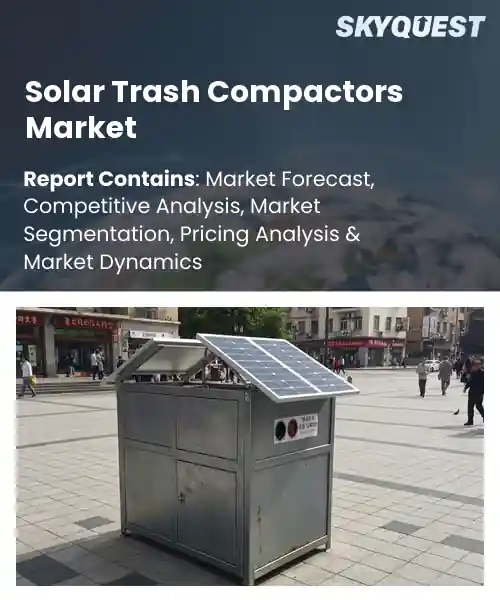
Solar Trash Compactors Market
Report ID: SQMIG20L2096
Report ID: SQMIG20L2096
[email protected]
USA +1 351-333-4748
Report ID:
SQMIG20L2096 |
Region:
Global |
Published Date: July, 2026
Pages:
157
|Tables:
181
|Figures:
79


Global Solar Trash Compactors Market size was valued at USD 1.74 Billion in 2024 and is poised to grow from USD 1.95 Billion in 2025 to USD 4.8 Billion by 2033, growing at a CAGR of 11.94% during the forecast period (2026-2033).
The solar trash compactor market comprises devices that combine photovoltaic panels with waste‑compression mechanisms to cut landfill volume while producing electricity. Its relevance arises from rising waste fees, tighter emissions rules, and demand for sustainable power in facilities. The primary driver is the alignment of renewable‑energy incentives with increasing landfill costs, prompting cities to adopt compactors that lessen collection trips. Early pilots in Copenhagen (2020) and Los Angeles (2021) showed a significant 30 % drop in haulage and a net‑zero carbon footprint for the units. Over five years, grants and private partnerships have moved the technology from prototypes to commercial offerings. Building on this momentum, the key growth factor is the link between smart‑city platforms and solar compactors, which enables remote monitoring that cuts collection trips and fuel use. Sensors that transmit fill‑level data to a central dashboard allow dispatch only when needed; Singapore’s Smart Waste Initiative reported a 25 % fuel reduction using this approach. The substantial cost savings encourage citywide municipalities to fund more units, and private operators capture significant revenue from performance‑based service contracts. As a result, long‑term market expansion derives from both hardware sales and recurring real‑time data‑service fees, reinforcing overall adoption and spurring continual significant technological refinement.
How is AI-driven IoT automation reshaping the solar trash compactor market?
AI-driven IoT automation is turning solar trash compactors into smart waste hubs. Sensors monitor fill levels, temperature and power generation, sending data to cloud platforms that trigger compaction cycles only when needed. This reduces energy waste and extends battery life while keeping streets cleaner. Machine‑learning algorithms predict peak usage periods, allowing municipalities to schedule collection routes more efficiently. Real‑time alerts alert operators to anomalies such as blockages or vandalism, enabling rapid response. The integration of AI with solar power creates a self‑optimising system that scales across neighborhoods, supporting the rapid expansion of compactors in urban environments.In June 2024 Waste Management announced its exclusive distribution of BigBelly solar compactor technology in North America, illustrating how AI‑enabled IoT controls are being deployed to boost operational efficiency and accelerate market growth.
Market snapshot - (2026-2033)
Global Market Size
USD 1.74 Billion
Largest Segment
Stationary Trash Compactors
Fastest Growth
Chute Fed Compactors
Growth Rate
11.94% CAGR
To get more insights on this market click here to Request a Free Sample Report
Global solar trash compactors market is segmented by product form factor, volumetric capacity, target waste type, application sector, distribution channel, end user facility and region. Based on product form factor, the market is segmented into Stationary Trash Compactors, Self-Contained Trash Compactors, Chute Fed Compactors and Indoor Stainless Steel Trash Compactors. Based on volumetric capacity, the market is segmented into Up to 120 Liters, 121 Liters to 500 Liters, 501 Liters to 1000 Liters and Above 1000 Liters. Based on target waste type, the market is segmented into Dry Waste and Wet Waste. Based on application sector, the market is segmented into Residential Use, Commercial Venues and Industrial Sites. Based on distribution channel, the market is segmented into Direct Sales, Industrial Distributors, Equipment Dealers and Online Procurement. Based on end user facility, the market is segmented into Airports, Railway Stations, Metro Terminals, Educational Institutions, Hospitals, Corporate Offices, Hotels, Restaurants, Stadiums, Public Parks and Others. Based on region, the market is segmented into North America, Europe, Asia Pacific, Latin America and Middle East & Africa.
Stationary Trash Compactors segment dominates because they provide a fixed, high capacity solution that integrates easily with existing waste infrastructure, allowing solar power to be harnessed continuously without the need for frequent relocation. Their robust design supports larger solar arrays, delivering reliable energy for compression cycles, which appeals to operators seeking low maintenance, long term cost savings. The stability of a stationary footprint also simplifies installation logistics and maximizes uptime, reinforcing market preference.
However, Self Contained Trash Compactors segment is witnessing the strongest growth momentum because its portable design enables deployment in remote or temporary locations where grid access is limited, making solar energy a practical power source. This flexibility drives adoption across emerging sites, expanding market reach and creating new opportunities for compact, renewable waste solutions.
501 liters to 1000 liters segment dominates because it strikes a balance between sufficient storage volume and manageable footprint, allowing solar panels to be sized efficiently for continuous operation. This capacity range meets the needs of many commercial and institutional sites where waste generation is steady but space is at a premium, delivering cost effective compression without oversized equipment. The alignment of volume and energy demand reinforces its preferred status among buyers.
Meanwhile, Above 1000 liters segment is emerging as the key high growth area because large scale facilities such as airports and stadiums require extensive storage, prompting investment in high capacity solar powered units that can offset significant electricity consumption. This demand fuels innovation in modular solar arrays and drives market expansion toward ultra large waste handling solutions.
To get detailed segments analysis, Request a Free Sample Report
North America’s leadership stems from robust infrastructure, strong policy frameworks supporting renewable energy, and a mature waste management ecosystem that embraces innovative technologies. The United States benefits from extensive municipal funding programs and a culture of sustainability that encourages adoption of off‑grid solutions. Canada’s emphasis on clean‑energy transition and abundant solar resources complement a collaborative research environment that drives product refinement. Together, these factors create a fertile ground for solar‑powered waste compactors, reinforcing market confidence and accelerating deployment across public and private sectors. The region’s ability to integrate smart grid capabilities with compacting equipment further enhances operational efficiency, solidifying its dominant position.
Solar Trash Compactors Market in United States is propelled by a network of progressive municipalities seeking to reduce landfill reliance while cutting energy costs. Incentive structures for renewable installations encourage city planners to incorporate solar arrays into waste collection points. Industry partnerships with technology providers foster rapid prototyping and scaling, while consumer awareness of sustainable practices drives public acceptance. This confluence of policy, innovation and community support sustains a vibrant market environment.
Solar Trash Compactors Market in Canada leverages abundant daylight hours and a strong commitment to carbon reduction across provinces. Government programs that prioritize green infrastructure create favorable conditions for solar integration in waste services. Collaboration between research institutions and equipment manufacturers accelerates adaptation to colder climates, ensuring reliable performance throughout seasonal variations. Public sector procurement emphasizes lifecycle cost savings, reinforcing the appeal of solar‑powered compactors as a forward‑looking waste management solution.
Europe’s expansion is anchored in ambitious climate objectives, dense urban populations and a well‑established circular economy mindset. Regulatory frameworks mandate reduced landfill use and promote renewable energy, encouraging cities to retrofit waste collection points with solar solutions. Strong engineering expertise across the continent supports sophisticated design adaptations that meet varied architectural and environmental constraints. Additionally, collaborative funding mechanisms between national governments and local authorities lower entry barriers for municipalities. Consumer expectations for environmentally responsible services further motivate adoption, while cross‑border research initiatives accelerate technology diffusion, positioning Europe as a hub of rapid market growth.
Solar Trash Compactors Market in Germany benefits from rigorous environmental standards and a tradition of engineering excellence that drives high‑performance system design. Federal incentives for renewable integration incentivize municipalities to replace conventional compactors with solar‑enabled units. A mature supply chain enables rapid component sourcing and localized manufacturing, reducing lead times. Stakeholder consensus around waste reduction and energy independence strengthens public sector commitment, fostering a stable and expanding market landscape.
Solar Trash Compactors Market in United Kingdom is energized by aggressive sustainability targets set by city councils and a vibrant startup ecosystem focused on green technology. Funding programs that support renewable infrastructure encourage trial deployments in densely populated boroughs. The regulatory emphasis on waste diversion aligns closely with solar compacting solutions, creating synergy between policy and practice. Engaged citizen groups champion visible eco‑friendly initiatives, accelerating acceptance and scaling across municipal fleets.
Solar Trash Compactors Market in France is emerging through a combination of national renewable energy ambitions and localized pilot projects in coastal and urban regions. Municipalities prioritize innovative waste handling to meet stringent landfill reduction goals, viewing solar compactors as a dual solution for energy and space efficiency. Partnerships between research labs and equipment firms facilitate customized designs that respect historic cityscapes. Early adopters demonstrate operational benefits, prompting broader interest among regional authorities.
Asia Pacific is advancing its role by capitalizing on rapid urbanization, supportive government policies and a growing emphasis on smart city concepts. Nations in the region are investing heavily in renewable energy integration within public services, creating a fertile environment for solar‑powered waste solutions. High population density in metropolitan areas generates substantial demand for efficient waste compacting, while advancements in micro‑inverter technology enhance reliability under diverse climatic conditions. Collaborative ventures between local manufacturers and global innovators accelerate technology transfer and cost optimisation. The convergence of policy incentives, technological progress and pressing waste management challenges positions Asia Pacific as an emerging leader in the solar trash compactor arena.
Solar Trash Compactors Market in Japan leverages the country’s long‑standing commitment to technological innovation and meticulous urban planning. Governmental programmes that promote renewable energy for municipal services encourage adoption of solar compactors in dense city districts. Engineering expertise ensures devices are tailored to withstand seismic activity and humid climates, enhancing durability. Partnerships between electronics firms and waste management agencies drive integration of IoT capabilities, enabling real‑time monitoring. This blend of policy support, technical acumen and smart city ambition fuels a robust market trajectory.
Solar Trash Compactors Market in South Korea is propelled by aggressive green growth strategies and a proactive approach to modernizing waste infrastructure. National initiatives that link renewable energy deployment with public service upgrades create incentives for municipalities to trial solar compactors. Strong domestic component manufacturers provide cost‑effective solutions that meet rigorous performance standards. Integration with nationwide smart‑city platforms allows for data‑driven operation, improving collection efficiency. The synergy of policy direction, manufacturing capability and digital infrastructure underpins a rapidly strengthening market presence.
To know more about the market opportunities by region and country, click here to
Buy The Complete Report
Increasing Renewable Energy Adoption
Growing Municipal Waste Management Needs
High Initial Capital Investment
Regulatory Uncertainty Across Regions
Request Free Customization of this report to help us to meet your business objectives.
The competitive landscape is shaped by firms leveraging solar integration to differentiate waste‑collection hardware, with alliances between municipal service providers and clean‑tech manufacturers accelerating adoption. Notable strategies include acquisitions of niche smart‑sensor companies to embed real‑time monitoring, joint ventures with renewable‑energy installers to bundle solar power with compactors, and rapid rollout of patented UV‑disinfection modules that enhance hygiene while reducing grid dependence.
Top Player’s Company Profile
Recent Developments
SkyQuest’s ABIRAW (Advanced Business Intelligence, Research & Analysis Wing) is our Business Information Services team that Collects, Collates, Correlates, and Analyses the Data collected by means of Primary Exploratory Research backed by robust Secondary Desk research. As per SkyQuest analysis the global solar trash compactors market is propelled primarily by the surge in renewable‑energy adoption, which lets municipalities replace diesel units with off‑grid solar‑powered bins and cut operating costs, while a second key catalyst is the integration of smart‑grid and IoT platforms that enable real‑time fill monitoring and demand‑responsive compaction cycles. The market is led by North America, where supportive policies and mature waste‑service networks drive deployment, and the stationary trash compactor segment holds the largest share because its fixed, high‑capacity design pairs well with continuous solar generation. However, high initial capital investment remains a notable restraint, slowing uptake in budget‑constrained jurisdictions.
| Report Metric | Details |
|---|---|
| Market size value in 2024 | USD 1.74 Billion |
| Market size value in 2033 | USD 4.8 Billion |
| Growth Rate | 11.94% |
| Base year | 2024 |
| Forecast period | (2026-2033) |
| Forecast Unit (Value) | USD Billion |
| Segments covered |
|
| Regions covered | North America (US, Canada), Europe (Germany, France, United Kingdom, Italy, Spain, Rest of Europe), Asia Pacific (China, India, Japan, Rest of Asia-Pacific), Latin America (Brazil, Rest of Latin America), Middle East & Africa (South Africa, GCC Countries, Rest of MEA) |
| Companies covered |
|
| Customization scope | Free report customization with purchase. Customization includes:-
|
To get a free trial access to our platform which is a one stop solution for all your data requirements for quicker decision making. This platform allows you to compare markets, competitors who are prominent in the market, and mega trends that are influencing the dynamics in the market. Also, get access to detailed SkyQuest exclusive matrix.
Table Of Content
Executive Summary
Market overview
Parent Market Analysis
Market overview
Market size
KEY MARKET INSIGHTS
COVID IMPACT
MARKET DYNAMICS & OUTLOOK
Market Size by Region
KEY COMPANY PROFILES
Methodology
For the Solar Trash Compactors Market, our research methodology involved a mixture of primary and secondary data sources. Key steps involved in the research process are listed below:
1. Information Procurement: This stage involved the procurement of Market data or related information via primary and secondary sources. The various secondary sources used included various company websites, annual reports, trade databases, and paid databases such as Hoover's, Bloomberg Business, Factiva, and Avention. Our team did 45 primary interactions Globally which included several stakeholders such as manufacturers, customers, key opinion leaders, etc. Overall, information procurement was one of the most extensive stages in our research process.
2. Information Analysis: This step involved triangulation of data through bottom-up and top-down approaches to estimate and validate the total size and future estimate of the Solar Trash Compactors Market.
3. Report Formulation: The final step entailed the placement of data points in appropriate Market spaces in an attempt to deduce viable conclusions.
4. Validation & Publishing: Validation is the most important step in the process. Validation & re-validation via an intricately designed process helped us finalize data points to be used for final calculations. The final Market estimates and forecasts were then aligned and sent to our panel of industry experts for validation of data. Once the validation was done the report was sent to our Quality Assurance team to ensure adherence to style guides, consistency & design.
Analyst Support
Customization Options
With the given market data, our dedicated team of analysts can offer you the following customization options are available for the Solar Trash Compactors Market:
Product Analysis: Product matrix, which offers a detailed comparison of the product portfolio of companies.
Regional Analysis: Further analysis of the Solar Trash Compactors Market for additional countries.
Competitive Analysis: Detailed analysis and profiling of additional Market players & comparative analysis of competitive products.
Go to Market Strategy: Find the high-growth channels to invest your marketing efforts and increase your customer base.
Innovation Mapping: Identify racial solutions and innovation, connected to deep ecosystems of innovators, start-ups, academics, and strategic partners.
Category Intelligence: Customized intelligence that is relevant to their supply Markets will enable them to make smarter sourcing decisions and improve their category management.
Public Company Transcript Analysis: To improve the investment performance by generating new alpha and making better-informed decisions.
Social Media Listening: To analyze the conversations and trends happening not just around your brand, but around your industry as a whole, and use those insights to make better Marketing decisions.
REQUEST FOR SAMPLE
 REQUEST FREE CUSTOMIZATION


Want to customize this report? This report can be personalized according to your needs. Our analysts and industry experts will work directly with you to understand your requirements and provide you with customized data in a short amount of time. We offer $1000 worth of FREE customization at the time of purchase.
Feedback From Our Clients


 USA (+1) 351-333-4748

