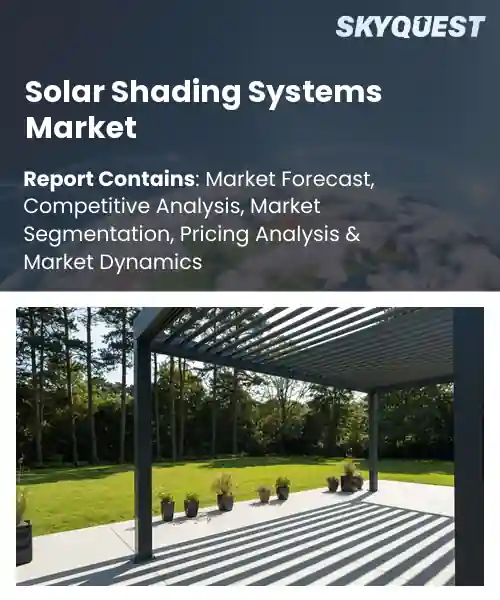
Solar Shading Systems Market
Report ID: SQMIG20B2213
Report ID: SQMIG20B2213
[email protected]
USA +1 351-333-4748
Report ID:
SQMIG20B2213 |
Region:
Global |
Published Date: July, 2026
Pages:
157
|Tables:
118
|Figures:
77


Global Solar Shading Systems Market size was valued at USD 14.81 Billion in 2024 and is poised to grow from USD 15.08 Billion in 2025 to USD 17.39 Billion by 2033, growing at a CAGR of 1.8% during the forecast period (2026-2033).
The global solar shading systems market comprises products such as louvers, blinds, perforated panels and dynamic glazing that regulate solar heat gain while preserving daylight. Its significance stems from the mounting pressure on building owners to cut energy bills and meet stringent net‑zero carbon mandates. Initially confined to high‑end office towers in North America, the sector expanded in the 2010s as green‑building certifications like LEED and BREEAM rewarded shading performance. A notable example is the Bloomberg European Headquarters, where automated blinds reduced cooling demand by 25 %. This evolution reflects a shift from optional aesthetic accessories to mandatory energy‑efficiency components today.
Building‑integrated photovoltaics (BIPV) serve as an engine, turning shading elements into electricity and converting cooling expense into revenue. When photovoltaic louvers shade a façade, the cooling demand raises energy output, a feedback that attracts developers seeking lower costs and green‑building credits. Dubai’s Museum of the Future uses solar panels that supply 15 % of its power while cutting interior temperatures by 4 °C, showing the advantage. This outcome drives demand for controllers, IoT sensors and low‑emissivity coatings, creating niches for firms that merge monitoring with durable hardware. Consequently, regions with incentives Gulf Cooperation Council and Asian markets are seeing adoption that expands production.
How is AI-driven Automation Influencing The Design Of Solar Shading Systems?
AI-powered automation is transforming solar shading design by allowing rapid development of optimized geometries to balance daylight, heat gain and aesthetic objectives. Based on climate data, building orientation and user preferences, machine-learning models suggest blade patterns or louvers that respond to changing conditions. This eliminates manual drafting cycles, enabling engineers to test multiple scenarios in minutes, not weeks. The technology also works with smart building controls, allowing shading devices to react automatically to sensor inputs. With the market growing, developers are using these tools to shorten project time, reduce costs and build more energy efficient facades.
Market snapshot - (2026-2033)
Global Market Size
USD 14.81 Billion
Largest Segment
External Screens
Fastest Growth
Textiles / Solar Control Fabrics
Growth Rate
1.8% CAGR
To get more insights on this market click here to Request a Free Sample Report
Global solar shading systems market is segmented by product type, mechanism, application, power source and region. Based on product type, the market is segmented into Blinds, Shades, Louvers, Textiles / Solar Control Fabrics and External Screens. Based on mechanism, the market is segmented into Fixed Systems, Manual Systems and Motorized / Automated Systems. Based on application, the market is segmented into Residential, Commercial and Industrial. Based on power source, the market is segmented into Electric and Solar-Powered. Based on region, the market is segmented into North America, Europe, Asia Pacific, Latin America and Middle East & Africa.
Blinds segment is leading because they are a simple cost effective solution that integrates easily with the existing window frames providing immediate glare reduction and thermal comfort. They can be adapted to a variety of architectural styles, and manufacturers benefit from established supply chains and relatively simple production processes. Therefore, architects and building owners prefer blinds due to their quick installation, reliable operation and simple maintenance. This further strengthens their position in the market for solar shading systems.
Meanwhile textiles solar control fabrics segment is the fastest growing area, with advancements in high performance fibres leading to superior light filtration and energy savings while preserving daylight quality. The demand for aesthetic integration and eco-friendly materials is increasing in premium projects, which is driving new design opportunities and market growth.
Manual systems segment held the largest market share owing to their tactile control and low installation complexity. They are preferred among cost conscious owners who prefer direct adjustability without any dependency on power sources. The simpler it is, the less maintenance you have to worry about. With no electronic components it will last a long time and work in harsh environments. These advantages have led manual operation to be the preferred choice for numerous residential and commercial projects, solidifying its market leadership.
However, the motorized automated systems segment is exhibiting the strongest growth momentum with building integration and IoT connectivity enabling remote scheduling, energy optimization and user convenience. Growth in investment in automated shading to address increased penetration of building management systems and seamless operation requirement in high rise structures, enhances the value proposition and drive the market.
To get detailed segments analysis, Request a Free Sample Report
The Asia Pacific region is the leading region in the global Solar Shading Systems Market, due to its high urban density, forward-looking building codes, and culture of energy efficiency. Fast-growing commercial and residential construction is driving demand for integrated shading solutions that improve thermal comfort and reduce cooling loads. Developers are more likely to install state-of-the-art shading technology due to strong government incentives for green building certification. A sophisticated manufacturing ecosystem also offers innovative products at competitive cost and adds to the region’s export capabilities. Academia-industry joint research accelerates technology adoption to position Asia Pacific as the benchmark for solar shading performance and sustainability.
The Japanese Solar Shading Systems Market is receiving a boost as the stringent energy performance standards require the inclusion of shading in new builds. Architects are focusing on daylight management to meet sustainability criteria and prefer high performance dynamic shading. Japanese manufacturers use their advanced materials know-how to provide solutions for small living spaces and varied climatic zones in Japan. Increased consumer awareness about indoor comfort and utility cost savings further promotes market uptake.
Strong governmental focus on green building initiatives, and thriving smart-city agenda are the key factors driving the growth of Solar Shading Systems Market in South Korea. Shading solutions can be integrated into building automation systems to increase occupant comfort and optimize energy consumption. The local companies are good at producing sleek, tech-savvy shading products that go with the aesthetics of modern architecture. The market growth is further enhanced by rising public awareness on environmental responsibility along with supporting policy frameworks.
Europe’s rapid expansion in the Solar Shading Systems Market is propelled by stringent energy efficiency directives, robust climate‑responsive design philosophies, and a mature construction sector eager to meet high sustainability benchmarks. The region’s commitment to carbon‑neutral building practices encourages widespread adoption of shading technologies that reduce cooling demand and improve indoor lighting quality. Strong research networks and cross‑border collaboration foster innovation in adaptive shading mechanisms, while premium market positioning for green building certifications drives architects to incorporate these solutions. Consumer demand for healthier indoor environments and durable, aesthetically integrated products further accelerates market momentum across the continent.
Solar Shading Systems Market in Germany is anchored by rigorous building energy standards that require innovative shading to achieve low‑energy performance. Engineers integrate advanced, often automated shading solutions into both historic renovations and contemporary projects, emphasizing precision and durability. German manufacturers lead in high‑quality material engineering, supplying robust products that meet demanding thermal and acoustic criteria. A strong culture of sustainability among developers and occupants reinforces steady market growth.
Solar Shading Systems Market in United Kingdom, noted as the fastest growing market, benefits from ambitious net‑zero building targets and a vibrant retrofit sector. Architects and developers prioritize dynamic shading to balance daylight quality with thermal regulation, especially in dense urban settings. Innovation hubs deliver cutting‑edge control systems that integrate with smart building platforms, enhancing occupant experience. Growing awareness of health and comfort benefits among occupants fuels demand for sophisticated shading solutions.
Solar Shading Systems Market in France is emerging as a key segment due to national incentives for energy‑saving construction and an increasing focus on bioclimatic architecture. French designers incorporate shading to harmonize indoor ambience with natural light, reflecting cultural appreciation for aesthetic harmony. Local manufacturers are developing elegant, low‑maintenance shading options tailored to France’s varied regional climates. Enhanced consumer awareness of environmental impact supports gradual market uptake.
North America strengthens its position in the Solar Shading Systems Market through a blend of progressive regulatory frameworks, heightened emphasis on occupant well‑being, and a thriving ecosystem of technology‑driven manufacturers. Policies encouraging high‑performance building envelopes incentivize the integration of shading solutions that mitigate heat gain and improve daylight quality. Innovation corridors foster development of intelligent shading that interfaces with building management systems, delivering precise control and energy savings. Market participants capitalize on a growing consumer preference for sustainable, comfortable indoor spaces, while substantial investment in commercial and residential construction sustains demand for advanced shading technologies across the region.
Solar Shading Systems Market in United States is propelled by expansive commercial real estate development and a strong push for energy‑efficient building certifications. Architects favor adaptable shading systems to meet diverse climate conditions across the country, while manufacturers leverage advanced fabrication techniques to deliver scalable solutions. Integration with smart home and office platforms enhances market appeal, aligning with consumer expectations for technology‑enabled comfort and sustainability.
Solar Shading Systems Market in Canada benefits from a climate that underscores the need for effective daylight and heat management. Building codes encourage adoption of shading to reduce reliance on mechanical cooling and improve indoor comfort. Local producers focus on durable, weather‑resistant shading products suitable for harsh conditions. Growing awareness of energy stewardship among homeowners and commercial operators supports steady market progression.
To know more about the market opportunities by region and country, click here to
Buy The Complete Report
Increasing Energy Efficiency Regulations
Rising Urban Architecture Trends
High Initial Capital Investment
Complex Installation Skill Requirements
Request Free Customization of this report to help us to meet your business objectives.
The competitive landscape is shaped by established players such as Duco Ventilation & Sun Control, Glasscon GmbH, and Hunter Douglas, each leveraging distinct tactics to secure market share; Duco has rolled out an IoT‑enabled sun‑control system that merges ventilation and shading functions, Glasscon is expanding its high‑performance glazing portfolio to address energy‑efficiency demands, and Hunter Douglas is investing in smart‑shade technology that integrates with building automation platforms.
SkyQuest’s ABIRAW (Advanced Business Intelligence, Research & Analysis Wing) is our Business Information Services team that Collects, Collates, Correlates, and Analyses the Data collected by means of Primary Exploratory Research backed by robust Secondary Desk research.
As per SkyQuest analysis the global solar shading systems market is propelled primarily by increasing energy‑efficiency regulations that push architects to embed shading for lower cooling loads, while a second driver comes from rising urban architecture trends that demand aesthetically integrated, customizable façades. The blinds segment leads the market because of its cost‑effective, easy‑to‑install nature, and Asia Pacific dominates due to dense urban growth, supportive green‑building policies and a strong manufacturing base. A notable restraint is the high initial capital investment required for large‑scale, technologically advanced systems, which can delay project adoption despite long‑term savings.
| Report Metric | Details |
|---|---|
| Market size value in 2024 | USD 14.81 Billion |
| Market size value in 2033 | USD 17.39 Billion |
| Growth Rate | 1.8% |
| Base year | 2024 |
| Forecast period | (2026-2033) |
| Forecast Unit (Value) | USD Billion |
| Segments covered |
|
| Regions covered | North America (US, Canada), Europe (Germany, France, United Kingdom, Italy, Spain, Rest of Europe), Asia Pacific (China, India, Japan, Rest of Asia-Pacific), Latin America (Brazil, Rest of Latin America), Middle East & Africa (South Africa, GCC Countries, Rest of MEA) |
| Companies covered |
|
| Customization scope | Free report customization with purchase. Customization includes:-
|
To get a free trial access to our platform which is a one stop solution for all your data requirements for quicker decision making. This platform allows you to compare markets, competitors who are prominent in the market, and mega trends that are influencing the dynamics in the market. Also, get access to detailed SkyQuest exclusive matrix.
Table Of Content
Executive Summary
Market overview
Parent Market Analysis
Market overview
Market size
KEY MARKET INSIGHTS
COVID IMPACT
MARKET DYNAMICS & OUTLOOK
Market Size by Region
KEY COMPANY PROFILES
Methodology
For the Solar Shading Systems Market, our research methodology involved a mixture of primary and secondary data sources. Key steps involved in the research process are listed below:
1. Information Procurement: This stage involved the procurement of Market data or related information via primary and secondary sources. The various secondary sources used included various company websites, annual reports, trade databases, and paid databases such as Hoover's, Bloomberg Business, Factiva, and Avention. Our team did 45 primary interactions Globally which included several stakeholders such as manufacturers, customers, key opinion leaders, etc. Overall, information procurement was one of the most extensive stages in our research process.
2. Information Analysis: This step involved triangulation of data through bottom-up and top-down approaches to estimate and validate the total size and future estimate of the Solar Shading Systems Market.
3. Report Formulation: The final step entailed the placement of data points in appropriate Market spaces in an attempt to deduce viable conclusions.
4. Validation & Publishing: Validation is the most important step in the process. Validation & re-validation via an intricately designed process helped us finalize data points to be used for final calculations. The final Market estimates and forecasts were then aligned and sent to our panel of industry experts for validation of data. Once the validation was done the report was sent to our Quality Assurance team to ensure adherence to style guides, consistency & design.
Analyst Support
Customization Options
With the given market data, our dedicated team of analysts can offer you the following customization options are available for the Solar Shading Systems Market:
Product Analysis: Product matrix, which offers a detailed comparison of the product portfolio of companies.
Regional Analysis: Further analysis of the Solar Shading Systems Market for additional countries.
Competitive Analysis: Detailed analysis and profiling of additional Market players & comparative analysis of competitive products.
Go to Market Strategy: Find the high-growth channels to invest your marketing efforts and increase your customer base.
Innovation Mapping: Identify racial solutions and innovation, connected to deep ecosystems of innovators, start-ups, academics, and strategic partners.
Category Intelligence: Customized intelligence that is relevant to their supply Markets will enable them to make smarter sourcing decisions and improve their category management.
Public Company Transcript Analysis: To improve the investment performance by generating new alpha and making better-informed decisions.
Social Media Listening: To analyze the conversations and trends happening not just around your brand, but around your industry as a whole, and use those insights to make better Marketing decisions.
REQUEST FOR SAMPLE
 REQUEST FREE CUSTOMIZATION
Global Solar Shading Systems Market size was valued at USD 14.81 Billion in 2024 and is poised to grow from USD 15.08 Billion in 2025 to USD 17.39 Billion by 2033, growing at a CAGR of 1.8% during the forecast period (2026-2033).
The competitive landscape is shaped by established players such as Duco Ventilation & Sun Control, Glasscon GmbH, and Hunter Douglas, each leveraging distinct tactics to secure market share; Duco has rolled out an IoT‑enabled sun‑control system that merges ventilation and shading functions, Glasscon is expanding its high‑performance glazing portfolio to address energy‑efficiency demands, and Hunter Douglas is investing in smart‑shade technology that integrates with building automation platforms. 'Hunter Douglas N.V.', 'Luxaflex (Hunter Douglas)', 'LUCOS (Lutron)', 'Somfy Group', 'Hillarys Blinds', 'Silhouette Window Shadings', 'VERTIGO (Aluplast)', 'Fabrics & Furnishings International', 'Brandenburg Window Fashions', 'Screenline s.r.l.', 'Zinco GmbH', 'Casanova (Renson)', 'Brands at Home', 'Alulux GmbH', 'NovaSol (Fakro)', 'Markilux GmbH', 'Bruno Ballarini & Figli', 'Jagdish Interior', 'Houzz Inc.', 'Sunesta Products'
Growing governmental and industry regulations that mandate higher energy performance for commercial and residential structures are prompting architects and developers to integrate solar shading solutions. These measures encourage the use of passive cooling technologies, reduce reliance on mechanical systems, and support sustainability certifications. By aligning product offerings with regulatory expectations, manufacturers find expanded opportunities as stakeholders seek compliant designs that lower operational costs and improve indoor comfort, thereby driving market adoption across diverse building projects and contribute to long‑term environmental resilience while enhancing property value.
Integrated Smart Glass Adoption: The industry is rapidly incorporating electrochromic and thermochromic glazing into commercial and residential shading solutions, enabling real‑time light modulation without mechanical parts. Architects and developers value the seamless aesthetic and energy‑saving benefits, prompting design standards to reference dynamic glass performance. Manufacturers are scaling production to meet rising demand, while software platforms integrate occupancy sensors and AI-driven controls, creating holistic building envelopes that enhance occupant comfort, reduce HVAC loads, and support sustainability certifications and future climate resilience.
Why does Asia Pacific Dominate the Global Solar Shading Systems Market? |@12


Want to customize this report? This report can be personalized according to your needs. Our analysts and industry experts will work directly with you to understand your requirements and provide you with customized data in a short amount of time. We offer $1000 worth of FREE customization at the time of purchase.
Feedback From Our Clients


 USA (+1) 351-333-4748

