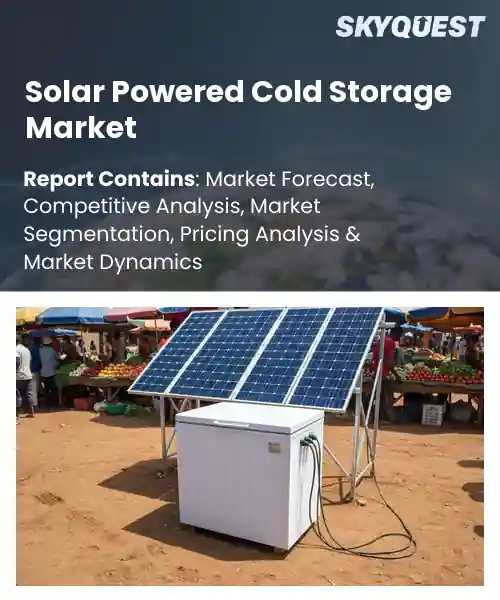
Solar Powered Cold Storage Market
Report ID: SQMIG10C2078
Report ID: SQMIG10C2078
[email protected]
USA +1 351-333-4748
Report ID:
SQMIG10C2078 |
Region:
Global |
Published Date: April, 2026
Pages:
157
|Tables:
118
|Figures:
77


Global Solar Powered Cold Storage Market size was valued at USD 5.12 Billion in 2024 and is poised to grow from USD 5.72 Billion in 2025 to USD 5.1 Billion by 2033, growing at a CAGR of 11.8% during the forecast period (2026-2033).
The primary driver of the solar powered cold storage market is the intersection of unreliable grid supply and high post-harvest losses in emerging economies, which has created urgent demand for decentralized refrigeration. Solar powered cold storage integrates photovoltaic panels with batteries and thermal buffers and efficient cooling systems to preserve food, vaccines, and other perishables. It matters because minimizing spoilage boosts farmer incomes, stabilizes local markets, and enables immunization programs in remote clinics. Over the decade pilots funded by development agencies transitioned into commercially scaled offerings, exemplified by solar cold rooms in India and solar milk chillers in East Africa.Building on rising demand, the decisive factor accelerating the global solar powered cold storage market is the rapid decline in the cost and improved performance of solar panels, lithium-ion batteries, and high-efficiency compressors, which lowers total cost of ownership and shortens payback periods. As component prices fall, developers can offer modular, pay-as-you-go services that make cold storage affordable for cooperatives and small farms, creating concrete opportunities in dairy chilling, fishery preservation, and vaccine distribution. In practice these systems enable longer autonomy during cloudy periods, qualify projects for carbon finance, and attract logistics providers, thereby turning pilots into scalable business models.
How is IoT improving efficiency in the solar-powered cold storage market?
IoT improves efficiency in solar powered cold storage by combining real time sensing with remote control and analytics. Key aspects include continuous monitoring of temperature, humidity and battery state, smart charging of thermal storage when solar is abundant, and predictive alerts that reduce unplanned downtime. This allows operators to shift cooling to optimal times, extend equipment life and manage inventory with greater confidence. In the current market these capabilities make solar cold rooms more reliable for smallholder farmers, community hubs and health clinics and help commercial operators integrate renewable energy without sacrificing cold chain performance.Koolboks August 2025, announced a major funding round to scale solar powered IoT enabled refrigeration across Africa and this development supports market growth by expanding deployments that use sensor driven charging and predictive maintenance to keep cold chains online while lowering operating cost.
Market snapshot - (2026-2033)
Global Market Size
USD 5.12 Billion
Largest Segment
Off-grid Solar Cold Rooms
Fastest Growth
Portable/Mobile Solar Containers
Growth Rate
11.8% CAGR
To get more insights on this market click here to Request a Free Sample Report
Global solar powered cold storage market is segmented by system configuration, storage tech/capacity, application vertical, end-user and region. Based on system configuration, the market is segmented into Off-grid Solar Cold Rooms, Hybrid (Solar + Grid/Diesel) Systems and Portable/Mobile Solar Containers. Based on storage tech/capacity, the market is segmented into Battery-based Energy Storage Systems, Thermal Energy Storage (Phase Change Materials) and Evaporative Cooling Systems. Based on application vertical, the market is segmented into Agriculture (Fruits & Vegetables), Dairy & Meat Processing, Pharmaceutical & Vaccine Cold Chain and Fisheries & Seafood Storage. Based on end-user, the market is segmented into Small-holder Farmers & Cooperatives, Logistics & Supply Chain Providers and Food Processing Units. Based on region, the market is segmented into North America, Europe, Asia Pacific, Latin America and Middle East & Africa.
Off-grid Solar Cold Rooms segment dominates because they eliminate reliance on grid infrastructure, enabling continuous refrigerated storage in remote production and collection points. Their integrated solar photovoltaics and energy management optimize on-site power use, reducing operational interruption and spoilage risk. Economies of scale in system design and established deployment models drive adoption by producers seeking autonomous, low running cost solutions that directly reduce post-harvest losses and logistics strain across supply chains.
However, Portable/Mobile Solar Containers are emerging as the fastest growing option because their modularity and transportability enable rapid response to seasonal harvests and shifting demand. Leasing and logistics service models lower entry barriers for cold chain providers, while innovations in insulation and integrated power controls accelerate deployments and market access.
Battery-based Energy Storage Systems segment dominates because mature electrochemical storage enables precise, dispatchable power to refrigeration compressors, stabilizing temperature control across diurnal cycles. Wide industry familiarity and scalable supplier ecosystems simplify integration with solar arrays and control systems, reducing technical barriers for installers. Operational flexibility and predictable ramping reduce reliance on supplemental fuels, enhancing uptime and making battery-based architectures the default choice for operators prioritizing continuous cold retention and simplified energy management.
Meanwhile, Thermal Energy Storage (Phase Change Materials) is the fastest growing technology because it stores cooling directly, lowering battery dependence for overnight retention. Advances in PCM design and modular integration with refrigeration systems, plus growing emphasis on energy efficiency and low-carbon operations, are accelerating adoption and enabling sustained cold retention solutions.
To get detailed segments analysis, Request a Free Sample Report
Asia Pacific dominance in the solar powered cold storage market is driven by a convergence of demand for resilient cold chains in agriculture and fisheries, abundant solar irradiation across key markets, and extensive adoption in off grid and remote locations where grid reliability is limited. Regional strengths include strong manufacturing ecosystems, local expertise in modular refrigerated systems, and active collaboration between technology providers and logistics operators. Public and private initiatives that prioritize energy access and supply chain resilience further accelerate deployment, while domestic firms leverage experience in compact system design and thermal storage integration. Market maturity benefits from diverse use cases spanning rural storage, peri urban distribution centers, and export oriented cold chains, establishing the region as both a large demand center and a center for innovation and cost effective solutions.
Solar Powered Cold Storage Market benefits from advanced refrigeration engineering, strong research capabilities, and reliable logistics supporting perishable goods. Leading companies focus on compact high efficiency systems and integration with energy management platforms. Collaboration between equipment makers and cold chain operators yields tailored solutions for urban and coastal uses, while emphasis on supply chain resilience and environmental performance fosters adoption of solar driven refrigerated storage across commercial and community applications.
Solar Powered Cold Storage Market leverages a strong electronics and manufacturing base, enabling cost effective modular solutions and sophisticated control systems. Domestic providers work with agricultural cooperatives and seafood processors to deploy off grid refrigerated units. Emphasis on industrial automation and compact thermal storage improves reliability in distribution hubs and remote collection points. Market momentum is supported by partnerships between technology vendors, logistics firms, and finance providers facilitating wider deployment.
Rapid expansion in North America is propelled by a combination of robust commercial demand, resilience driven procurement, and strong private sector investment in decentralized energy solutions. Large retail and pharmaceutical cold chains seek lower operating costs and greater energy independence, encouraging adoption of solar charged refrigeration and hybrid systems. Technology firms and integrators are adapting modular designs for urban distribution centers, rural farm collection points, and emergency response assets. Supportive financing structures and collaboration among utilities, logistics companies, and equipment providers reduce implementation barriers, while emphasis on emissions reduction and grid flexibility elevates solar powered cold storage as a strategic element within broader supply chain and energy transition agendas. Advances in storage technologies enhance round the clock performance, while pilot programs with community organizations demonstrate social value and reduce food loss. Growing service networks support wider roll out.
Solar Powered Cold Storage Market in the United States reflects diverse demand across retail, pharmaceutical, and agricultural sectors, with logistics hubs and rural collection points driving deployment. Integrators adapt modular systems for urban distribution centers and farm sites, pairing solar generation with thermal storage to ensure reliability. Private investment and sustainability targets create procurement momentum, while partnerships among utilities, equipment manufacturers, and logistics operators facilitate roll out and service coverage.
Solar Powered Cold Storage Market in Canada is shaped by dispersed population centers and agricultural and seafood supply chains that demand resilient refrigeration for remote locales. Local providers tailor modular cold tolerant systems and integrate solar with thermal storage to address grid limitations. Cooperative purchasing and provincial support enable community cold hubs, while focus on emissions reduction and harvest preservation sustains interest across commercial, social, and institutional buyers and charities.
Europe is strengthening its position by aligning decarbonization objectives, energy efficiency standards, and circular economy principles with targeted deployment of solar powered cold storage solutions across commercial and community applications. Regional momentum is supported by industry specialization in high efficiency refrigeration, advanced control systems, and integration with smart grid services. Pilot initiatives and cross border partnerships enable knowledge transfer and standardization, while logistics hubs and pharmaceutical supply chains demand reliable, low carbon refrigeration. Manufacturers and integrators are optimizing designs for retrofit and new build contexts, and collaboration among utilities, technology firms, and end users reduces implementation friction and accelerates broader uptake across diverse climates and market segments. Green financing mechanisms, harmonized standards, and demonstration projects reduce barriers, while research networks and manufacturing clusters sustain innovation and localized supply chains beneficial to diverse end users.
Solar Powered Cold Storage Market in Germany is driven by engineering excellence, strong refrigeration manufacturing, and rigorous energy efficiency standards that favor low energy designs. Integrators focus on high performance systems suited to industrial logistics centers and pharmaceutical cold chains, offering robust control and monitoring capabilities. Retrofit expertise enables upgrades of existing cold rooms, and collaboration with utilities and research institutes supports demonstration projects validating performance and savings over time.
Solar Powered Cold Storage Market in the United Kingdom is influenced by strong logistics networks, pharmaceutical distribution, and sustainability driven procurement among retailers. System providers concentrate on compact, modular units for urban distribution centers and logistics, integrating smart controls and remote monitoring to optimize operations. Collaboration with port operators and cold chain service firms enables flexible deployment, while financing models and demonstration projects encourage uptake across corporate and community stakeholders.
Solar Powered Cold Storage Market in France benefits from a large agricultural sector and organized cooperative networks that facilitate collective cold storage investments. Providers tailor solutions for farm collection, regional distribution hubs, and export logistics, emphasizing energy efficient refrigeration and integration with solar generation. Public authorities support demonstration and financing mechanisms, while local manufacturing and service ecosystems ensure availability of installation and maintenance capabilities across diverse climatic zones and stakeholders.
To know more about the market opportunities by region and country, click here to
Buy The Complete Report
Rising Renewable Energy Adoption
Declining Solar Technology Costs
Intermittent Energy Supply Challenges
High Upfront Capital Requirements
Request Free Customization of this report to help us to meet your business objectives.
Competitive activity in the global solar powered cold storage market centers on technology differentiation and institutional partnerships, driven by off grid refrigeration demand and food security needs. Established suppliers like BoxPower and SunDanzer pursue product innovation and pilot partnerships, while consolidation and NGO led co development pilots are emerging strategies, for example microgrid integrated SolarContainer deployments and donor funded cold chain pilots.
Top Player’s Company Profile
Recent Developments
SkyQuest’s ABIRAW (Advanced Business Intelligence, Research & Analysis Wing) is our Business Information Services team that Collects, Collates, Correlates, and Analyses the Data collected by means of Primary Exploratory Research backed by robust Secondary Desk research. As per SkyQuest analysis, the global solar powered cold storage market is propelled primarily by falling costs and improving performance of solar panels and batteries as a key driver, while high upfront capital requirements remain a notable restraint. Asia Pacific is the dominating region thanks to strong agricultural demand and manufacturing capacity and off-grid solar cold rooms are the dominating segment because they enable autonomous refrigeration in remote collection points. A second driver is rising renewable energy adoption and supportive public and private financing models that broaden access. The combined effect of technology cost declines and policy support is accelerating modular, IoT-enabled deployments for smallholders, cold chains and health clinics.
| Report Metric | Details |
|---|---|
| Market size value in 2024 | USD 5.12 Billion |
| Market size value in 2033 | USD 5.1 Billion |
| Growth Rate | 11.8% |
| Base year | 2024 |
| Forecast period | (2026-2033) |
| Forecast Unit (Value) | USD Billion |
| Segments covered |
|
| Regions covered | North America (US, Canada), Europe (Germany, France, United Kingdom, Italy, Spain, Rest of Europe), Asia Pacific (China, India, Japan, Rest of Asia-Pacific), Latin America (Brazil, Rest of Latin America), Middle East & Africa (South Africa, GCC Countries, Rest of MEA) |
| Companies covered |
|
| Customization scope | Free report customization with purchase. Customization includes:-
|
To get a free trial access to our platform which is a one stop solution for all your data requirements for quicker decision making. This platform allows you to compare markets, competitors who are prominent in the market, and mega trends that are influencing the dynamics in the market. Also, get access to detailed SkyQuest exclusive matrix.
Table Of Content
Executive Summary
Market overview
Parent Market Analysis
Market overview
Market size
KEY MARKET INSIGHTS
COVID IMPACT
MARKET DYNAMICS & OUTLOOK
Market Size by Region
KEY COMPANY PROFILES
Methodology
For the Solar Powered Cold Storage Market, our research methodology involved a mixture of primary and secondary data sources. Key steps involved in the research process are listed below:
1. Information Procurement: This stage involved the procurement of Market data or related information via primary and secondary sources. The various secondary sources used included various company websites, annual reports, trade databases, and paid databases such as Hoover's, Bloomberg Business, Factiva, and Avention. Our team did 45 primary interactions Globally which included several stakeholders such as manufacturers, customers, key opinion leaders, etc. Overall, information procurement was one of the most extensive stages in our research process.
2. Information Analysis: This step involved triangulation of data through bottom-up and top-down approaches to estimate and validate the total size and future estimate of the Solar Powered Cold Storage Market.
3. Report Formulation: The final step entailed the placement of data points in appropriate Market spaces in an attempt to deduce viable conclusions.
4. Validation & Publishing: Validation is the most important step in the process. Validation & re-validation via an intricately designed process helped us finalize data points to be used for final calculations. The final Market estimates and forecasts were then aligned and sent to our panel of industry experts for validation of data. Once the validation was done the report was sent to our Quality Assurance team to ensure adherence to style guides, consistency & design.
Analyst Support
Customization Options
With the given market data, our dedicated team of analysts can offer you the following customization options are available for the Solar Powered Cold Storage Market:
Product Analysis: Product matrix, which offers a detailed comparison of the product portfolio of companies.
Regional Analysis: Further analysis of the Solar Powered Cold Storage Market for additional countries.
Competitive Analysis: Detailed analysis and profiling of additional Market players & comparative analysis of competitive products.
Go to Market Strategy: Find the high-growth channels to invest your marketing efforts and increase your customer base.
Innovation Mapping: Identify racial solutions and innovation, connected to deep ecosystems of innovators, start-ups, academics, and strategic partners.
Category Intelligence: Customized intelligence that is relevant to their supply Markets will enable them to make smarter sourcing decisions and improve their category management.
Public Company Transcript Analysis: To improve the investment performance by generating new alpha and making better-informed decisions.
Social Media Listening: To analyze the conversations and trends happening not just around your brand, but around your industry as a whole, and use those insights to make better Marketing decisions.
REQUEST FOR SAMPLE
 REQUEST FREE CUSTOMIZATION


Want to customize this report? This report can be personalized according to your needs. Our analysts and industry experts will work directly with you to understand your requirements and provide you with customized data in a short amount of time. We offer $1000 worth of FREE customization at the time of purchase.
Feedback From Our Clients


 USA (+1) 351-333-4748

