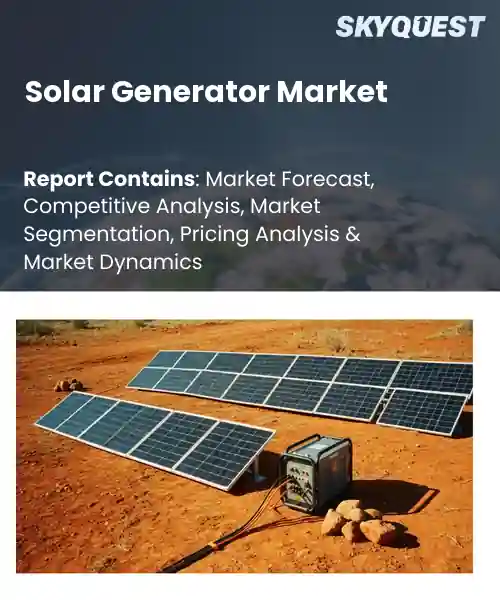
Solar Generator Market
Report ID: SQMIG20D2596
Report ID: SQMIG20D2596
[email protected]
USA +1 351-333-4748
Report ID:
SQMIG20D2596 |
Region:
Global |
Published Date: May, 2026
Pages:
157
|Tables:
176
|Figures:
79


Global Solar Generator Market size was valued at USD 665.2 Million in 2024 and is poised to grow from USD 722.41 Million in 2025 to USD 1397.72 Million by 2033, growing at a CAGR of 8.6% during the forecast period (2026-2033).
Solar generators combine photovoltaic panels with battery storage and power electronics to provide electricity, forming a rising segment of energy solutions that matter because they deliver reliable, low carbon power where grids are absent or unstable. The market began with small units for recreation and has matured into grid interactive systems as solar PV module prices plunged and lithium ion batteries gained energy density while costs fell. Early use cases were remote telecom sites and disaster relief operations, and today residential backup and community microgrids illustrate scale. The primary driver remains declining component costs alongside demand for resilience and decarbonization.
Because module and battery improvements reduced upfront and lifecycle costs, buyers now view solar generators as viable substitutes for diesel sets and grid extensions, which has accelerated uptake in construction, telecom and humanitarian response. Thus, financing methods such as pay-as-you-go and leasing have created demand for alternative energy sources in sub-Saharan Africa and Southeast Asia as they reduce entry costs and amortize long-term capital outlay. Companies can create opportunities to deliver power from microgrids to island populations, equip health clinics and schools with dependable electricity supply and provide hurricane prone homeowners with resilience packages that also generate measurable fuel savings, reduced emissions, and provide predictable operating costs.
How is IOT Improving Performance Monitoring in the Solar Generator Market?
In the solar generator market, IoT-enabled sensors attached to panels, inverters, and batteries can connect to the cloud providing real-time telemetry and analytical reporting for proper monitoring of performance. The most valuable features of IoT are module and string-level sensing, remote diagnostics, and automated alerts that provide more expedient fault identification and easy maintenance of systems. Distributed solar and storage systems will require a greater availability of smart O&M as demand from operators continues to increase. Practical examples include inverter fleet dashboards and module level power electronics that reveal underperforming strings. These capabilities translate into faster response times improved energy harvest and longer asset life while making service operations more predictable and scalable.
In May 2026, BLUETTI launched its Balco balcony solar series with a Smart S Meter and a wireless IoT system that enables seamless remote monitoring and automatic device interconnection, supporting broader adoption by reducing installation friction and improving ongoing performance oversight.
Market snapshot - (2026-2033)
Global Market Size
USD 665.2 Million
Largest Segment
Ground Mounted
Fastest Growth
Floating
Growth Rate
8.6% CAGR
To get more insights on this market click here to Request a Free Sample Report
Global solar generator market is segmented by power rating, battery type, application, portability, end user, distribution channel and region. Based on power rating, the market is segmented into Below 1,000 W, 1,000–2,000 W and Above 2,000 W. Based on battery type, the market is segmented into Lithium-Ion, Lead-Acid and Lithium Iron Phosphate (LiFePO4). Based on application, the market is segmented into Residential Backup Power, Outdoor & Recreational, Commercial Backup Power, Emergency & Disaster Relief, Off-Grid Power Supply and Others. Based on portability, the market is segmented into Portable Solar Generators and Stationary Solar Generators. Based on end user, the market is segmented into Residential, Commercial and Industrial. Based on distribution channel, the market is segmented into Online and Offline. Based on region, the market is segmented into North America, Europe, Asia Pacific, Latin America and Middle East & Africa.
Based on the global solar generator market growth, lithium iron phosphate (LiFePO4) segment dominates because its chemistry provides superior thermal stability, long cycle life, and robust deep discharge capability that directly enhances solar generator reliability. These characteristics reduce degradation and maintenance needs, support repeated full discharge profiles common in backup and off-grid applications, and encourage OEMs and system integrators to specify LiFePO4 for durable, safe solutions that lower lifecycle risk and ensure consistent performance.
However, lithium-ion batteries are emerging as the fastest growing area because their high energy density and improving battery management enable lighter, more compact portable solar generators. These advances expand consumer and professional portable applications, accelerate product innovation, and create demand for quickly deployable units that prioritize weight, form factor, and ease of transport.
Portable solar generators segment dominates because consumer demand for mobility and simple plug and play operation aligns with integrated products that bundle panels, inverters, and batteries into single units. By providing a convenient option for installation, manufacturers can eliminate the barriers to installation while increasing their potential retail/online distribution and motivating them to provide compact power banks with a high-speed charging capability. The increased utilization encourages users of portable off-grid power solutions to purchase the product.
However, stationary solar generators are the fastest growing area as interest in integrated backup and higher capacity installations rises among property owners and businesses. Installers will be more likely to adopt because of easier integration with building electric systems and more inverter compatibility. This allows for more turnkey stationary options that support extended hours of power and management of systems in less time.
To get detailed segments analysis, Request a Free Sample Report
As per the global solar generator market share, Asia Pacific dominates the industry because the region combines manufacturing depth, concentrated supply chains and integrated technology ecosystems that accelerate product development and deployment. The focus on energy independence and the use of renewable energy, combined with the breadth of electronics manufacturing and batteries, lead to a high rate of local adoption of both energy storage and power management technology. The regional component manufacturing community is able to achieve scale economies on component manufacturing and has established export channels, which allows for competitive pricing and a wide variety of products. The trend toward greater urbanization and the frequent reliability issues associated with electric utilities drive demand for alternative power sources, including affordable mobile power systems and resilient backup power sources.
Solar generator market in Japan focuses on reliability, compact design and tight integration with advanced battery management and power electronics. Domestic manufacturers draw on electronics expertise and strong research to produce resilient systems suited for disaster resilience and constrained urban environments. Consumer & institutional uptake is supported by established networks. When corporate buyer making purchasing decisions they prefer solutions that work within the framework of microgrid implementation strategies and provide long lasting performance in critical areas of operations.
Solar generator market in South Korea emphasizes high performance systems integrated with advanced battery and power electronics developed by major technology conglomerates. Strong domestic supply chain for cells and inverters supports rapid innovation and diverse product portfolios targeted at commercial, industrial and emergency power applications. Demand is driven by corporate energy strategies and urban resilience initiatives, while skilled installation networks and export oriented manufacturers reinforce product maturity and regional competitiveness.
Based on the global solar generator regional forecast, North America is experiencing rapid expansion of the industry due to growing concerns about grid resilience, increasing consumer interest in self supplied power and a vibrant ecosystem of installers, distributors and service providers. There is an increase in integrated generator and storage systems as utility companies are switching to more decentralized generation and companies are committing to continue purchasing power from these systems. The retail and professional market segments for outdoor recreation and preparedness for emergencies will provide strong opportunities for sales. Improved battery chemistry and electronics help make these systems more reliable and easier to use. The availability of different financing options and workforce development will contribute to a faster deployment of these systems. Strong consumer retail channels, active research hubs and product innovation pipelines drive frequent model refresh and broadened feature sets, helping to translate professional performance into mainstream household and commercial offerings.
Solar generator market in United States is shaped by strong consumer demand for backup power, outdoor recreation and mobile energy solutions, while commercial interest in microgrid and continuity offerings expands professional channels. Companies building connections through an expansive installer network and utilizing retail distribution provide increased product availability. Major product innovations focus on portability, rapid recharge capabilities, and interoperability with existing home energy systems to promote acceptance by all segments of residential customers.
Solar generator market in Canada is driven by demand for rugged, capable systems for remote communities and industrial sites. Most manufacturers and installers are primarily focused on ensuring that they produce durable equipment, develop batteries that perform well in cold temperatures, and create logistical systems for servicing their products. Public and private projects seek integrated solutions for energy access and resilience, while distributors build channels suited to long distance deployment and seasonal patterns, reinforcing interest among commercial operators and household buyers for off grid and backup power.
As per global solar generator regional outlook, Europe is strengthening its position in the industry through coordinated policy frameworks, mature renewable energy markets and an emphasis on integration of storage and smart controls. The ability of industrial manufacturers to develop competitive products relies upon both high levels of technical proficiency in power electronics and energy storage capabilities. In addition to harmonizing certification and standards across borders, having appropriate certifications reduces friction and facilitates cross border sales. The current economic climate is demonstrating both strong public and commercial interest in energy resilience, as well as the development of innovation ecosystems and financing that are specifically for distributed energy solutions. Additionally, the increasing expectation of customers for dependable products, along with the growing focus on lifecycle management and circular economy principles.
Solar generator market in Germany is anchored by engineering expertise, a robust manufacturing base and comprehensive standards that support high quality offerings. Some businesses and municipalities seek integrated solutions that integrate power generation, battery storage, and intelligent controls to provide continuity and flexibility. Through established installer networks and finance mechanisms, we can enhance the adoption of these technologies. Many research organizations and suppliers work towards improving system performance and durability to further strengthen the reputation of Germany as providing industrial-grade systems with high levels of reliability.
Solar generator market in United Kingdom reflects strong interest in household resilience, flexible commercial deployment and portable solutions for temporary sites. Market activity is supported by service oriented business models, rental channels and specialized installers that tailor systems to urban and rural contexts. Advances in system monitoring and customer financing are improving affordability and management, as well as collaborating between utility providers and technology providers to develop grid integrated products/services and improve customer service.
Solar generator market in France emphasizes versatility and integration with agricultural and municipal energy needs. Modular solutions which couple storage, generation and smart control maximally support off grid sites and urban backup applications while there are currently many manufacturers focused on developing adaptable designs and providing strong after sales support there are also a number of local installation and finance options available that help to reduce barriers to adoption. Through collaborative pilots between utilities and research organizations there has been an effort to create interoperability and tailored solutions across multiple jurisdictions.
To know more about the market opportunities by region and country, click here to
Buy The Complete Report
Declining System Installation Costs
Supportive Policy and Incentives
Intermittency and Reliability Concerns
Supply Chain and Material Constraints
Request Free Customization of this report to help us to meet your business objectives.
Competitive intensity in the global solar generator market outlook is driven by technology differentiation, strategic M&A and OEM entries, producing rapid product innovation and channel consolidation. Recent concrete moves include BioLite acquiring Goal Zero, Bluetti launching the Balco plug and play balcony solar range, Talix backed by Lenovo launching the Zeta modular power platform, and incumbent Generac releasing portable power stations.
Top Player’s Company Profile
Recent Developments
SkyQuest’s ABIRAW (Advanced Business Intelligence, Research & Analysis Wing) is our Business Information Services team that Collects, Collates, Correlates, and Analyses the Data collected by means of Primary Exploratory Research backed by robust Secondary Desk research.
As per SkyQuest analysis, declining component costs are a key driver accelerating adoption of solar generators by making systems more affordable and competitive with diesel alternatives. A principal restraint remains intermittency and reliability concerns that limit uptake for mission-critical applications. Regionally the market is dominated by Asia Pacific, supported by strong manufacturing, supply chains and policy support, and within product types the LiFePO4 battery segment is the dominating segment due to its safety and long cycle life. A second driver is the rise of flexible financing and service models such as PAYG and leasing, which lower entry barriers and broaden adoption across residential, commercial and off-grid users.
| Report Metric | Details |
|---|---|
| Market size value in 2024 | USD 665.2 Million |
| Market size value in 2033 | USD 1397.72 Million |
| Growth Rate | 8.6% |
| Base year | 2024 |
| Forecast period | (2026-2033) |
| Forecast Unit (Value) | USD Million |
| Segments covered |
|
| Regions covered | North America (US, Canada), Europe (Germany, France, United Kingdom, Italy, Spain, Rest of Europe), Asia Pacific (China, India, Japan, Rest of Asia-Pacific), Latin America (Brazil, Rest of Latin America), Middle East & Africa (South Africa, GCC Countries, Rest of MEA) |
| Companies covered |
|
| Customization scope | Free report customization with purchase. Customization includes:-
|
To get a free trial access to our platform which is a one stop solution for all your data requirements for quicker decision making. This platform allows you to compare markets, competitors who are prominent in the market, and mega trends that are influencing the dynamics in the market. Also, get access to detailed SkyQuest exclusive matrix.
Table Of Content
Executive Summary
Market overview
Parent Market Analysis
Market overview
Market size
KEY MARKET INSIGHTS
COVID IMPACT
MARKET DYNAMICS & OUTLOOK
Market Size by Region
KEY COMPANY PROFILES
Methodology
For the Solar Generator Market, our research methodology involved a mixture of primary and secondary data sources. Key steps involved in the research process are listed below:
1. Information Procurement: This stage involved the procurement of Market data or related information via primary and secondary sources. The various secondary sources used included various company websites, annual reports, trade databases, and paid databases such as Hoover's, Bloomberg Business, Factiva, and Avention. Our team did 45 primary interactions Globally which included several stakeholders such as manufacturers, customers, key opinion leaders, etc. Overall, information procurement was one of the most extensive stages in our research process.
2. Information Analysis: This step involved triangulation of data through bottom-up and top-down approaches to estimate and validate the total size and future estimate of the Solar Generator Market.
3. Report Formulation: The final step entailed the placement of data points in appropriate Market spaces in an attempt to deduce viable conclusions.
4. Validation & Publishing: Validation is the most important step in the process. Validation & re-validation via an intricately designed process helped us finalize data points to be used for final calculations. The final Market estimates and forecasts were then aligned and sent to our panel of industry experts for validation of data. Once the validation was done the report was sent to our Quality Assurance team to ensure adherence to style guides, consistency & design.
Analyst Support
Customization Options
With the given market data, our dedicated team of analysts can offer you the following customization options are available for the Solar Generator Market:
Product Analysis: Product matrix, which offers a detailed comparison of the product portfolio of companies.
Regional Analysis: Further analysis of the Solar Generator Market for additional countries.
Competitive Analysis: Detailed analysis and profiling of additional Market players & comparative analysis of competitive products.
Go to Market Strategy: Find the high-growth channels to invest your marketing efforts and increase your customer base.
Innovation Mapping: Identify racial solutions and innovation, connected to deep ecosystems of innovators, start-ups, academics, and strategic partners.
Category Intelligence: Customized intelligence that is relevant to their supply Markets will enable them to make smarter sourcing decisions and improve their category management.
Public Company Transcript Analysis: To improve the investment performance by generating new alpha and making better-informed decisions.
Social Media Listening: To analyze the conversations and trends happening not just around your brand, but around your industry as a whole, and use those insights to make better Marketing decisions.
REQUEST FOR SAMPLE
 REQUEST FREE CUSTOMIZATION
Global Solar Generator Market size was valued at USD 665.2 Million in 2024 and is poised to grow from USD 722.41 Million in 2025 to USD 1397.72 Million by 2033, growing at a CAGR of 8.6% during the forecast period (2026-2033).
Competitive intensity in the global solar generator market is driven by technology differentiation, strategic M&A and OEM entries, producing rapid product innovation and channel consolidation. Recent concrete moves include BioLite acquiring Goal Zero, Bluetti launching the Balco plug and play balcony solar range, Talix backed by Lenovo launching the Zeta modular power platform, and incumbent Generac releasing portable power stations. 'Jackery', 'EcoFlow', 'Bluetti', 'Goal Zero', 'Anker Innovations', 'Generac Holdings', 'Duracell', 'Lion Energy', 'Zendure', 'Mango Power', 'Pecron', 'Powerenz', 'ACOPOWER', 'Growatt', 'Renogy', 'ALLPOWERS', 'Suaoki', 'Humless', 'Westinghouse Electric Corporation', 'BioLite'
Declining costs of solar generator systems have significantly expanded accessibility for residential, commercial, and off-grid users, enabling more widespread adoption across diverse regions. Cost reductions lower the barrier to entry by reducing upfront investment requirements and making financing more feasible, which encourages new market entrants and stimulates demand. Manufacturers can allocate resources to innovation and distribution rather than cost absorption, creating a virtuous cycle that fosters greater deployment, broader consumer acceptance, and stronger market momentum driven by improved affordability worldwide.
Distributed Generation Adoption: Growing preference for localized, self-sufficient energy solutions is driving demand for portable solar generators across residential, commercial and community applications. Customers and organizations prioritize resilience, energy independence and onsite generation to support critical loads, outdoor operations and disaster preparedness. This trend encourages suppliers to tailor products for ease of deployment, interoperability with home energy systems, and modular scalability, while channel partners focus on installation services, value-added maintenance and localized customer education to accelerate adoption and long-term engagement and market differentiation.
Why does Asia Pacific Dominate the Global Solar Generator Market? |@12


Want to customize this report? This report can be personalized according to your needs. Our analysts and industry experts will work directly with you to understand your requirements and provide you with customized data in a short amount of time. We offer $1000 worth of FREE customization at the time of purchase.
Feedback From Our Clients


 USA (+1) 351-333-4748

