Solar Cooker Market
Report ID: SQMIG25H2070
Report ID: SQMIG25H2070
[email protected]
USA +1 351-333-4748
Report ID:
SQMIG25H2070 |
Region:
Global |
Published Date: March, 2026
Pages:
157
|Tables:
203
|Figures:
80


Global Solar Cooker Market size was valued at USD 527.2 Million in 2024 and is poised to grow from USD 574.12 Million in 2025 to USD 1135.6 Million by 2033, growing at a CAGR of 8.9% during the forecast period (2026-2033).
Key Takeaways: Market Trends & Insights
Growing demand for clean and renewable cooking solutions, rising energy costs, increasing awareness of environmental sustainability, government support for low-carbon technologies, and expanding adoption in off-grid regions are driving sales of solar cookers.
The use of policy support and subsidized distribution will help increase the sale of solar cookers because they will cut costs initially and facilitate easier adoption among rural and remote population groups. Subsidized programs in the state of Rajasthan, India have helped promote adoption and the creation of supply chains to support the process. Furthermore, improvements in design and technology have cut down the cost of manufacturing, thus making it possible to use the devices in institutions, such as schools and refugee camps. Growing concern over fuel costs and environmental impact, coupled with increasing need for affordable and sustainable cooking alternatives, is expected to primarily drive solar cooker market growth. Rising disposable income of people and increased awareness regarding the benefits offered by solar cookers are also forecasted to ensure sustained demand in the long run.
On the contrary, dependence on weather conditions, limited cooking capacity and speed, lack of awareness in certain regions, and initial adoption barriers are forecasted to hamper solar cooker market penetration across the study period and beyond.
How is IoT Integration Improving Performance Monitoring In Solar Cookers?
Incorporating IoT within solar cookers would facilitate the linking of temperature detectors, irradiance sensors, and location trackers with cloud-based servers, thus generating real-time data on the device’s performance. It allows monitoring of the level of heat generated, diagnosing problems remotely, and adjusting cooking based on the amount of sunlight available. Additionally, the increased uptake of IoT-powered devices being employed in community-based initiatives and standalone households compared to traditional solar cookers has opened up numerous possibilities.
In October 2025, GoSun introduced an upgraded solar appliance line with smart features and cloud connectivity. This allows real-time performance tracking, remote updates, and predictive alerts, reducing maintenance challenges and increasing user confidence, which supports wider adoption and market growth.

To get more insights on this market click here to Request a Free Sample Report
Global solar cooker market is segmented by technology type, power output, heat retention mechanism, price range, application, end user, distribution channel, and region. Based on technology type, the market is segmented into box cookers, panel cookers, parabolic cookers, and others. Based on power output, the market is segmented into under 500 Watts, 500 - 1000 Watts, and above 1000 Watts. Based on heat retention mechanism, the market is segmented into insulated cookers and non-insulated cookers. Based on price range, the market is segmented into economy, mid-range, and premium. Based on application, the market is segmented into domestic use, commercial use, educational purposes, and others. Based on end user, the market is segmented into residential, commercial, institutional, and others. Based on distribution channel, the market is segmented into online, offline, specialty outdoor retailers, NGO & aid-agency procurement, local workshops & informal networks, and others. Based on region, the market is segmented into North America, Europe, Asia Pacific, Latin America, and Middle East & Africa.
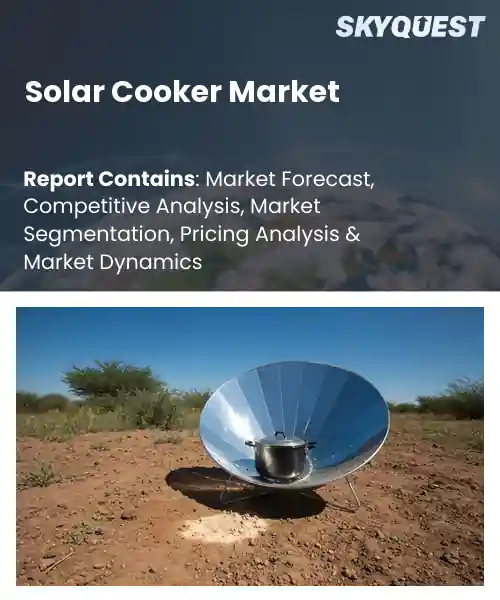
The parabolic cookers segment is slated to account for the largest global solar cooker market outlook. Reflector geometry concentrates sunlight to intense focal heat, producing rapid high-temperature cooking performance that is suitable for a wide range of end users to help cement the dominance of this segment. The performance edge is what fuels user demand for quick cooking times and industry applications, leading to manufacturers using high-quality material and tracking technologies. This is why parabolic cookers receive funding and attention from industries, securing their position as market leaders in terms of effectiveness.
However, box cookers are emerging as the rapidly expanding segment as per this solar cooker industry analysis. Ease of design, convenience of use, and enhanced insulation features have all contributed to their convenience when used daily at home. Enhancements in product design, strategic marketing tactics, and their adaptability to a maintenance-free way of life have made their adoption easier among a wider audience of consumers.
The offline segment is predicted to spearhead the global solar cooker market revenue generation across the forecast period. Brick-and-mortar retailers, specialty outdoor shops, and local workshops provide hands-on demonstrations, tactile product evaluation, and immediate after-sales service, which makes them a preferred channel among end users. Such channels ensure that repair and parts services are available, as well as facilitate institutional sales through existing procurement networks. As a result, conventional distribution ensures market reach, allowing end-users and business buyers to judge product performance prior to making their purchase decisions.
Nevertheless, Online distribution has become the most rapidly growing segment as e-commerce allows for increased outreach, direct-to-customer pricing, and the use of multimedia to demonstrate products. Digital marketing and improved logistics ensure the quick identification of potential customers and inventory management, which unlocks the potential for rapid growth in the marketplace.

To get detailed segments analysis, Request a Free Sample Report
Climatic suitability, strong manufacturing capabilities, supportive policy signals, and vibrant consumer and institutional adoption allows this region to maintain its dominance. Off-grid and energy-efficient cooking solutions are often given priority at both a public and private stakeholder level when providing cooking solutions to rural or peri-urban populations, thus creating opportunities for pilot projects as well as large-scale adoption. Solar cooker manufacturers are working in partnership with research organisations to develop solar cooking products that are tailored to the cooking methods and preferences of the users in specific regions to increase user acceptance. Continued expansion of the solar cooker market is also supported by the integration of logistics and supply chain networks which enhance the ability for local manufacturers to sell their products into the global marketplace and help continue to grow the number of solar cookers being used in demonstration sites. Low cost manufacturing and rising popularity of off-grid living are also ensuring sustained solar cooker demand across the Asia Pacific region through 2033.
Advanced manufacturing, strong research collaboration, and a consumer base receptive to high quality design and safety standards are shaping sales of solar cookers in Japan. Collaborations between manufacturing companies and research organizations help to adapt products according to local food culture, while distribution in specialized channels increases market exposure. Product optimization, linking with smart home ideas, and top-end positioning facilitate market penetration for early adopters from the urban environment and specialty customers.
Solar cooker demand in South Korea is governed by technological innovation, robust supply chain capabilities, and targeted urban deployment strategies. Joint ventures between technology companies, design agencies, and other public programs ensure that consumers try these products in smaller sectors. Focus on efficiency and integration into local culinary culture creates a positive effect among consumers. Collaborations between technology companies, designers, and government programs encourage testing and usage of products in specialized markets.
Consumer sustainability preferences, supportive institutional procurement across public and private sectors, and innovation in product design helps create a new business scope in North America. Manufacturers are focusing on producing modular, portable, and integrated products to work with other types of renewable energy systems and forming strategic relationships with distributors and community organizations to extend their reach into the marketplace. Investing in user education, demonstration programs, and safety certifications will help build trust and reduce barriers to adoption. Local manufacturers are also taking advantage of rapid prototyping and small batches to create products that are tailored to meet niche preferences and seasonal demand, thereby improving their product market fit. Increasing interest in off-grid and low-carbon cooking solutions among outdoor enthusiasts is also creating a new business scope across the region.
Varied solar cooker demand from outdoor enthusiasts, emergency preparedness communities, and eco minded households shapes market development in the United States. Concern safety certifications, portability, and suitability for camping usage influences product development. Wide availability through retail outlets and online portals helps in the discovery and purchase of these products. Cooperation with outdoor retail stores and organizations helps in showcasing products to the target consumers.
Rising interest in solar cookers from outdoor recreation groups, remote communities, and environmentally conscious consumers helps shape sales potential across Canada. Companies tailor their marketing and positioning according to the climatic conditions prevalent in specific markets, but at the same time ensure durable production and proper after-sales services. Portability, resistance to cold temperatures, and ease of maintenance drive consumer choices for products. Promotion through specialist stores and outdoor stores, along with demonstrations, aids in developing consumer awareness.
Coordinated emphasis on product quality, user safety, and alignment with broader sustainability objectives are helping boost solar cooker demand in the European region. Public and private sector efforts create demonstration projects, outreach to local communities, and integration of solar cookers within existing local renewable energy programs to increase awareness and help normalize solar cooking adoption. Manufacturers, technology companies, research institutions and specialty distributors are collaborating across borders to refine solar cookers to meet the broad range of culinary traditions and local climate conditions that exist throughout Europe. Targeted marketing plans, aftersales services and partnerships with nonprofit and community organizations are also expected to generate a new business scope. Local manufacturers are also focusing on designing solar cookers for different preparation techniques, along with seasonal design elements for practicality, while retailers are expanding their assortment of curated solar cookers to meet consumer expectations.
There is a strong preference in Germany for a solar cooker that meets the standards of energy efficiency and sustainability. Quality after-sales service and documentation are important requirements for all suppliers ofh solar cookers. The consumer needs are concerned with quality, safety, and information on performance; hence, the manufacturer should concentrate on these features when designing and testing the products. Specialty energy markets will help consumers make wise decisions regarding their purchase, while cooperation with scientific organizations will ensure suitability for local conditions.
Consumers practicing sustainable living, people engaging in outdoor activities, and local projects aimed at generating energy for communities are helping boost solar cooker demand in the United Kingdom. Manufacturers make sure that the products meet all the required safety standards and that there is an easy-to-understand guide on how to use them and quality customer care services. Consumers prefer products that are versatile, easy to operate, and suitable for different kinds of cooking.
Rising interest in sustainable cooking among outdoor gastronomy audiences seeking adaptable, design-oriented solutions are shaping solar cooker demand in France. Suppliers work together with culinary networks and community organizations to illustrate practical use, focusing on quality materials and after-sales support. Product selection is influenced by aesthetics, ease of use, and adaptability to local culinary practices. Product distribution through design stores, specialty stores for the outdoors, and the Internet allows products to reach lifestyle consumers.

To know more about the market opportunities by region and country, click here to
Buy The Complete Report
Rising Focus on Renewable Energy
Prioritizing renewable energy in government policies makes solar cookers increasingly attractive as green household appliances through supportive policies, marketing, and procurement practices. This priority motivates companies to develop their products in line with sustainable goals, facilitates collaboration with NGOs for marketing purposes, and builds consumers' confidence in using solar cookers as eco-friendly devices. The joint effort towards decarbonization and renewable energy makes consumers recognize the use of solar cookers as part of other larger renewable projects.
Technological Innovation and Design Improvements
Constant improvements in materials used for reflectors, methods for storing heat, and designs that make them more portable, durable, and convenient add to the attractiveness of solar cookers. This will allow companies to produce unique models that can meet various user requirements, facilitate better user experiences leading to viral marketing, and assist users in integrating solar cooking with other types of cooking processes. Through such advancements in technology, solar cookers can be made more appealing, ensuring greater consumer confidence in their performance and usage, which leads to successful marketing.
Intermittent Solar Resource Availability
Reliance on a constant source of sunlight hinders the use of solar cookers in areas characterized by changing weather conditions, cloudiness, or changes in seasonality, resulting in doubts about their ability to provide reliable daily services. The lack of reliability makes the commercialization of solar cookers more difficult, as the time and geographical scope during which they can be successfully used is very limited. It also makes people reluctant to replace traditional cooking methods.
Perceived High Upfront Costs
Misconceptions about substantial costs needed to buy the cooker prevent people from purchasing them despite possible future gains, especially for those who are financially constrained or organizations. The lack of financial mechanisms available for buyers limits their ability to purchase solar cookers. Cost issues result in hampered solar cooker market outlook, slow word-of-mouth marketing, and scaling issues due to the preference of people to save money on the upfront costs than save later.
Request Free Customization of this report to help us to meet your business objectives.
Competitive dynamics in the global solar cooker market center on product differentiation, hybrid technology and distribution partnerships that unlock humanitarian and off-grid channels. Manufacturers are launching hybrid solar-electric ovens to help expand their sales potential. NGOs are forming government and private-sector alliances to scale pilots across unreached countries as per this solar cooker market analysis. Here are some startups that could boost the sales of solar cookers in the long run. Athel Technology Limited: Formed in the year 2020, their primary goal is to produce and distribute the EcoMpishi solar cooker, a DC induction cooker that uses photovoltaics, ensuring clean cooking day and night while eliminating charcoal usage in rural settings. This young Kenyan startup company has also been through an accelerator program in 2023 and gained initial support from local NGOs to start small pilot tests and scale up the local assembly and marketing process of their solar cooker product.
Mag Fire: Established in 2022, their main objective is to produce affordable solar stoves for Indonesian households and small food businesses using simple parabolic and thermal storage designs to cut reliance on LPG and kerosene. The Indonesian startup launched prototypes in 2022, began soft sales via social media and campus exhibitions, refined the design through user testing, and is pursuing CSR partnerships to pilot distribution in rural communities locally.
SkyQuest’s ABIRAW (Advanced Business Intelligence, Research & Analysis Wing) is our Business Information Services team that Collects, Collates, Correlates, and Analyses the Data collected by means of Primary Exploratory Research backed by robust Secondary Desk research.
As per SkyQuest analysis, rising demand for clean and renewable cooking solutions and increasing focus on reducing fuel costs and carbon emissions are anticipated to drive the demand for solar cookers going forward. However, dependence on weather conditions, limited cooking efficiency, and lack of awareness in certain regions are slated to slow down the adoption of solar cookers in the future. Asia Pacific is slated to spearhead the demand for solar cookers owing to strong government support, presence of off-grid communities, and subsidization of sustainable energy solutions in countries such as India, Indonesia, and China. Integration of IoT-enabled smart features, advancements in modular and efficient cooker designs, and expansion of subsidized distribution programs are anticipated to be key trends driving the solar cooker sector across the study period.
| Report Metric | Details |
|---|---|
| Market size value in 2024 | USD 527.2 Million |
| Market size value in 2033 | USD 1135.6 Million |
| Growth Rate | 8.9% |
| Base year | 2024 |
| Forecast period | 2026-2033 |
| Forecast Unit (Value) | USD Million |
| Segments covered |
|
| Regions covered | North America (US, Canada), Europe (Germany, France, United Kingdom, Italy, Spain, Rest of Europe), Asia Pacific (China, India, Japan, Rest of Asia-Pacific), Latin America (Brazil, Rest of Latin America), Middle East & Africa (South Africa, GCC Countries, Rest of MEA) |
| Companies covered |
|
| Customization scope | Free report customization with purchase. Customization includes:-
|
To get a free trial access to our platform which is a one stop solution for all your data requirements for quicker decision making. This platform allows you to compare markets, competitors who are prominent in the market, and mega trends that are influencing the dynamics in the market. Also, get access to detailed SkyQuest exclusive matrix.
Table Of Content
Executive Summary
Market overview
Parent Market Analysis
Market overview
Market size
KEY MARKET INSIGHTS
COVID IMPACT
MARKET DYNAMICS & OUTLOOK
Market Size by Region
KEY COMPANY PROFILES
Methodology
For the Solar Cooker Market, our research methodology involved a mixture of primary and secondary data sources. Key steps involved in the research process are listed below:
1. Information Procurement: This stage involved the procurement of Market data or related information via primary and secondary sources. The various secondary sources used included various company websites, annual reports, trade databases, and paid databases such as Hoover's, Bloomberg Business, Factiva, and Avention. Our team did 45 primary interactions Globally which included several stakeholders such as manufacturers, customers, key opinion leaders, etc. Overall, information procurement was one of the most extensive stages in our research process.
2. Information Analysis: This step involved triangulation of data through bottom-up and top-down approaches to estimate and validate the total size and future estimate of the Solar Cooker Market.
3. Report Formulation: The final step entailed the placement of data points in appropriate Market spaces in an attempt to deduce viable conclusions.
4. Validation & Publishing: Validation is the most important step in the process. Validation & re-validation via an intricately designed process helped us finalize data points to be used for final calculations. The final Market estimates and forecasts were then aligned and sent to our panel of industry experts for validation of data. Once the validation was done the report was sent to our Quality Assurance team to ensure adherence to style guides, consistency & design.
Analyst Support
Customization Options
With the given market data, our dedicated team of analysts can offer you the following customization options are available for the Solar Cooker Market:
Product Analysis: Product matrix, which offers a detailed comparison of the product portfolio of companies.
Regional Analysis: Further analysis of the Solar Cooker Market for additional countries.
Competitive Analysis: Detailed analysis and profiling of additional Market players & comparative analysis of competitive products.
Go to Market Strategy: Find the high-growth channels to invest your marketing efforts and increase your customer base.
Innovation Mapping: Identify racial solutions and innovation, connected to deep ecosystems of innovators, start-ups, academics, and strategic partners.
Category Intelligence: Customized intelligence that is relevant to their supply Markets will enable them to make smarter sourcing decisions and improve their category management.
Public Company Transcript Analysis: To improve the investment performance by generating new alpha and making better-informed decisions.
Social Media Listening: To analyze the conversations and trends happening not just around your brand, but around your industry as a whole, and use those insights to make better Marketing decisions.
REQUEST FOR SAMPLE
 REQUEST FREE CUSTOMIZATION
Global Solar Cooker Market size was valued at USD 527.2 Million in 2024 and is poised to grow from USD 574.12 Million in 2025 to USD 1135.6 Million by 2033, growing at a CAGR of 8.9% during the forecast period (2026-2033).
Competitive dynamics in the global solar cooker market center on product differentiation, hybrid technology and distribution partnerships that unlock humanitarian and off-grid channels. Manufacturers are launching hybrid solar-electric ovens and NGOs are forming government and private-sector alliances to scale pilots. Examples include GoSun's hybrid Fusion launch and Solar Cookers International partnerships with refugee and government programs, demonstrating tech innovation and partnership-led scale. 'Sun Oven International', 'GoSun', 'Solavore', 'Solar Cookers International', 'EcoZoom', 'One Earth Designs', 'Sunfire', 'Haines Solar Cookers LLC', 'Rudra Solar Energy', 'SunSpot Solar Ovens', 'SunFlair Solar Ovens, LLC', 'Global Sun Oven', 'Changzhou-Raven New Energy', 'Box Solar Cookers', 'Sunking', 'SolarKettle', 'Sunrise Global Solar Energy', 'SunFire Solutions', 'Solar Oven Society', 'Anuman Solar'
Renewable energy prioritization by governments and institutions elevates the appeal of solar cookers as a clean household technology, creating policy support, awareness campaigns, and procurement preferences that encourage adoption. This focus stimulates manufacturers to align product development with sustainability goals, enhances partnerships with non governmental organizations for distribution, and fosters consumer trust in solar cooking as an environmentally responsible alternative to traditional fuels. The collective emphasis on decarbonization and energy access strengthens market demand by making solar cooking a visible solution within broader renewable initiatives.
Microgrid Integration Opportunities: Growing alignment with decentralized energy agendas positions solar cookers as complementary assets within community microgrids, enabling synchronized thermal and electrical load management. Manufacturers and service providers are exploring modular designs and interoperability standards to allow solar cookers to integrate with local power management systems, enhancing reliability and user adoption. This trend encourages partnerships between clean cooking advocates and microgrid developers, fostering bundled offerings, shared maintenance frameworks, and financing models that emphasize resilience and utility for rural and peri-urban energy ecosystems.
Asia Pacific Dominate the Global Solar Cooker Market.
The market includes box cookers, panel cookers, parabolic cookers, and hybrid solar cookers, each designed for different cooking capacities, heat efficiency, and consumer applications
Governments and non-governmental organizations are supporting adoption through subsidies, renewable energy awareness campaigns, rural development programs, and clean cooking initiatives aimed at reducing carbon emissions and dependence on traditional fuels.
Key challenges include dependence on sunlight availability, limited cooking speed during cloudy weather, low consumer awareness in certain regions, and higher initial setup costs compared to traditional cooking methods.


Want to customize this report? This report can be personalized according to your needs. Our analysts and industry experts will work directly with you to understand your requirements and provide you with customized data in a short amount of time. We offer $1000 worth of FREE customization at the time of purchase.
Feedback From Our Clients


 USA (+1) 351-333-4748

