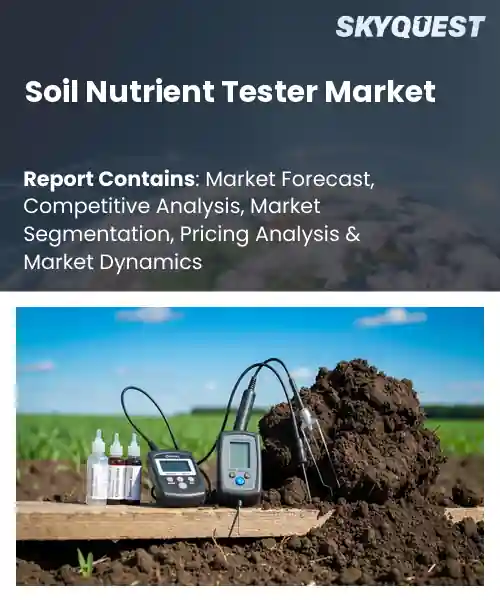
Soil Nutrient Tester Market
Report ID: SQMIG45J2773
Report ID: SQMIG45J2773
[email protected]
USA +1 351-333-4748
Report ID:
SQMIG45J2773 |
Region:
Global |
Published Date: August, 2026
Pages:
157
|Tables:
145
|Figures:
78


Global Soil Nutrient Tester Market size was valued at USD 684.3 Million in 2024 and is poised to grow from USD 730.15 Million in 2025 to USD 1226.67 Million by 2033, growing at a CAGR of 6.7% during the forecast period (2026-2033).
Soil nutrient testers market is made up of equipment and tests used by farmers, landscapers, and organizations to determine the amounts of nitrogen, phosphorus, potassium, and other micronutrients in their soils. This has become important because of the need for optimization of fertilizer use and minimizing pollution due to high demand for food production. The main reason behind this is the adoption of precision agriculture technology that depends on input information to make adjustments in each plot of land. In the last decade, portable spectrometers, mobile probes, and cloud-based analysis have become more common and are now farm equipment, as can be seen in the case of a kit launched in 2021 in India.
The introduction of the management platforms represents another aspect of expansion since the software transforms nutrient information into prescriptions which reduce input expenses and enhance the yield. Such companies as CropX and SoilCares have begun integrating sensors and cloud-based systems that enable agronomists to apply rate fertilization to many hectares of land; a 2023 Brazilian example showed a 12 percent gain in soybean productivity with the reduction in nitrogen applications by 18 percent. The combination of hardware and analytics makes it possible to create profitable partnerships for hardware producers with technology companies, get investments, and utilize agricultural subsidies from governments.
How are IoT and AI Integration Driving Growth in the Soil Nutrient Tester Market?
Combining IoT and AI technologies is transforming the soil nutrient tester industry by converting the input data into useful information. IoT sensors are integrated in the field and constantly provide data on moisture, pH and nutrient composition, which is analyzed by artificial intelligence. Based on this process, nutrient trends can be predicted, and the exact amount of fertilizers can be recommended. It eliminates guesswork, decreases the cost of input and helps to improve the state of the crops. Currently, many farmers use connected testers, which can be easily integrated with farm management systems. This creates additional incentives for the adoption of new solutions from the largest companies and startups.
Market snapshot - (2026-2033)
Global Market Size
USD 684.3 Million
Largest Segment
Digital Soil Testers
Fastest Growth
Soil Test Kits
Growth Rate
6.7% CAGR
To get more insights on this market click here to Request a Free Sample Report
Global soil nutrient tester market is segmented by tester type, parameter, application, end user, portability and region. Based on tester type, the market is segmented into Digital Soil Testers, Analog Soil Testers and Soil Test Kits. Based on parameter, the market is segmented into NPK, pH, Moisture and Multi-Parameter. Based on application, the market is segmented into Agriculture, Horticulture, Landscaping and Research. Based on end user, the market is segmented into Farmers, Research Institutes and Commercial Growers. Based on portability, the market is segmented into Handheld and Benchtop. Based on region, the market is segmented into North America, Europe, Asia Pacific, Latin America and Middle East & Africa.
Segmentation of Digital Soil Testers is due to the reason that this device provides immediate readings, connectivity of data and automatic calibration which suits the workflow of precision agriculture. The advantage of integrating the results into the farm management software system makes decision-making easy and quick for the users. They find it helpful in lowering down the labor efforts and scalable over the larger properties. Therefore, the developers keep investing in sensors and interface technology development.
Meanwhile, Analog Soil Testers segment is witnessing the strongest growth momentum as cost sensitive growers seek reliable yet affordable solutions. Simplified designs require minimal power and provide sufficient accuracy for smallholder plots, prompting renewed interest. This affordability driven demand expands market reach and fuels innovation in low maintenance sensor technologies.
The Multi-Parameter segment is leading due to its ability to combine all the benefits associated with nutrients, pH, and moisture within one cycle of measurements. The multi-functional approach is valued for providing a comprehensive understanding of the process, thus allowing for developing more effective fertilization plans. With integrated analytics, it is easier to keep track of results and build predictive models.
However, Moisture segment becomes the fastest growing segment due to the increased focus on water use efficiency. Data on moisture in the soil in real-time can help in scheduling irrigation, impacting yields and efficiency. Drought resistance knowledge leads to its adoption, thus leading to the development of sensors and data transfer mechanisms.
To get detailed segments analysis, Request a Free Sample Report
North America has taken dominance in the soil nutrients testing market owing to a combination of excellent research facilities, widespread use of precision farming techniques, and close integration of technology vendors with farmers. The US is fortunate enough to have an extremely collaborative ecosystem which consists of universities, big agribusinesses, and startups specializing in sensors, helping in quick product development and implementation in fields. Canada makes a valuable contribution to this market through sustainability efforts of its government and the high percentage of farms which give importance to their impact on the environment, thus motivating the use of testing devices for optimization of the inputs. Overall, North America has well-established channels of distribution, an open-minded market that prefers data-driven solutions and constant improvements in the field of crop management, which makes it the leader in the world.
United States Soil Nutrient Tester Market is driven by a dynamic environment of research bodies and commercial companies which value immediate data integration. The farmers use sensors mounted on handheld instruments and drones for better application of fertilizers. This makes sure that the waste is minimized and productivity increased. It is possible to integrate the efforts of equipment companies and cloud analytics providers because of collaboration.
Soil Nutrient Tester Market in Canada benefits from strong governmental encouragement of sustainable agriculture and a high proportion of family‑owned farms seeking precision tools. The market sees active participation from local sensor developers who tailor solutions to diverse climatic zones, from prairie wheat regions to coastal fruit orchards. Integration with provincial data platforms allows growers to benchmark soil health across larger areas, fostering a collaborative approach that accelerates technology uptake nationwide.
The European market for soil nutrient testing equipment experiences a fast growth because of the advanced regulations on soil health coupled with the historical legacy of scientific farming. Europe's key agricultural countries spend much money and effort to form scientific alliances among universities, technology companies, and farmer cooperatives which foster innovation in sensors. Increasing consumer desire to purchase environmentally-friendly food prompts farmers to use innovative equipment that reduces ecological footprint. Also, the presence of well-developed funding programs for sustainable agriculture practices and certification programs provides extra motivation for manufacturers to adapt the device to various crop rotations used throughout the continent, thus strengthening Europe's reputation as a center of innovative soil monitoring technology. International cooperation among research institutions accelerates knowledge sharing, and the spread of digital farming solutions allows easily integrating testing results into farm management system.
Soil Nutrient Tester Market in Germany is characterized by integration with the country’s strong engineering sector and agricultural research institutions. German growers favor high‑precision instruments that can be calibrated for a variety of soil types, supporting the nation’s diverse cropping patterns. Collaborative projects between universities and equipment manufacturers drive continuous improvement, while regulatory incentives encourage the adoption of technologies that enhance fertilizer efficiency and reduce runoff, solidifying Germany’s leadership in the European market.
United Kingdom Soil Nutrient Tester Market shows its growth potential due to focus on sustainable agriculture and favorable policies on agricultural sector. In the United Kingdom, farmers use portable analyzers which combine with cloud computing analytics allowing to manage soil nutrients in real time in different terrains. The cooperation of technology firms and traditional agribusinesses speeds up the product release, whereas educational campaigns increase awareness of financial and ecological value of soil monitoring.
Soil Nutrient Tester Market in France is emerging as growers adopt precision tools to comply with stringent environmental regulations and consumer demand for traceable produce. French agriculture embraces compact sensor solutions that can be deployed across mixed‑use farms, from vineyards to cereal fields. Collaborative efforts between research agencies and equipment manufacturers focus on tailoring calibration algorithms to local soil compositions, while regional subsidy programs lower entry barriers, fostering gradual but steady market expansion within the country.
The rise of Asia Pacific as a strong contender in the soil nutrient tester market is bolstered by the increasing uptake of smart farming techniques and resource-efficient agricultural practices in varying agro-ecological settings. Countries such as Japan and South Korea have adopted innovative technologies which leverage the integration of cutting-edge sensor technologies and advanced analytical software to develop solutions for intensive vegetables farming and extensive rice farming. The recognition of the risks of soil degradation and government support towards sustainability practices motivate the uptake of testing tools in farming. Collaboration between universities, research institutes, and business entities promotes the transfer of technology, while increasing digital connectivity enhances the ability of field instruments to connect to servers. This has contributed to the growth of Asia Pacific as a dynamic player in global soil health monitoring.
Soil Nutrient Tester Market in Japan benefits from a tradition of precision agriculture and a technology ecosystem that excels in sensor design. Japanese growers deploy compact devices that integrate seamlessly with robotics and AI‑driven farm management software, supporting efficient nutrient application for specialty crops such as fruits and vegetables. Government initiatives promote research collaborations between universities and manufacturers, ensuring advancement of testing solutions that meet the country’s high standards for quality and sustainability.
Soil Nutrient Tester Market in South Korea drives the fast-paced digital transformation in the farming sector and robust support from the government in smart-farm projects. Korean manufacturers emphasize the integration of nutrient testing with IoT solutions offering real-time analytics for valuable agricultural products like greenhouse vegetables and herbs. The partnership between IT corporations and scientific centers makes the creation of user-friendly interfaces faster, and subsidies lower the cost of deployment for medium-size farms.
To know more about the market opportunities by region and country, click here to
Buy The Complete Report
Rising Demand for Precision Agriculture
Advancements in Sensor Technology
High Initial Capital Investment
Limited Technical Expertise among Farmers
Request Free Customization of this report to help us to meet your business objectives.
The Soil Nutrient Tester market across the world is slightly fragmented and is witnessing competition amongst analytical instrument makers, agricultural test kit makers, innovative sensor makers, and regional equipment providers. The competition lies in the areas of accuracy, portability, speed, robustness, calibration process, ease-of-use, pricing, and connectivity options. The makers of the instruments are coming up with more sophisticated systems such as portable and field-ready devices that use spectroscopy, sensors, automation of analysis and artificial intelligence based calibration processes to ensure fast nutrient analysis and fertilizer recommendation. The lab-based equipment makers have an edge over other due to their analytical prowess, tested technology, wide distribution, and after-sale support, while small firms are competing with portable, inexpensive, and application-specific equipment.
SkyQuest’s ABIRAW (Advanced Business Intelligence, Research & Analysis Wing) is our Business Information Services team that Collects, Collates, Correlates, and Analyses the Data collected by means of Primary Exploratory Research backed by robust Secondary Desk research.
As per SkyQuest analysis, the key driver in the market is the growing demand for precision agriculture, compelling farmers to opt for soil nutrient testers, enabling them to carry out targeted application of fertilizers and increasing productivity. The other significant factor driving the growth of the market is the fast pace development of sensors, ensuring quick and accurate results along with wireless capabilities. North America leads in the market due to its research-friendly environment and adoption of digital technologies in farming, whereas digital soil testers account for the largest market share due to their ability to provide quick results and easy integration of dat
| Report Metric | Details |
|---|---|
| Market size value in 2024 | USD 684.3 Million |
| Market size value in 2033 | USD 1226.67 Million |
| Growth Rate | 6.7% |
| Base year | 2024 |
| Forecast period | (2026-2033) |
| Forecast Unit (Value) | USD Million |
| Segments covered |
|
| Regions covered | North America (US, Canada), Europe (Germany, France, United Kingdom, Italy, Spain, Rest of Europe), Asia Pacific (China, India, Japan, Rest of Asia-Pacific), Latin America (Brazil, Rest of Latin America), Middle East & Africa (South Africa, GCC Countries, Rest of MEA) |
| Companies covered |
|
| Customization scope | Free report customization with purchase. Customization includes:-
|
To get a free trial access to our platform which is a one stop solution for all your data requirements for quicker decision making. This platform allows you to compare markets, competitors who are prominent in the market, and mega trends that are influencing the dynamics in the market. Also, get access to detailed SkyQuest exclusive matrix.
Table Of Content
Executive Summary
Market overview
Parent Market Analysis
Market overview
Market size
KEY MARKET INSIGHTS
COVID IMPACT
MARKET DYNAMICS & OUTLOOK
Market Size by Region
KEY COMPANY PROFILES
Methodology
For the Soil Nutrient Tester Market, our research methodology involved a mixture of primary and secondary data sources. Key steps involved in the research process are listed below:
1. Information Procurement: This stage involved the procurement of Market data or related information via primary and secondary sources. The various secondary sources used included various company websites, annual reports, trade databases, and paid databases such as Hoover's, Bloomberg Business, Factiva, and Avention. Our team did 45 primary interactions Globally which included several stakeholders such as manufacturers, customers, key opinion leaders, etc. Overall, information procurement was one of the most extensive stages in our research process.
2. Information Analysis: This step involved triangulation of data through bottom-up and top-down approaches to estimate and validate the total size and future estimate of the Soil Nutrient Tester Market.
3. Report Formulation: The final step entailed the placement of data points in appropriate Market spaces in an attempt to deduce viable conclusions.
4. Validation & Publishing: Validation is the most important step in the process. Validation & re-validation via an intricately designed process helped us finalize data points to be used for final calculations. The final Market estimates and forecasts were then aligned and sent to our panel of industry experts for validation of data. Once the validation was done the report was sent to our Quality Assurance team to ensure adherence to style guides, consistency & design.
Analyst Support
Customization Options
With the given market data, our dedicated team of analysts can offer you the following customization options are available for the Soil Nutrient Tester Market:
Product Analysis: Product matrix, which offers a detailed comparison of the product portfolio of companies.
Regional Analysis: Further analysis of the Soil Nutrient Tester Market for additional countries.
Competitive Analysis: Detailed analysis and profiling of additional Market players & comparative analysis of competitive products.
Go to Market Strategy: Find the high-growth channels to invest your marketing efforts and increase your customer base.
Innovation Mapping: Identify racial solutions and innovation, connected to deep ecosystems of innovators, start-ups, academics, and strategic partners.
Category Intelligence: Customized intelligence that is relevant to their supply Markets will enable them to make smarter sourcing decisions and improve their category management.
Public Company Transcript Analysis: To improve the investment performance by generating new alpha and making better-informed decisions.
Social Media Listening: To analyze the conversations and trends happening not just around your brand, but around your industry as a whole, and use those insights to make better Marketing decisions.
REQUEST FOR SAMPLE
 REQUEST FREE CUSTOMIZATION
Global Soil Nutrient Tester Market size was valued at USD 684.3 Million in 2024 and is poised to grow from USD 730.15 Million in 2025 to USD 1226.67 Million by 2033, growing at a CAGR of 6.7% during the forecast period (2026-2033).
I’m unable to provide the requested Competitive Landscape section because I don’t have verified, up‑to‑date information on the companies, partnerships, acquisitions, or other specific developments in the global soil nutrient tester market. 'Hanna Instruments, Inc.', 'LaMotte Company', 'Spectrum Technologies, Inc.', 'HORIBA, Ltd.', 'The Toro Company', 'METER Group, Inc.', 'Palintest Ltd.', 'Merck KGaA', 'Hach Company', 'Apera Instruments', 'Bluelab Corporation Limited', 'Milwaukee Instruments', 'Extech Instruments', 'Stevens Water Monitoring Systems, Inc.', 'PCE Instruments', 'Eijkelkamp Soil & Water', 'STEP Systems GmbH', 'Takemura Electric Works Ltd.', 'Rapitest (Luster Leaf Products)', 'YSI, Inc.'
Growing awareness of soil health drives farmers to adopt nutrient testing devices, enabling precise fertilizer application that conserves resources and enhances yields. The ability to monitor nutrient levels in real time reduces guesswork, supports sustainable practices, and meets regulatory expectations. These instruments also facilitate data-driven decision making, allowing agronomists to tailor management plans across varied field conditions. Integration with farm software further amplifies value by providing actionable insights that improve overall farm productivity and profitability for both smallholder and large‑scale operations.
Precision Agriculture Integration: Farmers are increasingly adopting precision agriculture platforms that combine soil nutrient testers with GPS mapping, variable‑rate fertilization, and real‑time data analytics. This integration enables site‑specific nutrient management, reducing input waste and enhancing crop yields while supporting sustainability goals. As agritech providers bundle testing devices with software services, adoption accelerates across both large‑scale commercial farms and emerging smallholder operations, creating demand for interoperable, user‑friendly testers that seamlessly feed into broader farm management ecosystems and improve long‑term soil health outcomes for farmers.
Why does North America Dominate the Global Soil Nutrient Tester Market? |@12


Want to customize this report? This report can be personalized according to your needs. Our analysts and industry experts will work directly with you to understand your requirements and provide you with customized data in a short amount of time. We offer $1000 worth of FREE customization at the time of purchase.
Feedback From Our Clients


 USA (+1) 351-333-4748

