Software Outsourcing Market
Report ID: SQMIG45B2304
Report ID: SQMIG45B2304
[email protected]
USA +1 351-333-4748
Report ID:
SQMIG45B2304 |
Region:
Global |
Published Date: February, 2026
Pages:
157
|Tables:
154
|Figures:
78


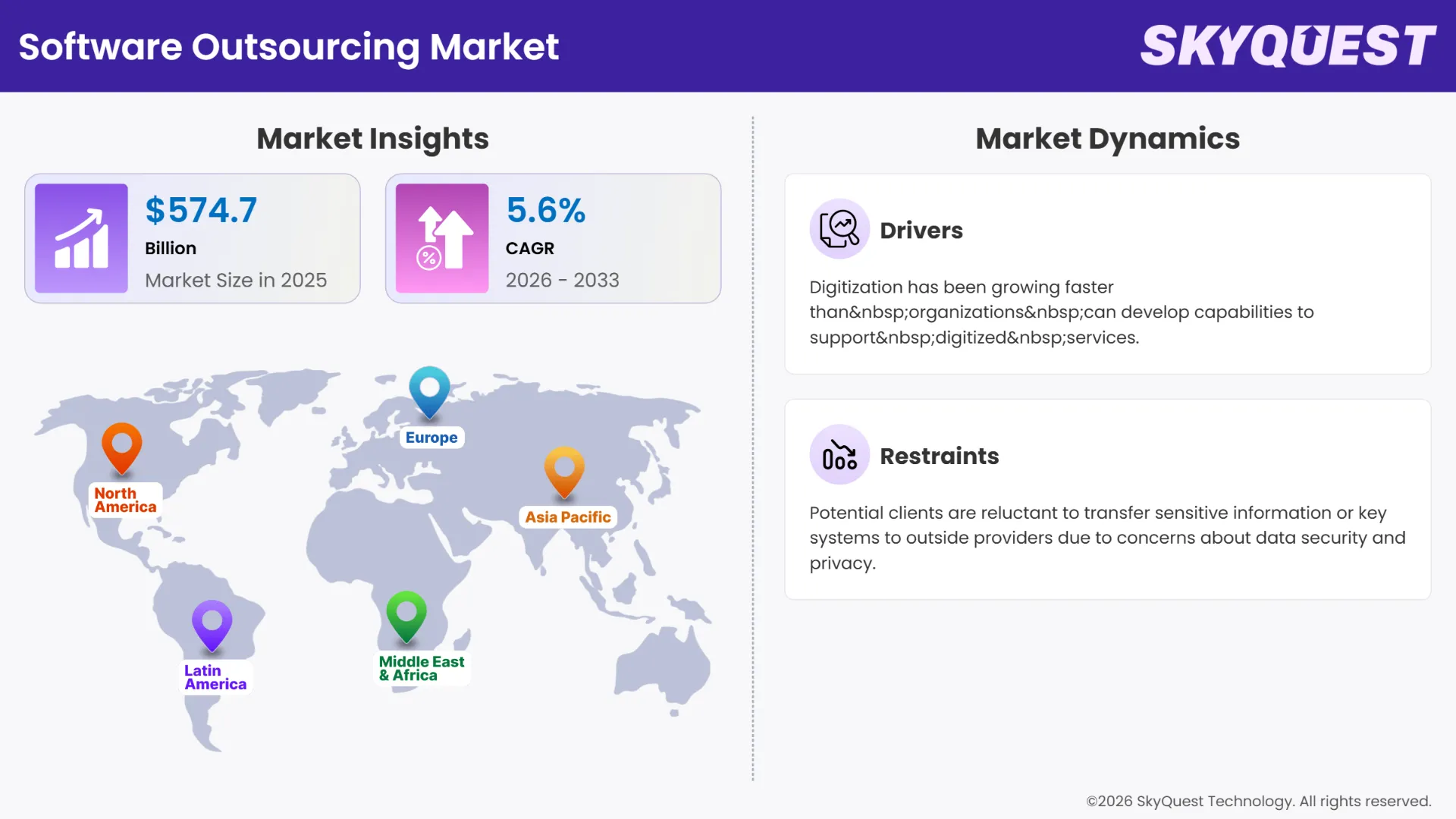
Global Software Outsourcing Market size was valued at USD 544.22 Billion in 2024 and is poised to grow from USD 574.7 Billion in 2025 to USD 888.69 Billion by 2033, growing at a CAGR of 5.6% during the forecast period (2026-2033).
With companies using third-party technology partners to speed up their digital transformation or save money by outsourcing service lines, the software outsourcing market has seen a huge amount of growth. From application development to cloud migration and from cybersecurity to data analytics, there are many services that businesses outsource. Additionally, as more organizations incorporate new technologies like AI, cloud, IoT, and blockchain into their business strategy, they are looking for outsourcing partners who can provide scalable and innovative solutions. Startups and SME's also benefit by having access to highly skilled global talent, instead of attempting to maintain large amounts of in-house resources dedicated to software development.
The rise of agile development methodologies, remote working platforms, and global delivery centers has significantly improved the efficiency and cost-effectiveness of cross-border outsourcing. Countries in the Asia Pacific region, especially India and Southeast Asia, are becoming well-known as global outsourcing hubs because of the abundance of talented developers and their ability to provide lower cost resource options.
Meanwhile, North America and Europe continue to be prominent markets for software outsourcing because of the increasing emphasis on digital product development, faster time-to-market, and flexible workforces. This continued growth will support an expanding software outsourcing market in the coming years.
How is AI Reshaping the Software Outsourcing Market?
The software outsourcing industry is changing because of the automation of engineering activities, development process enhancements using AI in developers' workflows, and evolving delivery models. More vendors are now offering AI-assisted coding, automated testing, and intelligent monitoring. These tools improve the speed of delivery and decrease manual rework. Buyers' expectations for results-based relationships and values derived from integrated AI tools will replace traditional labor arbitrage models. This progression places more of an emphasis on delivering high-value services such as system integration, governance, and designing AI-enabled processes. Some examples include using generative AI to generate program modules, having AI-assisted quality assurance processes, and implementing agentic automation for operational tasks performed by humans. The emphasis of the outsourcing market is on creating partnerships and developing capabilities rather than reducing costs.
To get more insights on this market click here to Request a Free Sample Report
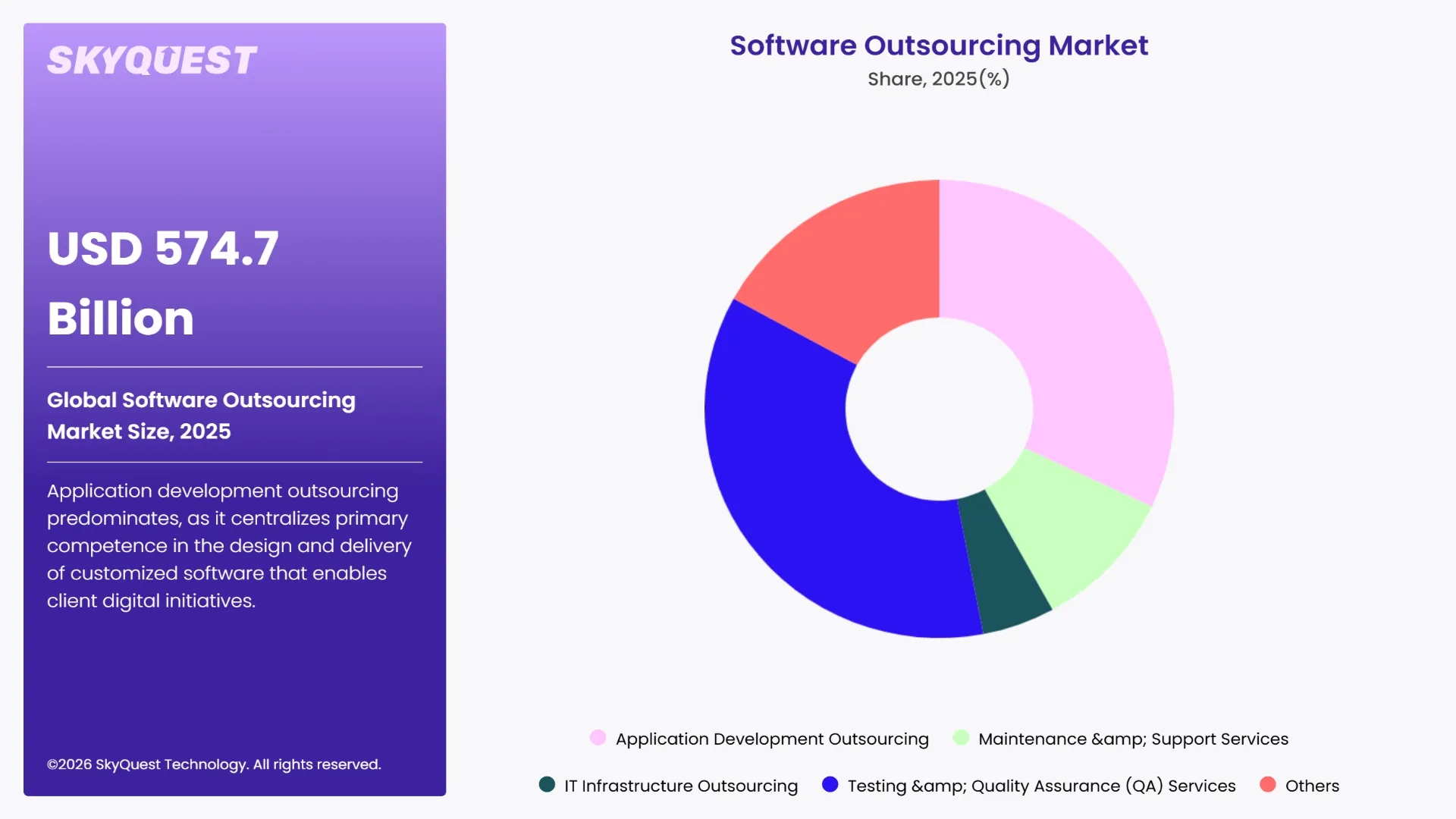
Global software outsourcing market is segmented into type of service, delivery model, client size, application, industry focus and region. Based on type of service, the market is segmented into application development outsourcing, maintenance & support services, infrastructure outsourcing, testing & quality assurance (QA) services and others. Based on delivery model, the market is segmented into onshore outsourcing, offshore outsourcing and nearshore outsourcing. Based on client size, the market is segmented into startups, medium enterprises, and large enterprises. Based on application, the market is segmented into mobile & web applications, cloud & DevOps support, AI & machine learning development, blockchain & iot solutions and others. Based on industry focus, the market is segmented into banking, financial services & insurance (BFSI), healthcare & life sciences, IT & telecommunications, retail & e-commerce, manufacturing & industrial iot, government & public sector, media & entertainment and others. Based on region, the market is segmented into North America, Europe, Asia Pacific, Latin America and Middle East & Africa.
Application development outsourcing predominates, as it centralizes primary competence in the design and delivery of customized software that enables client digital initiatives. The demand for customized applications, integration of legacy systems, and rapid feature delivery is prompting clients to outsource firms with large technology stacks and product management experience. This creates strong client connections and a steady pipeline of future projects since outsourcing vendors are responsible for complete, end-to-end performance and promote outsourced application programs' adoption.
Meanwhile, testing & quality assurance (QA) services are the area with the fastest growth due to the booming demand for both automated and continuous testing. The integration of DevOps pipelines and an increased focus on security validation combined with the expectation of dependable releases are leading clients to outsource to QA experts and use platformized testing tools, thus enabling shorter product development times and new managed services business models.
As a result of its ability to provide scalable, resilient outsourced systems and continuous delivery processes, the Cloud & DevOps support segment has been the leading area for IT service providers. By focusing on reducing deployment friction and ensuring uptime for their clients, organizations will place a growing emphasis on engaging providers with expertise in cloud platform management, automation, and infrastructure-as-code, which will ultimately drive ongoing demand from organizations.
The AI & machine learning development segment is also experiencing significant growth, as organizations increasingly require automation technologies that predict outcomes. As organizations continue to implement data science/machine learning models in customer experience and operational contexts, the need for both ML pipeline development and model operations capabilities has created a new opportunity for the development of managed services.
To get detailed segments analysis, Request a Free Sample Report
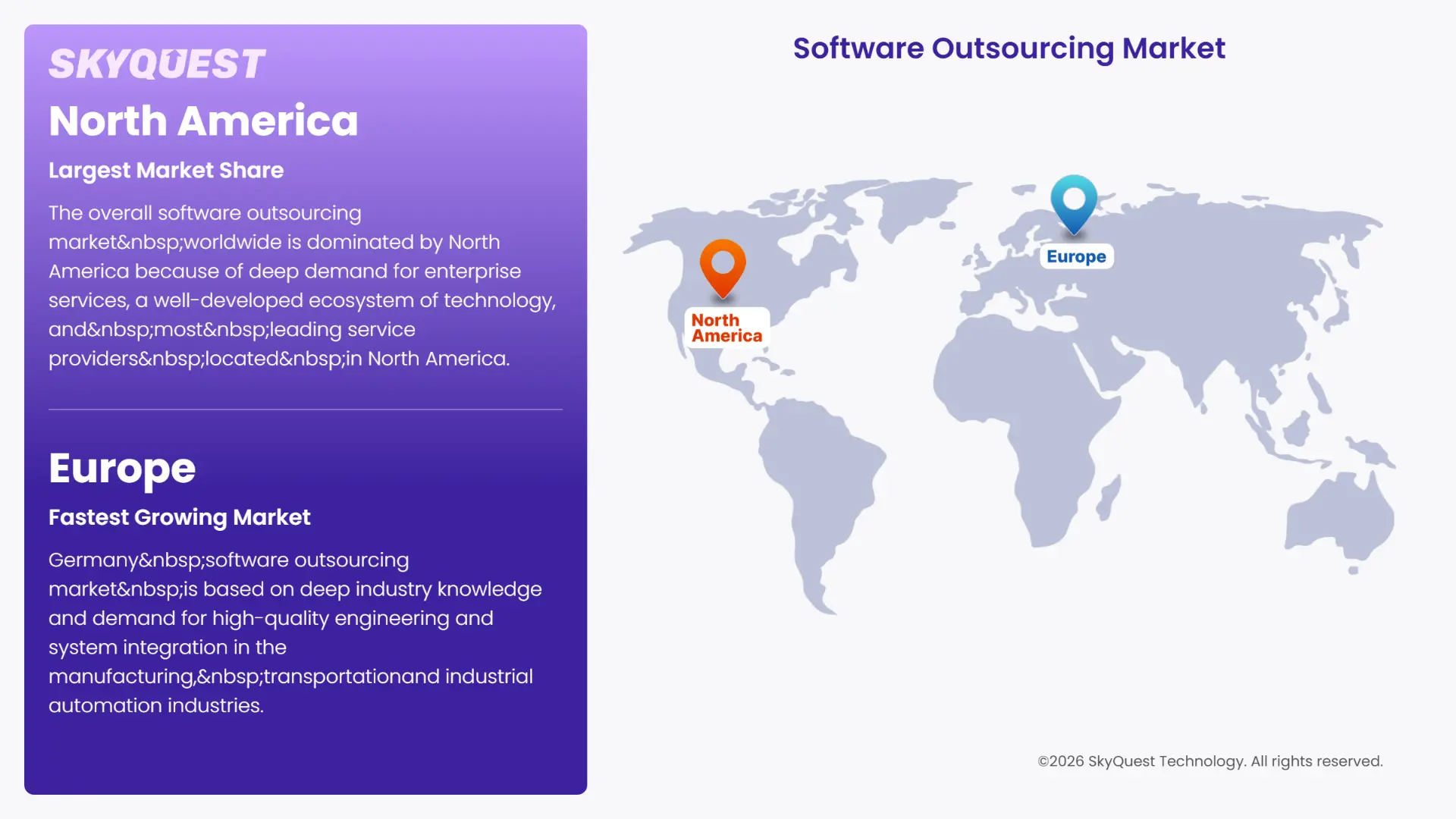
The overall software outsourcing market worldwide is dominated by North America because of deep demand for enterprise services, a well-developed ecosystem of technology, and most leading service providers located in North America. Both large corporate enterprises and innovative startup companies require expert assistance to accelerate their product development and modernization efforts, which results in an ongoing need for outsourcing capabilities to fulfill these requirements. Legal and regulatory frameworks, strong intellectual property protections, and easy access to capital markets all contribute positively to attracting more investments into this sector and encourage collaboration/partnerships among the various stakeholders.
The software outsourcing market in the United States benefits from a high-level concentration of enterprise buyers, technology innovators, and specialist service providers that help fulfil demand for engineering services, cloud migrations, and product developments. Providers typically develop offerings with strong consideration to safety/security, compliance, and scalability. Providers support complex engagements with long-term strategic relationships nationwide across multiple vertical industries based on collaboration between the client and service provider and the investment of time and effort in developing mature processes to procure services and create sophisticated vendor ecosystems.
Canada's software outsourcing market is characterized by collaboration between public and private sector companies, a growing number of technology service firms, and strong commercial ties between Canada and the United States. All these factors facilitate reaching customers located in the United States. Providers commonly provide service in French and place a strong emphasis on meeting data privacy regulations and providing expertise/knowledge that is specific to a customer's sector/industry. There is a strong emphasis by the provider on developing mutually beneficial partnerships through innovation activities and providing a positive work experience for employees to retain talent needed for continued success within the sectors in which they operate.
The rapid growth of software outsourcing in Europe is driven by several factors, including the need for businesses to modernize, the availability of highly skilled engineers, and the attractiveness of nearshore partnerships with neighboring regions. The developed vendor ecosystems across western Europe provide a supportive environment for clients seeking to partner with firms that offer specific domain expertise, multilingual delivery, and strict compliance with data protection and regulatory requirements. Additionally, the market dynamics associated with the cost versus the quality of work support competitive yet value-focused relationships between buyers and providers. Furthermore, there are many research institutions and industry clusters in Germany that generate demand for high-tech software applications in the manufacturing, vehicle and financial services sectors. The availability of government or regional programs that develop digital skills and innovation centres also contributes to developing the capabilities of suppliers and transforming local companies into strategic outsourcing partners for buyers globally.
Germany software outsourcing market is based on deep industry knowledge and demand for high-quality engineering and system integration in the manufacturing, transportationand industrial automation industries. Suppliers typically provide a combination of domain knowledge and engineering discipline and provide a compliance orientation, which is attractive to global buyers seeking secure, trustworthy solutions. The emphasis placed on the maturity of processes, education, and cooperative research fosters the creation of long-term strategic partnerships and places Germany as a dominant contracting hub throughout Europe.
As per software outsourcing industry analysis, UK is comprised of a variety of financial services companies and technology companies and is heavily reliant on agility, quick time-to-market and delivery as well as innovation. As a result of this reliance, providers are focusing on consulting-led deliveries, cloud-native architectures and strong client governance to be able to respond effectively to complex enterprise requests. The continued focus on developing strong alignment with global clients through language and culture, combined with mature vendor markets, a persistent focus on talented individuals and professional services, has been crucial in supporting the UK as an outsourcing hub for Europe.
As per software outsourcing market regional forecast, France has experienced dynamic growth due to a thriving startup ecosystem as well as the accelerating rate of digital transformation across businesses. Providers are placing more emphasis on design-led development, specialist consulting, and increasing levels of expertise in both cloud and data-related platforms than in prior years. The bilingual ability of professionals delivering services, in combination with increased number of skilled professionals from the technical training systems and a growing level of collaboration between public research and private firms, have resulted in the maturing of the French market and establishing it as an increasingly attractive outsourcing destination in Europe for global companies.
Software-outsourcing is being enhanced in Asia Pacific (APAC) through expanded technical depth; specialized expertise in selected industries; and improved global delivery. Engineering education, combined with strong supporting environments for hardware and software development (ecosystems), allows Appendix's software outsourcing providers to offer integrated solutions to electronic and gaming software developers, developers of mobile phones, and manufacturers of advanced goods. Investment in automation, cloud-native practices, and quality assurance is increasing delivery standards.
As per software outsourcing market regional outlook, Japan market involves precision engineering, systems integration and (software) solutions tailored to OEMs that produce hardware. The Japanese software outsourcing market focuses on robotics, automobiles, and industrial controls, while maintaining its excellent delivery track record because of its superior research capabilities and extensive depth of experience. A culture in Japan emphasizes the quality of craftsmanship and long-term supplier relationships, and as a result, Japan's outsourcing providers can consistently deliver high-quality results. Global collaboration continues to grow in Japan, as six major corporations become increasingly involved.
South Korean software outsourcing market is made up of a combination of emerging technologies and innovation. Companies engaged in the development of software for mobile and gaming applications and who have extensive knowledge and experience in developing semiconductor and artificial intelligence-based software (AI) are typically found in the South Korean software outsourcing market. Rapid iteration and a high level of technical quality within organizations and firms are key characteristics of the South Korean software outsourcing industry, providing rapid and high-quality software development cycles for demanding customers. Global ambitions are growing for many of the firms in the South Korean software outsourcing industry, as are supporting public policies and increasing collaboration between large multinational corporations and smaller, more agile indigenous vendors.
To know more about the market opportunities by region and country, click here to
Buy The Complete Report
Rising Demand for Digital Transformation
Digitization has been growing faster than organizations can develop capabilities to support digitized services. Thus, there is an increasing number of organizations that are turning to third parties (outsourcing) to provide them with the relevant skills, resources, and expertise they require to rapidly create, modernize and migrate to new platforms while managing internal resource constraints. As such, organizations are now starting to prioritize their need for rapid development by seeking external organizations to undertake their development activities for them through outsourcing.
Shortage of In-House Technical Talent
More organizations are utilizing third-party vendors to supplement the shortage of technical employees that have occurred because of digitization. These organizations are relying on these external vendors to provide them with long-term skilled resources to sustain project momentum and fill gaps in their technical capabilities. Organizations have moved towards an outsourcing model that gives them the flexibility to access a diverse range of technology profiles and domain specialists without the requirement for long-term employment contracts. Furthermore, by outsourcing third-party vendors, organizations can respond quickly to marketplace changes and the need for innovative solutions by eliminating bottlenecks in their recruitment processes.
Data Security and Privacy Concerns
Potential clients are reluctant to transfer sensitive information or key systems to outside providers due to concerns about data security and privacy. The risks associated with data breaches, regulatory compliance and cross-border data transfer make organizations reluctant to send key functions offshore or to have strict contractual or audit requirements, thus complicating the selection and engagement of vendors. These concerns may lead to extended procurement cycles, increased vendor qualification criteria and an increase in project complexity as a result; ultimately hindering the pace of adoption of outsourcing and reducing the total addressable market for some suppliers.
Quality and Project Management Risks
Concerns regarding lack of quality and project management consistency among providers may also deter organizations from entering outsourcing relationships, particularlycritical or strategic customer-facing software applications. Differences in delivery standards among providers, communication breakdowns and divergent expectations may result in rework, missed deadlines and lack of trust between buyer and supplier, causing buyers to be concerned about extending or renewing contracts with suppliers. Additionally, the perceived effort required to manage a remote team and ensure consistent governance adds to the overall internal resource burden and procurement scrutiny. Thus, extending the decision cycle and reducing the volume and frequency of outsourcing relationships ultimately limiting the number of viable suppliers.
Request Free Customization of this report to help us to meet your business objectives.
As the demand for cloud computing continues to rise, so does the competition in global software outsourcing. AI-enabled delivery models, cloud compliance, and nearshore speed have made established technology integrators (like Accenture) and regional managed service firms major players in the software outsourcing space. There are numerousacquisitions and alliances. Capgemini acquired Syniti for its data and SAP transformation capabilities, while Accenture is expanding its Google Cloud alliance for scaling generative AI services that emphasize these companies' use of acquisitions, partnerships, and proprietary platforms to establish differentiation among themselves.
AI-driven Service Evolution: Providers are transforming their service offerings around the use of artificial intelligence and automation, moving away from merely executing tasks to orchestrating the results of those executions. As a result, engagements will focus on integrating models and continuously operationalizing them, with the design of solutions being done by advisors. The factors most important to clients in determining which partners they want to work with are the capabilities of the partners to enable innovation and shorten the time to value that can be sustained. Therefore, businesses will focus their investments on reskilling talent, standardizing toolchains, and collaboratively creating intellectual property (IP). Outsourcing relationships will become strategic extensions of the client’s team and focus on the delivery of adaptive, intelligent applications and end-to-end digital transformation rather than just delivering isolated code.
Platform-Centric Ecosystem Partnerships: There is now a movement among clients and suppliers toward the formation of platform-based ecosystems, where the common objectives of these ecosystems are to create reusable components, share toolchains, and collaborate to grow the market for their joint go to market initiatives. In the past, outsourcing engagement has focused on using partner marketplaces and accelerator solutions to reduce the length of time needed to innovate. Today’s outsourcing engagements increasingly utilize the partner marketplace and co-developed accelerators to decrease innovation timelines and develop industry-specific solutions. The governance model for platform-centric ecosystems focuses on developing shared roadmaps, establishing joint IP sharing arrangements, and aligning commercial incentives to encourage collaboration across multiple providers over the long term.
SkyQuest’s ABIRAW (Advanced Business Intelligence, Research & Analysis Wing) is our Business Information Services team that Collects, Collates, Correlates, and Analyses the Data collected by means of Primary Exploratory Research backed by robust Secondary Desk research.
As per SkyQuest analysis, one key driver is rising demand for digital transformation, and a second driver is advancing in cloud platforms and artificial intelligence that increase demand for external expertise. One key restraint is concerns around data security and privacy, which slows adoption of outsourced work for sensitive systems. Application development outsourcing remains in the dominating segment as firms seek end to end delivery and recurring project pipelines, while North America is the dominating region. Vendors combining AI enabled services, cloud operations and outcome-oriented contracts are best positioned to capture software outsourcing market growth. The software outsourcing market trend is characterized by the growing adoption of cloud-based development, AI-driven automation, and global remote collaboration.
| Report Metric | Details |
|---|---|
| Market size value in 2024 | USD 544.22 Billion |
| Market size value in 2033 | USD 888.69 Billion |
| Growth Rate | 5.6% |
| Base year | 2024 |
| Forecast period | (2026-2033) |
| Forecast Unit (Value) | USD Billion |
| Segments covered |
|
| Regions covered | North America (US, Canada), Europe (Germany, France, United Kingdom, Italy, Spain, Rest of Europe), Asia Pacific (China, India, Japan, Rest of Asia-Pacific), Latin America (Brazil, Rest of Latin America), Middle East & Africa (South Africa, GCC Countries, Rest of MEA) |
| Companies covered |
|
| Customization scope | Free report customization with purchase. Customization includes:-
|
To get a free trial access to our platform which is a one stop solution for all your data requirements for quicker decision making. This platform allows you to compare markets, competitors who are prominent in the market, and mega trends that are influencing the dynamics in the market. Also, get access to detailed SkyQuest exclusive matrix.
Table Of Content
Executive Summary
Market overview
Parent Market Analysis
Market overview
Market size
KEY MARKET INSIGHTS
COVID IMPACT
MARKET DYNAMICS & OUTLOOK
Market Size by Region
KEY COMPANY PROFILES
Methodology
For the Software Outsourcing Market, our research methodology involved a mixture of primary and secondary data sources. Key steps involved in the research process are listed below:
1. Information Procurement: This stage involved the procurement of Market data or related information via primary and secondary sources. The various secondary sources used included various company websites, annual reports, trade databases, and paid databases such as Hoover's, Bloomberg Business, Factiva, and Avention. Our team did 45 primary interactions Globally which included several stakeholders such as manufacturers, customers, key opinion leaders, etc. Overall, information procurement was one of the most extensive stages in our research process.
2. Information Analysis: This step involved triangulation of data through bottom-up and top-down approaches to estimate and validate the total size and future estimate of the Software Outsourcing Market.
3. Report Formulation: The final step entailed the placement of data points in appropriate Market spaces in an attempt to deduce viable conclusions.
4. Validation & Publishing: Validation is the most important step in the process. Validation & re-validation via an intricately designed process helped us finalize data points to be used for final calculations. The final Market estimates and forecasts were then aligned and sent to our panel of industry experts for validation of data. Once the validation was done the report was sent to our Quality Assurance team to ensure adherence to style guides, consistency & design.
Analyst Support
Customization Options
With the given market data, our dedicated team of analysts can offer you the following customization options are available for the Software Outsourcing Market:
Product Analysis: Product matrix, which offers a detailed comparison of the product portfolio of companies.
Regional Analysis: Further analysis of the Software Outsourcing Market for additional countries.
Competitive Analysis: Detailed analysis and profiling of additional Market players & comparative analysis of competitive products.
Go to Market Strategy: Find the high-growth channels to invest your marketing efforts and increase your customer base.
Innovation Mapping: Identify racial solutions and innovation, connected to deep ecosystems of innovators, start-ups, academics, and strategic partners.
Category Intelligence: Customized intelligence that is relevant to their supply Markets will enable them to make smarter sourcing decisions and improve their category management.
Public Company Transcript Analysis: To improve the investment performance by generating new alpha and making better-informed decisions.
Social Media Listening: To analyze the conversations and trends happening not just around your brand, but around your industry as a whole, and use those insights to make better Marketing decisions.
REQUEST FOR SAMPLE
 REQUEST FREE CUSTOMIZATION
Global Software Outsourcing Market size was valued at USD 544.22 Billion in 2024 and is poised to grow from USD 574.7 Billion in 2025 to USD 888.69 Billion by 2033, growing at a CAGR of 5.6% during the forecast period (2026-2033).
Competition in global software outsourcing is sharpening as large systems integrators and regional managed service firms compete on AI enabled delivery, cloud compliance and nearshore speed. This has driven concrete M&A and alliance moves, such as Capgemini acquiring Syniti to bolster data and SAP transformation capabilities and Accenture expanding its Google Cloud alliance to scale generative AI services. Vendors use acquisitions, partnerships and proprietary platforms to differentiate. 'Accenture', 'Infosys', 'TCS', 'Wipro', 'Cognizant', 'HCL Technologies', 'Capgemini', 'DXC Technology', 'EPAM Systems', 'SoftServe', 'BairesDev', 'Zensar Technologies', 'Chetu', 'Altran', 'TechAspect', 'Itransition', 'Intellectsoft', 'Luxoft', 'Artech Information Systems', 'N-iX'
Rising demand for digital transformation prompts organizations to seek external expertise, accelerating adoption of software outsourcing. Companies prioritize rapid development, modernization, and platform migration while managing internal resource constraints, making outsourcing an attractive pathway to obtain specialized skills, flexible delivery models, and focused innovation. External providers offer domain knowledge and development capacity that align with enterprise timelines and strategic goals, enabling scalable project execution. This sustained need for digital capabilities supports consistent outsourcing engagements and longer-term partnerships, expanding market opportunities for experienced service providers.
Ai Driven Service Evolution: Providers are redefining service portfolios around artificial intelligence capabilities and automation, shifting from task execution to outcome orchestration. Engagements emphasize model integration, continuous operationalization, and advisor-led solution design, while clients prioritize partner capabilities that accelerate innovation and reduce time to sustainable value. This drives investments in talent reskilling, toolchain standardization, and collaborative IP creation. As a result, outsourcing relationships become strategic extensions of client teams, focused on delivering adaptable, intelligent applications and end-to-end digital transformation rather than isolated code delivery
North America Dominate the Global Software Outsourcing Market?


Want to customize this report? This report can be personalized according to your needs. Our analysts and industry experts will work directly with you to understand your requirements and provide you with customized data in a short amount of time. We offer $1000 worth of FREE customization at the time of purchase.
Feedback From Our Clients


 USA (+1) 351-333-4748

