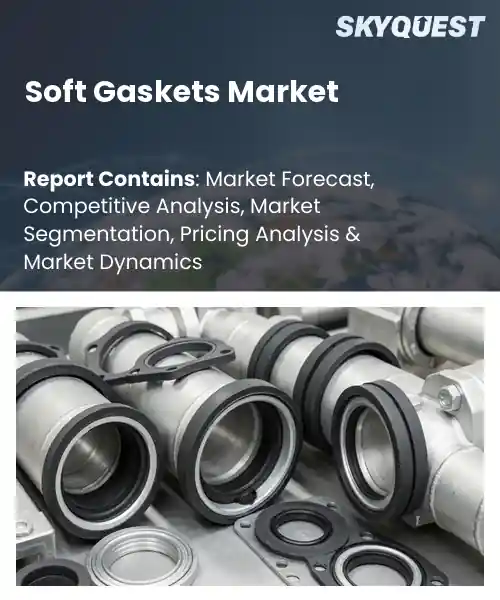
Soft Gaskets Market
Report ID: SQMIG15A2769
Report ID: SQMIG15A2769
[email protected]
USA +1 351-333-4748
Report ID:
SQMIG15A2769 |
Region:
Global |
Published Date: June, 2026
Pages:
157
|Tables:
95
|Figures:
76


Global Soft Gaskets Market size was valued at USD 4.12 Billion in 2024 and is poised to grow from USD 4.38 Billion in 2025 to USD 7.08 Billion by 2033, growing at a CAGR of 6.2% during the forecast period (2026-2033).
Rising demand for durable leak-proof seals in increasingly complex applications has become the main engine for global soft gaskets market growth, supporting the transformation from commodity rubber o-rings to engineered elastomeric solutions. In general, soft gaskets are flexible sealing elements that inhibit fluid, gas, and contamination ingress into automotive engines, pipelines, HVAC systems, and medical devices; gaskets matter because a failure will result in safety incidents, regulatory penalties, and unplanned downtime. Advances in materials science and precision molding moved from cork and simple neoprene to fluoroelastomers, silicone blends, and PTFE composites. The turbocharged engine and LNG flange examples illustrate how harsher operating environments and stricter emissions regulations have escalated the industry requirements.
The most significant contributor to growth in the global soft gaskets market is innovation in material formulations and precision manufacturing, as newer formulations with tighter tolerances create new applications and decrease lifecycle costs. In addition, fluorosilicones and PTFE composites are becoming accepted materials for gaskets utilized in chemical processing, LNG and hydrogen pipelines due to their ability to withstand elevated temperatures and aggressive media. This trend is escalating the demand for soft gaskets and driving research and development at suppliers. CNC molding also creates opportunities for reducing scrap and custom shape creation, such as gaskets in EV battery enclosures and seals for semiconductor manufacturing tools, which reduce maintenance cycles and dramatically increase uptime. These cause-and-effect dynamics create opportunities for vertical partnerships, aftermarket retrofit programs and service-based models as end users pursue reliability and regulatory compliance.
How is IoT Driving Efficiency In The Soft Gaskets Market?
The Internet of Things (IoT) is enhancing efficiency within the soft gasket industry through the introduction of sensor-enabled gaskets that allow for real-time condition monitoring and proactive maintenance. Major characteristics of the new gaskets are the integration of built-in strain gauges, wireless communication technologies, and integration with enterprise-level asset management systems. Currently, many products within the soft gasket sector are being piloted or are in the process of being deployed and include products that add sensing layers to traditional elastomers with the intent to expanding their lifespan and eliminating costly unplanned downtime. In addition, the soft gasket sector is being faced with mounting pressure from Industry 4.0 to provide data-based reliability across the oil and gas, electric, and heavy industry sectors.
Examples of how the use of integrated strain gauges and machine elements with integrated sensors will lead to an increase in the efficiency of maintenance planning through increased intelligence and reduced disruption. In a press release dated May 2026, Freudenberg Sealing Technologies announced the development of a new sealing solution for high-pressure compressors designed to improve resiliency and operational reliability. The use of IoT-enabled monitoring and this sealing solution will facilitate condition-based maintenance resulting in an increased service life of these components, which in turn, will enhance the overall operational efficiency of the organization. This will promote the wider application of intelligent soft gaskets solutions.
Market snapshot - (2026-2033)
Global Market Size
USD 4.12 Billion
Largest Segment
Rubber
Fastest Growth
PTFE (Polytetrafluoroethylene)
Growth Rate
6.2% CAGR
To get more insights on this market click here to Request a Free Sample Report
Global soft gaskets market is segmented by material type, application, end-use industry and region. Based on material type, the market is segmented into Rubber, PTFE (Polytetrafluoroethylene), Flexible Graphite, Non-Asbestos Fiber, Cork and Felt. Based on application, the market is segmented into Static Sealing and Dynamic Sealing. Based on end-use industry, the market is segmented into Oil & Gas, Chemical Processing, Power Generation, Automotive, Food & Beverage and Pharmaceuticals. Based on region, the market is segmented into North America, Europe, Asia Pacific, Latin America and Middle East & Africa.
The rubber segment is the largest, as rubber materials offer elasticity, conformability, and resilience for more dependable seals across different type of flanged surfaces and irregular joint surfaces in the soft gaskets market. Additionally, the versatility of rubber materials to provide compatibility with most common fluids, being easy to fabricate into many different types of gaskets, and being cost-effective will allow both manufacturers and end-users to be able to achieve their service life and maintenance goals and ultimately, reduce the complexity involved with selecting material(s) by using proven, familiar material characteristics.
As per soft gaskets market forecast, the PTFE segment is the fastest growing segment due to the widespread use of PTFE for its excellent chemical resistance, relatively wide temperature capacity range, as well as being used as a friction-reducing material in many high-performance applications and other aggressive conditions. The introduction of new materials, as well as an increase in the requirement for longer lasting seals and intended to minimize maintenance requirements, is expanding the number of applications and generating future growth potential for this market segment.
In the soft gaskets industry, static seal segment comprises the majority of low-motion joint applications, where it is important to reliably make certain that something will be contained over time without leaking. Because of the straightforward construction, compatibility with common soft materials, and known performance properties under steady loads, static seals are typically the default specification for flanged connections and non-moving machines; therefore, they reduce equipment downtime and simplify maintenance strategy for plant maintenance personnel and specifications listed with specifiers.
As per soft gaskets market analysis, dynamic seals are seeing the fastest growth due to the large increase in use of rotating and reciprocating pieces of equipment as well as mobile applications, all of which require soft gaskets designed to accommodate motion without leakage. Advances in formulations of materials used to manufacture soft gaskets, engineered profile geometries, and sealing technologies designed for interfaces with high degrees of motion are broadening the use of these types of sealing solutions and creating new service and aftermarket opportunities for the various equipment class applications.
To get detailed segments analysis, Request a Free Sample Report
Manufacturing depth, supply chain density, and sectoral demand are converging in the Asia Pacific region to create a highly competitive environment for manufacturers of electronic, automotive, and industrial products. The region's competitiveness is enhanced through the broad base of suppliers that provide scale and customization, as well as the material science capabilities (e.g. elastomers and engineered polymers) that drive product innovation. Integration between OEMs and local suppliers has enabled rapid prototyping and cost-effective production. In addition, established export channels and a strong aftermarket ecosystem are increasing the demand for replacement and specialty seals. Robust policy environments that promote industrial investments and clusters focused on precision fabrication further enhance the region's competitive advantage, while continual improvement in the quality control and certification processes are ensuring that suppliers meet stringent global standards, positioning the Asia Pacific region as a leading production/innovation hub for soft gaskets.
The Japanese soft gaskets market has high standards of manufacturing precision and quality, which conform to stringent OEM requisites (automotive/computer/electronics production companies). Supply-side firms place a strong emphasis on developing the appropriate material while achieving tight manufacturing tolerances to ensure that customers receive gaskets that are reliable (and able to last for long periods). Various research institutions around the world work cooperatively with industry to create advanced formulations of elastomer (rubber type) material and develop the best techniques for manufacturing elastomeric materials. The aftermarket sector complements the OEM sector, with many established certification programs in place to ensure that domestic suppliers are viewed as the preferred partner for complex OEM based sealing technology solutions.
The soft gaskets market in South Korea has the advantage of being closely associated with large businesses. The major production data in South Korea comes from large businesses, for example: electronics industry, semiconductor manufacturing, shipbuilding industry, automotive manufacturing that consistently create demand for highly-specialized sealing solutions. Therefore, there is always a need for rapid innovation cycles and close technical support provided by local manufacturers to South Korean OEMs, allowing the OEM to utilize tailored materials and designs that best suit their requirements. Due to the export nature of the South Korean economy, efficiencies in production processes combined with investments in automation and material research will result in improved quality and performance of South Korean-produced soft gaskets, which can thus be expected to improve their competitiveness in both regional and global markets.
Rapid expansion in North America stems from a combination of technology adoption, diversified end use, and a mature aftermarket that values reliability and service. Demand drivers include automotive manufacturing, industrial machinery refurbishment, energy and infrastructure maintenance, and a growing emphasis on advanced materials for enhanced sealing performance. Supply chains are evolving toward greater supplier collaboration and customization, supported by engineering services that translate application needs into optimized gasket designs. Regulatory and procurement standards push suppliers toward traceability and consistent quality, encouraging professionalization across the value chain. Distribution networks and technical service providers further accelerate deployment by simplifying specification and installation for end users, while regional innovation hubs foster materials research and specialized manufacturing capabilities.
Soft Gaskets Market in United States is shaped by a large industrial base with substantial demand from automotive, aerospace, and heavy equipment sectors that prioritize performance and compliance. Suppliers deliver engineered solutions with emphasis on material certification, long life, and compatibility with complex systems. Strong aftermarket channels and technical distribution facilitate rapid replacement and testing services, while close partnerships with OEM engineering teams enable bespoke designs and material selection for challenging sealing environments.
Soft Gaskets Market in Canada is influenced by energy, mining, and transportation sectors that require durable sealing solutions for harsh operating conditions. Suppliers focus on materials able to withstand temperature extremes and corrosive environments, while service providers offer field support and retrofit expertise. Proximity to broader regional supply chains supports collaboration with large OEMs and distributors, enabling access to specialized products and technical consultation for infrastructure and industrial maintenance projects.
Europe is strengthening its role through a blend of advanced engineering, regulatory harmonization, and focused innovation in materials and sustainability. Regional strengths include a concentration of high-value industries such as automotive, aerospace, and industrial machinery that demand high-performance seals and close supplier collaboration. Emphasis on environmental considerations and lifecycle performance encourages development of longer-lasting materials and recoverable solutions. Cross-border standards and testing frameworks raise baseline quality and enable easier market access across countries, while cluster-based ecosystems support rapid technology transfer between research institutions and manufacturers. Investment in automation, precision fabrication, and specialized sealing technologies enhances competitiveness, enabling European suppliers to meet stringent application requirements and differentiate through engineering services and certification.
Soft Gaskets Market in Germany is dominated by precision engineering requirements from automotive and industrial machine builders that demand robust, high-tolerance sealing solutions. Suppliers focus on material science and controlled manufacturing processes to meet strict quality and certification expectations. Close interaction with OEM engineering teams and a culture of continuous improvement support development of application-specific gaskets for demanding environments, while export orientation and reputation for reliability underpin strong international demand.
Soft Gaskets Market in United Kingdom benefits from strengths in aerospace, defense, and marine sectors that require specialty seals with high reliability and traceability. Suppliers provide technically sophisticated solutions and aftermarket service capabilities, supported by a network of engineering consultancies and testing facilities. Emphasis on innovation and bespoke design allows meeting complex specifications, while a focus on service and certification helps maintain long-term relationships with key industrial customers.
Soft Gaskets Market in France is driven by aerospace, rail, and energy sectors that favor high-performance materials and integrated supplier partnerships. Local manufacturers emphasize research-driven material development and close collaboration with system integrators to deliver tailored sealing solutions. National research centers and industry consortia promote advancements in polymer technology and testing methodologies, enhancing the ability to respond to specialized application demands and quality standards.
To know more about the market opportunities by region and country, click here to
Buy The Complete Report
Rising Automotive Seal Demand
Shift Toward Advanced Materials
Volatile Raw Material Availability
Stringent Regulatory Compliance Challenges
Request Free Customization of this report to help us to meet your business objectives.
Competitive dynamics in the global soft gaskets market are driven by product innovation, targeted M&A and supplier partnerships responding to OEM demand for lighter battery safe and emissions compliant seals. Firms pursue thinner coated isolation gaskets, regional capacity builds and bolt on die cutting acquisitions, illustrated by GPT's EVOLUTION launch, Semperit's factory investments and recent die cutter acquisitions.
SkyQuest’s ABIRAW (Advanced Business Intelligence, Research & Analysis Wing) is our Business Information Services team that Collects, Collates, Correlates, and Analyses the Data collected by means of Primary Exploratory Research backed by robust Secondary Desk research.
As per SkyQuest analysis, one key driver is rising demand for reliable leak-free seals across automotive, oil & gas and industrial applications, which pushes adoption of engineered elastomeric solutions. One restraint is volatile raw material availability that creates procurement uncertainty and supply disruptions. Asia Pacific is the dominating region due to manufacturing scale, supplier density and strong OEM integration. The dominating segment is static sealing, reflecting prevalence of low-movement joints and long-term leak prevention needs. A second driver is material innovation and precision manufacturing, where advanced elastomers, PTFE composites and CNC molding expand performance envelopes, enable new applications and reduce lifecycle costs, encouraging supplier investment and aftermarket growth.
| Report Metric | Details |
|---|---|
| Market size value in 2024 | USD 4.12 Billion |
| Market size value in 2033 | USD 7.08 Billion |
| Growth Rate | 6.2% |
| Base year | 2024 |
| Forecast period | (2026-2033) |
| Forecast Unit (Value) | USD Billion |
| Segments covered |
|
| Regions covered | North America (US, Canada), Europe (Germany, France, United Kingdom, Italy, Spain, Rest of Europe), Asia Pacific (China, India, Japan, Rest of Asia-Pacific), Latin America (Brazil, Rest of Latin America), Middle East & Africa (South Africa, GCC Countries, Rest of MEA) |
| Companies covered |
|
| Customization scope | Free report customization with purchase. Customization includes:-
|
To get a free trial access to our platform which is a one stop solution for all your data requirements for quicker decision making. This platform allows you to compare markets, competitors who are prominent in the market, and mega trends that are influencing the dynamics in the market. Also, get access to detailed SkyQuest exclusive matrix.
Table Of Content
Executive Summary
Market overview
Parent Market Analysis
Market overview
Market size
KEY MARKET INSIGHTS
COVID IMPACT
MARKET DYNAMICS & OUTLOOK
Market Size by Region
KEY COMPANY PROFILES
Methodology
For the Soft Gaskets Market, our research methodology involved a mixture of primary and secondary data sources. Key steps involved in the research process are listed below:
1. Information Procurement: This stage involved the procurement of Market data or related information via primary and secondary sources. The various secondary sources used included various company websites, annual reports, trade databases, and paid databases such as Hoover's, Bloomberg Business, Factiva, and Avention. Our team did 45 primary interactions Globally which included several stakeholders such as manufacturers, customers, key opinion leaders, etc. Overall, information procurement was one of the most extensive stages in our research process.
2. Information Analysis: This step involved triangulation of data through bottom-up and top-down approaches to estimate and validate the total size and future estimate of the Soft Gaskets Market.
3. Report Formulation: The final step entailed the placement of data points in appropriate Market spaces in an attempt to deduce viable conclusions.
4. Validation & Publishing: Validation is the most important step in the process. Validation & re-validation via an intricately designed process helped us finalize data points to be used for final calculations. The final Market estimates and forecasts were then aligned and sent to our panel of industry experts for validation of data. Once the validation was done the report was sent to our Quality Assurance team to ensure adherence to style guides, consistency & design.
Analyst Support
Customization Options
With the given market data, our dedicated team of analysts can offer you the following customization options are available for the Soft Gaskets Market:
Product Analysis: Product matrix, which offers a detailed comparison of the product portfolio of companies.
Regional Analysis: Further analysis of the Soft Gaskets Market for additional countries.
Competitive Analysis: Detailed analysis and profiling of additional Market players & comparative analysis of competitive products.
Go to Market Strategy: Find the high-growth channels to invest your marketing efforts and increase your customer base.
Innovation Mapping: Identify racial solutions and innovation, connected to deep ecosystems of innovators, start-ups, academics, and strategic partners.
Category Intelligence: Customized intelligence that is relevant to their supply Markets will enable them to make smarter sourcing decisions and improve their category management.
Public Company Transcript Analysis: To improve the investment performance by generating new alpha and making better-informed decisions.
Social Media Listening: To analyze the conversations and trends happening not just around your brand, but around your industry as a whole, and use those insights to make better Marketing decisions.
REQUEST FOR SAMPLE
 REQUEST FREE CUSTOMIZATION
Global Soft Gaskets Market size was valued at USD 4.12 Billion in 2024 and is poised to grow from USD 4.38 Billion in 2025 to USD 7.08 Billion by 2033, growing at a CAGR of 6.2% during the forecast period (2026-2033).
Competitive dynamics in the global soft gaskets market are driven by product innovation, targeted M and A and supplier partnerships responding to OEM demand for lighter battery safe and emissions compliant seals. Firms pursue thinner coated isolation gaskets, regional capacity builds and bolt on die cutting acquisitions, illustrated by GPT's EVOLUTION launch, Semperit's factory investments and recent die cutter acquisitions. 'Freudenberg Sealing Technologies', 'Trelleborg AB', 'Parker Hannifin Corporation', 'Garlock Sealing Technologies', 'Flexitallic Group', 'Dana Incorporated', 'ElringKlinger AG', 'James Walker Group', 'Klinger Holding', 'Donit Tesnit', 'Teadit Group', 'Lamons', 'Spetech', 'Hennig Gasket & Seals', 'Allied Gasket Inc.', 'NICHIAS Corporation', 'Uchiyama Manufacturing Corp.', 'Interface Performance Materials', 'W. L. Gore & Associates', 'Leader Gasket Technologies'
Lightweight Materials Adoption: Manufacturers are prioritizing lightweight polymeric and composite soft gaskets to meet evolving design and efficiency goals. This trend drives material substitution away from heavier traditional compounds toward engineered elastomers and thermoplastic blends that offer comparable sealing performance with reduced mass. Demand stems from product designers seeking lower assembly complexity, improved handling, and enhanced integration with lightweight housings. Suppliers are responding by developing formulations through collaborative research, emphasizing ease of processing, durability, and compatibility with diverse substrates to support differentiated solutions.
Why does Asia Pacific Dominate the Global Soft Gaskets Market? |@12


Want to customize this report? This report can be personalized according to your needs. Our analysts and industry experts will work directly with you to understand your requirements and provide you with customized data in a short amount of time. We offer $1000 worth of FREE customization at the time of purchase.
Feedback From Our Clients


 USA (+1) 351-333-4748

