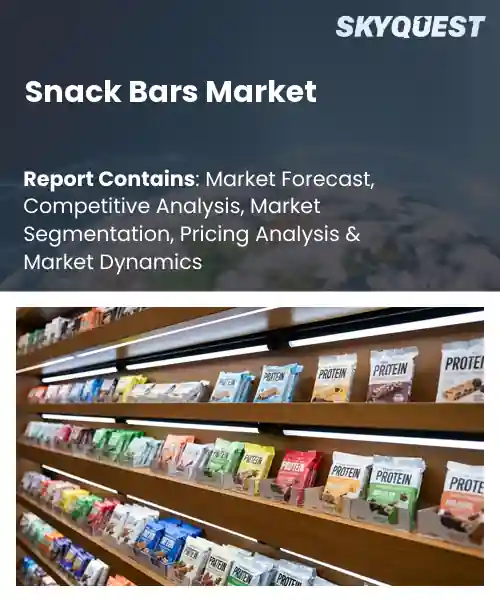
Snack Bars Market
Report ID: SQMIG30I2919
Report ID: SQMIG30I2919
[email protected]
USA +1 351-333-4748
Report ID:
SQMIG30I2919 |
Region:
Global |
Published Date: May, 2026
Pages:
157
|Tables:
180
|Figures:
79


Global Snack Bars Market size was valued at USD 25.5 Billion in 2024 and is poised to grow from USD 27.57 Billion in 2025 to USD 51.4 Billion by 2033, growing at a CAGR of 8.1% during the forecast period (2026-2033).
As a research analyst on the snack bars market, I think that the main impetus for demand is the lifestyle change to convenience. The market consists of ready-to-eat bars sold as snacks, meal supplements and protein enhancers. Why it matters: Changing eating habits are shifting preference from traditional meals to grab-and-go, healthy options. The category has moved from basic granola and cereal bars to a variety of functional options, as demonstrated by the explosion of brands like Clif and KIND and later entrants like Quest and RXBAR that focus on protein and clean labels. Urbanization, longer commutes and the rise of online retail have encouraged adoption and increased distribution worldwide.
The main driver of growth is consumer demand driven by health, which creates opportunities for products and channels. The function innovation is sampled from a wider distribution. As brands like Quest and plant-based newcomers like Oatly gain market share, more shoppers are seeking high-protein, low-sugar and clean label formulations and manufacturers are reformulating recipes and launching protein-focused lines. This dynamism is pushing retailers to offer premium shelf space, pushing direct-to-consumer subscription models for personalized nutrition, pushing athletes to consume bars for post-workout recovery and pushing busy professionals to replace meals with fortified bars. Invest in R&D. Transparency of your supply chain and then you can go global and premium.
How is AI transforming product development in the snack bars market?
AI is reshaping product development in the snack bars market by speeding formulation, sharpening sensory prediction and deepening consumer insight. Machine learning models simulate recipes and suggest ingredient pairings that match taste and health trends, while predictive analytics guide sourcing and shelf life decisions. Generative tools help teams explore novel flavor concepts and reduce lab cycles. Brands are using AI driven consumer segmentation to tailor textures and functional benefits so launches feel more targeted. In a crowded market that prizes clean labels and convenience, these capabilities make smaller teams more productive and lower the risk of new product failures.
PepsiCo April 2026, announced a multi year collaboration with Google Cloud and the Gemini Enterprise Agent Platform to scale AI across R and D and supply chains, enabling faster sensory simulation and improved demand forecasting. This investment helps shorten formulation timelines, align new bars with consumer preferences and boost production efficiency to support category growth.
Market snapshot - (2026-2033)
Global Market Size
USD 25.5 Billion
Largest Segment
Protein Bars
Fastest Growth
Protein Bars
Growth Rate
8.1% CAGR
To get more insights on this market click here to Request a Free Sample Report
Global snack bars market is segmented by product type, ingredient type, distribution channel, consumer group, claim type, end user and region. Based on product type, the market is segmented into Protein Bars, Energy Bars, Granola Bars, Meal Replacement Bars, Cereal Bars, Fruit & Nut Bars and Others. Based on ingredient type, the market is segmented into Plant-Based, Animal-Based and Mixed Ingredients. Based on distribution channel, the market is segmented into Supermarkets & Hypermarkets, Convenience Stores, Specialty Stores, Online Retail and Others. Based on consumer group, the market is segmented into Adults, Children and Athletes & Fitness Consumers. Based on claim type, the market is segmented into Organic, Gluten-Free, High-Protein, Low-Sugar, Vegan and Others. Based on end user, the market is segmented into Household Consumers, Sports & Fitness Centers and Institutional Buyers. Based on region, the market is segmented into North America, Europe, Asia Pacific, Latin America and Middle East & Africa.
The Protein Bars segment is leading as it satisfies the basic need of consumers for convenient, satiating nutrition and muscle recovery, a trait that appeals to both mainstream and fitness-oriented consumers. Manufacturers are looking to R&D to create high-protein formulations, new textures and fortified ingredients, which will mean more support from retailers and premium shelf space. This dynamic drives brand investment in marketing, endorsements and line extensions that keeps protein bars at the forefront of product development and category leadership, reinforcing visibility.
However, Meal Replacement Bars are becoming the fastest growing segment on the back of busy lifestyles and increasing demand for complete on-the-go nutrition. Innovations in balanced macronutrient profiles, palatable flavors and ready-to-consume formats appeal to working adults and weight-management consumers, as well as subscription models and targeted marketing, which drive product diversification and new market opportunities.
The Supermarkets & Hypermarkets segment is the most important one, as it has a wide coverage, a high number of visitors and shelf space, which guarantees constant visibility and impulse buying for snack bars, thus benefiting both national brands and private labels. Big-format retailers get promotional programs, optimum shelf space and in-store sampling to generate trial and repeat sales. These structures put in place define selection criteria, pricing policies and category expectations. Supermarkets are still the main place to buy mainstream snack bars.
Online Retail is also the fastest growing sector with shoppers wanting convenience, more choice and personalized recommendations. E-commerce can help niche products such as vegan and gluten-free bars to find targeted buyers, enable direct-to-consumer launches and subscription services, and leverage data-driven marketing to optimize assortments, rapidly increasing distribution reach and creating opportunities for innovative and niche brands.
To get detailed segments analysis, Request a Free Sample Report
North America is at the forefront of the global snack bars market due to a combination of consumer preferences, robust distribution networks and significant industry investment. The consumer’s demand for convenient nutrition is driving demand for protein, meal replacement and clean label formats that manufacturers are innovating. Large retail chains and fast-moving e-commerce channels deliver rapid product rollouts and broad visibility, while private label offerings improve competitive positioning. Big brands have great marketing ecosystems and relationships with athletes and wellness influencers. The shelf stability and the variety are supported by sophisticated packaging technologies and supply chain integration. Regulatory clarity around labeling and fortification is opening the door to new formulations, and strategic acquisitions continue to drive portfolio expansion. These forces generate scale, speed and diversity that reinforce North America market dominance and set performance benchmarks for other regions.
The U.S. Snack Bars Market is highly competitive with leading household brands, functional ingredient innovation, and collaboration with retailers. Consumers want convenient nutrition through the day and this is driving different formats and premium positioning.” Manufacturers are banking on clean labels and specialty formulations, backed by targeted marketing and endorsements from athletes. Strong private label activity and e-commerce support for reach and price segmentation. Regulatory transparency and sophisticated manufacturing capabilities accelerate product launches and distribution.
The Snack Bars Market in Canada is a combination of national brands and regional players to cater to the demand for natural and plant-based ingredients. Premium, functional assortments are hotly contested by retailers and specialty channels, with opportunities for flavor and format innovation to serve active lifestyles. They want local sourcing, investment in sustainable packaging. Working with manufacturers gives advocates credibility and flexible manufacturing capacity allows smaller brands to grow and reach broader retail channels.
In Europe, the market is driven by evolving consumer habits towards convenient, nutrient dense snacks and cultural acceptance of premium, natural ingredients. The broad assortments of retailers and specialty health channels expose consumers to a variety of formats and functional claims. Private label strategies deliver value and quality. Manufacturers are responding in some of the following ways: flavour localisation, botanical and plant based innovation and transparency around sourcing and sustainability. Cross border brands depend on the regulatory frameworks and ingredient standards that provide consumers with confidence. The smaller format is fast becoming the format of choice for urban professionals and students who want nutrition on-the-go. Distribution touchpoints in core markets with strong foodservice / travel channels to drive awareness / trial R&D spending and cross industry partnerships are driving advances in formulation and differentiation positioning. Adaptive marketing is local loyalty to local taste profiles.
Germany: The Snack Bars Market Germany has a strong manufacturing ecosystem and an educated consumer base that values quality, organic certification, and transparency in ingredient sourcing. Premium and functional launches are supported by sophisticated category management in retail chains and health stores. Manufacturers tout their technical know-how around texture and shelf life; shoppers are drawn to sustainability and recyclable packaging. Sophistication of private labels pushes up standards in the category; export oriented producers use domestic success as platform for expansion across Europe.
Snack Bars Market United Kingdom: Multichannel retailing influences assortment strategies. Brand experimentation is being driven by consumer demand for on-the-go options, fortified formulas and indulgent yet perceived healthier options. Marketing is all about provenance and ethical credentials. Sustainability claims are increasing. Smaller innovators can build niche audiences by selling directly to consumers, but established manufacturers can offer a consistent product at scale, with agility.
Snack Bar Market In France, diversification comes through culinary influence, artisan producers and a shift in consumer preferences towards premium, clean label ingredients. There is a rising demand for indulgent flavour profiles inspired by local tradition, in formulations that are natural and plant-based. Niche brands are being driven by specialist and online retailers as mainstream chains embrace curated ranges. Provenance, traceability and responsible packaging speak to the conscious buyer. Chef/Scientist collaborations accelerate unique development.
Localization, ingredient innovation and wider retail access are helping to cement the Asia Pacific region’s position in the snack bars market. Manufacturers modify the textures and flavor profiles to accommodate the diverse taste preferences based on regional cuisines and add functional ingredients to attract health-aware consumers. Rapid growth of modern retail and digital commerce opens new paths for niche and mass brands to access urban and emerging consumers. Flexible manufacturing and supply chain collaboration allows a faster response to seasonal availability of ingredients and local regulatory requirements. Sustainable sourcing and recyclable packaging are also increasingly becoming a factor in consumer acceptance across markets as global brands collaborate with local players for quicker product customization. Regional retailers are strengthening the value propositions through private label development and category management and foodservice and convenience channels are also helping to bring about more everyday consumption occasions. Better marketing taps into local health stories and celebrity endorsements help with mainstream acceptance.
Sophisticated consumers who pay close attention to product design, texture, packaging innovation and seasonal limited editions characterize Japan’s snack bar market. The convenience store networks provide ongoing exposure and the manufacturers have been tailoring functional claims to energy and wellness needs. Ingredient specialists and food engineers work together to create new formats and shelf life solutions. Sustainability initiatives around sourcing and packaging are being integrated into product stories to mirror changing consumer expectations.
Snack Bars Industry South Korea is characterized by trend driven consumers and adoption of new flavors and formats influenced by popular culture. Online ecosystems and convenience chains allow rapid product discovery; agile local manufacturers are experimenting with functional ingredients and new textures. Social influencers create awareness, and premium limited editions create urgency. Attractive packaging, ingredient provenance and sustainability focus increase appeal to style conscious, health oriented buyers.
To know more about the market opportunities by region and country, click here to
Buy The Complete Report
Rising Health Consciousness
Convenience Driven Consumption
Ingredient Cost Volatility
Regulatory Labeling Requirements
Request Free Customization of this report to help us to meet your business objectives.
Competition in the global snack bars market is driven by functional differentiation and rapid channel expansion, pushing incumbents toward strategic M&A and capacity investment while challengers pursue clinically backed formulations and direct to consumer rollouts. Notable recent moves include Laird Superfood acquiring Picky Bars and manufacturers expanding production capacity, while clinical validation and retail partnerships shape competitive positioning.
SkyQuest’s ABIRAW (Advanced Business Intelligence, Research & Analysis Wing) is our Business Information Services team that Collects, Collates, Correlates, and Analyses the Data collected by means of Primary Exploratory Research backed by robust Secondary Desk research.
As per SkyQuest analysis, the global snack bars market is being propelled primarily by convenience-driven consumption while rising health consciousness further accelerates demand for higher-protein, low-sugar and clean-label formulations. Protein bars dominate the category by addressing satiation and recovery needs, and North America remains the leading region due to mature retail infrastructure and strong brand investment. However, ingredient cost volatility poses a notable restraint, disrupting supply chains and pressuring margins. Market growth is supported by innovation in plant-based proteins, direct-to-consumer channels and e-commerce that expand reach, and continued R&D and premiumization will determine how manufacturers balance consumer expectations with cost and regulatory challenges.
| Report Metric | Details |
|---|---|
| Market size value in 2024 | USD 25.5 Billion |
| Market size value in 2033 | USD 51.4 Billion |
| Growth Rate | 8.1% |
| Base year | 2024 |
| Forecast period | (2026-2033) |
| Forecast Unit (Value) | USD Billion |
| Segments covered |
|
| Regions covered | North America (US, Canada), Europe (Germany, France, United Kingdom, Italy, Spain, Rest of Europe), Asia Pacific (China, India, Japan, Rest of Asia-Pacific), Latin America (Brazil, Rest of Latin America), Middle East & Africa (South Africa, GCC Countries, Rest of MEA) |
| Companies covered |
|
| Customization scope | Free report customization with purchase. Customization includes:-
|
To get a free trial access to our platform which is a one stop solution for all your data requirements for quicker decision making. This platform allows you to compare markets, competitors who are prominent in the market, and mega trends that are influencing the dynamics in the market. Also, get access to detailed SkyQuest exclusive matrix.
Table Of Content
Executive Summary
Market overview
Parent Market Analysis
Market overview
Market size
KEY MARKET INSIGHTS
COVID IMPACT
MARKET DYNAMICS & OUTLOOK
Market Size by Region
KEY COMPANY PROFILES
Methodology
For the Snack Bars Market, our research methodology involved a mixture of primary and secondary data sources. Key steps involved in the research process are listed below:
1. Information Procurement: This stage involved the procurement of Market data or related information via primary and secondary sources. The various secondary sources used included various company websites, annual reports, trade databases, and paid databases such as Hoover's, Bloomberg Business, Factiva, and Avention. Our team did 45 primary interactions Globally which included several stakeholders such as manufacturers, customers, key opinion leaders, etc. Overall, information procurement was one of the most extensive stages in our research process.
2. Information Analysis: This step involved triangulation of data through bottom-up and top-down approaches to estimate and validate the total size and future estimate of the Snack Bars Market.
3. Report Formulation: The final step entailed the placement of data points in appropriate Market spaces in an attempt to deduce viable conclusions.
4. Validation & Publishing: Validation is the most important step in the process. Validation & re-validation via an intricately designed process helped us finalize data points to be used for final calculations. The final Market estimates and forecasts were then aligned and sent to our panel of industry experts for validation of data. Once the validation was done the report was sent to our Quality Assurance team to ensure adherence to style guides, consistency & design.
Analyst Support
Customization Options
With the given market data, our dedicated team of analysts can offer you the following customization options are available for the Snack Bars Market:
Product Analysis: Product matrix, which offers a detailed comparison of the product portfolio of companies.
Regional Analysis: Further analysis of the Snack Bars Market for additional countries.
Competitive Analysis: Detailed analysis and profiling of additional Market players & comparative analysis of competitive products.
Go to Market Strategy: Find the high-growth channels to invest your marketing efforts and increase your customer base.
Innovation Mapping: Identify racial solutions and innovation, connected to deep ecosystems of innovators, start-ups, academics, and strategic partners.
Category Intelligence: Customized intelligence that is relevant to their supply Markets will enable them to make smarter sourcing decisions and improve their category management.
Public Company Transcript Analysis: To improve the investment performance by generating new alpha and making better-informed decisions.
Social Media Listening: To analyze the conversations and trends happening not just around your brand, but around your industry as a whole, and use those insights to make better Marketing decisions.
REQUEST FOR SAMPLE
 REQUEST FREE CUSTOMIZATION
Global Snack Bars Market size was valued at USD 25.5 Billion in 2024 and is poised to grow from USD 27.57 Billion in 2025 to USD 51.4 Billion by 2033, growing at a CAGR of 8.1% during the forecast period (2026-2033).
Competition in the global snack bars market is driven by functional differentiation and rapid channel expansion, pushing incumbents toward strategic M&A and capacity investment while challengers pursue clinically backed formulations and direct to consumer rollouts. Notable recent moves include Laird Superfood acquiring Picky Bars and manufacturers expanding production capacity, while clinical validation and retail partnerships shape competitive positioning. 'Mars', 'Mondelez International', 'General Mills', 'Kellogg Company', 'Nestlé', 'The Hershey Company', 'PepsiCo', 'Clif Bar & Company', 'Kind LLC', 'Quest Nutrition', 'RxBar', 'Barebells', 'Nature's Bakery', 'Atkins Nutritionals', 'Lenny & Larry's', 'GoMacro', 'The Simply Good Foods Company', 'NuGo Nutrition', 'Fulfil Nutrition', 'Grenade'
Consumers' increasing focus on healthier snacking options has expanded demand for snack bars formulated with natural ingredients, higher protein, and lower sugar, encouraging manufacturers to innovate and broaden product portfolios to meet diverse dietary preferences; this shift motivates retailers to allocate more shelf space and promotional support to better for you bars, enhances brand differentiation opportunities, and fosters partnerships with health focused channels, together creating a favorable environment for market expansion as producers respond with targeted marketing, new formulations, and wider distribution of health oriented snack bar variants.
Plant-Based Protein Focus: Manufacturers are prioritizing plant-based formulations and higher protein positioning to meet consumer demand for healthier, ethically oriented snacks. This shift encourages innovation in ingredient blends, texture engineering, and flavor masking to replicate traditional bar appeal while delivering perceived nutritional benefits. Retailers respond with dedicated shelf space and promotional programs, and brands explore premiumization and clean ingredient narratives. Product development emphasizes versatility for on-the-go lifestyles, cross-category collaborations, and expanded appeal among flexitarians, athletes, and mindful consumers seeking satisfying, sustainable alternatives globally.
Why does North America Dominate the Global Snack Bars Market? |@12


Want to customize this report? This report can be personalized according to your needs. Our analysts and industry experts will work directly with you to understand your requirements and provide you with customized data in a short amount of time. We offer $1000 worth of FREE customization at the time of purchase.
Feedback From Our Clients


 USA (+1) 351-333-4748

